


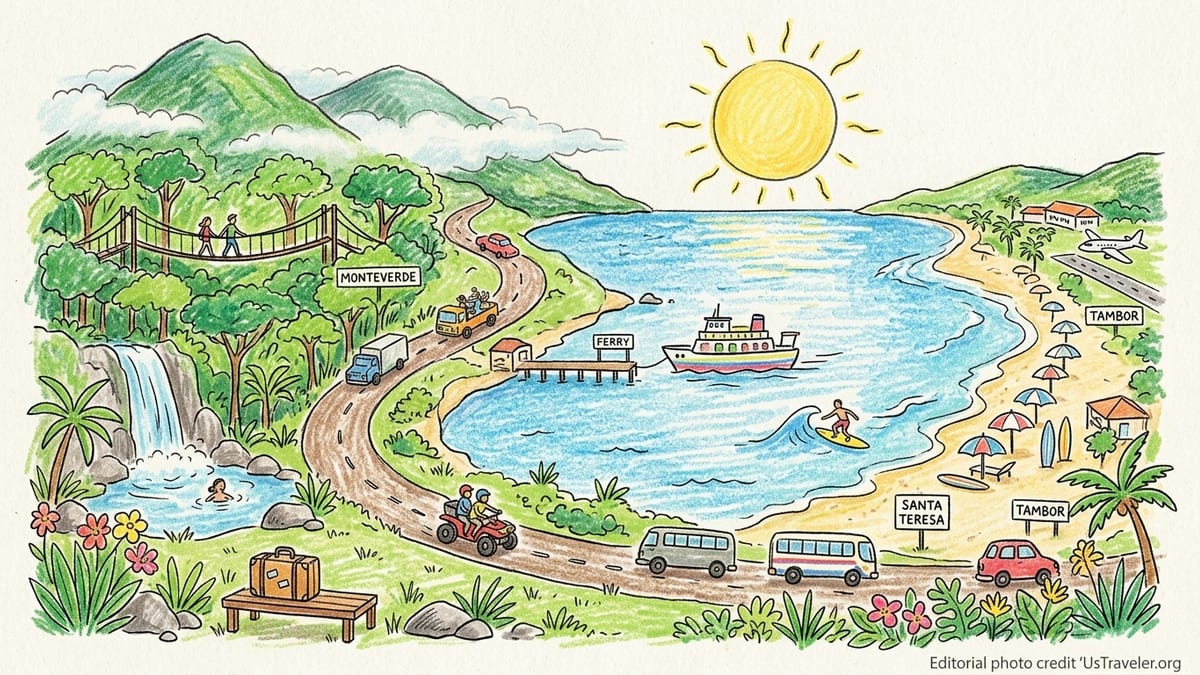
Puntarenas province stretches from misty cloud forest to laid-back Pacific beach towns, and choosing the right base here can shape your entire Costa Rica trip. The biggest decision is not which hotel to book, but which area to commit to: Monteverde for cloud forest adventure, Puntarenas city for ferry and cruise logistics, Tambor for quiet resort life, Montezuma for a small walkable beach-and-nature town, or Santa Teresa for surfing, restaurants and boutique stays. This guide compares these five hubs on hotel style, trip cost, car requirements, ferry logistics, nightlife and activities so you can decide where to spend your hard-earned travel budget.
First Decision: Which Puntarenas Base Fits Your Trip?
If you are looking at a map and feeling overwhelmed, start with one clear question: what do you want to walk to when you step out of your room each morning? If the answer is cloud forest and hanging bridges, Monteverde is your base. If it is surf breaks and sunset cocktails, lean toward Santa Teresa. For a small, walkable town with waterfalls and boat tours, Montezuma makes sense. For low-key beach resort life with easy flights and golf, consider Tambor. If your priority is catching a ferry, cruise ship or bus connection without stress, Puntarenas city is the practical choice.
Money and time are the other big filters. Getting to Monteverde or the Nicoya Peninsula beach towns usually takes four to six hours by road from San Jose. That means each move between bases costs you a half-day of shuttles or driving, plus extra hotel nights. If you have a week or less, most travelers are happier choosing one main base in Puntarenas province and maybe adding a second for contrast, rather than trying to sample all five. A common pattern is three nights in Monteverde for nature and three or four nights in either Santa Teresa or Montezuma for the beach.
Budget also nudges the decision. Average hotel prices in Monteverde sit in the moderate range, with many clean lodges and cabinas under 100 US dollars per night and some eco-luxury properties well above that. Santa Teresa, by contrast, has a strong boutique and villa scene where mid-range rooms often run from roughly 130 to 220 dollars and high-end suites can climb into the several hundreds, while dorm beds can be found from about 20 to 30 dollars. Montezuma and Tambor often come out slightly cheaper overall, especially if you are comfortable with simple cabinas or vacation rentals.
Finally, think about how much you want to drive. The road into Monteverde is paved but still winding and slow. The coastal road that runs through Santa Teresa can be rough, dusty and busy with ATVs. Montezuma and Tambor are easier to navigate on foot or with occasional taxis and boat trips. Puntarenas city itself needs no car at all if you are just overnighting near the ferry pier or cruise dock.
Monteverde: Cloud Forest Capital With Rustic Lodges and Eco-Luxury
Monteverde, high in the Tilarán Mountains, is Costa Rica’s classic cloud forest base. Visitors come for the Monteverde Cloud Forest Reserve, nearby Santa Elena Reserve and privately run adventure parks with zip lines and hanging bridges. Entry to the main reserves typically costs in the mid-twenties to high-twenties US dollars per adult, and hanging bridge parks charge higher fees for longer circuits. Guided night walks and wildlife tours add to the activity budget but are usually a highlight.
The hotel scene in Monteverde ranges from simple family cabinas to polished eco-lodges. Data aggregated from dozens of properties suggests an overall average nightly rate under 100 US dollars, but the spread is wide. You can find basic guesthouses and hostels around Santa Elena village in the 40 to 70 dollar range for private rooms, while established eco-hotels such as Cloud Forest Lodge or Hotel Belmar can easily run from roughly 250 dollars per night in low season to well above that in peak months for suites with forest views. Seasonal variation is significant, with many properties dropping prices by around a quarter between the dry high season and the wetter shoulder months.
Monteverde works well without a rental car if you base yourself near Santa Elena town. Shuttle companies run daily services from San Jose and La Fortuna, and local tour operators commonly include hotel pickup for zip line parks, reserves and night tours. A couple can often spend four days here without driving by relying on shared shuttles and tours, spending more on activities than on transport. A car becomes useful if you want to explore side roads, hidden viewpoints and smaller private reserves at your own pace.
Nightlife in Monteverde is relaxed rather than raucous. Expect a cluster of restaurants, cafes and a few bars in Santa Elena serving craft beer, pizza, Costa Rican casados and vegetarian options, but the cool, misty evenings and early start times for wildlife tours mean most people are in bed not long after ten. If you want beach bar hopping until late, this is not the right primary base. Monteverde pairs best with a later stop in Santa Teresa or Montezuma if you want both forest and a little coastal buzz in one trip.
Puntarenas City: Functional Hub for Ferries, Cruises and Transit
Puntarenas city itself sits on a long, narrow sand spit projecting into the Gulf of Nicoya. For many travelers it is less of a destination and more of a transport hub. The ferry to Paquera, which serves the southern Nicoya Peninsula and towns like Tambor, Montezuma and Santa Teresa, departs from the eastern side of town, often taking around one hour and twenty minutes to cross. Vehicle spaces fill up in peak periods, so arriving well ahead of departure time is wise, and tickets are relatively inexpensive compared with the cost of driving the long road route around the gulf.
Hotel options in Puntarenas city skew toward simple, functional stays aimed at local tourism and short stopovers. You will find basic hotels and cabinas near the ferry terminal and cruise dock, often in the 40 to 90 US dollar range for standard double rooms with air conditioning. There are a few more comfortable mid-range hotels with pools and sea views, which can be useful if you are breaking a long journey or catching an early ferry. This is not the place for secluded bungalows or jungle lodges; think convenience over atmosphere.
Most travelers do not need or want a car strictly for Puntarenas city. Buses connect the town with San Jose and other regional centers, taxis are easy to find, and the streets around the ferry dock and seaside promenade are walkable. If you are traveling on to the Nicoya Peninsula with a rental car, you will simply drive onto the ferry and continue on the other side. If you are on foot, plan on buses or shared shuttles from Paquera to Cóbano, Montezuma, Tambor and Santa Teresa.
Activities in Puntarenas city are modest: a long beachfront promenade with snack stands, basic bars and seafood restaurants, a small lighthouse viewpoint and an urban beach where locals swim. Nightlife is mostly low-key bars and music on weekends, with a more local than international feel. If you are deciding where to base yourself for several nights, Puntarenas city usually loses out to the more scenic destinations nearby, but it is extremely practical for one-night ferry or cruise logistics.
Tambor: Quiet Bay, Calmer Resorts and Easy Logistics
Tambor sits on a protected bay on the southern Nicoya Peninsula, with a small airstrip and a long curve of beach. The setting feels calmer than the open Pacific beaches at Santa Teresa and Montezuma, which suits travelers who want a quieter surf and a resort atmosphere. The bay’s gentle waves make it appealing for families with younger children and travelers who prefer swimming and kayaking to heavy surf.
Accommodation in Tambor trends toward resort and all-inclusive properties, plus a handful of small hotels and villas. A typical mid-range beachfront resort here might charge in the low-to-mid hundreds of dollars per night in high season for a double room with meals included, pools and organized activities. More modest lodges and vacation rentals inland from the beach can bring nightly costs down, especially if you do not mind driving a few minutes to the shore. Because Tambor is less of an international hot spot than Santa Teresa, deals are often easier to find outside holiday peaks.
Tambor is one of the easiest Nicoya Peninsula bases to reach without spending all day on the road. You can fly directly from San Jose to Tambor’s small airport on regional airlines, then take a short taxi ride to your hotel. Overland, you will typically ride the Puntarenas to Paquera ferry, then drive or take a shuttle for roughly an hour to reach Tambor. Roads in this part of the peninsula are generally in better shape than the rougher tracks closer to Santa Teresa, and much of what visitors want to access sits along or near the main paved routes.
Nightlife in Tambor is limited to hotel bars, occasional live music nights and a few local restaurants. The area’s appeal lies in early morning walks along the bay, sunset on a quiet beach and day trips to nearby nature reserves or boat excursions to places like Isla Tortuga. If you want a base where you can fully relax by the pool, take a gentle kayak or stand-up paddleboard outing and enjoy predictable resort comfort, Tambor deserves a close look. It is less ideal for visitors who crave a dense strip of restaurants and independent cafes within a short walk.
Montezuma: Walkable Beach Town With Waterfalls and Boat Trips
Montezuma, near the southern tip of the Nicoya Peninsula, grew from a small fishing village into a laid-back beach town that still feels intimate. The main cluster of streets sits close to the shore and is compact enough that many visitors do not need a car at all. You can walk from most central hotels to the beach, small supermarkets, restaurants and tour agencies in a matter of minutes. That simplicity is a major part of its draw.
Lodging in Montezuma runs from backpacker hostels and rustic cabinas to charming small hotels built into forested hillsides overlooking the sea. Prices are generally slightly lower than in Santa Teresa for comparable levels of comfort, with simple but pleasant rooms often starting from around 70 to 100 US dollars for a double in high season and hostels under that. At the upper end, boutique hotels and villas with ocean views can charge several hundred dollars per night, though the town does not yet have the same concentration of ultra-luxury properties that Santa Teresa has developed.
Montezuma is particularly attractive for travelers who prefer nature activities they can reach without complicated logistics. The well-known Montezuma waterfalls are within hiking distance from town, and tour operators sell boat trips to Isla Tortuga for snorkeling and beach time, as well as visits to nearby wildlife reserves. It is feasible to spend three or four days here doing a mix of hikes, swims, boat excursions and relaxed meals without ever renting a car. For regional travel, shuttle services, taxis and boats connect Montezuma with Cóbano, Tambor airport and Paquera for the ferry back to Puntarenas.
In the evenings, Montezuma offers a mellow form of nightlife. Expect beachfront bars, low-key live music, occasional events and a mix of local sodas and international restaurants. Things can stay open late in high season, but the scale is small, and much of the social life is centered on a handful of venues rather than a long strip. If you want a small-town feel where you can recognize familiar faces after a few nights and walk everywhere in flip-flops, Montezuma is an excellent base choice.
Santa Teresa: Surf Town Energy, Boutique Hotels and Higher Costs
Santa Teresa has evolved into one of Costa Rica’s best-known surf and lifestyle towns. Stretching along the western side of the Nicoya Peninsula, it offers long beaches with consistent waves, yoga studios, cafes and an international restaurant scene. The central dirt-and-gravel road that runs parallel to the beach is lined with surf shops, small groceries, boutique hotels and open-air eateries. For many visitors, the daily rhythm revolves around sunrise or late-afternoon surf sessions, remote work in shaded cafes and sunset gatherings on the sand.
The accommodation mix here is distinct. There is a dense cluster of boutique hotels, villas and design-forward eco-lodges, often tucked into the jungle just uphill from the beach or hidden behind lush gardens. Midrange boutique rooms commonly range from roughly 130 to 220 US dollars per night, with higher-end beachfront suites and villas reaching several hundred dollars or more, particularly in the dry high season and over holiday weeks. Budget travelers still have options in the form of dorms and basic private rooms in hostels or surf camps starting around 20 to 30 dollars for a bed in a shared room, though demand can make even simple places book out early in peak months.
Santa Teresa is the one base on this list where having your own wheels changes the experience significantly. The main road is busy with ATVs, motorcycles, delivery trucks and pedestrians, and distances between different parts of town, nearby beaches and hilltop lodgings can be longer than they appear on the map. Many visitors either rent an ATV for around 50 US dollars per day or arrive with a 4x4 rental car to handle rougher stretches, river dips during the rainy season and offshoot roads to quieter beaches. It is possible to stay car-free if you pick a well-located hotel near the beach and rely on walking and taxis, but you will likely pay for the convenience in higher nightly rates.
Nightlife in Santa Teresa is more active than in Monteverde, Tambor or Montezuma. While the town is not a party capital at the scale of larger resort cities, there are evenings with DJs, bars offering happy hours and sunset events at beach clubs, particularly in high season. Restaurants serve everything from plant-based bowls and sushi to wood-fired pizzas and upscale tasting menus, with prices that can feel closer to North American city levels than rural Costa Rica. Surf lessons, yoga classes and wellness retreats add to daily activity costs, so travelers on a tight budget should plan carefully. For those who want a strong blend of surfing, dining and stylish lodging, and who do not mind higher prices, Santa Teresa is often the top pick.
Car, Ferry and Cost: How the Bases Compare in Practice
When you translate the romance of each destination into concrete logistics, three practical questions usually decide where to stay: do you need a car, will you be using the Puntarenas to Paquera ferry, and how do nightly rates and daily expenses line up with your budget. Monteverde and Santa Teresa tend to command higher per-night and per-day activity spending, but for different reasons. In Monteverde, guided experiences like canopy tours, hanging bridges and night walks stack up; in Santa Teresa, it is the combination of boutique lodging, dining out, surf lessons, gear rentals and local transport.
Puntarenas city and Tambor can be the most economical from a transport perspective. Puntarenas removes the need for domestic flights or long mountain drives if your main focus is simply catching the ferry or a cruise. Tambor’s small airport allows you to substitute a short domestic flight for hours of road travel from San Jose, which can be appealing for families or older travelers willing to spend a bit more upfront to avoid long bus rides. Montezuma sits in the middle: it still requires the ferry crossing, but once you have arrived in town, you can often rely on your feet and the occasional taxi or tour boat.
If you are renting a car, factor in the realities of each base. Driving to Monteverde means slow, winding ascent with fog, but generally manageable road surfaces and clear signage. Reaching Santa Teresa or Montezuma from Paquera involves paved segments mixed with rougher local roads, dust in the dry season and mud in the rainy months. Many visitors choose a high-clearance or 4x4 vehicle for peace of mind, particularly if their lodge sits up a steep hill. Tambor’s access roads are typically less challenging, and Puntarenas city is the easiest of all. Traveling without a car is noticeably simpler in Monteverde, Montezuma and Puntarenas city than in the more spread-out Santa Teresa area.
In terms of nightly costs, consider this rough hierarchy for mid-range couples in high season: Santa Teresa at the top, thanks to boutique lodging and dining; Monteverde next, because of its eco-lodge scene and high demand during peak months; Tambor and Montezuma slightly lower on average, with pockets of both budget and upscale options; and Puntarenas city often the most budget-friendly for simple overnights. Prices are very date-sensitive, and even a shift from a major holiday week to the following week can noticeably alter what you pay.
The ferry itself is one of the region’s best value transport links, typically costing just a few US dollars per passenger and higher but still reasonable fees for vehicles. The main cost is time: you must coordinate bus or driving schedules, arrive early to secure a spot, and accept that a crossing eats up a significant portion of your day. For shorter trips of five to seven days, some travelers choose to skip the Nicoya Peninsula entirely and focus on Monteverde and interior destinations to cut back on transit hours. For trips of ten days or more, splitting time between Monteverde and one Nicoya base, often Santa Teresa or Montezuma, balances travel days and vacation days more comfortably.
The Takeaway
If your priority is immersive cloud forest, hummingbird gardens and cool mountain air, Monteverde is the best first choice. It offers a wide range of lodges at different price points, can be navigated without a car, and pairs beautifully with a later beach stop. If you are building your trip around surfing, boutique hotels and an international restaurant scene, Santa Teresa justifies its higher prices as a full-focus destination, especially for travelers comfortable driving or renting ATVs.
For those who want a slower pace and easier walking, Montezuma offers a compact beach town with waterfalls and boat trips, usually at slightly lower costs than Santa Teresa. Tambor is the right fit if you imagine a quieter bay, resort amenities, golf and easy airport access rather than a dense strip of shops and bars. Puntarenas city, at the other end of the scale, is rarely the star, but it is the smart overnight choice when ferry and cruise logistics matter more than scenery.
The expensive decision is not just which hotel looks best on your screen, but where you want to be anchored. Once you pick the right base in Puntarenas province, smaller choices about lodges, tours and restaurants fall into place much more easily. Think in terms of what you want at your doorstep, how much transit time you can tolerate and how your daily spending stacks up, then choose the one or two places that genuinely match your style rather than trying to see them all.
FAQ
Q1. Is Monteverde or Santa Teresa better as a first stop in Costa Rica?
Monteverde is often better as a first stop if you are flying into San Jose and want to adjust to the climate with cooler temperatures and nature-focused days. Santa Teresa works well later in a trip, when you are ready for beach time and do not mind a longer journey or higher daily costs.
Q2. Do I need a 4x4 rental car to reach Santa Teresa, Montezuma and Tambor?
You do not strictly need a 4x4 in the dry season, but a high-clearance vehicle is strongly recommended for Santa Teresa and some Montezuma and Tambor lodgings, especially those up steep hills or along rough side roads. In the rainy season, a 4x4 provides extra security for river dips and muddy stretches.
Q3. Can I visit Monteverde as a day trip from Puntarenas city or Santa Teresa?
It is technically possible, but travel times of four to five hours each way from many coastal bases mean a day trip leaves little time in the actual cloud forest. Most travelers are happier spending at least two nights in Monteverde to explore the reserves and hanging bridges without rushing.
Q4. Which base is best if I am traveling without renting a car?
Monteverde, Montezuma and Puntarenas city are the most practical without a car. Monteverde has many tours with hotel pickup, Montezuma is compact and walkable, and Puntarenas city is mainly a ferry and bus hub. Santa Teresa and parts of Tambor are more spread out and often feel more comfortable with a rental car or ATV.
Q5. How far in advance should I book hotels in Santa Teresa and Monteverde?
In the dry high season from roughly December through April and during holiday weeks, booking several months ahead is wise for popular properties in both destinations. In shoulder and low seasons, you can often book a few weeks ahead, but boutique hotels and small eco-lodges can still sell out on weekends.
Q6. Is Puntarenas city a good place to spend several vacation days?
Puntarenas city is best seen as a practical overnight stop for ferry and cruise connections rather than a long-stay destination. While there are local beaches, a promenade and seafood restaurants, most visitors find the scenery, swimming and activities more rewarding in Monteverde, Montezuma, Tambor or Santa Teresa.
Q7. Which area is most budget-friendly for backpackers?
Backpackers looking for lower costs and a social atmosphere often gravitate to Montezuma or to hostels in Santa Teresa, as well as basic lodgings in Monteverde. Santa Teresa can still feel expensive overall, but shared dorms and surf camps help keep nightly costs down compared with private boutique rooms.
Q8. Are the beaches swimmable in all these destinations?
Tambor’s bay usually has the calmest water, which is attractive for swimming and paddling. Santa Teresa and Montezuma offer beautiful beaches but stronger surf, so swimmers need to be cautious and pay attention to local advice. Puntarenas city’s urban beaches are more about local recreation than pristine swimming.
Q9. How much time should I allocate to Monteverde versus a beach town?
For many itineraries, three nights in Monteverde and three or four nights in a beach base like Santa Teresa, Montezuma or Tambor works well. That allows two or three full days in each place without constant packing and long transit days eating into your stay.
Q10. Can I combine Monteverde, Santa Teresa and Montezuma in a single week?
While it is possible, trying to visit all three in seven days means you will spend a large share of your trip in shuttles, on the ferry and packing and unpacking. Most travelers find it more enjoyable to choose Monteverde plus one coastal base for a week-long trip, saving the others for a future visit.