


The Gulf of Nicoya ferry pulls into Paquera after 70 scenic minutes from Puntarenas, and suddenly the real decision begins: do you base yourself in Santa Teresa or Montezuma? Both lie on the southern Nicoya Peninsula in Puntarenas province, fringed by Pacific beaches and tropical forest. Yet a few days on the ground reveal that they deliver very different kinds of trips. One is a long, surf-centric beach strip with serious dining and nightlife; the other is a compact village backed by waterfalls and howler-monkey forest where evenings stay quiet. Choosing well can make the difference between a relaxed, well-matched base and a stay that never quite fits your style.
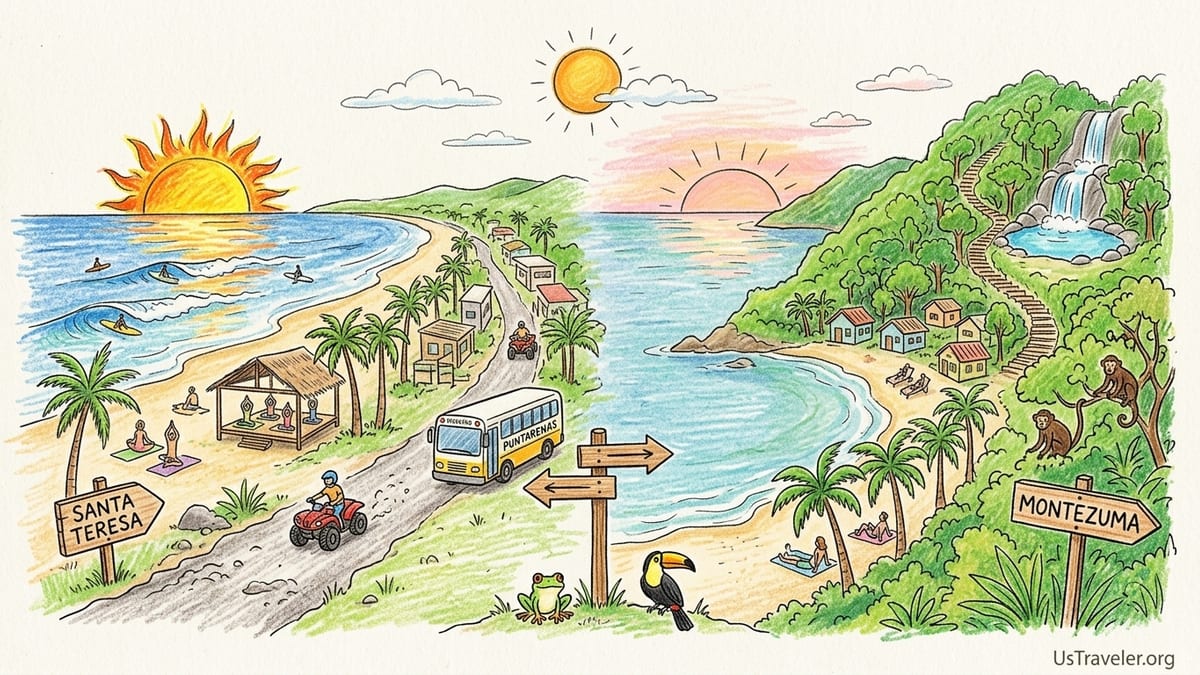
Big Picture: Two Very Different Beach Bases
For travelers getting off the Puntarenas to Paquera ferry, Santa Teresa and Montezuma sit at the end of the same road network but feel like opposite personalities. Santa Teresa stretches along several kilometers of sand on the western side of the peninsula, with low-rise hotels, surf shops, yoga shalas and international restaurants strung out along a bumpy main road. It is one of Costa Rica’s trendiest surf towns, with a strong expat presence, co-working spaces and a social scene that runs from sunrise surf to late-night beach bars.
Montezuma, on the southeastern side, is smaller and more contained. The whole center is basically one main street that runs from the tiny crossroads down to a small cove beach, with a handful of guesthouses, cafes and tour kiosks. Behind the village, steep green hills hide rivers, waterfalls and forest reserves. It still has the bohemian, artsy atmosphere that first put it on the backpacker map decades ago, and nights usually wind down early apart from the occasional live-music session.
If you want a bigger choice of everything – surf breaks, hotels, restaurants, beach bars, yoga studios – Santa Teresa is the logical pick. If you are more excited by waterfalls, wildlife, sunrise walks, and being able to park the car and forget about it for three days, Montezuma usually fits better. Neither is objectively “better”; they reward different priorities.
In practical terms, most travelers who ask this question right now are choosing a single base after arriving from Puntarenas rather than trying to bounce between the two. With travel times of roughly 60 to 80 minutes between Santa Teresa and Montezuma on slow, hilly roads, day-tripping in either direction is possible but rarely feels effortless.
Beaches, Surfing and Swimming
Santa Teresa’s biggest draw is its beach. The coastline here runs in a long, mostly sandy arc broken into named sections like Playa Carmen, Playa Santa Teresa and Playa Hermosa. At low tide you get huge expanses of hard sand ideal for walking, jogging or teaching kids to ride a boogie board in the swash. Waves break consistently year-round, which is why there are surf shops and schools every few hundred meters; travelers talk about paying around 50 to 70 US dollars for a group lesson including board rental. Intermediate and advanced surfers often base themselves near the punchier peaks around central Santa Teresa, while beginners gravitate toward mellower corners like Playa Carmen or head up to Hermosa, about a 15-minute drive north.
The trade-off is that Santa Teresa is not always the safest place for casual swimming. Beach flags and local surf schools regularly remind visitors about rips and powerful shore breaks, especially at mid-tide when the waves can pound onto steep sandbanks. Confident swimmers are usually fine staying shallow and reading the conditions, but families with small children will want to time beach time around lower tides and stick close to lifeguarded zones if present. Many hotels add pools for that exact reason: it is common to spend the heat of the day by the pool and head to the ocean for late-afternoon surf or sunset walks rather than mid-day swims.
Montezuma’s main in-town beach is smaller and feels more intimate. The cove directly in front of town has a mix of sand and rock, with calmer water on many days than Santa Teresa’s surf face. It is not a surf destination in its own right; there is little in the way of board-rental shacks, and most visitors are swimming, snorkeling around rocky outcrops at higher tides, or just lying under the palms after a waterfall hike. A short walk north brings you to longer stretches like Playa Grande, where stronger waves roll in but with far fewer people. Because the sun rises over this side of the peninsula, Montezuma rewards early risers with pink and orange dawn light on the water rather than Santa Teresa’s fiery sunsets.
If consistent surf access is important, Santa Teresa is the better base by a wide margin. You can roll out of bed, cross the main road and be paddling into waves in minutes, and there are multiple surf schools happy to schedule daily lessons. If your ideal beach day is mostly about swimming, snoozing under palms and not worrying about rips, Montezuma’s smaller, more protected cove and nearby beaches feel friendlier, particularly for less confident swimmers.
Waterfalls, Nature and Outdoor Activities
When it comes to waterfalls and forest, Montezuma quietly wins. Within walking distance of town you have the Montezuma Waterfalls, a set of cascades along the same river with natural pools popular for cooling off after a hot uphill hike. Travelers who do not want to drive can walk to the main trailhead from the center in around 15 minutes, pay a modest entry fee to cross private land, and then scramble upriver to multiple swimming holes. For many visitors this is the single most memorable day of the trip, especially when combined with lunch back in town and a siesta on the beach.
The surrounding hills hide more options. Day tours from Montezuma can take you to less-visited waterfalls such as El Chorro, which flows directly into the ocean at Playa Cocolito when in season, typically reached via a guided hike or 4x4 transfer followed by a beach walk. Wildlife is part of everyday life in Montezuma: it is normal to hear howler monkeys at dawn and spot white-faced capuchins or coatis moving through the trees above town. Because everything is compact, you can string together waterfall hikes, beach time and a simple dinner without ever starting the car.
Santa Teresa also has nature on its doorstep, but it is spread out. Cabo Blanco Absolute Natural Reserve, one of Costa Rica’s earliest protected areas, sits roughly 45 minutes’ drive from town and is a classic half-day hike for spotting monkeys, agoutis and tropical birds under deep shade before ending at a hidden beach. Horseback tours trot along remote stretches south toward Mal País at sunset. Yoga studios and wellness centers set in jungle gardens offer daily classes and retreats; it is easy to build a surf-and-yoga routine that fills your entire week.
If your idea of “nature” is hiking to multiple waterfalls and hearing jungle sounds from your downtown guesthouse, Montezuma is more satisfying with less effort. If you want a mix of surf, some driving-accessible hikes and a wider choice of guided tours, and you do not mind hopping in the car or on an ATV, Santa Teresa offers more variety across a bigger area.
Eating, Nightlife and Atmosphere
Santa Teresa has become known for having one of the strongest restaurant scenes on the Nicoya Peninsula. Along the main road you will find everything from family-run sodas serving plates of casado for the equivalent of 7 to 10 US dollars, to upscale beach restaurants attached to boutique hotels with mains upward of 20 dollars. International options are remarkably dense for a town of its size: wood-fired pizza at spots near Playa Carmen, sushi bars like Katana Asian-style dining, stylish beachfront venues at hotels such as Nantipa, and creative street-food-style hubs where you can combine falafel, poke bowls and craft cocktails under one roof. Coffee culture is firmly established, with specialty cafes serving flat whites and smoothie bowls from early morning for the pre-surf crowd.
Nightlife in Santa Teresa is not a city-style club circuit but there is enough to fill several evenings. Beach bars such as Banana Beach host DJ sets and live bands at sunset with happy-hour cocktails. Places like Muchacha Surf Bar close to the sand draw a mix of locals and visiting surfers for burgers, beers and occasional themed parties. Dedicated nightspots and dance bars light up on weekends, with modest cover charges and music running into the early hours in peak season. Even on quieter nights, the main road hums with ATVs and motorcycles ferrying people between dinners, bars and late-night taco stands.
Montezuma’s dining scene is smaller but surprisingly varied for its size. The main street packs in several long-running restaurants serving fresh fish, vegetarian plates and wood-fired pizza, plus a handful of beachfront bars where you can sit with a cold drink and watch the waves a few meters away. Simple sodas in and around town serve typical Costa Rican staples at prices that are often a little lower than Santa Teresa’s trendiest venues. If you are staying a few nights, you will likely rotate through the same half-dozen options, which some travelers find cozy and others find limiting.
After dark Montezuma is decidedly mellow. A few bars might host live music or a DJ one or two nights a week, and there is often a relaxed gathering on the beach at sunset, but by 10 or 11 p.m. many nights are quiet outside of high season and holidays. Street noise is generally limited to the sound of waves, a few motorbikes and people walking home from dinner rather than continuous traffic. For couples and families who dislike the constant buzz of Santa Teresa’s main drag, that peace is part of the appeal.
Hotels, Costs and Overall Value
Santa Teresa’s boom over the last few years means lodging runs the full spectrum, from basic hostels a short walk from the beach to high-end design hotels in jungle settings with private plunge pools. In the 2025–2026 high season, it is common to see shared hostel dorm beds starting around 20 to 30 US dollars per night, mid-range boutique hotels in the 150 to 300 dollar range, and luxury villas or suites going significantly higher, especially if they offer direct beach access or panoramic sunset views. Many properties require a minimum stay of three nights or more in peak periods.
Because the town is long and linear, where you stay in Santa Teresa affects your experience. Budget guesthouses set a block or two back from the beach will be closer to the dust and noise of the main road, especially as ATVs and delivery trucks go by. Higher-priced hotels often sit on side roads climbing inland, trading a short uphill walk for more space, quieter nights and jungle or ocean views. Digital nomads and long-stay visitors frequently rent apartments or villas with full kitchens, laundry and decent Wi-Fi, taking advantage of Santa Teresa’s grocery stores, produce trucks and delivery services to live semi-locally for weeks at a time.
Montezuma’s accommodation stock is smaller and more intimate. You will still find a couple of simple hostels and budget cabinas, but the sweet spot is often mid-range guesthouses, small hotels and open-air cabins tucked into the hillside forest with ocean glimpses. Prices can be a touch lower than comparable properties in Santa Teresa, though the difference is narrowing as Montezuma gains popularity. The feel is more “jungle lodge meets beach village” than “design hotel cluster,” and staff often know guests by name after a day or two.
Day-to-day costs track the difference in scale. Groceries and gasoline are broadly similar because both towns sit at the end of the same road network from Paquera, but Santa Teresa simply offers more ways to spend: daily surfboard rentals, drop-in yoga classes, coffee and smoothie runs, craft cocktails, ATV rentals and boutique shopping. In Montezuma, you are more likely to spend on a handful of tours, waterfall entries and simple dinners, then read in a hammock. Travelers on a tighter budget who are happy with fewer restaurant choices and quieter evenings often find Montezuma easier to keep costs under control.
Roads, Transport and Getting Around After the Ferry
Whether you sail the Puntarenas to Paquera route with a rental car or arrive as a foot passenger, the basic geometry is the same: Paquera is your gateway to the southern Nicoya. From the ferry terminal, the paved road heads toward Cóbano, the inland service town that anchors this corner of Puntarenas. Buses and shuttles with decades of experience operate routes from Paquera through Cóbano onward to Santa Teresa and Montezuma, so even travelers who do not want to drive can continue by public transport or pre-booked minivan.
From Paquera, expect around 1 hour and 15 minutes of driving to Santa Teresa in normal conditions, and closer to 45 to 60 minutes to Montezuma. The final stretches toward the beaches use sections of National Route 160 and connecting roads, which alternate between asphalt and well-graded gravel. In dry season months, dust and potholes are the main annoyances; in the green season, parts of the road network can turn muddy and develop ruts. A higher-clearance vehicle is helpful for comfort, and a 4x4 becomes more useful if you plan to explore smaller side roads, but many visitors successfully make the trip in standard rental sedans by simply taking it slow.
Once you are based in Santa Teresa, getting around is part of the daily rhythm. The town’s linear shape means that even traveling a short distance between a hotel in Playa Hermosa and a dinner booking near Playa Carmen can involve a 10 to 20-minute drive along the main road. Many visitors rent ATVs for 24 hours at a time to hop between surf spots, restaurants and viewpoints, with daily rental prices often reported in the 60 to 100 dollar range depending on season and model. Taxis exist but are not as plentiful as in larger cities, so planning ahead for late-night returns is wise.
In Montezuma, the experience is almost the opposite. If you choose lodging close to the village center, you can often park the car and forget about it for days. The main beach, tour departure point, waterfall trailhead, grocery shops, cafes and restaurants all sit within a few minutes’ walk. Taxis and local buses connect Montezuma with Cóbano and onward to Santa Teresa, but many visitors never need them except for arrival and departure. For travelers who dislike dust, constant vehicle noise and ATV traffic, this walkability is a key reason to base here rather than only visiting as a day trip from Santa Teresa.
Best Fit: Families, Couples, Solo Travelers and Surfers
Families weighing Santa Teresa against Montezuma should think carefully about pace and logistics. Santa Teresa gives kids space to run on broad beaches, and older teens will love surf lessons and the general energy of the town. However, parents of younger children may not enjoy shepherding them along a main road without continuous sidewalks while ATVs and motorcycles pass by, or dealing with strong waves and rips on days when the surf is heavy. Montezuma’s slower traffic, compact center and easier walks from hotel to beach, waterfall and ice cream shop can make daily life simpler, even if you trade away some restaurant choice and wave action.
For couples, the decision turns on whether you imagine slow, early nights or social, occasionally late ones. Santa Teresa suits pairs who want to combine days of surfing, yoga and beach-hopping with dinners at buzzy restaurants and at least a couple of nights with live music or DJs. Boutique hotels with private plunge pools and sunset views cater directly to this market. Montezuma feels more intimate and introspective: you might hike to waterfalls in the morning, read on the balcony in the afternoon, and stroll down for a quiet dinner and a nightcap by the water before bed. It is an excellent base for honeymooners or long-term couples who prioritize nature and time together over trying every new restaurant in town.
Solo travelers and digital nomads tend to skew toward Santa Teresa. There are simply more hostels, social surf camps, co-working spots and day tours to plug into, and more people working remotely in cafes during the week. You can assemble a routine of morning surf, midday work, sunset beach session and casual bar meetups without trying too hard. That said, Montezuma draws a smaller but loyal solo crowd, many of whom return year after year for its slower pace and creative, arts-oriented vibe. Here, you are more likely to meet fellow travelers on waterfall trails or at a weekly farmer’s market than at a late-night club.
Dedicated surfers almost always choose Santa Teresa or one of its neighboring beaches such as Mal País and Playa Hermosa as a base. Montezuma can still work as a non-surfing partner’s base if the surfer is willing to drive across the peninsula daily, but that usually means 60 to 80 minutes round trip on hilly roads. Given fuel costs and time, most wave-focused trips start and end on Santa Teresa’s side of the peninsula, with Montezuma saved for a future, more nature-oriented visit.
The Takeaway
If you step off the Puntarenas ferry imagining several days built around surfing, coffee, dining and social sunsets, Santa Teresa is the natural fit. It is larger, livelier and more developed, with an impressive spread of restaurants and bars, multiple surf schools, yoga studios and an international community that keeps things buzzing long after the last light fades from the Pacific.
If, instead, you picture yourself waking to the sound of howler monkeys, walking to a waterfall before breakfast, swimming in calm coves and wandering a small, walkable center where you quickly recognize familiar faces, Montezuma is the better match. It trades surf breaks and nightlife for waterfalls, nature, sunrise beaches and a quieter, more intimate village feel.
For many travelers, the real question is not “which town is better” but “which version of the Nicoya Peninsula am I chasing this time.” If this is your first trip to Costa Rica and your priority is classic surf-town energy with lots of dining and nightlife, base in Santa Teresa and consider a full-day tour to Montezuma for waterfalls and a change of scene. If you already know you value early nights, forest trails and being able to walk almost everywhere after you roll off the ferry, booking Montezuma as your primary base will likely leave you happier.
Both towns justify the journey across the Gulf of Nicoya. Picking the right one for your priorities means that once you drive off the ferry ramp at Paquera, your Puntarenas beach base will feel less like a compromise and more like exactly the place you hoped to find.
FAQ
Q1. Is Santa Teresa or Montezuma easier to reach after the Puntarenas ferry?
From the Paquera ferry dock, Montezuma is typically a bit closer in pure driving time, around 45 to 60 minutes, while Santa Teresa usually takes about 75 minutes. In practice, both are straightforward on the main Paquera–Cóbano road, then branching toward either coast. If you prefer to minimize driving after the ferry, Montezuma has the slight edge.
Q2. Which town is better for learning to surf?
Santa Teresa is clearly better for learning to surf. It has multiple surf schools, year-round waves and long sandy beaches like Playa Carmen and Playa Hermosa that regularly host beginner lessons. Montezuma is not really a surf town and has limited access to suitable breaks, so most surf-focused travelers base on the Santa Teresa side.
Q3. Where are beaches safer for casual swimming?
Montezuma’s central cove and nearby beaches often feel gentler for casual swimming, with smaller crowds and, on many days, calmer water. Santa Teresa’s open Pacific face produces stronger waves and rip currents, which are great for surfing but require more caution for swimmers, especially children or less confident ocean lovers. In Santa Teresa many families rely on hotel pools for relaxed swimming and visit the beach more for walks, playtime at the edge and sunset.
Q4. Which base is better for waterfalls and hiking?
Montezuma is the better base if waterfalls and hikes are your top priority. The Montezuma Waterfalls sit within walking distance of town, and tours reach further cascades like El Chorro that flow toward the ocean. You can combine waterfall swims, short forest hikes and beach time without driving. Santa Teresa offers access to places like Cabo Blanco Absolute Natural Reserve, but most hikes involve a drive and feel more like day trips than quick outings from your front door.
Q5. How do restaurant prices compare between Santa Teresa and Montezuma?
In both towns you can find inexpensive local sodas with meals around the equivalent of 7 to 10 US dollars and international restaurants charging significantly more. Santa Teresa generally has a higher concentration of upscale and trendy venues, so it is easier to spend heavily on dining out. Montezuma has fewer restaurants overall but makes it simpler to rotate between a small set of mid-range and budget-friendly spots if you are watching your costs.
Q6. Is Santa Teresa too busy or noisy for families?
Many families enjoy Santa Teresa, especially those with teens keen to surf and socialize, but some find the constant traffic of ATVs and motorbikes along the main road tiring. Lodging choices matter: properties set back from the main strip or up side roads tend to be quieter. If your children are young, you value early nights and you prefer to walk everywhere without navigating a busy road, Montezuma often feels more relaxed.
Q7. Can I stay in one town and visit the other on a day trip?
Yes, you can. In dry conditions, the drive between Santa Teresa and Montezuma is often around 60 to 80 minutes each way via Cóbano. Many travelers in Santa Teresa book a full-day tour to Montezuma to combine waterfalls and beach time, while those based in Montezuma might rent a car or hire a driver for an afternoon and evening in Santa Teresa. It is feasible, but the roads are slow enough that it usually feels like a big day out rather than a quick hop.
Q8. Which town is better for couples seeking a quiet, romantic stay?
For couples who put quiet and nature first, Montezuma usually wins. Its small scale, softer nightlife and easy walks between jungle lodges, waterfalls and the beach make it ideal for low-key romantic trips. Santa Teresa, by contrast, suits couples who want a mix of romance and buzz: think sunset cocktails, stylish dinners and maybe a late-night bar or two after a day of surfing and yoga.
Q9. Do I need a 4x4 to reach Santa Teresa or Montezuma?
You do not strictly need a 4x4 in the dry season. The main routes from Paquera via Cóbano to both towns are mostly paved or well-graded gravel, and standard rental cars make the trip daily. However, a higher-clearance vehicle improves comfort on potholes and is helpful in the rainy season when some segments become muddy. If you plan to explore side roads, remote beaches or hilltop villas, a 4x4 or at least higher clearance is a practical choice.
Q10. If I can only choose one, which base is better for a first-time visitor to Costa Rica?
If you are a first-time visitor with broad interests and no strong preference, Santa Teresa is often the safer all-round base. It offers a bigger range of hotels, restaurants, surf schools and activities, making it easier to adjust plans on the fly. However, if you already know you prefer quieter places, early mornings, waterfalls and small villages over nightlife, Montezuma can deliver a more relaxed and memorable first taste of the Nicoya Peninsula.