


Guanacaste, on Costa Rica’s sunny northwest Pacific coast, has quietly become one of the strongest family-resort regions in Central America. Within about 30 to 90 minutes of Liberia International Airport, you can choose between polished all-inclusive complexes, low-key condo resorts with beach clubs and lively surf towns where howler monkeys call from the trees above your hotel pool. The challenge for parents is not finding a good resort, but deciding which part of Guanacaste fits your family best.
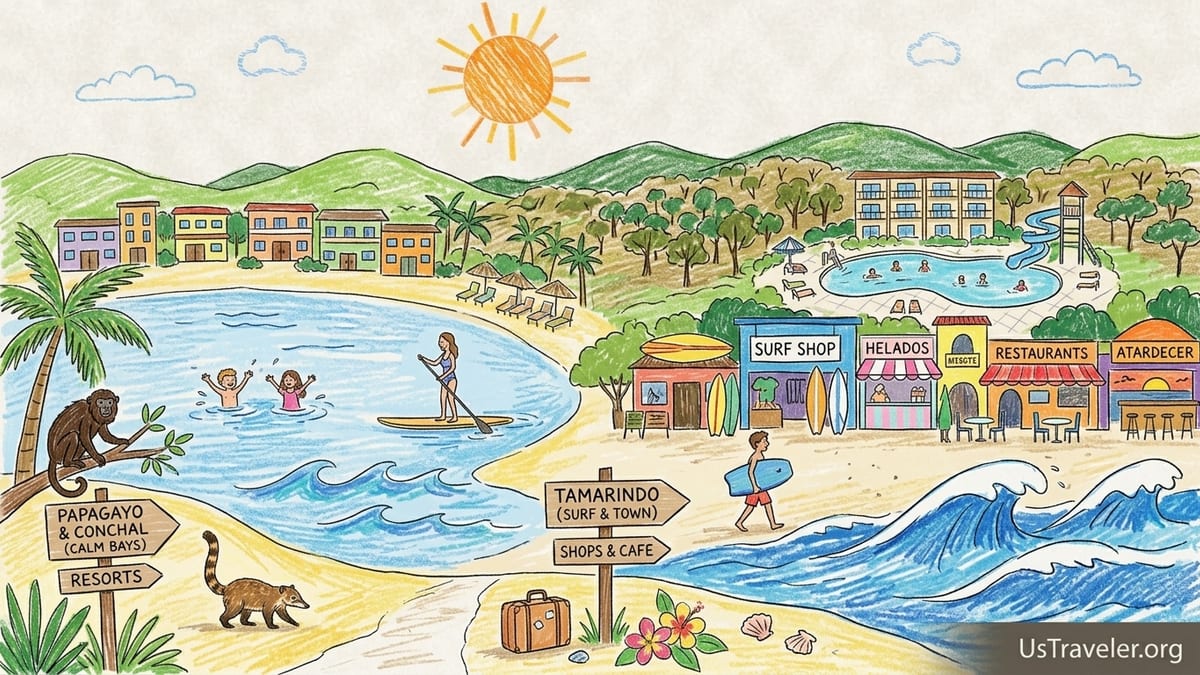
How to Choose the Right Area in Guanacaste for Your Family
Before you fall in love with a single resort, it helps to pick your general area first. In Guanacaste, the big family choices cluster around five main zones: Papagayo, Conchal and its neighbors (including Flamingo), Tamarindo and Hacienda Pinilla, the RIU complex on Playa Matapalo, and a handful of farther-flung all-inclusives such as Dreams Las Mareas. Each trades off transfer time, beach character, access to towns and the overall feel of the stay.
Transfer time is often the first practical filter. Many family-focused resorts in Papagayo and the RIU complex sit 30 to 45 minutes from Liberia Airport in normal traffic, while Conchal, Flamingo and Tamarindo are more often 60 to 90 minutes away. That difference can feel big with a toddler who just got off a five-hour flight. On the other hand, the slightly longer drive to Conchal or Tamarindo buys you easier access to surf schools, casual restaurants and local supermarkets, which can matter on a week-long stay with teens.
Next come the water conditions and built-in activities. Some beaches, such as Papagayo’s protected bays and Conchal’s gently shelving shore, are typically calmer for swimming and stand-up paddleboards. Others, including Tamarindo and Avellanas in the Hacienda Pinilla area, are honest-to-goodness surf beaches with choppier waves and stronger currents, better for supervised boogie boarding than for small kids playing independently in the shallows. Overlay that with the resort itself: some properties run proper kids clubs and water slides, while others are more about a great pool and arranging off-site adventure tours.
Finally, think about how much “Costa Rica” you want on your doorstep. Papagayo and the RIU complex feel like self-contained resort worlds, with wildlife on the grounds and most activities packaged as excursions. Conchal and Flamingo offer an in-between feel, with beach vendors and independent tour operators right outside the gates. Tamarindo places you in a bustling town where you can walk to surf shops, ice cream stands and sunset bars, and where you will hear some nightlife even from family-friendly hotels.
Conchal & Surrounds: All-Inclusive Ease on a Swimmable Beach
The Conchal area has become a favorite recommendation for families who want an all-inclusive base on a beautiful, generally calm beach without feeling completely isolated. The Westin Reserva Conchal anchors the main development here, a large all-inclusive spread between a golf course and the crushed-shell sands of Playa Conchal. Families often choose the Westin for its combination of a sizable lagoon-style pool, an organized kids club, a range of buffet and à la carte restaurants and access to a beach that tends to have gentler water than nearby surf breaks.
Room types matter here if you are traveling as a group. The Westin’s layout of junior suites and family-focused sections allows parents with younger kids to request ground-floor rooms near the pool and kids club, while multigenerational groups sometimes reserve adjacent units in one building. Many families treat Playa Conchal as their daytime living room: teenagers rent kayaks or stand-up paddleboards from licensed vendors on the beach, while younger kids sift shells or swim under close supervision in the often clear, turquoise shallows. Expect to see coatis and iguanas on the paths and hear howler monkeys from the trees, a reminder that you are in the dry tropical forest even inside a full-service resort.
Conchal also connects easily to the small town of Brasilito and to Playa Flamingo and Tamarindo by road, which expands your options without giving up the predictability of an all-inclusive. In practice, many families spend most days between the pool and beach, then break the routine with a half-day catamaran cruise, a zipline and hot springs loop inland toward Rincon de la Vieja, or a sunset horseback ride arranged through local operators. If you prefer a boutique feel with meal charges instead of an all-inclusive bracelet, nearby properties like W Costa Rica within the same broader development give active, design-conscious families a different take on the same beach corridor.
Papagayo: Calm Bays and High-End Family Comfort
On the Papagayo Peninsula and the surrounding Culebra Bay shoreline, families find some of Guanacaste’s calmest beaches and most polished resort experiences. Luxury options like Four Seasons Resort Costa Rica and Andaz Peninsula Papagayo aim squarely at travelers who value service, design and nature as much as water slides. These properties offer supervised kids programs, multiple pools and easy access to sheltered coves where even young children can wade or try kayaking under close watch, all roughly 40 minutes from Liberia Airport in typical traffic.
Planet Hollywood Costa Rica, on the edge of the peninsula, targets a more mid-range, all-inclusive crowd and often appeals to families with school-age kids. Themed decor and a branded kids club add novelty, while extensive pools and organized activities keep children busy on property. Parents appreciate that bays here are typically calmer than the open Pacific, which can make first-time snorkeling or stand-up paddleboarding less intimidating. At the same time, Papagayo is not a built-up town: you will mostly stay within the resort complex or book boat trips, wildlife hikes, ziplining days or national park visits as narrated excursions rather than walking out to an independent strip of restaurants.
Papagayo works especially well for families who want a “soft adventure” introduction to Costa Rica. It is common to see white-faced capuchin monkeys in the trees around the pool area at breakfast, hear howlers echoing from the hills and spot rays or turtles from kayaks in the bay. Day trips can include guided outings to Rincon de la Vieja for mud baths and hot springs or to Palo Verde to see crocodiles and birds along the river. The trade-off is that prices at the top luxury resorts can climb into the high hundreds of dollars per night in peak season, and food and spa treatments are priced accordingly.
Tamarindo & Hacienda Pinilla: Surf Town Energy With Family Comfort
Tamarindo is Guanacaste’s best-known beach town, and families split sharply on whether that is a plus or a minus. On the positive side, Tamarindo offers a real town with grocery stores, surf schools, bakeries, souvenir stands and a wide choice of restaurants within a short walk or quick taxi ride of most hotels. Teens can take daily surf lessons directly in the mild beach break, while parents watch from a beachfront cafe. The downside is that Tamarindo is busy and can be noisy at night, with a bar and nightlife scene that some families find at odds with a quiet, early-to-bed routine.
For families who want Tamarindo’s access but a quieter base, the Hacienda Pinilla area just south of town is a popular compromise. This private development spreads out along multiple beaches, including Playa Avellanas and Playa Langosta, and houses resorts such as the JW Marriott Guanacaste, plus numerous villas and condos. Families staying here often spend mornings at the beach club pool or on relatively uncrowded surf breaks, then drive or shuttle 20 to 30 minutes into Tamarindo for dinner, ice cream and shopping. The beaches in this zone tend to have stronger waves than Conchal or Papagayo, so parents with small non-swimmers often rely more on resort pools for water play.
Hacienda Pinilla and the Tamarindo area also give easy access to non-resort activities. You can sign up the kids for group or private surf lessons, arrange estuary boat tours to spot crocodiles and birds in the mangroves, or do a day trip inland for ziplining and hanging bridges. Families who book condos or vacation homes instead of hotel rooms here appreciate being able to cook some meals, use laundry machines and spread out across multiple bedrooms, though that typically means giving up a formal kids club in favor of independent activities.
Flamingo & Playa Potrero: Beach Clubs, Condos and a New Marina
North of Conchal, the Flamingo and Playa Potrero area offers a different mix: more condos and small hotels, fewer true all-inclusives, and a growing number of beach clubs anchored to a new marina complex. This corridor can suit families who want easy beach access, sunset views and a local-feeling base without committing to a large resort’s daily schedule. Properties range from simple beachfront inns across from the sand to higher-end condo towers overlooking the bay, many with access to shared pools and on-site restaurants.
Families who choose Flamingo or Potrero often value walkability. From many stays here you can walk to a handful of casual restaurants, small supermarkets and tour kiosks selling catamaran cruises, snorkeling trips, sunset sails and fishing charters. The bay is semi-sheltered compared with open-ocean surf spots, so older children can often try paddleboarding or kayaking close to shore in reasonable conditions, while smaller kids stick to supervised splashing at the shoreline or in the pool. The vibe is slower than Tamarindo’s, and nightlife is muted, which appeals to families traveling with young kids and early bedtimes.
Because there are fewer large all-inclusive properties in Flamingo and Potrero, you will want to check carefully what is included. Some condo-style resorts bundle daily breakfast and access to a beach club with loungers, pools and kids splash areas, but lunch and dinner are pay-as-you-go either on-site or in town. For longer stays, that freedom to choose where you eat and to explore nearby beaches by rental car or taxi can feel more like living in Costa Rica than visiting a gated complex.
RIU Stays on Playa Matapalo: Big-Resort Energy and Value
On Playa Matapalo, about 35 to 45 minutes from Liberia Airport in typical conditions, RIU runs two large sister properties that appeal to families seeking predictable all-inclusive value: Hotel Riu Guanacaste and the slightly more upscale Riu Palace Costa Rica. Both sit side by side on a long, dark-sand beach backed by forested hills, with large pool complexes, multiple restaurants and bars, nightly entertainment and a dedicated kids program. Budget-conscious families are drawn by comparatively lower room rates than Papagayo’s luxury options, especially outside peak holiday weeks.
Rooms at Riu Guanacaste and Riu Palace are generally more compact than suites at some higher-end resorts, but several categories are configured with families in mind, such as units with two double beds plus a sofa bed or connecting options. A highlight for many kids is the dedicated children’s pool area with small slides at the RIU complex, along with a basic but energetic kids club. The beach itself usually has moderate Pacific waves rather than bathtub-calm water, so families often split their time between short supervised dips in the ocean and long afternoons around the expansive pools and swim-up bars.
The RIU location feels relatively isolated compared with Conchal, Flamingo or Tamarindo. There is no town at the gate, and independent restaurants are not within an easy walk, which suits some parents who want to stay mostly on property and keep costs predictable. For wildlife and adventure, you book guided day trips, such as combined zipline and river tubing experiences near Rincon de la Vieja or boat tours in the Papagayo Gulf. Monkeys and iguanas are commonly seen on the grounds, so even a day by the pool often comes with some animal sightings.
Kids Clubs, Pools, Food and Suites: What Really Matters Day to Day
When you compare the many family resorts spread across Guanacaste, it helps to focus on the details that shape each day of your stay. Kids clubs are a prime example. At most Guanacaste beach resorts that accept children, a club for ages roughly 4 to 12 operates during daytime hours with crafts, games and occasional themed activities. The feel varies widely: at an all-inclusive like Planet Hollywood Costa Rica or the RIU properties, the club might be centrally located near the pool and used by many children each day, whereas at some luxury or boutique resorts it functions more like a quiet playroom with staff available when families request it.
Pools matter just as much as the beach because Pacific conditions can change with tides and wind. Conchal’s Westin, for example, has a large free-form pool where families spend much of the day, especially when afternoon swells make the ocean choppier. Papagayo resorts often feature tiered infinity pools overlooking calm bays, with shallower ledges and separate kids sections. The RIU complex emphasizes scale, with extensive pools and a dedicated children’s splash area with small slides that can occupy younger kids for hours. When comparing properties, look closely at pool depth markings, shaded areas and proximity to restrooms and snack bars if you are traveling with toddlers.
Food logistics quickly become central with children. At all-inclusives like the Westin Reserva Conchal, Planet Hollywood and the RIU resorts, buffets provide safety for picky eaters, and parents report plenty of familiar options like pasta, fresh fruit, grilled chicken and simple desserts alongside Costa Rican staples such as gallo pinto and plantains. In non-all-inclusive setups around Flamingo, Tamarindo or Papagayo, you trade that predictability for the flexibility of trying local sodas, bakeries and beachfront restaurants. For families with food allergies or very specific diets, it can be worth emailing the resort in advance to confirm what the kitchen can safely provide and how far the nearest supermarket is.
Room layout is another make-or-break factor. Families with babies often prefer ground-floor rooms or suites close to the pool but set far enough back from bars and stages to minimize evening noise. Many Guanacaste resorts offer some kind of family suite or connecting-room configuration, but inventory is limited in peak periods, so booking early is wise. In Papagayo and Hacienda Pinilla, renting a condo or villa with separate bedrooms, a kitchen and laundry can be a smart move for longer stays, even though you give up the seamlessness of an all-inclusive bracelet.
Wildlife, Adventure Tours and How Much Time You Will Spend Off Property
One of Costa Rica’s big selling points for families is wildlife, and Guanacaste delivers it in more subtle ways than a pure rainforest lodge. Many resorts back onto dry tropical forest where howler monkeys, iguanas, coatis and colorful birds pass through the grounds daily. At the Westin Reserva Conchal, for example, guests commonly report seeing troops of howler monkeys in trees above the paths near sunrise and at dusk. At Papagayo properties, it is not unusual for white-faced capuchins to visit the trees by the breakfast terrace, and for kids to spot rays or fish from the dock or kayaks.
To see marquee species such as sloths or to experience dense rainforest and waterfalls, most families book at least one full-day or long half-day tour away from the coast. From Conchal, Flamingo and Tamarindo, popular options include inland adventure parks that bundle ziplining, horseback riding, hot springs and river tubing into a single outing. From Papagayo and Riu’s Playa Matapalo, many families choose river safaris on the Tempisque or Corobicí rivers to look for crocodiles, monkeys and wading birds, or they drive to national parks such as Rincon de la Vieja for short guided hikes and volcanic mud baths. These trips typically involve one to two hours of driving each way, so they fit better in itineraries with school-age kids than with very young toddlers.
Because travel times within Guanacaste add up quickly, a useful planning question is how many off-resort days your family truly wants. Some parents design their trip as a pure beach week, rarely leaving the property except for a single boat trip. Others treat a Guanacaste resort as a base for several day-long adventures, accepting early departures and late returns in exchange for zip lines, hanging bridges and waterfall swims. Being honest about your children’s patience for car time can help you pick whether to prioritize a resort with more on-site activities or one whose main draw is a beautiful beach and pool.
The Takeaway
There is no single “best” family resort in Guanacaste, because each area and property balances its own mix of calm water, transfer time, price, on-site programming and access to local towns or wilderness. Papagayo excels for high-end comfort on sheltered bays and quick transfers from Liberia, especially for families who value polished service and guided nature outings. Conchal and its neighbors, including Flamingo, tend to be the sweet spot for many first-time visitors who want an excellent beach, a solid all-inclusive or condo base and easy access to boats, zip lines and nearby towns.
Tamarindo and Hacienda Pinilla suit families who want more independence and town life, with surf lessons, cafes and grocery stores close at hand, while the RIU complex on Playa Matapalo offers a classic big-resort, high-energy all-inclusive experience with strong value. Across all of these, the right choice comes down to your children’s ages, your tolerance for transfer times and your preferences around food and structure. With realistic expectations about driving distances and a bit of thought about what your family actually enjoys day to day, Guanacaste can deliver a memorable mix of beach time, wildlife encounters and soft adventure that keeps both kids and adults happy.
FAQ
Q1. Which Guanacaste area is best for a first-time family trip to Costa Rica?
For many first-time visitors, the Conchal and Flamingo corridor works well. You get a generally calm, beautiful beach, access to an all-inclusive like the Westin Reserva Conchal if you want simplicity, and easy day trips to Tamarindo, zipline parks and catamaran cruises, all within roughly 60 to 75 minutes of Liberia Airport in typical traffic.
Q2. How long is the airport transfer from Liberia to Papagayo, Conchal and the RIU complex?
In normal conditions, resorts on the Papagayo Peninsula and nearby bays are often around 30 to 45 minutes from Liberia International Airport by private transfer. Conchal, Flamingo and Tamarindo usually take about 60 to 90 minutes depending on traffic and road conditions. The RIU properties on Playa Matapalo sit somewhere in between, at roughly 35 to 45 minutes by car in typical traffic.
Q3. Which Guanacaste beaches are usually calm enough for young kids to swim?
Papagayo’s protected bays and Playa Conchal are often among the calmer options, with gentler waves on many days. Flamingo’s bay can also be relatively sheltered. Surf-focused beaches around Tamarindo and Hacienda Pinilla tend to have stronger waves and currents, so families with small children often rely more on pools there and treat ocean time as short, closely supervised play.
Q4. Are Guanacaste’s all-inclusive resorts good for picky eaters?
Most of the large all-inclusives in Guanacaste, such as the Westin Reserva Conchal, Planet Hollywood Costa Rica and the RIU properties, cater well to picky eaters. Buffets usually feature familiar items like pasta, pizza, grilled chicken, fries, fresh fruit and simple desserts alongside Costa Rican dishes. If you have allergies or strict dietary needs, it is still wise to email the resort ahead of time and speak with restaurant staff on arrival.
Q5. Do I need to rent a car for a family resort stay in Guanacaste?
Many families at all-inclusives in Papagayo, Conchal or the RIU complex skip rental cars and rely on airport transfers and organized tours that include transportation. In Tamarindo, Flamingo and Hacienda Pinilla, a car can be more useful because you may want to explore different beaches, supermarkets and restaurants on your own schedule. For nervous drivers, hiring private shuttles for a few key excursions can be a good compromise.
Q6. How many days should a family plan in Guanacaste?
A stay of 5 to 7 nights is typical and works well for most families. That usually allows for 2 or 3 full days of pure pool and beach time, plus 2 or 3 days with off-resort activities like a catamaran cruise, a zipline and hot springs excursion or a river safari. With fewer than 4 nights, long adventure days can feel rushed, especially with younger children recovering from flights.
Q7. Are kids clubs in Guanacaste resorts suitable for toddlers?
Most formal kids clubs in Guanacaste are designed for children around 4 to 12 years old and may not accept younger toddlers without a parent staying with them. If you are traveling with a 2 or 3 year old, plan on being present for most activities or arranging private babysitting through the resort if available. Always confirm age policies and opening hours with your hotel before booking.
Q8. What are typical price differences between Papagayo, Conchal and RIU for families?
Exact prices change with season and promotions, but in general Papagayo’s top luxury resorts sit at the higher end of the market, especially in school holidays. Conchal’s large all-inclusive and nearby upscale properties are often in the mid to upper range. The RIU complex on Playa Matapalo tends to be more budget-friendly among full all-inclusives, particularly if you book well ahead or travel outside peak holiday periods.
Q9. Can we see wildlife without leaving the resort?
Yes, at many Guanacaste resorts you will see wildlife right on the grounds. Howler monkeys, iguanas, coatis and a wide variety of birds are common in Conchal, Papagayo, RIU’s Playa Matapalo and the Tamarindo and Hacienda Pinilla area. Guided tours inland or to national parks increase your chances of seeing additional species such as sloths, crocodiles and more elusive birds, but even a pool day often comes with animal sightings.
Q10. Is it better to split time between two Guanacaste areas or stay in one resort?
For trips shorter than a week, most families are happier staying in one resort area to minimize packing and transfers. If you have 8 to 12 nights and enjoy variety, you might split between two contrasting zones, such as a Papagayo luxury resort for calm bays and pampering, then a Tamarindo or Flamingo base for town life and independent exploring. Just keep in mind that each move typically costs at least half a day of vacation time.