


Two of Guanacaste’s biggest beach draws, the Gulf of Papagayo and Tamarindo, offer very different Costa Rica vacations. One is a string of secluded, high-end resorts tucked into calm bays. The other is a lively, walkable surf town with a big restaurant scene and sunset bars. If you are torn between Papagayo and Tamarindo for your trip, understanding how they differ in price, vibe, logistics and activities will make your decision much easier.
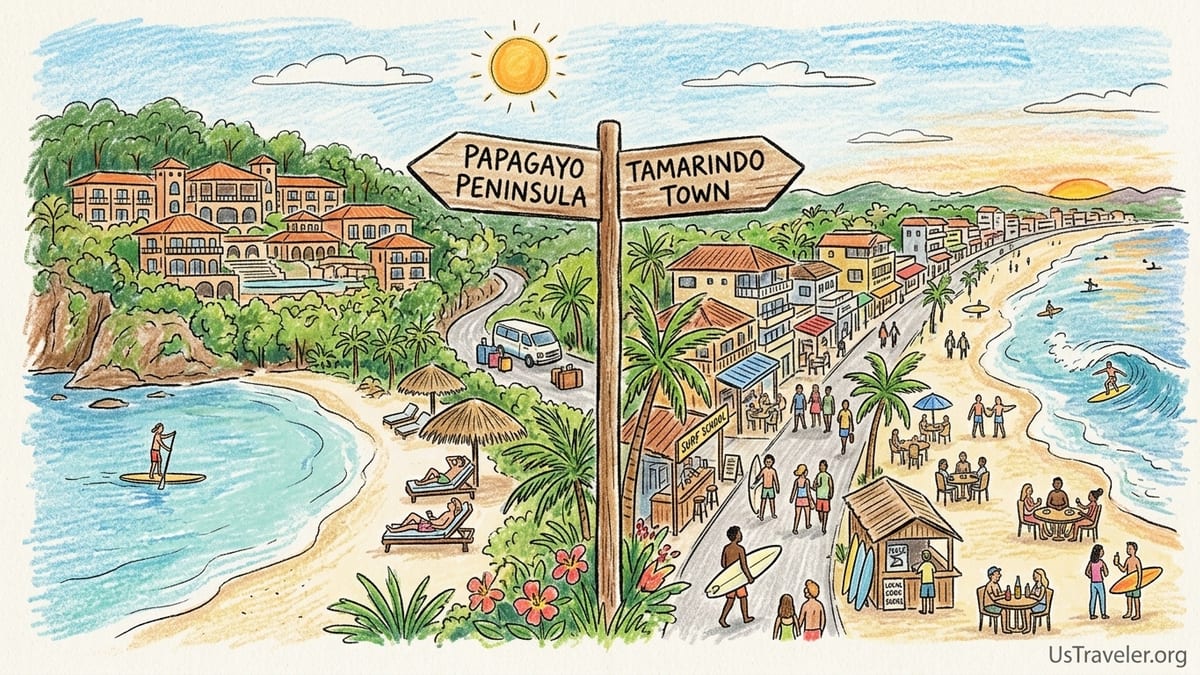
Overall Vibe: Secluded Resort Enclave vs Walkable Surf Town
Papagayo is first and foremost a luxury resort destination. The peninsula north of Liberia airport is dominated by a handful of upmarket properties such as Four Seasons Resort Peninsula Papagayo, Andaz Costa Rica Resort and Secrets Papagayo. These are self-contained worlds set on forested hillsides above quiet coves, with guests spending most of their time on property. You feel removed from the rest of Costa Rica, which for some travelers is exactly the point.
Tamarindo, by contrast, feels like a classic beach town that grew up. What started as a fishing village is now Guanacaste’s most developed surf hub, with a continuous strip of low-rise hotels, rental condos, surf shops, cafés and bars running behind a long crescent of sand. You can walk almost everywhere in town, and the social life happens along the beach and main street rather than inside resort gates.
This split shapes the kind of vacation you have. In Papagayo, you might spend the morning at a resort spa, the afternoon paddling in a calm bay and the evening at a fine-dining restaurant that is part of your hotel. In Tamarindo, a typical day might involve grabbing a smoothie bowl at a café, taking a surf lesson in the afternoon and joining a sunset happy hour at a beachfront bar before wandering to a casual dinner spot.
Neither style is inherently better. Papagayo suits travelers who want quiet, curated comfort and are happy to stay mostly within one property. Tamarindo works for people who like to explore on foot, meet other travelers and have a wider mix of local and international experiences.
Resorts, Hotels and Prices: What Your Budget Buys
On Papagayo, the accommodation inventory skews decisively upscale. A sample search for early October 2026 shows entry-level rooms at Four Seasons Peninsula Papagayo starting around 1,400 US dollars per night for two adults, with Andaz Costa Rica often in the 500 to 800 US dollar range depending on season and offers. Adults-only all-inclusive Secrets Papagayo usually prices below Four Seasons but still squarely in the four to five-star bracket. Smaller boutique choices like El Mangroove sit in a similar price band.
Those high nightly rates do buy a lot: large rooms and suites, polished service, manicured pools, on-site spas and several dining venues per property. Many guests use loyalty programs or credit card points at brands like Hyatt to make stays at Andaz or Secrets more attainable. Still, travelers on moderate budgets can find Papagayo pricing eye-opening, especially once resort fees, service charges and on-site food and beverage are added.
Tamarindo offers a far wider spread of options. At the top end, beachfront boutique hotels such as Capitan Suizo or Cala Luna just south in Playa Langosta can run 350 to 700 US dollars per night in high season. In the mid-range, hotels like Ten North Tamarindo Beach Hotel or Jardín del Edén Boutique Hotel typically fall around 150 to 300 US dollars, while simple guesthouses and hostels in town can come in under 100 US dollars per night, especially outside Christmas and Easter weeks.
This variety makes Tamarindo more flexible for mixed groups. A family might put parents at a comfortable mid-range beach hotel while adult children share a cheaper apartment nearby. That is far harder to do on Papagayo, where the geography and resort model keep everyone inside a limited collection of pricey properties.
Beaches, Swimming and Surfing Conditions
The geography of Papagayo gives it one clear advantage: very calm water. Resorts curve around the protected Gulf of Papagayo, where beaches such as those at Four Seasons and Andaz sit in small bays. These coves generally have gentle waves, making them ideal for relaxed swimming, stand-up paddleboarding and beginner-friendly kayaking. Families with younger children often appreciate the lack of strong surf and rips immediately in front of their hotel.
Tamarindo beach, stretching roughly 1.5 kilometers in front of town, is an exposed Pacific break known for consistent surf. Waves are usually manageable for beginners near the main access points, and the town is packed with surf schools offering board rentals and lessons by the hour or day. Conditions can be rough on very big swell days, and red flag warnings are common in certain seasons, so weaker swimmers need to be cautious if they are not taking a lesson with an instructor.
For stronger surfers, Tamarindo has a clear edge. Within a 30 to 60 minute drive you can reach spots like Playa Avellanas and Playa Negra, and boat trips from Tamarindo estuary head to nearby breaks when the sandbars line up. Papagayo resorts occasionally arrange surf excursions to more exposed beaches, but you will not find walk-out-the-door waves in front of most properties. Instead, the appeal there is morning swims in bathtub-warm, flat water and lounging in shaded beach chairs.
If your ideal beach day is bobbing in calm turquoise water between spa appointments, Papagayo wins. If you dream of learning to surf or watching experienced riders at sunset with a cold drink in hand, Tamarindo is the more compelling choice.
Food Scenes, Restaurants and Nightlife
Papagayo’s restaurant scene is largely inside the resorts. Four Seasons might have a fine-dining restaurant focusing on local seafood, a poolside grill and a casual cafe, all with polished wine and cocktail lists. Andaz spreads its dining across spaces like a Latin-inspired small plates bar and a more formal restaurant set above the bay. Secrets Papagayo, as an all-inclusive, includes several themed venues in the nightly rate. Quality is generally high, but prices at non all-inclusive resorts can easily rival or surpass major US cities, and the number of independent, locally owned restaurants nearby is limited.
Tamarindo, by comparison, feels saturated with choice. Within a few blocks you can move from Costa Rican sodas serving casados and gallo pinto to beachfront seafood grills, wood-fired pizzerias, vegetarian cafés and sushi lounges. Travelers routinely mention being able to eat at a different place every night for a week without repeating, from simple ceviche stands near the estuary entrance to more polished dining rooms at hotels like Tamarindo Diria or Cala Luna.
The nightlife divide is even clearer. On Papagayo, evenings are mostly low-key, centered on resort bars, mellow live music sets and perhaps a cocktail by the pool. Quiet hours are observed, and many guests are in bed shortly after dinner. Tamarindo, on the other hand, remains one of Guanacaste’s liveliest night spots, with beach bars hosting DJ sets, weekly ladies’ nights and live Latin bands. Venues like Crazy Monkey Bar up on the hill, beachfront spots near the main roundabout and occasional pop-up party nights give the town a reliably social after-dark scene, especially in high season and around holidays.
If you want to stroll after dinner, listen to music spilling out of different venues and maybe bounce between a couple of bars, Tamarindo is designed for you. If your idea of a perfect night is a long tasting menu with wine pairings followed by a quiet walk back to your suite under the stars, Papagayo fits better.
Families vs Couples: Who Each Destination Suits Best
Papagayo attracts a mix of high-end family vacations and couples’ getaways. Four Seasons and Andaz both court families with kids’ clubs, family pools and connecting room options, and the calm bays are practical for young children. At the same time, adults-only spaces, upscale spas and private plunge pools make them equally popular for honeymoons and milestone trips. Secrets Papagayo and some boutique properties focus explicitly on adults, which can be a strong draw for couples seeking quiet.
The trade-off is that everything your family does is mediated through the resort. Children may spend their days at the kids’ club, by the pool or on arranged excursions, but they will have less interaction with local culture than in town-based destinations. For some parents this feels safe and simple. Others prefer their kids to walk through a real town, buy snacks at a corner supermarket and hear more Spanish on the street than inside a hotel.
Tamarindo offers that town experience, which can be good or challenging depending on your expectations. The beach and central strip are busy, and during peak weeks you will share space with backpackers, digital nomads and bachelor parties alongside families pushing strollers. Larger beachfront resorts such as Occidental Tamarindo and Tamarindo Diria cater well to families, with kids’ pools and on-site restaurants, while quieter hotels in the Langosta area tend to suit couples looking for a more peaceful base within reach of the action.
For couples, the decision often comes down to how much privacy versus atmosphere you want. An ocean-view suite on Papagayo offers complete seclusion, with room service breakfasts on the balcony and little need to see anyone else. In Tamarindo, even upscale hotels are woven into the town’s energy. You can still find romantic corners, especially toward the south end of the beach, but you will sense a more social, younger crowd around you.
Getting There, Getting Around and Car Dependence
Both Papagayo and Tamarindo are served by Liberia’s Daniel Oduber Quirós International Airport. Papagayo lies closer in pure distance. Many resorts sit roughly 30 to 40 minutes by car from the terminal, and private transfers are often arranged directly through the hotel. Expect to pay in the region of 60 to 100 US dollars one way for a private SUV for two to four people, with some luxury resorts charging more but bundling the cost into packages for longer stays.
Tamarindo is farther, usually quoted as a 60 to 90 minute drive depending on traffic and road works. Shared shuttles per person can keep costs down for solo travelers or couples, while private transfers for small groups typically run in a similar range to Papagayo once split among four passengers. For those combining San José and the Pacific coast, Tamarindo is also on the radar of long-distance bus companies and domestic airlines using nearby airstrips, which gives it slightly more independent-transport options than the resort-specific Papagayo enclave.
Once you arrive, car dependence becomes a major differentiator. On the Papagayo peninsula and surrounding bays, distances between resorts, marinas and any off-site restaurants are significant and often involve winding roads. Most visitors rely on hotel shuttle services, resort-organized taxis or private drivers. You can certainly rent a car at the airport, but you may not use it much if you intend to stay on property. Papagayo works particularly well for travelers who want to arrive, check in and let the resort handle all logistics from that point forward.
Tamarindo’s appeal lies in the opposite. You can base yourself in town without a rental car and still fill a week with activities. Surf lessons, estuary boat tours, sunset catamarans and most popular restaurants are within walking distance of central hotels. Taxis and local drivers can be hired for half-day or full-day trips to nearby beaches or adventure parks. A car becomes useful if you want to explore more remote coves or stay in quieter neighborhoods outside the core, but it is not essential for a short stay.
Excursions and Day Trips From Each Base
From Papagayo, the most convenient excursions tend to be boat-based or resort-organized. Many hotels have their own small marinas or share access to marinas nearby, enabling private snorkeling trips, sunset cruises and inshore fishing charters that leave practically from your doorstep. The calm gulf is good for spotting turtles, rays and seabirds, and some trips combine beach hopping with lunch at a quiet cove inaccessible by road.
Land-based adventures from Papagayo usually involve a longer drive inland, often 60 to 90 minutes to reach zipline parks, hot springs or volcano viewpoints in the foothills of Rincón de la Vieja. Resorts package these as full-day tours that include transport, entrance fees and lunch. It is a comfortable way to see the region but can feel curated and schedule-bound if you prefer spontaneity.
Tamarindo, despite lying a bit farther from Liberia, has excellent access to varied day trips. Operators along the main street sell estuary wildlife tours where you glide through mangroves in flat-bottom boats, spotting crocodiles and herons. Surf schools organize trips to Playa Avellanas or Playa Grande when local conditions are flat. Inland, you can join full-day excursions to canopy zip lines, tubing and hot springs at adventure parks roughly two hours away, in a similar driving radius to those accessed from Papagayo.
Because Tamarindo has many independent tour companies, prices can be more competitive and travelers often shop around in person once they arrive. In Papagayo, you are more likely to book through your resort’s concierge, which typically means higher prices but also more predictable service and pickup directly in front of your lobby.
Cost of Eating, Drinking and Daily Life
Beyond the headline room rates, the daily cost of a vacation plays out differently in each destination. On Papagayo, where nearly all dining is on-site, breakfast buffets can be included in the nightly rate at some properties but a la carte options, cocktails and dinners often match or exceed big-city prices. It is not unusual to see simple resort cocktails in the 15 to 20 US dollar range and main courses that start around 30 US dollars at signature restaurants. All-inclusive properties like Secrets Papagayo simplify budgeting but still charge premium nightly rates for the package.
In Tamarindo, price points spread much wider. A basic breakfast plate at a local soda might cost not much more than what you would pay for a coffee alone at a Papagayo resort. Happy hour margaritas at beach shacks can be several dollars cheaper than resort bars, and mid-range international restaurants offer main courses at prices many North American visitors consider comparable to or slightly below home. Of course, upscale venues in Tamarindo can still be expensive, but the key difference is that you have options to go cheap, moderate or splurge on any given day.
Grocery shopping is also simpler in Tamarindo. Several small supermarkets and mini-marts in town sell fruit, snacks, bottled drinks and basic supplies, which is useful for families or long-stay guests in apartment-style lodging. On Papagayo, reaching a full-size supermarket usually requires a drive to communities like Playas del Coco, so guests staying without a car rely more heavily on resort shops and room service for incidentals.
If you are trying to manage a tighter budget while still enjoying Guanacaste’s beaches, Tamarindo is generally easier to calibrate. Papagayo, by design, encourages you to lean into a high-end, mostly on-property lifestyle where each extra drink or spa treatment comes at a premium.
The Takeaway
Choosing between Papagayo and Tamarindo is less about which is objectively better and more about which matches the kind of Costa Rica experience you want. Papagayo excels as a secluded, high-end resort enclave. You get calm bays, luxurious pools, attentive service and the feeling of being cocooned in nature with everything handled for you. It suits honeymooners, special-occasion trips and families who prioritize ease, safety and comfort over constant exploration.
Tamarindo, on the other hand, is Guanacaste’s archetypal surf town. It is walkable, social and packed with restaurants, bars and surf schools. You can step out of your hotel and immediately be part of local daily life, whether that means grabbing a coffee at a corner café, haggling over a surfboard rental or joining a sunset crowd on the sand. It is more flexible on budget and better for travelers who like energy and spontaneity.
If you picture quiet infinity pools, spa days and dinner at your resort most nights, Papagayo is likely the better fit. If your ideal day involves a surf lesson, tacos at a beach shack and bar-hopping in flip-flops after dark, Tamarindo will feel more natural. Some travelers split their time, spending three or four nights at a Papagayo resort to unwind before moving down the coast to Tamarindo for a more informal, in-town finish.
Whichever you choose, remember that both destinations are just starting points. Guanacaste is full of beaches, dry forest reserves and small towns. A well-planned itinerary that matches your travel style at the front end will leave you better rested and better placed to savor the rest of Costa Rica.
FAQ
Q1. Which is closer to Liberia airport, Papagayo or Tamarindo? Papagayo is generally closer, with many resorts around a 30 to 40 minute drive from Liberia airport, while Tamarindo usually takes between 60 and 90 minutes by road.
Q2. Where is better for learning to surf, Papagayo or Tamarindo? Tamarindo is better for surf lessons, with consistent beach breaks, many surf schools along the main beach and easy board rentals aimed at beginners and intermediates.
Q3. Which destination is more affordable overall? Nightly rates and food costs on Papagayo skew higher due to the luxury resort focus. Tamarindo offers a broader range of hotels, hostels and restaurants, making it easier to keep daily costs down.
Q4. Is Papagayo or Tamarindo better for families with young children? Papagayo’s calm bays and resort kids’ clubs work very well for young children, while Tamarindo suits families who want a busier town beach scene and do not mind more crowds.
Q5. Which area has better nightlife? Tamarindo has a much livelier nightlife scene, with beach bars, live music and late-opening venues. Papagayo evenings are mostly limited to hotel bars and low-key entertainment.
Q6. Do I need to rent a car in Papagayo or Tamarindo? A car is not essential in either place, but on Papagayo you will rely heavily on resort transport, whereas in Tamarindo you can walk to most restaurants and activities from central hotels.
Q7. Are the beaches swimmable year-round in both destinations? Papagayo’s sheltered bays are usually calm and swimmable most of the year. Tamarindo is swimmable too, but surf and currents can be stronger, so visitors should heed local safety flags and lifeguard advice.
Q8. Which is better for an all-inclusive stay? Papagayo has more classic resort-style options, including adults-only all-inclusive properties. Tamarindo is mostly non all-inclusive, encouraging you to explore the town’s independent restaurants and bars.
Q9. Can I visit Tamarindo as a day trip from Papagayo or vice versa? Yes, the drive between the two is typically around two hours each way by car, so it is possible as a long day trip, though many travelers prefer to stay a few nights in each instead.
Q10. Which destination feels more authentically Costa Rican? Tamarindo, as a functioning beach town with local businesses, street life and nearby communities, feels more integrated into everyday Costa Rican life than the more insulated Papagayo resort enclave.