


Landing at Guanacaste Airport in Liberia puts you within a short drive of some of Costa Rica’s most iconic beaches and surf breaks. The big decision visitors face at the rental counter is not only which company to choose, but whether they really need an SUV or full 4x4 to handle Guanacaste’s roads, beach towns and more remote surf access. This guide walks through how rental choices, insurance and road conditions fit together so you can decide with clear expectations before you arrive.
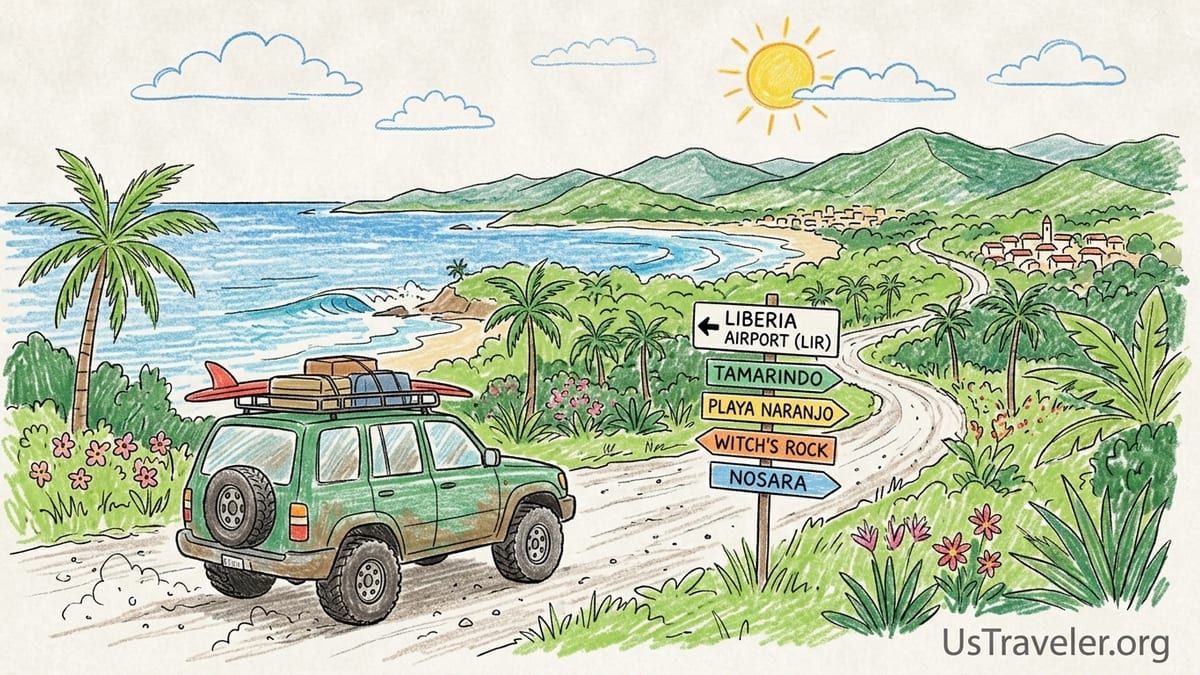
Why Rent a Car at Guanacaste Airport in Liberia
Guanacaste Airport, also known as Liberia International Airport or Daniel Oduber Quirós International Airport, is the main gateway to Costa Rica’s northwest Pacific coast. It sits roughly 11 kilometers from Liberia city and serves as the natural starting point for trips to Papagayo, Tamarindo, Playa Grande, Nosara, Samara and the beaches of the Nicoya Peninsula. For many itineraries, renting a car directly from the airport area is the most flexible way to move between these scattered destinations.
Most major Costa Rican rental brands operate near the airport, including Adobe Rent a Car, Budget, Alamo, Enterprise, National and locally focused companies such as Solid and Vamos. Some have on-airport desks while others operate just outside on the main road with a shuttle pick-up from the arrivals area. For example, Budget advertises a branch strategically located near the Daniel Oduber Quirós terminal specifically for travelers heading straight to Guanacaste’s beaches and national parks. Rental comparison sites and local tourism portals list daily base rates for compact cars starting around the upper 20s in US dollars in low season, rising for SUVs and 4x4 vehicles and during peak holiday weeks.
Hiring a car from Liberia makes the most sense if you plan to visit more than one coastal area, stay in smaller hotels or rentals away from main bus lines, or surf and explore at your own pace. Shuttle services work well for point-to-point transfers, but they become expensive and inflexible once you start stringing together multiple beaches, sunset spots and restaurants scattered along the coast.
The airport itself recommends that new arrivals use only authorized transportation providers, which includes the established car rental brands operating via official counters and shuttles. Booking ahead and confirming that you will be met by a named company representative outside customs helps you avoid informal operators and gives you a clear handoff from flight to rental vehicle.
Standard Car vs SUV vs True 4x4: What You Actually Need
Guanacaste’s road network divides roughly into three types: primary paved highways like Route 21 and Route 1, secondary paved spurs down to major beach towns, and then a web of gravel, rocky and seasonally muddy tracks leading to smaller coves, river mouths and surf points. Your choice between a compact car, an SUV and a true 4x4 should follow the roads you realistically plan to drive.
For most visitors staying on the usual tourist corridor, a standard compact or midsize car is generally sufficient. If your route is Liberia to Playas del Coco or Hermosa, Papagayo resorts, Tamarindo, Playa Grande, Brasilito, Flamingo or Potrero and back, you will spend nearly all your time on paved roads in good or fair condition. Recent road condition summaries for Guanacaste describe these main routes as suitable for regular two-wheel-drive vehicles in normal weather, with the main traffic concerns being congestion and occasional potholes rather than deep ruts or river crossings.
An SUV with higher ground clearance but without low-range 4x4 is the middle ground. It offers more comfort on broken pavement, steep hotel access driveways and occasional gravel connectors, and it is often the most popular category for families heading to Nosara, Samara, or slightly more secluded beaches accessed by graded dirt roads. A common example is the drive from Liberia to Nosara via Nicoya and Route 160, where much of the road is paved or compacted but you will encounter speed bumps, short rough patches and sometimes dusty, washboard surfaces that an SUV handles more comfortably than a sedan.
A true 4x4 with proper four-wheel drive and higher clearance becomes important once you start targeting remote surf breaks and unpaved routes that deteriorate during the rainy season. Costa Rica’s official tourism information on surfing notes that vehicles with four-wheel drive are recommended for access to certain Guanacaste surf beaches such as Playa Negra and Playa Naranjo, and that a four-wheel drive must be used for land access to Witch’s Rock in Santa Rosa National Park because of the road conditions. These are real-world examples where an SUV without 4x4 can struggle, especially in heavy rain.
Route-by-Route Recommendations: From Resorts to Remote Surf
On the most common Liberia-based itineraries, a standard car usually works well. The run from Liberia Airport to Playas del Coco or Playa Hermosa on the Gulf of Papagayo is short, paved and busy with tourist traffic. Likewise, Liberia to Tamarindo or Playa Grande is mostly on Route 21 and paved connectors, so a compact car can handle it fine in dry or moderately wet conditions. Visitors who plan to stay in larger resorts or in-town hotels in Coco, Tamarindo or Flamingo rarely need 4x4 capability unless they plan separate side trips.
Step a little further down the Nicoya Peninsula and an SUV becomes the more practical baseline. The drive from Liberia to Samara or Carrillo involves a mix of highways and secondary roads, with the last stretches often narrower and more potholed, especially after peak rainy months. The route south to Nosara and Playa Guiones has seen ongoing paving and improvement, but travelers still report uneven sections, dirt connectors and steep driveways once you reach hillside rentals. Here, an SUV’s higher clearance provides a margin of comfort even in the dry season, and can prevent underbody scrapes and bumper damage when negotiating dips and rough entrances.
For dedicated surf travelers targeting more isolated breaks such as Witch’s Rock at Playa Naranjo in Santa Rosa National Park, or the stony access towards Playa Caletas and other less developed coves in southern Guanacaste, a full 4x4 is strongly recommended. Official descriptions of Playa Naranjo note that the access road is not in good condition and that a 4x4 or at least a high-clearance vehicle is recommended because of rocks and muddy stretches in the rainy season. The national park’s sector information reiterates that mud and rutted sections appear in wet months, which can trap low cars and 2WD SUVs. Local surf operators and guides commonly reach Witch’s Rock by boat to avoid road issues, which hints at how rough the land access can get.
Another classic example is exploring lesser-known spots south of Tamarindo, including Playa Avellanas, Junquillal and rougher tracks out towards more isolated coves. While many visitors manage these in SUVs or even cars in the dry season, ruts, loose rock and occasional flooded sections appear quickly once the rains set in. If your priority is flexible dawn patrol sessions and willingness to chase sandbars up and down the coast, choosing a 4x4 from the start removes the temptation to push a regular car beyond its safe limits.
Understanding Costa Rica Rental Insurance from Liberia
One of the biggest surprises for first-time visitors renting at Liberia is the cost and complexity of Costa Rica’s rental car insurance. Daily base rates advertised online often look attractive until mandatory coverages are added at the counter. In Costa Rica, some level of liability coverage is required on all rental cars, and local rental contracts and the Costa Rican Car Rental Association clarify that international auto policies usually cannot replace this minimum third-party liability coverage. In practice, that means every renter pays for a liability component through the rental company, even if they arrive with their own insurance or credit card protections.
Most agencies separate this into two concepts. First is the mandatory third-party liability coverage that protects against injury or damage you cause to others or their property, up to policy limits defined by local law and rental company terms. This fee is typically charged per day and cannot be declined, although some companies include it in their quoted rate rather than itemizing it separately. Travelers sharing recent experiences from Costa Rica often mention this mandatory liability adding roughly the equivalent of low double-digit US dollars per day to the cost, though exact amounts vary by company, car class and season.
The second layer is coverage for damage or loss to the rental vehicle itself, commonly called CDW or LDW. This is where many travelers hope to rely on premium credit card insurance. Some Costa Rican rental brands allow renters to decline their CDW if they present a letter from the credit card issuer confirming collision coverage valid in Costa Rica, with the cardholder’s name, last four digits and maximum coverage amount specified. Others maintain their own lists of cards they accept without additional paperwork. However, even when CDW from the rental company is waived, the mandatory liability portion usually still applies and must be paid to legally take the car.
Because policies differ between brands, it is important to ask for a full cost breakdown in writing before confirming your booking. For example, a compact car advertised at a base rate around 30 US dollars per day may climb significantly once mandatory liability, optional CDW with a lower or zero deductible, and extras like roadside assistance are added. The key is to compare final, all-in quotes between companies at Liberia Airport rather than just the headline daily rate, and to decide in advance how much financial risk in the form of deductibles and deposits you are comfortable carrying during your trip.
Airport Pickup, Shuttles and One-Way Rentals
At Guanacaste Airport, rental logistics typically follow one of two models. Some brands maintain desks and vehicle lots within or immediately next to the terminal area, allowing you to walk from customs to the counter and then out to the car. Others operate off-airport locations within a few minutes’ drive and meet customers outside arrivals, loading them into branded vans for a quick shuttle to the rental office. In both cases, using a recognized company with an existing reservation helps streamline the process and reduces waiting time, especially during busy periods in December through March.
It is common to see travelers arrive at Liberia and depart from San Jose or vice versa, particularly on surf and road trip itineraries that combine Guanacaste with Arenal, Monteverde or the Central Pacific. Most national brands offer one-way rentals between Liberia and San Jose, but they usually charge a drop fee. The fee can range from a modest amount included in promotional packages to a noticeable extra cost on shorter rentals. When comparing options, factor in how many hours of driving and how many shuttle tickets you save by dropping the car at a different airport instead of looping back to Guanacaste.
Within Guanacaste itself, some agencies also allow one-way rentals between Liberia and popular beach town branches in Tamarindo, Nosara or Samara. These arrangements can be useful if, for example, you want a car for only the first portion of your trip, then settle into a car-free beach stay. Always confirm return locations, opening hours and whether your chosen drop point has secure parking for after-hours returns. Rental contracts in Costa Rica often specify that vehicles must not be left on public streets overnight, so returning during office hours and receiving a written check-in avoids disputes later.
For travelers who prefer not to drive at all on arrival day, another option is to take a shared or private shuttle from the airport to a beach town, then rent from a local branch once you have rested. Many Liberia-focused visitors, however, appreciate the ability to stock up on groceries at large supermarkets outside the city on the way to the coast, which is much easier with your own vehicle immediately after landing.
Road Conditions, Rainy Season and Parking Realities
Guanacaste’s primary highways around Liberia are generally in reasonable condition, but driving standards and weather patterns are different enough from North America or Europe that visitors should allow extra time and caution. On main paved roads, you will share space with buses, slow trucks, motorcycles and occasional wildlife. Speed bumps appear without much warning near towns and schools, and rural intersections are not always well signed. Night driving is more stressful because of poor lighting, so many visitors plan flights that land in daylight and schedule longer drives for the morning or early afternoon.
Road condition guides for Costa Rica emphasize that two-wheel-drive vehicles are usually fine on tier-one and tier-two routes such as San Jose to La Fortuna, the coastal highway south of Jaco and the main arteries between Liberia and Guanacaste’s larger beach communities. The picture changes quickly on tertiary roads, especially in the rainy months roughly from May to November. On unpaved sections, the surface can shift from firm gravel to loose rock to deeply rutted mud after storms. In Guanacaste, this often affects the last kilometers to more isolated beaches and surf points rather than the main highway itself.
Parking conditions vary by town. In compact centers such as Tamarindo or Playas del Coco, street parking on or near the beach is common, with informal attendants offering to “watch” your car for a small fee. In more upscale or resort-oriented areas, hotels and condominiums usually have gated parking. In rural stretches and national park access points, you may leave your vehicle in a simple dirt lot with limited shade. Regardless of location, it is wise to avoid leaving valuables in the car and to keep bags out of sight. Rental agreements sometimes specify that theft from an unlocked or obviously unattended vehicle may not be covered, so basic precautions make both practical and insurance sense.
When heading to national parks like Santa Rosa or to beaches accessed by river-adjacent tracks, ask locally about current conditions. A road that was easily passable in February can become problematic after a few heavy October storms. Locals at surf shops, hotels and gas stations are usually frank about which sections are only for high-clearance 4x4s after rain and which are safe for cautious two-wheel-drive drivers. Adjusting your route, or even choosing to reach a spot like Witch’s Rock by boat from Playas del Coco instead of driving, may be the safest and least stressful choice in shoulder and rainy seasons.
Where Higher Clearance and 4x4 Really Matter
Not every visitor to Guanacaste needs a 4x4, but certain categories of trip benefit greatly from higher clearance and true four-wheel drive. The clearest example is surf itineraries that prioritize remote breaks over convenience. Witch’s Rock at Playa Naranjo is the classic case: Costa Rica’s own tourism and park information warn that the access road is rough, with rocks, ruts and seasonally muddy sections that call for a 4x4 or at least a very robust high-clearance vehicle. Travelers who ignore this and attempt it in a small sedan run a real risk of getting stuck, damaging the car or voiding their rental insurance by taking the vehicle off approved roads.
Another category is visitors staying on hilltop or off-grid properties in the hills behind Nosara, Samara, Santa Cruz or Playa Hermosa. Many of these rentals are reached via steep access roads that switch abruptly from pavement to gravel, with deep rain washouts across the track. In dry season, an experienced driver might coax a compact car up these hills, but in practice, many hosts and property managers recommend at least a compact SUV and often insist on a 4x4. When you are arriving after dark with luggage and possibly rain, the extra traction and clearance translate directly into safety and peace of mind.
The southern Nicoya coast towards Playa Caletas, Coyote and other lesser-known beaches is another example where higher clearance matters. Tourism material describing this area notes that some stony beaches are difficult to access and that 4x4 and quad vehicles are common ways to explore. During the peak rainy months, temporary streams cross the track and deep puddles form in low points. In these cases, even if you never engage low-range four-wheel drive, the higher stance and more robust suspension of a 4x4 SUV significantly reduce the risk of undercarriage damage and getting stranded.
If your plans are limited to major resort areas, in-town hotels and well-trafficked beach roads, higher clearance is more about comfort than necessity. However, once your itinerary description includes words like “remote,” “track,” “river mouth” or “national park sector entrance past the main gate,” it is wise to budget for a 4x4. The extra daily cost is often less than what a single tow, damaged undercarriage or lost surf day could cost in time, stress and money.
The Takeaway
For most travelers renting a car at Liberia’s Guanacaste Airport, the decision is not whether driving is possible without a 4x4, but how much flexibility, comfort and margin of safety you want built into your trip. Compact cars can comfortably handle the paved routes between Liberia, Coco, Tamarindo, Grande and many other popular beaches in normal weather. SUVs add comfort and confidence on broken pavement and routine dirt roads, and they are a smart default for families or anyone heading to Nosara, Samara or hillside rentals.
True 4x4s come into their own for surf-driven routes and remote access, especially to places like Witch’s Rock at Playa Naranjo, the rougher reaches of the Nicoya coastline and hilltop villas with steep gravel approaches. These are the same areas where Costa Rican tourism and park authorities explicitly recommend or require four-wheel drive, particularly in wet months. If your itinerary revolves around those spots, it is safer to treat a 4x4 as essential rather than optional.
Separately, understanding Costa Rica’s rental insurance structure before you land at Liberia matters as much as choosing the right vehicle. Mandatory liability coverage is non-negotiable and will be added regardless of foreign policies or credit card perks, while collision coverage may or may not be waivable depending on your documentation and the rental company. Asking for full written quotes, reading the fine print on where you can and cannot drive, and planning realistic daily routes around daylight and weather will make your Guanacaste road trip smoother from the first turn out of the airport parking lot.
FAQ
Q1. Do I really need a 4x4 if I am just visiting Tamarindo and Playas del Coco?
For a straightforward loop between Liberia, Tamarindo, Playa Grande, Flamingo, Potrero, Playas del Coco and Playa Hermosa, most travelers manage perfectly well with a compact car or standard SUV. The roads between these towns are largely paved, and while you may encounter potholes and speed bumps, they rarely require four-wheel drive in normal dry-season conditions.
Q2. When is a true 4x4 strongly recommended in Guanacaste?
A true 4x4 is strongly recommended if you plan to access remote surf breaks like Witch’s Rock at Playa Naranjo in Santa Rosa National Park, rougher tracks to beaches such as Playa Negra or Playa Caletas, or hilltop and off-grid accommodations reached by steep gravel roads. It becomes even more important in the rainy season when mud, ruts and small water crossings appear on unpaved stretches.
Q3. Is car rental insurance mandatory in Costa Rica?
Some form of third-party liability coverage arranged through the rental company is effectively mandatory in Costa Rica. Local rental associations and company policies emphasize that international auto insurance usually cannot replace this minimum liability, so renters must pay for a liability component, even if they use a credit card for collision coverage on the vehicle itself.
Q4. Can my credit card insurance cover collision damage so I can decline CDW?
Many premium credit cards offer collision coverage for rental cars in Costa Rica, and some local rental companies will let you decline their CDW if you present a letter from the card issuer confirming coverage, validity in Costa Rica and maximum limits. However, this generally does not remove the mandatory local liability fee, and not all rental brands accept every card, so you must confirm policy details in advance.
Q5. How much extra should I budget for mandatory insurance at Liberia?
Exact amounts vary by company, vehicle category and season, but travelers commonly report that mandatory liability coverage adds the equivalent of low double-digit US dollars per day to the advertised base rate. When you include optional CDW, reduced deductibles and extras, the total daily cost can be significantly higher than the initial quote, so it is best to compare final all-in prices before booking.
Q6. Are main roads from Liberia to the beaches paved?
Yes, the primary routes from Liberia Airport to major destinations like Papagayo, Playas del Coco, Playa Hermosa, Tamarindo and Playa Grande are largely paved. You may encounter rougher patches and construction zones, but regular cars and SUVs can manage them in normal weather. The roughest conditions usually appear on the last kilometers to smaller or less developed beaches.
Q7. What is driving and parking like in Guanacaste beach towns?
Driving in Guanacaste involves sharing roads with buses, trucks, motorcycles and occasional livestock, so patience is important. Parking in beach towns is a mix of street spaces, informal lots and hotel garages. It is wise not to leave valuables in the car and to park in well-lit or attended areas when possible, as rental contracts often limit coverage for theft from unlocked or obviously unattended vehicles.
Q8. Should I avoid night driving after landing in Liberia?
Whenever possible, it is safer to schedule flights and transfers so that longer drives happen in daylight. Many rural roads are poorly lit, with limited signage and unexpected speed bumps or animals on the road. If your flight arrives late, consider staying near the airport or in Liberia for the night, or choose a short transfer to a nearby beach rather than a longer, unfamiliar drive in the dark.
Q9. Can I do a one-way rental from Liberia to San Jose?
Yes, most national rental brands with branches at both Liberia and San Jose airports offer one-way rentals between the two. They typically charge a drop fee that depends on the rental length and season. For trips that naturally start in Guanacaste and finish in the Central Valley or vice versa, this can save significant backtracking time compared with returning the car to Liberia.
Q10. What should I check before taking the rental car from the airport lot?
Before leaving the lot, walk around the car and note any existing scratches or dents on the inspection form, check that the spare tire and jack are present, confirm that the fuel level matches the contract and test lights, wipers and air conditioning. Take timestamped photos of the exterior and interior. Verifying these details at the airport reduces the risk of disputes when you return the vehicle at the end of your trip.