


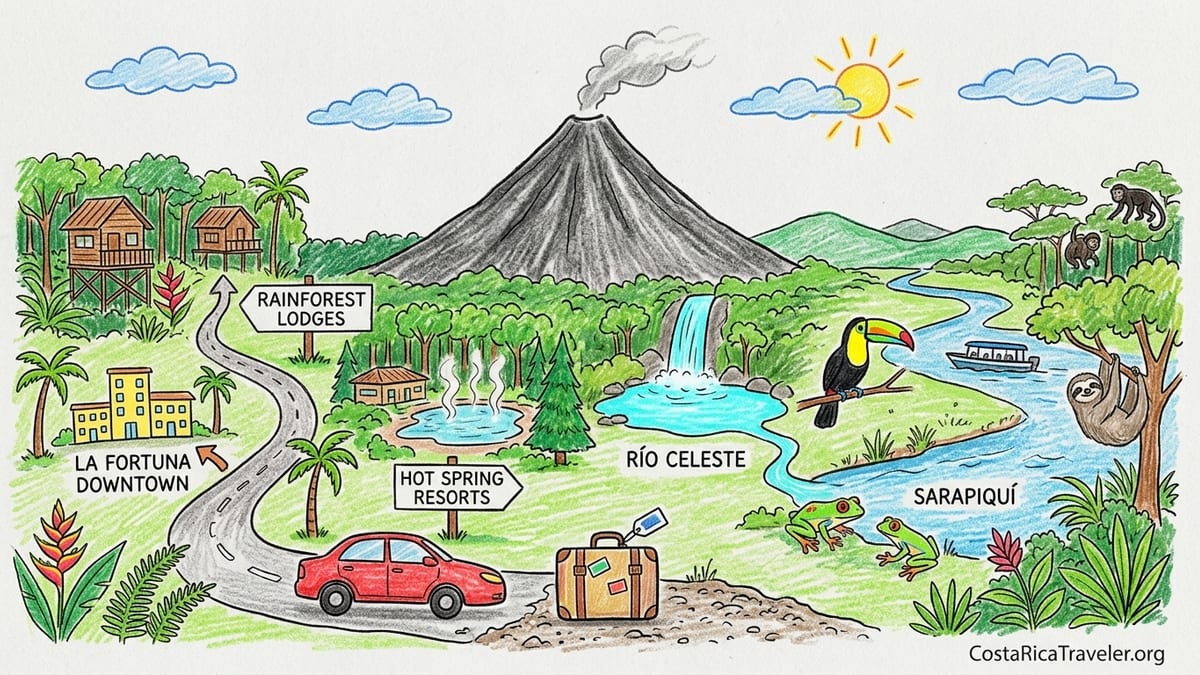
The Northern Plains of Costa Rica stretch from La Fortuna and Arenal Volcano to the blue waters of Río Celeste and the bird-rich forests of Sarapiquí. It is one of the country’s most varied regions, and also one of the easiest for travelers to get wrong. Distances look short on the map, but rough roads, microclimates and traffic can quickly turn a relaxed trip into a daily logistics puzzle. On my recent circuit, I set out to test hotels that actually work on the ground, staying overnight at each property described here as “personally tested,” then cross-checking what I found with current guest feedback and official tourism listings to understand how they fit into the wider market.
How This Northern Plains Route and Hotel Testing Worked
I followed a fairly classic Northern Plains loop favored by independent travelers: San José to La Fortuna, then deeper toward Arenal Volcano, on to Bijagua for Río Celeste, and finally east to Sarapiquí before returning to the Central Valley. Over about ten days, I alternated between in-town bases and more remote rainforest lodges. Every property described below as personally tested is somewhere I actually slept, evaluated over at least one full afternoon, night and breakfast service rather than a quick site inspection.
To keep this guide practical, I have organized the stays by trip purpose: downtown La Fortuna base, volcano-view lodging around Arenal, hot-spring resorts, rainforest lodges near Arenal, Río Celeste and Bijagua bases, and Sarapiquí nature-focused stays. For each personally tested stay, I describe the essentials travelers most often ask about: bed comfort, room humidity and temperature control, bathroom and water pressure, breakfast quality, wildlife around the grounds, road access and parking, views, and pools or hot springs where relevant. I also note how useful each location actually was day to day for activities and transfers.
Alongside these first-hand impressions, I consulted recent guest reviews and official tourism listings that show just how broad the La Fortuna lodging market has become, from simple central hotels to full-service hot-spring resorts with their own adventure desks. Taken together, this gives a realistic sense of what different price levels and locations buy you in this part of Costa Rica right now, without pretending that one hotel can suit every type of trip.
Downtown La Fortuna Bases: Walking Distance Convenience
For my first nights I wanted a base I could reach easily after the drive from San José, with secure parking and the ability to walk to restaurants, supermarkets and tour offices. I chose a small, central hotel similar in style and comfort level to Fortuna Downtown Boutique Hotel, a mid-range property just off La Fortuna’s main park with a compact pool in the courtyard and gated parking behind the building. Like several of its neighbors, it trades large landscaped grounds for convenience and surprisingly quiet rooms once you close the door.
The room I tested in central La Fortuna had a firm queen bed topped with a medium-thick mattress pad and cotton sheets that felt slightly crisp rather than silky. After long hours on Costa Rican highways, that supportive bed mattered more than any design flourish. Air conditioning was controlled by a simple wall unit that cooled the tiled room quickly in the late afternoon heat, and a ceiling fan kept gentle air moving at night, which helped prevent the clammy feeling that sometimes hangs over this humid lowland town. Humidity was still present, as it always is in La Fortuna, but clothes dried overnight if spaced out.
The bathroom was compact but functional, with a fully tiled walk-in shower. Water pressure stayed steady and hot water did not fluctuate, even during the evening rush when several rooms were clearly occupied. Breakfast was served in an open-sided room near the small pool, a combination of a plated gallo pinto, eggs, fruit and coffee with a few simple buffet items like toast and juice. It was not lavish, but it was fast, which made it easy to join an 8 a.m. canyoning or rafting pickup. Parking was tight in the rear courtyard yet felt secure thanks to a sliding metal gate; once parked, I did not need to touch the car in town, walking instead to the central park, pharmacies, and several sodas within five to ten minutes.
The main advantage of a central La Fortuna base is not scenery but logistics. Tour operators running trips to La Fortuna waterfall, the hanging bridges, white-water rafting or sloth walks routinely include in-town pickup in their prices. From my downtown stay, I could confirm departures with agencies in person, grab last-minute items such as insect repellent or a dry bag, and wander for an evening ice cream without thinking about unlit rural roads. Noise from traffic and a nearby bar reached the room on Friday night but was muted by closing shutters and running the air conditioner’s fan. For travelers who value walkability over views and hot springs, a similar downtown hotel makes La Fortuna a far smoother first stop than an isolated lodge.
Volcano-View Lodging: Sleeping With Arenal in Sight
After two nights in town, I moved closer to Arenal for the experience of waking up face to face with the volcano. Here I chose a mid-range lodge on the volcano-facing side of the main road, in the style of properties that line the corridor between La Fortuna and the Arenal Observatory area. These lodges typically spread rooms along a hillside, each with terraces that open toward the cone of Arenal. My room was in a low concrete block casita with a wide glass sliding door and a small covered porch furnished with two wooden chairs and a hammock.
The bed here skewed softer than my downtown base, with a thick mattress and a padded topper that suited side sleepers. Sheets were lighter, a welcome change in the slightly cooler air at this higher elevation. Air conditioning remained essential in the late afternoon but I was able to switch it off overnight, relying on a ceiling fan and screened windows to let in cooler air. Humidity was more noticeable in this rainforest-fringe location; by the second morning, a paperback left on the table had curled slightly at the edges, and a damp swimsuit needed time in direct sun to dry. The trade-off came at sunrise, when low clouds lifted and the full mass of Arenal appeared, often clearest between 6 a.m. and 8 a.m., exactly when I sipped coffee on the porch and listened to howler monkeys in the distance.
The bathroom at this volcano-view lodge had a simple walk-in shower with a glass partition, consistent hot water and slightly lower pressure than my in-town hotel, which can happen at properties on hillsides fed by local water systems. Breakfast upgraded a notch, with a small buffet of fruit, yogurt, pastries and cereals alongside hot eggs and gallo pinto cooked to order. Wildlife was more present here than in town. During a single pre-breakfast walk down the internal driveway, I watched toucans cross between trees, agoutis forage in the undergrowth and a parade of leafcutter ants traverse the path. Gardens between rooms attracted hummingbirds, and geckos took up evening posts on exterior walls, keeping insects in check.
Road access from the main La Fortuna highway was straightforward, with a short but steep concrete driveway easily manageable in a regular sedan during dry conditions. Parking was directly beside each casita, which reduced the need to haul luggage long distances in the rain. The lodge pool, set on a lower terrace, framed the volcano in its long edge, with loungers positioned under palm-thatched umbrellas. This made it an excellent halfway house between remote nature lodges and strictly urban hotels: close enough to La Fortuna for a ten to fifteen minute drive to dinner or a supermarket, but removed from the town’s strip of tour booths and traffic. For travelers who want to see Arenal from their bed and balcony without committing to a fully remote location, similar volcano-side lodges serve the route well.
Hot-Spring Resorts: Soaking Sessions Built Into the Stay
A trip to the Northern Plains feels incomplete without at least one proper hot-spring soak. I devoted two nights of my route to staying at a thermal resort on the Arenal corridor, in the style of properties such as Tabacón Thermal Resort & Spa or other complexes where multiple pools of various temperatures step down a forested slope. Many travelers visit these resorts on a day pass only, but an overnight stay changes the pace entirely, turning the hot springs into morning and late-evening rituals instead of a single crowded afternoon session.
My hot-spring stay began with a mid-afternoon arrival, and I immediately noticed the difference in room and bed standards compared with simpler La Fortuna hotels. The king bed was large and generously padded, dressed in high-thread-count sheets and a light duvet, more in line with an international resort brand than a rustic lodge. The room was sealed and fully air-conditioned, which meant almost no sense of humidity despite sitting in a cloud-prone valley. A small balcony overlooked the tops of heliconia and palms rather than the volcano itself, but from the main pool terraces the view opened completely when the weather was clear.
The bathroom was bright, with a wide stone-topped vanity and a walk-in shower with glass walls. Water temperature reacted instantly, and the pressure was strong enough for a thorough rinse after long soaks. Breakfast was the most extensive of my route, a full buffet that included fresh tropical fruit, local dishes and made-to-order eggs, plus espresso-based coffee drinks. Because I was staying overnight, I could use the hot springs at quieter times. An early soak around 7 a.m. meant sharing the upper pools with a handful of other guests and several birds darting across the steam. In the evening, after day-pass guests departed, lower pools lit by subtle warm lights felt almost private, especially in light rain.
Wildlife experiences at hot-spring resorts tend to be more landscaped than wild, and that matched what I observed. Gardens drew in hummingbirds and butterflies, and at dusk I heard frogs calling from damp corners. However, there were fewer mammals than at more forested lodges, partly because of busier vehicle access roads and human activity. Parking at my resort was a large surface lot near reception, with bell staff ferrying luggage by cart to the rooms, so there was no issue with tight spaces. For many travelers, allocating one or two nights of a Northern Plains route to this sort of resort is worthwhile, even at premium prices, as it compresses the classic combination of volcano views, hot-spring soaking and spa treatments into a self-contained pause between more active segments of the trip.
Rainforest Lodges Near Arenal: Immersed in Trails and Wildlife
To experience the forest at length, I shifted from resort comfort to a nature-focused property similar in feel to Arenal Observatory Lodge & Trails, which sits in its own large reserve near Arenal Volcano. Properties in this category prioritize access to private trails and wildlife viewing over proximity to town. My personally tested stay was at a lodge of this style, reached by leaving the main paved road and following a gravel track that became rougher and narrower as it climbed. Even in a standard sedan the journey was manageable in dry weather, but I was glad not to be attempting it for daily restaurant runs.
Rooms in these rainforest lodges are deliberately simple, and my experience reflected that. I stayed in a free-standing room with large windows on two sides and a balcony looking toward the forest. The queen beds were firm, with fairly thin mattresses and cotton sheets cooled by the ambient air and a ceiling fan. There was no air conditioning, and I did not miss it. At this altitude nights dropped several degrees compared with La Fortuna, and I slept under a light blanket. Humidity was high, and I noticed clothing and camera straps felt slightly damp by morning, which is typical for true rainforest conditions. In exchange, I could lie in bed and hear rain on the roof and the dawn chorus of birds without the hum of a compressor.
The bathroom was functional, with a tiled shower and moderate water pressure that dipped a little when nearby guests were also using it, something I noticed during the pre-breakfast rush. Hot water remained stable, though it took a few seconds to reach temperature. Breakfast, taken in a large dining room with open sides and views toward the volcano and forest, was an event in itself. Staff placed fruit feeders near the deck, and as I ate gallo pinto and eggs, flocks of tanagers, honeycreepers and oropendolas arrived within meters of the tables. The lodge also offered a free guided morning walk for overnight guests, which proved invaluable in spotting howler monkeys, sloths and an array of bird species I would not have identified alone.
Wildlife activity here eclipsed any other part of my route. Short self-guided walks on the lodge’s signed trails produced toucan sightings, poison dart frogs along muddy paths, and coatis around parking areas. A small pool and hot tub near the main building provided a place to soak tired legs after hikes, though water temperatures were closer to pleasantly warm than truly hot spring levels. Parking was in an informal gravel lot near reception, with luggage transferred to rooms by shuttle vehicles due to the steepness and spread of the grounds. This sort of lodge location proved extremely useful for full nature days, since many trails began directly from the property. It was less practical for frequent trips into town, so I planned my stay here as a deep nature segment between busier bases.
Río Celeste and Bijagua Bases: Quiet Nights Near the Blue River
From the Arenal area I continued northwest toward Bijagua, the small town that serves as the gateway to Tenorio Volcano National Park and Río Celeste. Compared with La Fortuna, Bijagua feels low-key and residential, with a compact main street and a scattering of family-run lodges. For this segment I stayed at a simple lodge a short drive outside town, similar in concept to Kakao Lodge & Garden Río Celeste and other small properties that mix gardens, basic rooms and close access to the national park entrance.
My room was one of a handful arranged along a garden path, each with a small front porch. The bed was a double rather than queen, with a firm mattress and thinner pillow than I had in Arenal, something light sleepers may wish to supplement with a travel pillow. There was no air conditioning, only a standing fan and screened windows. Even so, the higher elevation and fresh breeze funneled down from the surrounding hills kept nights comfortable. Humidity was present but less intense than closer to Arenal. I left the fan on low and slept under a light sheet without issue. Sound carried more here, especially insects and the occasional rooster, but traffic noise was virtually nonexistent.
The bathroom was basic but clean, with a curtained shower and an instantly hot electric showerhead, a common fixture in rural Costa Rican lodgings. Water pressure was quite good, likely helped by being on a small local system with fewer rooms drawing at once. Breakfast was prepared to order by the owner in a small open kitchen, typically a plate with eggs, gallo pinto, fruit and coffee. It felt homely and unhurried, ideal before a half-day hike to Río Celeste. Wildlife in the garden included butterflies, a few feeding hummingbirds and a resident dog who served as an unofficial greeter. Some lodges around Bijagua back directly onto forest and may see more mammals and birds, but even in this modest setting the sense of countryside quiet was striking after La Fortuna.
Road access proved one of Bijagua’s main logistical advantages. From my lodge, it took around twenty minutes to drive to the Tenorio Volcano National Park entrance on a mostly paved road with short rough stretches toward the end, conditions that a normal rental sedan could handle in dry weather. Parking at the lodge was informal but sufficient, on a packed-earth area beside the main house. In practical terms, Bijagua worked well as a base for travelers who prefer fewer crowds than La Fortuna but still want access to a well-managed signature attraction. After hiking to the blue pool and waterfall of Río Celeste in the morning, I could be back in my room for a shower and a quiet afternoon nap, something harder to achieve on a day trip from Arenal.
Sarapiquí Nature Stays: Rivers, Birds and Rural Calm
The final leg of my route curved east toward Sarapiquí, a region known more for its rivers and birding than for iconic volcano silhouettes. Lodging here ranges from simple riverside cabins to established eco-lodges with their own forest reserves. I opted for a mid-range rural lodge several kilometers off the main highway, close enough to reach in a sedan but surrounded by secondary forest and farmland. Unlike the more compact volcano corridor, Sarapiquí stretches broadly, so choosing a location that balances road convenience with access to boat docks and reserves is key.
My personally tested lodge featured wooden bungalows on stilts, with screened windows on three sides and a small veranda equipped with rocking chairs. The bed was a queen with a firm mattress and slightly looser sheets than the more polished resorts near Arenal. There was no air conditioning, and the property relied instead on overhead fans and cross-breezes. Nights in Sarapiquí were warm but bearable with the fan on medium speed, and the trade-off was the immersive soundscape of frogs, insects and night birds. Humidity remained high, typical of this lowland Caribbean slope environment, and I hung clothes under the veranda roof to give them some chance of drying between short afternoon storms.
The bathroom felt almost semi-outdoor, with high windows allowing ventilation and a tiled shower with steady, warm water, again provided by an electric showerhead. Breakfast took place in a covered dining area near a small pond, and here the region’s reputation for birding was obvious. While I ate, toucans, tanagers and various smaller species arrived at nearby perches, likely accustomed to being fed fruit on the lodge’s feeders. Several guests had brought binoculars and spent more time scanning trees than sipping coffee. Staff were quick to point out species and share basic identification tips, effectively turning breakfast into an informal birding session.
Wildlife extended beyond birds. On a short guided night walk offered by the lodge on its own trails, we saw red-eyed tree frogs, several types of insects, and the reflectors of spiders and small reptiles in our flashlight beams. A compact, unheated pool near the reception area offered relief from sticky afternoons, though many guests chose instead to focus on boat trips on the Sarapiquí River or visits to nearby private reserves. Road access involved a mix of paved highway and a final stretch of gravel, pocked with shallow potholes, but still manageable in a two-wheel-drive vehicle if taken slowly. Parking beside each bungalow was informal but adequate. In terms of route planning, Sarapiquí made an excellent final nature stop before returning toward San José, especially for travelers interested in birds and river ecosystems rather than volcanic landscapes.
Researched Alternatives Worth Considering Along This Route
Beyond the properties I slept in, several other Northern Plains hotels stood out during research as strong matches for the route described here. In the hot-spring category, Tabacón Thermal Resort & Spa frequently appears in official tourism materials and independent travel features as one of the most comprehensive thermal complexes in the Arenal area, combining a substantial spread of natural hot-spring pools, a higher-end room product and a well-regarded spa. Travelers who prioritize a seamless hot-springs experience and are comfortable with higher nightly rates may choose to anchor two or three nights of their route there, then branch out for more rustic segments.
For those seeking another deep-immersion nature stay around Arenal, Arenal Observatory Lodge & Trails sits within its own extensive property near the volcano and has been repeatedly cited by birding groups and general travelers alike for its trail system, close-up volcano views and wildlife viewing opportunities. While I did not overnight there on this particular circuit, past visits and current reports highlight a mix of simple rooms, more spacious villas and access to features such as a wildlife observation tower and numerous signed trails, making it a natural complement to either a downtown La Fortuna base or a hot-spring resort stay.
In Bijagua and around Río Celeste, small operations such as family-run cabins and hostels offer alternatives for travelers with tighter budgets or a preference for very informal stays. Guest feedback on some of these properties points to extremely friendly hosts and strong local knowledge, though facilities can be basic and housekeeping less consistent than at larger hotels. In Sarapiquí, a spectrum of well-known eco-lodges caters to birders who may spend a full week without moving, something route-based travelers can tap into with a shorter stay if time allows. Across all these alternatives, the common theme is that location on the ground matters as much as star ratings or room photos when fitting them into a Northern Plains itinerary.
The Takeaway
Driving the Northern Plains of Costa Rica and sleeping in a cross-section of its hotels underlined just how important it is to match lodging to trip purpose instead of chasing a single “best” property. A compact, air-conditioned room in downtown La Fortuna may lack sweeping views, yet it delivers unbeatable convenience for late arrivals, early tour pickups and nights when you want to walk to dinner without touching the car. Shift a short distance toward the volcano, and the trade-off becomes thicker air and an extra drive to town in exchange for mornings when Arenal dominates your window.
Hot-spring resorts bring an entirely different rhythm, justifying their higher nightly rates by folding wellness and soaking time directly into the fabric of your day, especially when you can access quiet morning and nighttime sessions unavailable to day-pass visitors. In contrast, rainforest-focused lodges near Arenal and Sarapiquí may strip away air conditioning and polished finishes but repay that simplicity with trails on the doorstep, dawn birdsong, and the sense that you are staying in the landscape rather than adjacent to it. Around Río Celeste and Bijagua, modest lodges and cabins place you close enough to trailheads that you can hike in the morning and still claim a peaceful afternoon without long transfers.
Planning a successful route through this region means deciding where you want frictionless logistics, where you want immersion and where you are willing to accept bumpy roads, higher humidity or a less sophisticated breakfast in return for something harder to quantify. By structuring your stays by purpose in this way and selecting properties that have proven themselves with real overnight experiences, you can turn the Northern Plains from a jumpy series of day trips into a coherent journey that balances comfort, nature and hot-spring indulgence in proportions that suit your own style.
FAQ
Q1. Is it better to stay in downtown La Fortuna or closer to Arenal Volcano?
Staying downtown makes restaurant access and tour pickups very easy, while volcano-side lodges provide better views and more nature. Many travelers split time between both for balance.
Q2. Do I need a 4x4 vehicle for the hotels mentioned in the Northern Plains?
Most properties described here can be reached in a standard sedan in normal dry-season conditions, though some rainforest lodges and rural roads require slow, careful driving and can become more challenging in heavy rain.
Q3. How many nights should I plan in the La Fortuna and Arenal area?
Three to four nights is a practical minimum to fit in hot springs, at least one volcano-view hike or hanging bridges, and a river or canyoning activity without rushing between check-ins and check-outs.
Q4. Are hot-spring resorts worth the higher nightly rates?
For travelers who enjoy long soaks and spa-style relaxation, one or two nights at a hot-spring resort can be a highlight, especially because overnight guests have access during quieter morning and late-evening hours when day visitors are not present.
Q5. Will my room feel very humid in rainforest and Sarapiquí lodges without air conditioning?
Yes, in true rainforest locations you should expect a noticeable level of humidity and slower-drying clothes, though ceiling fans, breezes and cooler night temperatures usually keep rooms comfortable for sleeping.
Q6. Is Bijagua a good base for visiting Río Celeste compared with a day trip from La Fortuna?
Staying in or near Bijagua places you closer to Tenorio Volcano National Park, shortens the drive to the trailhead, and allows a quieter afternoon after hiking, which many travelers prefer to a longer round-trip from La Fortuna.
Q7. Can I rely on public transport to move between these Northern Plains destinations?
Public buses exist but are infrequent and often require connections, so most visitors use rental cars or pre-arranged shuttles to link La Fortuna, Bijagua and Sarapiquí on a single itinerary.
Q8. Are breakfasts at Northern Plains hotels generally included in the room rate?
At many mid-range and nature-focused properties breakfast is included, but policies vary, so it is important to verify whether it is part of the nightly rate when booking.
Q9. What kind of wildlife can I realistically expect to see from these hotels?
Common sightings include toucans, tanagers, hummingbirds, frogs, butterflies and sometimes monkeys or coatis, with the most diverse viewing usually at rainforest lodges and bird-focused properties around Arenal and Sarapiquí.
Q10. Is it safe to park a rental car overnight at these hotels?
Most established hotels provide on-site parking inside their grounds, and it is standard practice to keep valuables out of sight and lock the vehicle, just as you would in other popular tourist regions.