


I have based myself in La Fortuna, Río Celeste and Sarapiquí on different northern Costa Rica trips, sometimes in quick succession on the same itinerary. Each place delivered the lush landscapes and wildlife that draw most travelers to this region, but they felt very different once I parked the car, checked into a room, and tried to fill three or four days without spending all my time on the road. Below is how these three bases actually worked for me in real life, where I leaned on firsthand experience, and where I relied on current research to round out the details.
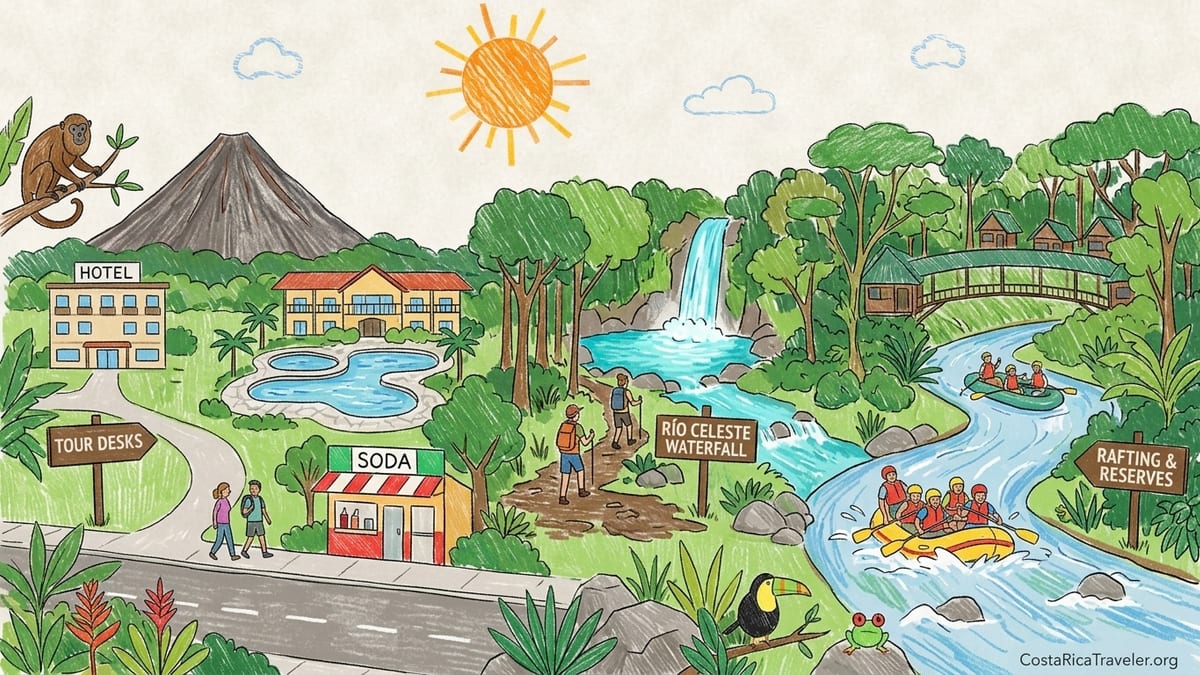
How the Three Bases Feel on the Ground
La Fortuna felt instantly like a tourism hub. Driving in from San José, the last hour turned into a strip of tour desks, sodas and midrange hotels, followed by the unmistakable shape of Arenal Volcano looming over town. I stayed once in a basic hotel a few blocks off the main road and once at a hot-springs resort on the road toward the park. In both cases I could hear traffic and tour buses during the day, but I could also walk to supermarkets, ATMs, bakeries and multiple tour operators in minutes. It worked well when I wanted convenience and a full menu of activities without much planning.
Río Celeste, by contrast, felt like a road with scattered lodges rather than a town. When I based myself near Bijagua for Tenorio Volcano National Park, I drove small paved roads flanked by pasture and pockets of forest, with the volcano massing in the background when the clouds lifted. The center of Bijagua has a few sodas, small supermarkets and tour offices, but in the evenings my world shrank to the lodge, the sounds of frogs and the glow from my cabin porch. Everything revolved around the park entrance and the famous turquoise river, with a quieter, slower rhythm.
Sarapiquí sat somewhere in between. The highway town of Puerto Viejo de Sarapiquí has practical services and truck traffic, but the classic experience happens in lodges strung along the Sarapiquí River or tucked into private reserves. At La Virgen and nearby stretches, I woke to howler monkeys and the rumble of trucks on Route 4 at the same time. Days were filled with river sounds, cicadas and rain on broad leaves. Compared with La Fortuna, it felt less polished and less busy, but also more deeply rooted in working countryside and research stations than in pure tourism.
Official tourism messaging reflects the same divide: La Fortuna is framed as the region’s main service and adventure hub, Sarapiquí as river and rainforest country with rafting and scientific reserves, and Río Celeste as the gateway to Tenorio’s natural showpiece. In practice, that is exactly how they felt once I settled in.
Accommodation: Where I Slept and What I Noticed
In La Fortuna I tried both a simple in-town hotel and a hot-springs resort on the Arenal road. The in-town stay put me in a small room with air-conditioning, a fan and basic breakfast included. I could walk out to a bakery in two minutes and to a tour office in thirty seconds, which made it simple to add an afternoon canyoning tour or a last-minute sloth walk. On another visit I booked a midrange hot-springs hotel with multiple pools. That stay cost roughly three times as much per night as my in-town room once I factored in resort taxes and dinner, but it came with the luxury of wandering between warm pools in a bathrobe after dark and hearing nothing but water and quiet conversations.
Current prices in La Fortuna reinforce what I felt on the ground. Day passes at a more intimate hot-springs property like EcoTermales now sell around 80 dollars for a six-hour session, placing them in the midrange field, while bigger complexes like Baldi offer full-day access for a lower ticket but with a high-energy atmosphere and water slides. Local travelers in recent seasons describe cheaper family-oriented hot springs and the free hot-springs river spot as budget options, with some simple pools charging around 20 dollars per person for a day, making La Fortuna one of the easiest places in Costa Rica to match lodging and soaking style to budget.
Near Río Celeste my stays were smaller in scale. I slept in a cabin on a gravel side-road, about 15 minutes’ drive from Tenorio’s park entrance, and another time in a rustic lodge closer to Bijagua. Both had simple rooms with fans rather than air-conditioning, open-air dining areas, and trails or gardens lit for night walks. At one lodge, rain on the metal roof drowned out the sounds of passing motorbikes and I woke to toucans in the treetops. Lodging choice mattered here because there was no town to escape to in the evening. After dinner, I either joined a night walk offered by the lodge or read in a hammock. The upside was immersion; the downside was that if you do not like your lodge’s vibe, there is nowhere else to go without driving unlit rural roads.
In Sarapiquí I stayed at two different styles of accommodation: a long-established eco-lodge on the river and a simpler guesthouse closer to town. The eco-lodge reminded me of a small campus, with cabins connected by covered walkways, a central dining hall, and private trails into secondary forest. Rain hitting the broadleaf plants outside my window, bats swooping around lights after dusk and the distant shouts from rafting guides on the river were all part of the atmosphere. My room had screened windows, a powerful ceiling fan and no television. Nearby lodges position themselves as private wildlife refuges with hundreds of hectares of forest and several kilometers of trails, which matched my experience of being able to birdwatch at dawn without leaving the property. The guesthouse in town was cheaper and functional, but the magic was undeniably deeper at the forest lodges.
Eating Out, Nightlife and How Evenings Actually Felt
La Fortuna was where I never had to think hard about dinner. On one trip I wandered from my hotel to a casual soda on the main street for a casado and a local beer for around ten to fifteen dollars total. Another night, after a long hot-springs soak, I splurged on a steak at a volcano-view restaurant that catered mostly to tourists. The main strip offered wood-fired pizza, vegan cafes, bakeries selling fresh pan dulce each morning and ice-cream shops that stayed open into the evening. There were also bars with cocktails and occasional live music. Nightlife here is not like a big city, but compared with Río Celeste and Sarapiquí, La Fortuna felt the most alive after dark, with people walking the main road, traffic circulating and tour shuttles dropping off late from night walks and frog tours.
Near Río Celeste, every evening was quiet. At my cabin, dinner happened in an open-sided restaurant run by the property, usually serving a set menu or a short list of hearty plates based on rice, beans, grilled chicken or trout, and fresh juices. I could drive into Bijagua for a soda or bakery, but most guests stayed put. After 8:30 p.m., the only sounds were insects and rain. There were no bars with music, no crowds of backpackers, and no late-opening coffee shops. The social center tended to be the communal dining tables where guests swapped mud stories from the trail and debated whether the river had looked more blue in the sun that day or the previous one.
Sarapiquí fell somewhere in between. At river lodges, dinner was often buffet-style or a set meal. I remember one evening at a lodge where the power cut during a thunderstorm and we finished dinner by candlelight while frogs called louder than the rain on the roof. After dinner, most guests either joined a guided night walk, watched for nocturnal frogs and insects near the ponds, or went early to bed for dawn birding. In Puerto Viejo de Sarapiquí town, I found fried chicken stands, sodas and a couple of low-key bars serving cold beers to drivers and locals. It was not fancy, but it was real. Travelers looking for cocktails and crafted menus will find fewer options here than in La Fortuna, and the atmosphere leans far more to early nights than to nightlife.
Activities, Wildlife and How Easy It Was to Fill Several Days
La Fortuna was where my days filled up the fastest. On one trip I did a morning hike on the Arenal 1968 lava trail, followed by lunch in town and an afternoon soaking at a hot-springs resort. Another day combined the La Fortuna waterfall in the morning with a hanging-bridges walk and an evening sloth tour. With tour desks on every corner, I could sign up for canyoning, zip lining, rafting on the nearby Balsa River, chocolate tours, night frog walks and more. Several tour companies also run full-day rafting trips to the Sarapiquí River from La Fortuna, which added whitewater to the mix even without changing bases. After four nights I still had not exhausted the menu. If your main goal is adventure tourism built around Arenal Volcano, La Fortuna simply makes logistics easiest.
Río Celeste, by contrast, centered almost completely around Tenorio Volcano National Park and a handful of nearby reserves. My cornerstone day there was the hike to the famous blue waterfall and river. I arrived early to beat the crowds, checked in at the official entrance station and started up the trail. Much of the path was stepped or paved near the start, but several sections quickly turned to thick mud after the previous night’s rain. By the time I reached the river-view platforms I was ankle-deep in brown clay. The payoff was standing at the Río Celeste waterfall, watching the improbable turquoise water drop into the pool below, and then walking on to the area where two clear rivers meet and the minerals cause the sudden blue color. The park service has installed railings, signs and structured lookout points, but it still felt very much like a rainforest walk rather than a polished attraction.
Recent park guidelines and traveler reports confirm that Tenorio management often closes sections of the park or the whole trail temporarily after heavy rain for safety and to protect the trail. Visitor numbers per day are capped and entry tickets are sold in timed blocks. This matches my experience of having to commit a full morning or afternoon to the hike and accepting that the park is the anchor activity. Outside the park I joined a night walk run by a local guide who grew up in Bijagua, spotting red-eyed tree frogs on heliconia leaves and a kinkajou moving quickly through the canopy. I also visited a small privately run sloth and frog sanctuary one afternoon when the rain was too heavy for another long hike. Beyond that, activity choices slimmed down quickly.
In Sarapiquí, my days were anchored by the river and the forest. On one visit I took a half-day whitewater rafting trip on the Sarapiquí River, joining a small group with helmets and paddles and traveling to a put-in point upstream. The rapids we ran were mostly Class II and III, which meant splashy waves, some technical moves around boulders, and plenty of time in the calmer sections to look for kingfishers, herons and iguanas on the banks. Other outfitters now market more intense Class IV sections, typically costing between about 90 and 110 dollars for a half-day including gear and transport, while the Class II and III family runs hover around the 60 to 85 dollar range. On another trip I chose a quiet safari float instead of whitewater, drifting under overhanging trees while a guide pointed out toucans, basilisks and, once, a distant sloth.
Off the river, I spent a memorable morning at a private rainforest reserve reached via a long suspended bridge over the Sarapiquí. Starting just after sunrise, my guide and I spent hours walking well-maintained trails while howler monkeys roared from the canopy and leafcutter ants crossed the path in constant files. Birding is a major draw here. One nearby biological station reports upwards of several hundred bird species recorded on its property, and my own short walks produced aracaris, trogons and multiple species of tanagers. I also joined a cacao tour at a farm that combined an overview of sustainable agriculture with chocolate tasting. Over four nights I never ran out of things to do, but nearly everything revolved around the river or forest rather than around a volcano.
Driving, Rain and Dealing With Crowds
Driving into La Fortuna from San José felt straightforward, mostly on paved highways and only the last segment on smaller roads with occasional potholes. The approach from Liberia traditionally followed the lake road, which is scenic but prone to landslides and temporary closures after heavy rain. In 2024 there were multiple reports of Route 142 experiencing closures around the lake, with drivers diverting through Upala and Guatuso, sometimes passing near Río Celeste as an alternate route. I have not personally been stopped by a closure, but I have driven that stretch in heavy rain and been grateful for decent ground clearance and daytime hours.
From La Fortuna to Río Celeste, my experience matched what many recent travelers describe online: mostly paved secondary roads, with some patched sections and occasional gravel segments closer to Bijagua and the park. I used a small SUV with modest clearance, which helped on the rougher bits without feeling like overkill. I would not personally choose to drive that route for the first time in the dark or during a major storm, but in daylight and normal rain it felt manageable if I kept speeds low and watched for livestock and cyclists.
Reaching Sarapiquí from San José involved taking the road that crosses the mountains toward Guápiles, then turning north toward Puerto Viejo de Sarapiquí. The mountain section can be foggy and wet, with slow trucks and tight curves. Once in the lowlands, roads flattened out but shared space with heavy freight traffic and buses. At no point did I need four-wheel drive for the main approach roads, although unpaved stretches to certain lodges were easier with higher clearance, especially in the wettest months. In all three destinations, I found that using local navigation apps and checking recent traveler reports for landslides, construction and river flooding made more difference than the official map suggested.
Rain patterns also shaped my stays. La Fortuna sits on the wetter Caribbean slope side of Arenal, which for me translated into brief, heavy showers on several afternoons, especially between May and November, and occasional full rain days. The upside was dramatic clouds building around the volcano and waterfalls in full flow. Río Celeste’s famous color can dull after very heavy rain when sediment churns through the river, and park staff sometimes warn visitors at the entrance if conditions are not ideal. On my first visit the water was a vivid blue in mid-morning sun. On another, after a night of torrential rain, the color looked milkier and the trail was significantly muddier and more slippery.
Sarapiquí, sitting in the northern Caribbean lowlands, felt like rainforest in earnest. During one March stay, rain came mostly as overnight or late-afternoon storms, leaving mornings relatively clear for birding and rafting. Local operators describe March and April as among the drier months for hiking and wildlife, with heavier rain returning from around May through November and raising river levels for bigger rapids. On my rainiest Sarapiquí day, trail sections in a private reserve turned into ankle-deep mud and one planned river trip was shifted from whitewater to a calmer wildlife float for safety. Flexible plans were essential.
Crowds differed dramatically between bases. In La Fortuna, parking lots at the waterfall, hanging bridges and popular hot springs filled with tour buses and rental cars by mid-morning. I shared trails with dozens of other people and hot-springs pools with couples taking photos around every corner. In Río Celeste, timed entry and a more limited number of accommodations nearby kept numbers lower, but the main waterfall platform and the first stretches of the trail were still busy during standard entry windows. In Sarapiquí, even in high season, my rafting groups were small and I rarely saw other parties on private reserve trails outside of peak hours, though some better-known birding spots near research stations could feel busier around sunrise.
Which Base Fit Best for Different Types of Trips
For volcano views and a packed adventure schedule, La Fortuna was the base that worked best for me. I could see Arenal from my hotel pool, book canyoning, zip lining, rafting, sloth tours and night walks all from the same strip, and finish each day in a hot spring or a town restaurant. When I traveled with friends who wanted something new every day and did not mind a bit of bustle, La Fortuna made everyone happy. I would choose to base here again for a first-time visitor focused on classic Costa Rica adventure, especially if they had three or four nights and wanted to minimize driving once they arrived.
For quieter nature and slow mornings, Río Celeste felt more suitable. When I stayed near Tenorio, my days followed a restful rhythm: an early hike to the waterfall and blue river, a long lunch back at the lodge, maybe a second short trail in the afternoon if the rain held off, and a night walk after dinner. There were no competing attractions pulling me around, which helped me sink into the forest sounds. If someone told me they wanted two nights with minimal crowds, simple meals and one truly memorable hike, I would point them toward Río Celeste, while warning them that if rain is heavy, the trail can be closed or the color less intense.
For rafting, wildlife and feeling inside working rainforest rather than at a volcano resort, Sarapiquí became my preferred base. I liked being able to choose between splashy whitewater days and quiet safari floats, then spend non-river days exploring private reserves and agricultural tours. Serious birders and travelers who care about conservation and research would likely find Sarapiquí especially rewarding, given the proximity of famed biological stations and private refuges with extensive trail networks. When I wanted to hear howler monkeys in the pre-dawn hours and watch toucans from the breakfast table, Sarapiquí delivered.
For very short stays of one or two nights, I found La Fortuna easier logistically than the other two. Its concentration of lodging, tours and dining meant I could arrive in the afternoon, drop my bags and still fit in a night walk or hot-springs session without pre-planning. Río Celeste and Sarapiquí, by contrast, required more advance coordination with lodges for night walks or early-morning tours, and distances from the main roads to some properties made late arrivals more stressful. For travelers landing in San José with limited time, two or three nights in La Fortuna, perhaps with a day trip or transfer tour toward Sarapiquí or Río Celeste, often makes more sense than trying to sleep in two or three different bases.
The Takeaway
After rotating through La Fortuna, Río Celeste and Sarapiquí on multiple trips, I stopped looking for a single “best” base and started thinking in terms of what I wanted most from that particular week. When I craved hot springs, a dramatic volcano backdrop and a dense menu of tours, I headed for La Fortuna. When I wanted to slow down and build my days around one iconic hike and evenings with frog calls replacing bar music, I chose Río Celeste. When I wanted to alternate between river days and forest walks, with dawn birding and the sense of being in an active research-and-farming landscape, I looked to Sarapiquí.
Official tourism materials frame La Fortuna as the northern hub where services cluster, Sarapiquí as centered on river and rainforest experiences, and Río Celeste as synonymous with Tenorio’s natural attractions. My own time on the ground lined up closely with that marketing, but each place felt more nuanced once I factored in the rhythm of the days, the taste of the rain in the air and the practicalities of driving, mud and meal choices. The good news is that all three can fit into a single northern Costa Rica loop if you have a week or more. If you do not, choosing the base that matches your priorities will give you a better trip than chasing every highlight in one frantic circuit.
FAQ
Q1. Is La Fortuna, Río Celeste or Sarapiquí better for first-time visitors to Costa Rica?
For a first visit with limited time, I usually recommend basing in La Fortuna because it combines easy logistics, a wide choice of hotels and restaurants, and a big variety of tours and hot springs close together. Río Celeste and Sarapiquí are excellent second bases if you have more days or a strong interest in quieter nature or rafting.
Q2. How many nights should I stay in each place?
In my experience, three or four nights in La Fortuna lets you sample hot springs, a waterfall or hanging bridges and one or two adventure tours without rushing. Two nights near Río Celeste is enough for the Tenorio hike and a night walk. In Sarapiquí, three nights work well if you want both river time and forest walks.
Q3. Do I need a 4x4 to drive to these destinations?
I have reached all three areas in a small SUV with modest clearance. The main roads are paved, but some side roads to lodges and wet-season conditions make higher clearance helpful. A true four-wheel-drive is most valuable if you visit in the heaviest rains or choose remote lodges down unpaved tracks.
Q4. Which base is best for wildlife watching?
All three offer wildlife, but I personally saw the most diversity in Sarapiquí and around Río Celeste, especially during early morning hikes and guided night walks. La Fortuna has good sloth and frog tours, but the density of lodges and roads means it feels less like continuous forest than Sarapiquí’s river corridors or Tenorio’s protected areas.
Q5. Is the Río Celeste trail really very muddy?
On every visit I have done, at least part of the Tenorio National Park trail has been muddy, sometimes ankle-deep after heavy rain. Good footwear and clothing you do not mind getting dirty make a big difference. In very wet conditions, park staff may temporarily close sections of the trail for safety.
Q6. Can I visit Sarapiquí or Río Celeste as a day trip from La Fortuna?
It is possible but can be tiring. Some tour operators run full-day rafting trips from La Fortuna to Sarapiquí, and you can drive to Tenorio and Río Celeste waterfalls in a long day. I have done both as long outings, but I preferred staying at least one night in each area to avoid long drives before and after activities.
Q7. Where did you find the best hot springs experience?
My most relaxing hot-springs evenings were in La Fortuna, at midrange resorts with multiple pools and rainforest landscaping. EcoTermales, for example, offers limited-capacity sessions that feel quieter than larger complexes. Río Celeste and Sarapiquí focus more on rivers and forest than on thermal resorts.
Q8. Which destination is quietest at night?
Río Celeste has been the quietest for me, with nights dominated by insect and frog sounds and very little road noise or nightlife. Sarapiquí lodges along the river are also tranquil once truck traffic dies down. La Fortuna is livelier, especially near the main strip, with more vehicle noise and social activity.
Q9. How do crowds compare among the three?
La Fortuna’s main attractions and hot springs can get crowded in standard high-season hours. Tenorio and Río Celeste feel busy on the main sections of the trail but benefit from entry limits and timed tickets. In Sarapiquí, I have rarely felt crowded on forest trails or river trips, though popular birding spots see more people at sunrise.
Q10. If I can only choose one base, which would you personally pick?
If I had to choose a single base for a varied trip, I would personally pick La Fortuna for its balance of volcano views, hot springs, adventure tours and dining options. If my main aim were rafting and immersive rainforest, I would choose Sarapiquí instead, and if I wanted a slower, quieter stay anchored around one signature hike, I would go with Río Celeste.