


I have visited Costa Rica’s Northern Plains in both the dry and green seasons, splitting my time between La Fortuna near Arenal Volcano, the lowland forests around Sarapiquí, and the river wetlands that feed Caño Negro. What surprised me most was not the rain itself, but how differently the landscape, rivers, wildlife and even crowds behaved from one season to the other. The green season was not the washout many travelers fear, and the dry season was not the perfect-weather guarantee often promised in glossy brochures. Instead, each brought trade-offs that mattered a lot once I was staring up at Arenal hoping the clouds would move, or standing ankle-deep in mud before a hanging bridge tour.
Understanding Seasons in Costa Rica’s Northern Plains
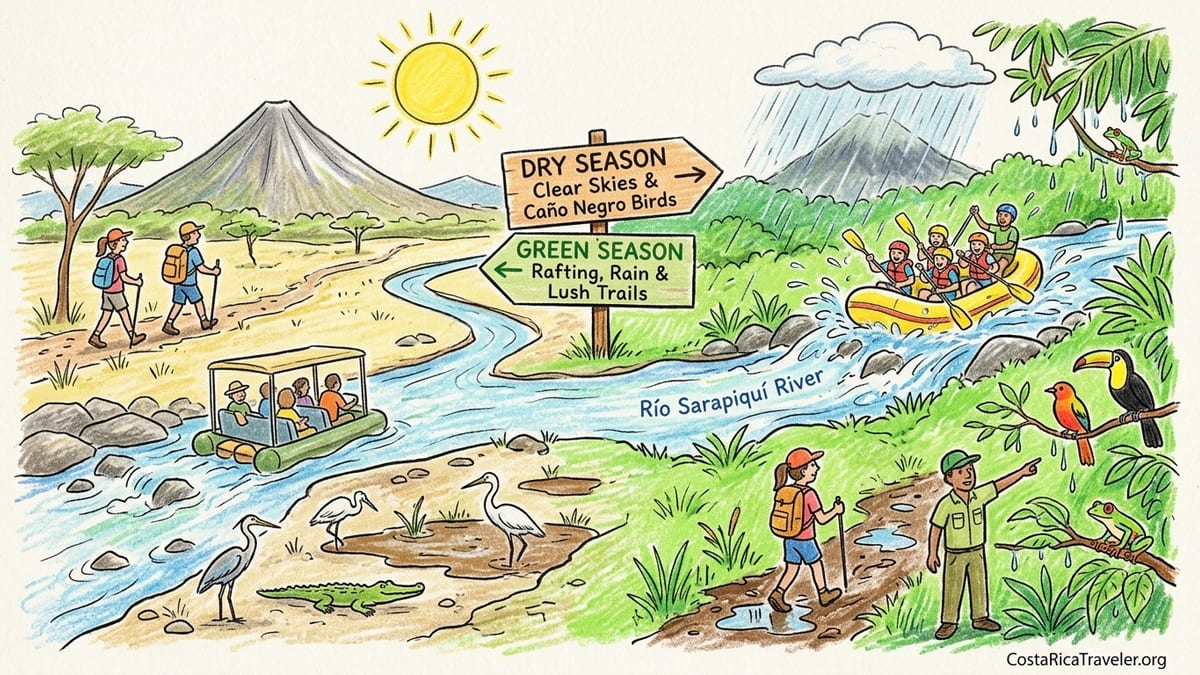
The Northern Plains region stretches from the flanks of the Central Volcanic Range out toward the Nicaraguan border. It includes La Fortuna and Arenal Volcano, Sarapiquí, Caño Negro and the cattle and dairy country around San Carlos. Official climate guidance for this region describes a long rainy period that generally starts in May and runs into December or early January, with a relatively drier window centered on December to April. Temperatures sit in the mid 20s to low 30s Celsius year-round, so the real difference is not heat, but how much water is in the air, soil and rivers.
On my dry-season visits in February and March, days in La Fortuna were usually clear by mid-morning, with Arenal’s cone visible about seven days out of ten. Showers still rolled through, especially overnight, but they were brief and rarely altered plans. In the green season months of August and early November, mornings often began clear or lightly overcast, then built toward heavy showers or full thunderstorms in the mid to late afternoon. Around Sarapiquí, the pattern was more humid and consistently wet, with at least some rain almost every day I was there, regardless of month.
National tourism materials now explicitly frame these periods as dry season, roughly December to April, and green season, roughly May to November, for the Northern Plains. Within those broad labels, though, local operators in La Fortuna and Sarapiquí talk more about “shoulder weeks” when the first or last serious rains arrive, and when rivers finally drop enough to calm down. That nuance is important if your trip revolves around rafting the Sarapiquí River, scanning Caño Negro’s lagoons for wading birds, or getting that classic postcard view of Arenal’s perfectly conical volcano.
Because the region is a transition zone between the drier Pacific and the wetter Caribbean slopes, it never truly becomes bone-dry the way Guanacaste’s beaches do. Even in March I walked sections of Arenal’s forest trails on damp ground, and Sarapiquí’s farms and riverbanks stayed lush. This is why the green season here should not be confused with constant storms, and the dry season should not be assumed to be cloudless skies every day.
Dry Season on the Northern Plains: Clearer Skies and Lower Rivers
My most classically “sunny Costa Rica” trip to the Northern Plains was in late February, when I based myself in La Fortuna. Mornings were cool and fresh, with temperatures around 20 to 22 Celsius at sunrise, climbing to around 30 by mid-afternoon. Humidity was still high compared with inland valleys, but I could hike the Arenal 1968 lava flow trail in late morning without feeling overwhelmed. The biggest difference compared with my August visit was the sky. On three consecutive days that February, Arenal’s summit was completely visible from 7 a.m. until mid-afternoon, which meant that photos from viewpoints like Arenal 1968 and the Mirador El Silencio trails captured the full cone with minimal cloud cover.
Rivers and trails told another story. On a safari float along the Río Peñas Blancas, the water level in February had dropped enough that our raft occasionally brushed stones. Guides explained that this was typical late in the dry season. It did not make the trip less enjoyable, but it did mean more careful navigation and a slower pace in certain bends. In the Caño Negro wetlands, the dry season changes the landscape even more dramatically. When I visited in March, the main channels of the Río Frío had shrunk, exposing muddy banks and creating isolated pools where birds congregated. Local boat captains pointed out that this seasonal drawdown is precisely what makes dry-season wildlife watching famous there, because herons, spoonbills, storks and caimans are easier to spot around shrinking water sources.
Dry trails were one of the most noticeable quality-of-life improvements. The Mistico Arenal hanging bridges circuit in late February felt almost like a paved park walk, with only a few damp patches in shaded gullies. Footwear stayed clean and traction was never a concern. On the volcano-side Arenal 1968 loop, I crossed exposed lava flows and open pasture with only a light dusting of volcanic ash on my shoes. Compared with my experience in August, when those same routes turned into slick clay and puddles, the dry-season version was more accessible for visitors who dislike mud or have limited mobility.
On the downside, crowds and tour availability reflected the typical dry-season high demand. In La Fortuna, many hotels and hot spring complexes were close to full in February, and popular tours like the full-day combination packages that include hiking, hanging bridges and hot springs often sold out a day or two ahead. Rafting companies told me that February and March departures on the Sarapiquí and Balsa rivers can fill quickly, particularly the family-friendly class II–III runs. I found that booking at least several days in advance was necessary to secure early-morning time slots, which are best for both wildlife viewing and avoiding heat fatigue.
Green Season: Rain, Mud and Remarkable Wildlife Activity
My first green-season Northern Plains trip took place in mid-August, with a second visit in early November that overlapped the seasonal transition back toward drier conditions. Both times, the landscapes around Arenal, San Carlos and Sarapiquí felt noticeably lusher than in February. Hillsides were intensely green, banana and pineapple plantations looked vibrant, and the sound of flowing water was a constant backdrop. The change in rain pattern was immediate. In August I rarely had a fully dry day, but the rain often followed a rhythm. Mornings were usually usable for outdoor activities with only light drizzle or low clouds, then by mid-afternoon the sky would darken and a heavy, sometimes torrential, downpour would begin.
In Sarapiquí, I stayed on a small farm during one early November trip. On two of four days, rain started before noon and continued in intermittent bursts until night. During one particularly strong storm, the intensity was high enough that conversation under a tin roof became impossible, and the farm’s red-clay path turned into a shallow stream in minutes. I walked to the main road in ankle-deep mud, and even sturdy rubber boots sank slightly. Yet by the next morning, birds were extremely active along the same path. Toucans, tanagers and oropendolas moved through dripping foliage at eye level, apparently unbothered by the lingering showers.
These wetter months brought some disruption, although not as much as first-time visitors might fear. My original plan in August included an afternoon volcano viewpoint hike combined with a late hot springs visit. On the scheduled day, clouds began stacking over the volcano right after lunch, and by 2 p.m. Arenal had disappeared into a solid grey mass. The hike went ahead, but it became a forest walk without views, and rain jackets and pack covers were essential. However, the hot springs portion of the day felt almost better under light rain, with steam rising off the pools and cooler air temperatures making the water more comfortable.
Green season is also when I noticed more mosquitoes and other insects, especially around wetlands and agricultural land. At dusk in Sarapiquí I needed long sleeves and repellent to sit comfortably on an open veranda. During an early November night walk near La Fortuna, the forest seemed to pulse with insect life: crickets, katydids and moths in particular. Guides mentioned that higher humidity and standing water increase breeding habitat. At the same time, many iconic species such as tree frogs and certain snakes are easier to find on damp nights, and bird activity at dawn along green-season rivers can be excellent.
River Levels, Rafting and Wildlife: Why Green Season Shines
Costa Rica’s official tourism guidance highlights Sarapiquí rafting and Northern Plains hanging bridges as signature green-season activities, and my time on the rivers helped explain why. On an August run of the Sarapiquí’s family-friendly Chilamate section, water levels were visibly higher than photos I had seen from February. The current was strong but not extreme, and rapids felt bouncy and continuous rather than scraping over rocks. Guides from a local operator explained that they monitor river gauges daily and adjust put-in points to keep commercial trips within a safe class II–III range for most visitors, while more advanced sections are reserved for higher-experience groups.
Higher water transformed the sensory experience. Instead of navigating narrow, shallow channels as in late dry season, we glided between fully green riverbanks overhung by trees. Kingfishers, herons and iguanas were easy to spot at eye level, and occasional rain showers created a misty curtain over the water. The trade-off was that eddies used for swimming breaks were sometimes too fast-moving to be safe, so guides shortened in-water stops. On one particularly rainy afternoon, a second departure that day was cancelled because the river rose beyond the operator’s preferred window, and those guests were rescheduled for the next morning, when the level had dropped back into range.
Green season also improves certain types of wildlife viewing away from whitewater. Around Arenal’s forest reserves and the Mistico hanging bridges, guides pointed out that many resident bird species become more vocal and easier to detect during and after showers. On a lightly rainy morning in November, I crossed one of Mistico’s highest bridges with clouds rising through the canopy below. Visibility toward the volcano was blocked, but mixed flocks of tanagers and warblers moved across the treetops at close distance. In drier months, those same birds often stay deeper in the foliage, and the forest is acoustically quieter by mid-morning.
In the Caño Negro wetlands, local operators and conservation materials stress a seasonal contrast. During the dry months of roughly December to April, receding water leaves isolated lagoons and sandbars that concentrate migratory and resident birds. During wetter months, higher water spreads wildlife across a larger area. When I visited on the cusp of the green season shift, in late April, boat guides talked about how earlier weeks had been “peak concentration,” with thousands of waders along exposed mud. By the time I was there, more water meant a more dispersed but still rich bird scene. That conversation highlighted an important nuance: if your priority is dense bird flocks and easy spotting around Caño Negro, the heart of the dry season can be extraordinary. If you prefer a more flooded, marshlike landscape with fewer bare mudbanks, the early or late edges of the rainy period may suit you better.
Volcano Views, Heat and Comfort: What I Noticed Month by Month
Almost every traveler I met in La Fortuna, regardless of month, asked the same question on arrival: “Will I see the volcano?” My personal answer after visits in February, March, August and November is that patience and early mornings help more than the calendar alone. In February, as mentioned earlier, I had clear views about seven mornings out of ten, often from sunrise through midday. In March, a slightly hazier atmosphere meant that high thin clouds sometimes clipped the summit, but full volcano silhouettes were still common. Heat was more noticeable in March, and walking around town in mid-afternoon sun felt tiring without frequent shade or pool breaks.
August and November produced more dramatic swings. On one August trip, I arrived to three straight days with the upper half of Arenal completely obscured. Tour companies kept all their hikes and hanging bridges departures on schedule, but guides were frank that views might be minimal. Then, on the fourth morning, the sky opened just after sunrise, giving a nearly perfect volcano view from town for two or three hours before new clouds rolled in. By contrast, my early November visit coincided with what locals described as a “lucky” patch. I saw the full cone on three mornings in a row, even though scattered showers still passed through later in the day.
From a comfort standpoint, I found the combination of moderate heat and frequent breezes in November particularly pleasant. Daytime highs felt slightly cooler than August, and overnight temperatures in the countryside around San Carlos dipped enough that a light blanket was comfortable without air conditioning. Mosquito pressure dropped a bit compared with peak green-season months, although low-lying and wet areas still required repellent. In February and March, sunny afternoons in La Fortuna were warmer and more intense, especially on exposed sections of hikes or while walking paved streets in town. However, evenings cooled off reliably, and indoor spaces felt less damp than in green season.
What surprised me most was that weather disruptions to tours were relatively rare across all these months. I personally had one hanging bridges visit in August that became almost entirely socked in by fog by the end of the circuit, reducing long-distance views but not making the route unsafe. Rafting departures were occasionally rescheduled earlier in the day in response to forecasted storms, and as mentioned, one late-afternoon Sarapiquí run was cancelled after heavy morning rain pushed river levels up. In every case, operators offered refunds or rebookings, and there were usually alternative activities such as chocolate tours or hot springs that worked well in wet weather.
Crowds, Costs and Booking Strategy by Season
From a practical planning angle, the dry season months of December through April brought higher prices and more competition for space in the Northern Plains. In La Fortuna during February, most mid-range hotels that include on-site hot spring access were quoting rates significantly higher than shoulder months, and some were fully booked weeks out around holiday periods. Tours such as combination packages that bundle Arenal 1968 hiking, waterfall visits and hot springs filled with large groups, and popular time slots like early-morning Mistico bridge entries felt busy. At peak times, waiting a few minutes at certain viewpoints on the bridges was normal while others took photos.
In August, by contrast, my hotel options expanded. I was able to book comfortable, locally owned lodges with breakfast near La Fortuna with only a few days’ notice at rates that were notably lower than what I paid in February. Group tours ran with fewer participants, and on one green-season morning at Mistico, my guided group never exceeded eight people. The trade-off was accepting a greater risk of rain and cloud cover. Around Sarapiquí, where tourism infrastructure is more low-key than La Fortuna, the sense of seasonality showed up more in the number of foreign visitors than in pricing. In green season there, I met mostly birders and researchers, while in dry months more general-interest travelers and families joined river and farm tours.
Caño Negro, which lies farther from the main flow of international visitors, felt fairly quiet during both my late dry-season and shoulder-season stops. Local boat tours to the wetlands tended to run regardless of month as long as a minimum of a few guests signed up, but guides emphasized different selling points. In March, they highlighted the concentration of migratory waterbirds and the drama of shrinking lagoons. In April and November, they talked more about the “full wetland” feel, with broader flooded areas and lush banks. Either way, advance reservations through lodges or agencies in La Fortuna made logistics easier, especially for travelers without rental cars.
Because hot springs remain appealing throughout the year, I found it useful to treat them as a flexible buffer activity. On both dry and green-season trips, I booked at least one evening at a major hot spring complex such as a resort-style property with multiple pools. In February, I reserved specific entry times in advance because occupancy was high. In August and November, walk-in access or same-day booking was widely available, and soaking during light rain became one of the highlights of my trips. Using hot springs as a weather-proof anchor around which to shuffle more sensitive activities like volcano hikes or rafting helped me adapt to day-to-day changes.
How to Choose: Matching Your Trip to the Right Season
Deciding on the best time to visit Costa Rica’s Northern Plains ultimately comes down to your priorities. If your top goals are clear volcano views, relatively dry hiking trails and a strong chance of Caño Negro’s famous bird concentrations on shrinking lagoons, then the core dry months from roughly January through March align best with those aims. You will contend with more visitors, higher accommodation prices and the need for earlier bookings, but you are also more likely to see Arenal’s cone fully revealed and to walk hanging bridges without wading through mud.
If, on the other hand, you are drawn to full, fast-moving rivers, a deep green landscape and quieter trails, then the heart of the green season from about August to early November offers a different kind of reward. While you must accept heavier rain, muddier routes and occasional tour rescheduling, rafting on rivers like the Sarapiquí can be at its most exciting and scenic, and birding and general wildlife activity around Arenal’s forests and hanging bridges can be excellent. The official promotion of the Northern Plains as a prime green-season destination for rafting and forest experiences reflects what I saw on the ground during those months.
Shoulder periods deserve special attention. Late November and early December can bring a mix of lingering showers and the first more stable dry-season days, with somewhat lower crowds before peak holiday travel. Similarly, late April may still deliver good wildlife concentrations in Caño Negro and reasonably low river levels, while beginning to edge into wetter afternoons around Arenal. For travelers who can tolerate a bit of weather uncertainty in exchange for fewer people and somewhat softer prices, these transition weeks can work extremely well.
Regardless of season, a flexible daily schedule proved more important than the exact travel month. On every trip, I tried to place weather-dependent experiences, like volcano viewpoint hikes, hanging bridges and rafting, in the earliest morning slots available, leaving afternoons open for hot springs, coffee and chocolate tours, or simply relaxing in a hammock with a view of the hills. That pattern allowed me to enjoy the Northern Plains across both dry and green seasons without feeling that weather had “ruined” any particular day.
The Takeaway
Across multiple visits, the lesson I took from Costa Rica’s Northern Plains is that there is no single universally “best” time to go. There are, however, better times for specific kinds of trips. Dry season rewarded my desire for big, clear volcano panoramas, easier hiking conditions and classic Caño Negro bird spectacles. Green season gave me fuller rivers, quieter trails, deeper forest greens and some of the most memorable wildlife encounters I have had in the country, especially around Sarapiquí and the hanging bridges.
The official tourism messaging that promotes rafting, birding and canopy walks in the May to November green season is not marketing spin so much as a recognition that this region stays active and inviting even when the rain calendar fills in. Conversely, the emphasis on dry-season wildlife touring in Arenal and Caño Negro reflects the real advantages of lower water and more predictable skies. For most travelers, the right answer lies in deciding whether you care more about minimizing mud and maximizing sun, or about trading some weather risk for quieter trails and livelier rivers.
If you build flexibility into your plans, start key activities early in the day and pack with water in mind, the Northern Plains can deliver rich experiences year-round. Instead of chasing a mythical perfect month, use an honest understanding of dry and green season differences to choose the version of Arenal, Sarapiquí and Caño Negro that best fits your own idea of a great trip.
FAQ
Q1. When is the best month to see Arenal Volcano clearly?
In my experience, February and early March offered the most consistent clear views in the morning, but visibility still varied day to day. Even in green season, I occasionally had excellent clear windows right after sunrise, so booking several days in the area improves your chances more than targeting a single “perfect” date.
Q2. Does green season rain often cancel tours in the Northern Plains?
On my trips, full cancellations were uncommon. I saw one afternoon Sarapiquí rafting departure cancelled due to high water after intense morning rain, and one hanging bridges visit that lost long-distance views to fog. Most tours went ahead with adjustments such as earlier start times, mandatory rain jackets or route changes, and operators typically offered rescheduling when conditions were not ideal.
Q3. Is dry season always mud-free around Arenal and Sarapiquí?
No. Even in February and March, the Northern Plains remain humid, and forest trails can hold damp patches or small muddy sections, especially in shaded ravines. The difference from green season is degree. In August and November I routinely walked through ankle-deep mud and standing puddles, while in late dry season those same trails were mostly firm with occasional soft spots rather than full slogs.
Q4. Which season is better for Sarapiquí rafting?
Local practice and official promotion both lean toward the green months from around May to November, when river levels are higher and the forest is at its greenest. On my August run, rapids were more continuous and the river corridor felt very lush. During late dry season, lower water can mean more rock dodging and a slightly less fluid ride, though it is still enjoyable and suitable for families on the gentler sections.
Q5. When should I visit Caño Negro for the best bird watching?
Boat guides I spoke with recommended the heart of the dry season, roughly January through March, for the most dramatic concentrations of waterbirds around shrinking lagoons and exposed mudflats. In wetter months the wetland looks more like a broad flooded plain, with birds spread out over a wider area. If you prefer dense flocks and easy spotting, lean toward mid-dry season. If you like a fuller wetland landscape, shoulder months at the edges of the rains can also be rewarding.
Q6. Are insects significantly worse in green season?
Yes, I encountered more mosquitoes and biting insects around wetlands and farms in August and early November than in February or March. Standing water and higher humidity create more breeding habitat. Long sleeves, light trousers and a good repellent made a big difference. That said, some insects that travelers come specifically to see, such as colorful tree frogs and certain nocturnal species, were more active and visible on damp green-season nights.
Q7. Do hot springs feel better in dry or green season?
I enjoyed them in both, but for different reasons. In the dry season, hot springs were a welcome way to relax after sunny hikes, and evenings were clear and crisp. In green season, soaking while a gentle rain fell through the surrounding foliage was one of the most atmospheric experiences of my trips. Because the pools themselves are heated, cooler, wetter air can actually make long soaks more comfortable than on very hot nights.
Q8. How far in advance should I book Northern Plains hotels in high season?
Around popular dry-season weeks, especially late December, January and February, I found that well-located mid-range hotels and hot spring resorts could fill several weeks in advance. For these months, booking core accommodations and any must-do tours before arrival is wise. In green season, I was often able to secure good rooms in La Fortuna and Sarapiquí with only a few days’ notice, though very small lodges with limited inventory can still sell out.
Q9. Is it worth renting a car in the Northern Plains during rainy months?
Having a car gave me flexibility to shuffle activities around changing weather, especially in green season. Roads between major towns are paved, but access tracks to some rural lodges, farms and trailheads can become rutted or slick in heavy rain. A vehicle with decent clearance helped on those stretches. If you prefer not to drive, shuttles and tour pickups still function year-round, but you will have less spontaneous freedom to chase clear-sky windows or move between microclimates.
Q10. If I only have four days, should I prioritize dry or green season?
With a short stay, dry season slightly reduces the chance that heavy rain will interfere with a high-priority activity, and may increase your odds of clear volcano views. However, if your travel window falls in green season, it is still worth going. Focus on scheduling key outdoor tours for early mornings, keep one flexible day for reshuffling plans, and embrace weather-friendly experiences like hot springs and chocolate or coffee tours when the skies decide to open.