


The night before my hike in Arenal Volcano National Park, I lay in my La Fortuna hotel listening to the low growl of thunder and the steady patter of rain on the roof, wondering what the trails would look like by morning. Arenal is famous for moody weather and fast-changing clouds, and I knew whatever I found on the lava and forest paths would be very different from the glossy brochure photos. What I did not expect was how much the details of timing, footwear, and route choice would shape my day inside one of Costa Rica’s most iconic parks.
Getting From La Fortuna to the Park Entrance
I left central La Fortuna just after 7:15 a.m., aiming to be at Arenal Volcano National Park when it opened at 8:00 a.m. The town was just waking up. A few sodas were already serving plates of gallo pinto and eggs, and tour vans were loading for zipline and rafting trips. The road toward the volcano is fully paved, a straightforward 15 to 20 minute drive in normal conditions, and on this April morning traffic was light. I passed the signed turnoffs for private reserves like Arenal 1968 and El Silencio before reaching the official SINAC entrance for the national park, about 16 kilometers northwest of La Fortuna’s central park.
Even on a cloudy morning, you feel the presence of the volcano as you approach. Arenal’s cone rose ahead of me, but the top third was wrapped in a collar of white cloud. Below that, the slopes were vivid green after several days of rain. I pulled into the main parking lot a few minutes before 8:00 a.m. There were already a handful of rental cars with foreign plates and one local family in a small sedan. The lot is compact but properly marked, with a gravel and compacted dirt surface. On a wet day it is slightly muddy around the edges, but standard cars manage it without trouble.
At that hour, there were no attendants collecting a separate parking fee. Parking was included in the park visit for the day, and no one checked my license plate. I locked the car, made sure valuables were out of sight, and walked the short ramp up toward the ticket office building, glad I had arrived before the late-morning rush of tours.
Tickets, Fees, and Entering the Park
The official information from SINAC listed the park’s hours as daily from 8:00 a.m. to 4:00 p.m., with the last entry typically allowed in early afternoon so visitors have time to walk out before closing. The posted rate at the entrance matched the current SINAC tariff sheet: 15 US dollars for non-resident adults, charged per person for the day. I brought my passport in a small waterproof pouch, which the ranger briefly checked against the ticket. For residents and Costa Ricans, a separate colón rate applied, displayed on the board beside the window.
Tickets were sold directly at the entrance window. There was no requirement to book online in advance, unlike some of Costa Rica’s more crowded parks that now rely on the SINAC reservation platform. Payment was taken by credit or debit card, and there were clear signs stating that cash was not accepted. A couple ahead of me used a Visa travel card without issues. I tapped a standard US-issued Visa and received a small printed receipt and admission ticket with that day’s date.
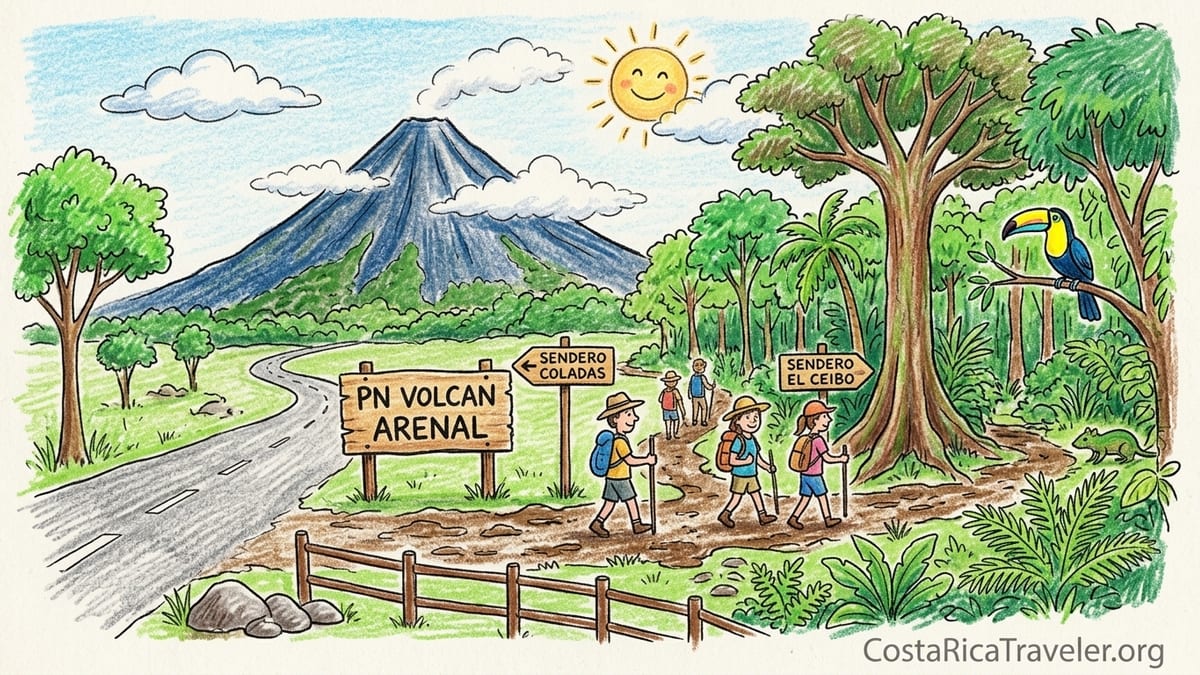
Just past the ticket window, a ranger offered laminated trail maps for reference while she explained the main official routes. The Coladas trail was listed at around 1.7 kilometers one way, leading through secondary forest and over old lava flows to a main volcano viewpoint. El Ceibo was noted at about 2.3 kilometers, forming more of a loop through denser forest with a massive ceiba tree as its star attraction. Both were clearly marked as official SINAC trails, with a network of signed viewpoints branching off. I confirmed that I could combine both trails in a single visit and return to the parking area without needing to retrace every step.
Before walking away from the building, I used the restrooms and filled my bottle from the sink to top up the water I had brought. There is no potable water available once you are out on the trails, and no snack kiosk inside the park itself, so anything you need for the next few hours has to be carried from the start.
Choosing a Route and First Steps on the Coladas Trail
My plan was to hike both Coladas and El Ceibo in a single continuous route, starting with Coladas while temperatures were cooler, then cutting over to El Ceibo on the way back. Based on the official distances and some recent trip reports, I expected to spend about three to three and a half hours on the trails at a relaxed pace, including time at viewpoints and stops for wildlife. I stepped off from the main trailhead at about 8:15 a.m., with a light daypack, one and a half liters of water, rain jacket, and a small dry bag for my phone and documents.
The initial section of the Coladas trail is surprisingly civilized. The path was wide, with compacted gravel and some concrete sections near the start. After a night of rain, there were damp patches but no deep mud in the first few hundred meters. Boardwalk-style planks crossed the wettest low spots. The forest here is second-growth, with thin trunks and plenty of undergrowth, and the soundscape at that hour was a mix of cicadas and distant calls of motmots and tanagers.
About 20 minutes in, the trail surface changed. The gravel petered out, replaced by a more natural dirt path reinforced with roots and stones. The previous night’s storm had left the soil slick. In the flat stretches, the mud was just enough to cake onto my boots. On the small ascents, particularly where old lava rock formed natural steps, the mud became a slick film over uneven surfaces. I was grateful that I had chosen mid-cut hiking shoes with good tread instead of trail runners with smoother soles. One couple in lightweight sneakers ahead of me moved cautiously and used a simple wooden walking stick they had picked up at the trailhead to steady themselves.
The Coladas trail gradually climbed toward the lava flow area, with occasional signed spurs to viewpoints. When the forest canopy thinned, I could feel the heat building, even though the sun was mostly behind high clouds. Humidity was intense; within half an hour, my shirt was soaked with sweat. I slowed my pace deliberately, accepting that this was not the place to “make good time” and that frequent water sips were necessary.
Reaching the Lava Fields and Volcano Viewpoints
The character of the trail changed again as I reached the lava flow zone. The soil gave way to rough, jagged blocks of old lava, stacked and scattered like broken charcoal. A series of uneven rock steps climbed to a main viewpoint. In dry conditions these rocks would still demand careful footing. On my visit, each crevice held a bit of water and green moss, and the mud on my soles made every step slightly less secure. I used my hands a couple of times, bracing on larger rocks to keep my balance, and was glad to have closed-toe shoes rather than sandals.
At the principal viewpoint, around 40 to 45 minutes from the park entrance at my pace, Arenal Volcano stood almost directly in front of me. The lower half of the cone was crystal clear, its flanks striped with old lava scars amid thick vegetation. The upper cone, however, slid in and out of cloud. For a few precious minutes, the wind shifted and peeled back the cloud layer, revealing the summit with its sharp profile against a pale blue sky. Then the mist rolled back in, erasing the top as if someone had cut it away with a soft gray brush.
From the same viewpoint, I could see toward Lake Arenal in the opposite direction. Patches of blue water flashed between folds of green hills. On a cloudless day this must be spectacular. In the mixed conditions I had, the scene felt more intimate and moody, with light shafts occasionally piercing the clouds to highlight one finger of the lake at a time. The air was still, and the heat on the dark rocks was palpable. Even with cloud cover, standing there felt at least a few degrees warmer than on the shaded forest trail.
Level-headed expectations helped. In the weeks before my trip, I had seen recent visitor photos where Arenal was completely hidden all day, the cone just a dark suggestion behind solid cloud. Compared to those stories, I felt lucky to have any summit view at all. I stayed at the lava viewpoint for about 20 minutes, enough time to watch the cloud dynamics and drink a good portion of my water before heading back down toward the forest and the junction for El Ceibo.
Into the Forest on El Ceibo and Actual Wildlife Sightings
Back at the signed junction, I turned onto the El Ceibo trail, which immediately felt quieter and more enclosed. The path narrowed slightly and the canopy closed overhead, muting the sound of distant tour groups that occasionally drifted across the lava. The surface here alternated between compacted soil and sections of embedded stone, with more frequent mud patches than on the early part of Coladas. Wooden steps reinforced a few short, steeper slopes, and some of these were slick enough that I stepped on the side edges where roots gave better traction.
The first noticeable wildlife encounter was sound rather than sight. About 15 minutes along El Ceibo, a series of deep, guttural roars rolled through the trees. A small group ahead of me stopped, visibly startled. The ranger at the entrance had warned us that howler monkeys create an impressively dramatic soundtrack, especially on humid mornings. Sure enough, as we waited quietly, I spotted a small troop moving through the canopy, dark shapes leaping between branches. They were too high and backlit for clear photos, but seeing them silhouetted against the pale sky was still memorable.
Birdlife along El Ceibo rewarded this slower pace. On one stretch I watched a keel-billed toucan hop between two leafless snags, its beak impossibly bright against the gloom of the understory. A pair of Montezuma oropendolas flashed chestnut and yellow as they glided overhead, their nasal gurgling calls echoing faintly. Closer to the ground, a small brown agouti darted off the trail edge, pausing just long enough for me to notice its oversized hind legs before disappearing into the foliage.
Reptiles were present, though subtle. In a sunny patch where the canopy briefly opened, a striped basilisks lizard froze on a rock beside the trail, banking on its camouflage. I nearly stepped past it before noticing the eye. I did not see snakes on this particular visit, though other hikers I spoke with at the parking lot later had seen a small, non-venomous species near the trail margin. Insects were a constant; small biting midges appeared whenever I stopped for more than a minute in shaded, windless spots. A light layer of insect repellent proved invaluable here.
Heat, Humidity, and How Long the Route Took
By the time I reached the massive ceiba tree that gives the El Ceibo trail its name, it was nearing 10:00 a.m. The ceiba’s buttress roots flared like fins, and the trunk was so wide that even a large group would struggle to encircle it with joined hands. Standing still in that clearing drove home how thick the air had become. Even without direct sun, the combination of high humidity and moderate exertion had me sweating steadily. I wrung out my bandana and took a longer break than planned, leaning against one of the roots and sipping water while a guided group arrived behind me for their own photos.
This was the hottest stretch of the day. Temperatures in the La Fortuna area frequently reach the high 20s to low 30s Celsius by late morning. Inside the forest there is shade, but very little breeze. My total fluid intake on the hike ended up just under two liters, and I could happily have used more. Anyone sensitive to heat should consider starting as close to 8:00 a.m. as possible or even building the visit around a cooler, slightly overcast day if their schedule allows.
From the ceiba, the trail gradually looped back toward the main path that returns to the parking area, with a few modest ups and downs. I made occasional short stops whenever I felt my shirt drying, a sure sign that I was not drinking enough. The mud on this closing section was manageable but persistent. In more than one place, I stepped on what looked like firm ground only to sink a few centimeters and hear the soft squelch of waterlogged soil. My shoes and the lower part of my hiking pants ended up uniformly speckled in brown. I saw at least one visitor in white sneakers lamenting their now permanently stained footwear.
I arrived back at the parking lot at about 11:25 a.m., roughly three hours and ten minutes after starting, including all my viewpoint stops, wildlife watching, and short rest breaks. A fit hiker who keeps a steady pace and does fewer photo stops could comfortably combine Coladas and El Ceibo in about two and a half hours. Guided groups, especially those focused on nature interpretation, often take closer to four hours to complete a similar circuit.
Footwear, Gear Choices, and What I Would Change Next Time
For this visit I wore mid-cut waterproof hiking shoes with a moderately aggressive sole, paired with thin synthetic socks and quick-dry hiking pants that could roll up to mid-calf. Overall, this turned out to be a solid combination. The shoes protected my feet from the sharp edges of lava rock on Coladas and the embedded stones on El Ceibo, and the ankle coverage gave helpful support when stepping between uneven blocks. The waterproofing was useful in shallow puddles, although in the tropical humidity my feet still felt warm and damp inside by the end.
A few hours of muddy trail taught me what I would fine-tune on a return visit. First, I would bring slightly taller, more breathable hiking socks instead of ankle-length ones. On this trip, bits of grit and small plant debris occasionally slipped between the low sock and the shoe collar, especially on the rockier sections, leading to minor irritation. Second, I would consider trail shoes with excellent drainage during the drier season, accepting wet feet in exchange for cooler, quicker-drying footwear, particularly if rain was forecast. On a truly rainy day, a lightweight gaiter would be handy to keep mud from splashing up into the tops of low shoes.
I carried a small, packable rain jacket which I did not end up needing. Around Arenal, showers can roll in quickly, so I still consider that extra 200 grams of weight worthwhile. A wide-brimmed hat turned out to be more valuable than I expected. Even when the summit was hidden, sections of the lava field and some forest clearings offered full exposure, and the tropical UV index is high enough that sun protection is non-negotiable. Sunscreen and insect repellent both saw heavy use; the former for exposed stretches, the latter for shaded pauses, especially along El Ceibo.
One item I wished I had brought was a lightweight trekking pole. Although the trails are short in absolute distance, the combination of slick mud, irregular steps, and hot, humid air made balance more of a factor than I anticipated. Several hikers with simple aluminum poles from local outdoor shops in La Fortuna seemed to be having an easier time descending from the lava viewpoint, especially those less comfortable on uneven terrain.
Weather, Crowds, and Managing Expectations
Arenal’s weather is famously fickle. During my visit, the day began with high overcast and partial views of the volcano. By late morning, thicker clouds had rolled in, and by the time I drove away just after noon, the cone was completely hidden. Other travelers I spoke with in La Fortuna reported the opposite pattern on their days there, with opaque morning clouds that broke open for dramatic late-afternoon clearings. The key lesson is that no particular hour guarantees a view, so your best bet is to build flexibility into your itinerary, perhaps visiting the park one morning and planning viewpoints from town or hot springs on other days to increase your chances.
Crowds followed a predictable rhythm. From 8:00 a.m. to about 9:30 a.m., the park felt calm. I passed only a handful of independent hikers, and the lava viewpoint never felt crowded, with plenty of space along the rocks for everyone. Around 10:00 a.m., groups from La Fortuna hotels and tour operators began to arrive more frequently. Guides gathered small clusters of visitors to point out birds and explain the history of Arenal’s eruptions. The trails did not feel congested in the way of some coastal parks, but the quiet forest soundtrack was occasionally replaced by overlapping conversations in English, Spanish, French, and German.
If solitude is a priority, arriving right at opening time remains your best tactic, even in the busier dry months. The park’s official closing time of 4:00 p.m. means that afternoon visits are possible, but the combination of heat and a higher chance of clouds building during the day may reduce the odds of a clear volcano view. On the flip side, late afternoon light over Lake Arenal can be beautiful, with softer colors and longer shadows across the hills, which some photographers may prefer even without a perfectly revealed cone.
As for wildlife, it helps to calibrate expectations. Arenal’s forests harbor impressive biodiversity, but on a typical mid-morning walk along these particular trails, you are more likely to hear howler monkeys than see them at close range. Birds and small mammals appear in brief windows. If your top priority is wildlife viewing, consider pairing a daytime hike in the national park with an early-morning birding walk or a night tour in a nearby private reserve. The park itself is better appreciated as a place to walk on official lava flows, understand Arenal’s volcanic story, and experience the landscape that frames La Fortuna’s famous hot springs.
The Takeaway
Walking the Coladas and El Ceibo trails in Arenal Volcano National Park from La Fortuna gave me a grounded sense of the place behind all the brochures. It is not a long or difficult hike in terms of distance or elevation, but the combination of mud, heat, and uneven volcanic terrain makes it more demanding than the numbers on the trail map suggest. The experience is defined less by summit panoramas and more by the textures underfoot, the sudden openings in the forest, and the small wildlife encounters that punctuate the walk.
From a practical standpoint, the logistics are refreshingly simple. You drive or take a short taxi from La Fortuna, park near the entrance, pay an admission fee that, as of this visit, is 15 US dollars for non-resident adults, show your identification, and start walking. There is no complicated reservation system to navigate, and the official trails are clearly signed and well maintained. The main variables you cannot control are the weather and your own preparation. Accept the clouds as part of Arenal’s personality, and invest a little thought into footwear, water, and timing, and you will likely come away satisfied.
On another visit, I would repeat the same basic route, with a few tweaks. I would start even closer to 8:00 a.m., carry at least two full liters of water, and add a lightweight trekking pole to help on wet rock. I would also build in an extra day in La Fortuna specifically as a “flex” day, to give myself another chance at both clear volcano views and a different mood on the trails. Arenal changes quickly, and that, ultimately, is the real lesson from hiking these paths: every walk here is a snapshot of a living, shifting landscape, rather than a fixed postcard scene.
FAQ
Q1. How long does it take to hike the main trails in Arenal Volcano National Park?
For a relaxed visit combining the Coladas and El Ceibo trails with time at viewpoints and short breaks, most independent hikers spend about three to three and a half hours on the trails.
Q2. Do I need to reserve tickets online in advance?
At the time of my visit, tickets for Arenal Volcano National Park were purchased directly at the entrance during opening hours, with no mandatory online reservation system in place.
Q3. What are the current hours and entrance fee for non-resident adults?
The park was open daily from 8:00 a.m. to 4:00 p.m., and the posted admission fee for non-resident adults was 15 US dollars, payable by card at the entrance.
Q4. What kind of footwear is best for the trails?
Sturdy closed-toe shoes with good grip are highly recommended, such as hiking or trail shoes, because sections of the Coladas and El Ceibo trails can be muddy and involve uneven lava rocks.
Q5. How visible is the volcano from the trails?
Visibility varies dramatically by day and even by hour; on some visits the cone is fully visible, while on others the summit is hidden in cloud, with only the lower slopes in view.
Q6. Is the hike suitable for children or less experienced hikers?
The distances are relatively short and there is no extreme elevation gain, but mud, humidity, and irregular steps can be challenging, so families and beginners should allow extra time and move at a cautious pace.
Q7. What wildlife might I realistically see during a morning hike?
Common sightings include howler monkeys in the canopy, various tropical birds such as toucans and oropendolas, small mammals like agoutis, and lizards; more elusive animals usually require longer or specialized tours.
Q8. Are there facilities like food, water, or shops inside the park?
Near the entrance there are restrooms and sinks, but once you are on the trails there are no food outlets or potable water sources, so you must bring all snacks and water you need.
Q9. How do I get to the park entrance from La Fortuna without a rental car?
Many travelers use local taxis or arrange transport through their hotel or a tour operator; the drive from central La Fortuna to the park entrance typically takes about 15 to 20 minutes on a paved road.
Q10. Is a guided tour necessary, or can I visit on my own?
You can easily visit independently by following the signed trails, but hiring a guide can enhance the experience if you are especially interested in learning about local wildlife, plants, and the volcano’s history.