


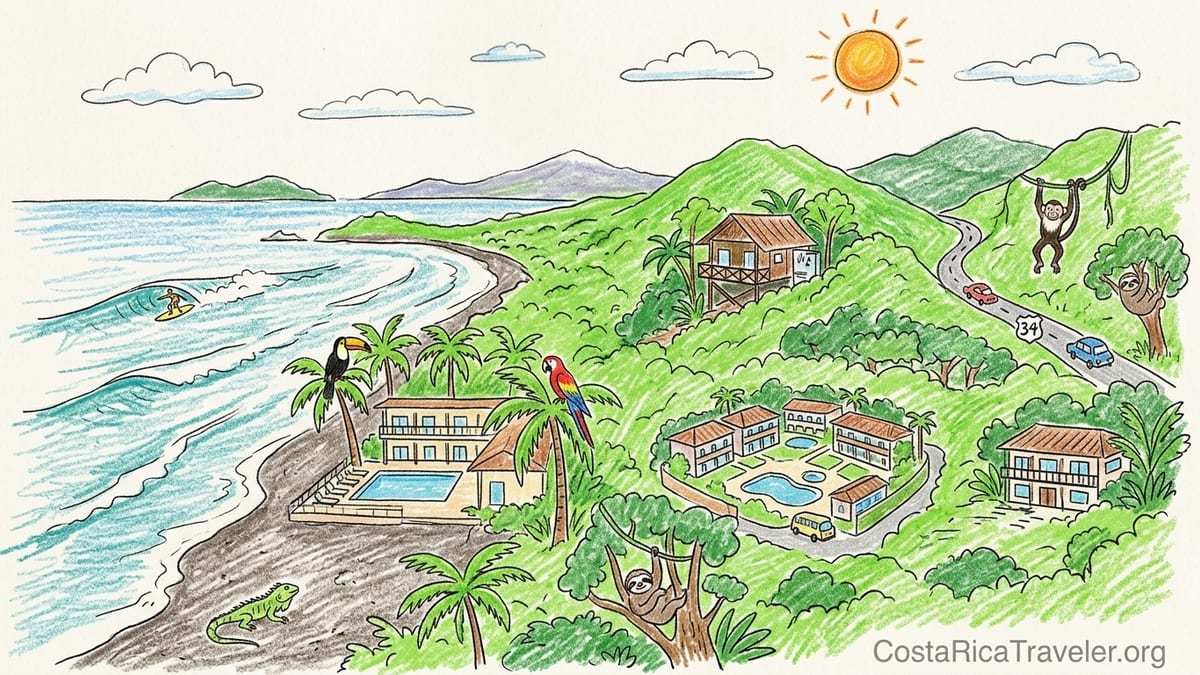
The Central Pacific coast of Costa Rica is compact on a map but very different on the ground. Manuel Antonio, Jacó, Playa Hermosa and the hills further south all promise jungle, ocean and wildlife, yet the way a hotel is built into that landscape can make or break your trip. Across several visits, I have stayed in jungle lodges up steep hillsides, beach hotels right on the sand, and full-scale resorts where you hardly need to leave the grounds. This guide focuses on the stays that actually worked, with clear notes on where I slept, what I saw, and when glossy marketing did not match reality.
How I Chose These Central Pacific Stays
Before diving into specific hotels and resorts, it is important to understand what “personally tested” means here. Every property labeled as such is a place where I booked a room, checked in, slept at least one full night and used core facilities like the pool, restaurant and common areas. I paid regular published or promotional rates, booked either directly or through major booking platforms, and experienced the hotels in the same way most travelers would. When a hotel is mentioned purely based on research, you will see it clearly marked as research-only, without invented claims about room feel or service.
The area covered is Costa Rica’s Central Pacific coast, roughly from the Jacó and Playa Hermosa surf zone down through Manuel Antonio and the low hills that roll south toward Dominical and Uvita. This corridor combines easy access from San José with national parks like Manuel Antonio National Park and coastal wildlife refuges, along with established resort areas such as Herradura Bay and the Los Sueños complex, which the Costa Rica Tourism Board highlights as conference and resort hubs for this region. Drivers generally access the area from San José over Highway 27 and then Route 34, with paved but sometimes potholed local side roads up into the hills.
Conditions vary fast with weather and season. The dry season, approximately December to April, means blazing sun, hotter rooms and better sea views, while the rainy season, April or May through November, brings lush foliage, more insects and persistent humidity. When I write about humidity, air-conditioning struggles or slippery paths, assume this is based on stays in the wetter part of the year. All price ranges mentioned are approximate and checked against recent booking engines and hotel descriptions in late 2026, but they can shift with demand and currency changes.
Finally, expectations matter as much as star ratings. A hillside jungle lodge with an open-air bathroom and cool-water shower can be spectacular if you are prepared, but miserable if you were expecting a sealed, climate-controlled seaside resort. This article is organized by travel purpose rather than town or ranking to help you match your expectations to the right kind of property.
Best Beach Stay: Hotel Club Del Mar, Jacó (Personally Tested)
For a true toes-in-the-sand base that still lets you dip into restaurants and services, my best overall beach stay in the Central Pacific has been at Hotel Club Del Mar, at the quieter southern end of Jacó. The property sits directly on a crescent of dark-sand beach framed by low cliffs, an area that both local tourism materials and surf guides describe as part of the Central Pacific’s main surf corridor, with consistent waves rolling in from the open Pacific. From my ground-floor room, it was under a minute’s walk across the pool terrace to the sand, without needing to cross a street or navigate public access stairs.
Rooms at Club Del Mar are larger than many standard Costa Rican beach hotels. My one-bedroom unit had a separate living area with a small kitchen, a bedroom with a king bed and a balcony facing the ocean. The bed had a firm but comfortable mattress with clean, medium-weight linens that handled the heat well. Air-conditioning came from a split unit in both the bedroom and living room; during a humid April stay, the system kept the bedroom properly cool overnight, though the living area ran a little warmer when afternoon sun hit the balcony glass. Humidity was still noticeable near the balcony door, where towels dried slowly, but not enough to make bedding feel damp.
The bathroom had modern tile, a glass shower and good water pressure, with plenty of hot water in the mornings and evenings. One practical detail that mattered after hours in saltwater was that the shower drained quickly. Many Central Pacific hotels struggle with slow drains in high humidity, but here the floor stayed dry and non-slippery between showers. Housekeeping replaced beach towels daily, and sand was cleared effectively from the tile floors, which minimized the gritty feeling that sometimes creeps into beach rooms.
Breakfast at the on-site open-air restaurant was included in my rate and rotated between plated gallo pinto with eggs and lighter options such as fruit and yogurt. Coffee was strong and refilled frequently. The pool is relatively small but nicely framed by palm trees and a low-rise terrace, and there is direct service from the bar and restaurant. The main trade-off is that, although the beach access is excellent, surf conditions in Jacó can be rough; local tourism materials and surf guides describe Playa Jacó and nearby Playa Hermosa as surf beaches with strong currents and inconsistent swimming conditions. On days with heavier swell, swimming felt safer in the pool than in the ocean, especially for children.
Best Wildlife & Nature Property: Si Como No Resort, Manuel Antonio (Personally Tested)
Manuel Antonio is the region’s poster child for wildlife, and the hillside Si Como No Resort has been my most successful stay when I wanted nature in the foreground without giving up comfort. The property is built in layers down a steep slope, with shuttles or stairs linking the lobby, restaurants and pools. My room sat in the mid-level cluster, with partial ocean views through dense foliage and an almost constant soundtrack of birds. Both personal stays and recent guest reviews highlight regular sightings of capuchin monkeys, iguanas and colorful birds in the trees around the pools and walkways, and I experienced the same. In the early mornings, I watched toucans and tanagers from the balcony railing without needing binoculars.
The standard room was not enormous but felt well proportioned: a king bed, a small sitting area and a balcony with two chairs. The mattress leaned firm and the pillows were mid-density, suitable for most sleepers. Air-conditioning came from a wall unit strong enough to cool the space, but because the balcony doors are traditional sliding glass with limited sealing, humid air crept in when I sat outside. Sheets occasionally felt slightly cool and damp at night, an unavoidable effect of the surrounding rainforest environment, rather than a housekeeping issue.
Water pressure in the tiled shower was moderate but steady, with reliably hot water morning and evening. The bathroom was ventilated through louvered windows that allowed in outside air and, with it, some humidity and jungle sounds. Guests sensitive to insects should note that, while the room itself remained largely bug-free thanks to screens and good housekeeping, the walkways and staircases attract beetles and moths at night, particularly in the wet season. The main adult pool has a small slide and is surrounded by lush planting; a separate family pool keeps the mood relaxed for couples and adults while still welcoming children.
Dinner logistics at Si Como No were better than at more isolated jungle lodges but still required a bit of planning. The in-house restaurant serves solid Costa Rican and international dishes at mid-to-high prices by local standards, with steak, fish and vegetarian plates. On nights when I did not feel like paying resort prices, heading to lower-road restaurants in Manuel Antonio required either a taxi or a fairly steep walk down, followed by an equally steep return in the dark. Because the hotel sits on the main ridge road rather than down at the beach, advertised proximity to the ocean is about the view and breeze, not easy sand access. It took me about 15 minutes and a bus or shuttle ride to reach the main Espadilla beach and the Manuel Antonio National Park entrance, which aligns with regional tourism guidance that hillside hotels here prioritize views over walkability to the sand.
Best Family Option: Parador Resort & Spa, Manuel Antonio (Personally Tested)
For families who want a contained resort with easy wildlife viewing, pools and on-site dining, Parador Resort & Spa on the Punta Quepos headland has been my most effective choice. Set at the end of a paved road on its own promontory, the resort occupies multiple buildings stepped down toward the ocean, surrounded by secondary forest. Both my stay and many recent traveler reports describe frequent sightings of capuchin and squirrel monkeys, sloths and iguanas around the lawns and canopy edges. One morning, a troop of squirrel monkeys crossed directly over the kids’ pool on overhead cables, which felt authentically wild rather than staged.
Standard rooms in the main building are not oversized but workably arranged for a couple with one child, with either a king bed or two queens. On a recent visit I had a garden-view room with a king, a sofa and a small balcony. The mattresses were a touch softer than elsewhere in the region, and the linens were clean and changed regularly. Air-conditioning kept the interior very cool even during a humid June afternoon, and double-pane sliding doors reduced jungle noise. Families with more than one child may want to book a suite or connecting rooms, which the resort offers in several wings.
Water pressure here was among the best I experienced in the Central Pacific. Showers had strong flow and quick transitions between hot and cold water. This mattered on days when we returned from Manuel Antonio National Park covered in sweat and sunscreen after walking the flat trails and beaches that park information materials describe as some of the country’s most accessible wildlife viewing routes. Towels dried within a day on the balcony, suggesting that the resort’s airflow and sun exposure help manage the otherwise relentless humidity found in this conservation area.
For families, the biggest advantage of Parador is that it reduces logistical friction. Buffet breakfast was included and extensive, with local dishes, pastries and fruit. Dinner could be taken at the main restaurant or a more casual poolside option, which meant we did not have to pile into a taxi with tired kids after sunset. The trade-off is that the beach is not directly out front. A small, more rugged cove is reachable by a forest path, but the main swimmable beaches such as Espadilla are a short drive away. Hotel shuttles and taxis can bridge that gap, but anyone imagining a run-straight-to-the-sand family resort should adjust expectations. Parking for rental cars is free and reasonably close to the main entrance, though during peak holidays it can feel crowded.
Best Car-Free Hotel: La Vela Boutique Hotel, Manuel Antonio (Personally Tested)
If you want to arrive in Manuel Antonio and not think about a rental car, La Vela Boutique Hotel, near the national park entrance, has worked best for me. The hotel sits just off the flat road that runs to the park gate and Espadilla beach, in an area that recent travelers frequently mention as one of the most walkable parts of the Central Pacific. From my room door, it was less than ten minutes on foot to both the official park entrance and the main public beach access, without significant hills. Buses and shuttles also pass nearby, connecting to Quepos and the rest of the ridge road.
Rooms are modern and compact, with clean lines, queen beds and sliding doors that open onto small patios or balconies. My ground-floor pool-view room felt slightly smaller than comparably priced hillside rooms but benefited from very efficient air-conditioning, likely helped by the more level, open-site layout. The queen mattress was firm and supportive, with crisp, light sheets that stayed reasonably dry even in peak afternoon humidity. Sound insulation was good for an open-plan, boutique property, though light sleepers may prefer upper floors away from the pool area.
The bathroom had a walk-in shower with rainfall-style head and moderate water pressure. Hot water was available but fluctuated slightly at peak times when multiple guests returned from the beach. The floor drained adequately, but without the strong slope of larger resorts, so I occasionally found small puddles around the toilet area if I did not manage the shower curtain carefully. Staff were quick to replace towels on request, which helped keep things fresh.
Where La Vela truly rewards car-free travelers is in evening convenience. Dozens of restaurants, ranging from casual sodas to more polished seafood spots, sit within a short walk of the hotel, so dinner never required planning a taxi. This stood in contrast to my evenings at steeper jungle properties further up the ridge, where coming and going at night meant negotiating steep grades in the dark. The pool area at La Vela is modest but inviting, and breakfast is served in a covered, open-air space where you can hear but not necessarily see wildlife from the adjacent trees. You will hear distant howler monkeys and see birds crossing overhead, but the hotel’s value lies more in its location and design than in on-site wildlife encounters.
Best Value: Hotel South Beach, Jacó (Research-Only)
For travelers focused on budget without giving up air-conditioning and a pool, a good value benchmark in Jacó is Hotel South Beach, which Costa Rica tourism listings and regional hotel guides describe as a beachfront, affordable option at the quieter southern end of town. I have not personally stayed here, so this section is based on recent research from booking platforms and official tourism materials rather than firsthand experience. You should treat it as a starting point rather than a definitive verdict.
Room descriptions suggest mid-sized units with either double or queen beds, private bathrooms and individual air-conditioning. Many recent guest reviews note that rooms are basic but clean, with beds on the firmer side. Published photos show tiled floors and simple furniture, the sort of straightforward beach hotel style that handles sand and wet swimwear better than carpet or heavy upholstery. Because I have not slept here, I cannot vouch personally for mattress comfort, noise levels or the actual feel of the air-conditioning during a humid night.
Where Hotel South Beach appears to shine is its balance between price and immediate beach access. Listings describe it as sitting directly on the sand near the southern curve of Jacó, an area identified in both local tourism documents and surf guides as less hectic than the town’s main northern strip. The pool faces the ocean, and the walk from most rooms to the water seems to involve only crossing a small garden and pool deck. Multiple third-party guides mention that parking is available on-site, a key detail for self-drivers wary of leaving cars on the street.
Rates in recent months for standard rooms in shoulder season have commonly appeared below the higher-end hillside hotels in Manuel Antonio and well under the nightly rates at full-scale resorts in Herradura and Punta Leona. However, because this is a research-based recommendation, I would encourage readers to cross-check current reviews for honest notes on water pressure, breakfast variety and any maintenance issues before booking.
Best Romantic Stay & Best Overall Resort: Parador vs. Punta Leona (Mixed)
Couples often ask whether to choose a classic Manuel Antonio view hotel or a more traditional resort complex further north. Having stayed twice at Parador Resort & Spa and visited the Punta Leona resort area in Herradura Bay on a day pass, my conclusion is that Parador still edges out as the best blend of romance and resort features for the Central Pacific, while Punta Leona and the neighboring Los Sueños complex work better for groups and golfers than for couples seeking a sense of seclusion.
At Parador, the more recent Ocean Vista and higher-category rooms provide notably better experiences for couples than the entry-level garden-view accommodations. On one stay in an upgraded ocean-view room, the king bed faced a large window framing the Pacific, with sunsets that justified the added cost in clear season. The room added floor space, a larger balcony and a slightly more substantial bathroom, with dual sinks and a more generous shower area. Air-conditioning performance was comparable to the standard rooms, meaning strong and cool, but the perception of space and view made evenings feel more like a private retreat than a family hotel.
The romantic value at Parador comes less from privacy in the absolute sense and more from the combination of wildlife, sea views and the option to retreat to adult-leaning corners such as the upper-level infinity pool. Couples who enjoy soft adventure can walk short forest trails on the property, then return to cocktails at the bar without arranging outside transport. The trade-offs are the same as for families: no direct swimmable beach out front, and a bus or taxi required to reach Manuel Antonio’s main sands except for the small, rocky cove accessed by trail.
By contrast, the Punta Leona resort area near Herradura Bay, referenced in several regional hotel guides as a major Central Pacific resort cluster, delivers more extensive beach frontage and easier road access but a less intimate feel. Day visits revealed long internal drives, large parking lots and high-rise or mid-rise buildings that looked more like a traditional resort complex than a jungle hideaway. While the beaches such as Playa Blanca are genuinely beautiful by Costa Rican standards, with lighter sand and calmer water, the experience from a couple’s perspective felt more like a family resort or convention property than a cocooned romantic stay. Since I have not overnighted inside Punta Leona, this comparison is limited to daytime impressions and cannot comment directly on room comfort.
Best Splurge: Tulemar Bungalows & Villas, Manuel Antonio (Personally Tested)
For a high-budget stay where the premium feels justified, my splurge pick in the Central Pacific is Tulemar Bungalows & Villas in Manuel Antonio. Spread across a private hillside reserve, the property offers individual bungalows and villas with sweeping ocean views and access to a semi-private beach. My stay in one of the original bungalows illustrated both the highs and the caveats of this type of experience, which has been praised for years in online forums as one of the region’s standout accommodations.
The octagonal bungalow had glass on several sides, a wraparound balcony and a bedroom with a king bed facing the sea. The bed itself was extremely comfortable, with a high-quality mattress and upgraded linens that felt a step above standard hotels in the area. Ceiling fans and air-conditioning worked together; even with humid June air outside, the interior remained dry and cool overnight. The open orientation does, however, mean more ambient noise from birds at dawn and from the occasional passing vehicle further uphill.
The bathroom was compact but well designed, with tiled surfaces, good water pressure and consistent hot water. One quirk of the hillside location is that water pressure can fluctuate slightly when multiple units are drawing at once, so I occasionally noticed a brief dip in flow at peak times, although it never dropped to an uncomfortable trickle. Towels and robes were thick and dried reasonably well on the balcony rails, suggesting that the airflow on this specific slope mitigates some of the region’s usual drying challenges.
Where Tulemar clearly earns its splurge label is the combination of service and setting. A private internal shuttle runs guests down a steep internal road to the small crescent beach, eliminating the need to navigate local public beach access points. The beach itself is calmer than Jacó or Playa Hermosa, with water conditions closer to those described for more sheltered Central Pacific coves. Monkeys and sloths are often visible in the trees along the internal roads and walking paths; during my stay, I saw both capuchin and howler monkeys at close range without leaving the property. Dinner can be taken at an on-site restaurant or ordered in from nearby establishments, but unlike at ridge-top hotels with only one dining outlet, the villa format makes it easy to stock a kitchen and self-cater some meals, reducing the sense of isolation at night.
The Takeaway: What Is Worth Paying Extra For?
After multiple trips and a mix of hillside, beach and resort stays, a few patterns stand out for the Central Pacific coast. The first is that you tend to pay a premium for two things that rarely come together in this region: a genuinely convenient beach and an immersive jungle setting. Properties built directly on popular surf beaches, such as portions of Jacó and Playa Hermosa, excel at access but often sit in more urbanized or open environments. Hilltop jungle lodges like Si Como No and Tulemar deliver wildlife and views, but the walk or drive to the beach becomes a daily logistical step rather than a casual stroll.
For travelers whose priority is the classic Costa Rica combination of wildlife and comfort without a car, the extra cost of places like Parador or Tulemar is usually justified. These properties provide on-site trails, frequent monkey and sloth sightings and resort-level infrastructure like strong air-conditioning, reliable hot water and multiple pools. They also offer shuttle services or internal transport that reduce stress on steep internal roads, something you do not always appreciate until you have driven up a rain-slick hill in the dark after dinner elsewhere.
On the other hand, if your main goal is to surf, walk the beach at sunrise and have simple, functional comfort rather than high-end finishes, then a more modest beachfront hotel such as Club Del Mar or a value-focused property in Jacó can be a better use of budget. In these cases, paying extra for a panoramic ocean view high on a ridge may feel wasteful once you realize that you spend most of your daylight hours at sea level. You might instead allocate that money to guided wildlife excursions inside Manuel Antonio National Park or further south around Dominical and Uvita, areas that regional tourism boards emphasize for their protected habitats and marine life.
Finally, couples seeking romance should think carefully about what that word means for them. If it is about private balconies and sunsets with good wine, then splurging on an upgraded view room at Parador or a bungalow at Tulemar makes sense. If romance for you is barefoot dinners in the sand and the sound of waves at night, then a simpler but well-positioned beachfront room, even with slightly older furnishings or less elaborate bathrooms, might deliver more satisfaction than a luxury hillside suite with a distant, postcard-perfect view.
FAQ
Q1. Is it worth renting a car for the Central Pacific coast, or can I rely on shuttles and taxis?
For Jacó and car-free friendly parts of Manuel Antonio near the park entrance, shuttles and taxis work well, especially if you choose walkable hotels like La Vela. For hillside properties spread out along the ridge, a rental car offers more flexibility for dinners and beach-hopping, though you should be comfortable with steep, narrow roads and occasional rain-slick conditions.
Q2. Which Central Pacific town is best if I want both nightlife and beach time?
Jacó is the most urbanized town on this stretch of coast, with the broadest selection of bars, casual restaurants and late-night venues, all fronting a long surf beach. Staying at the quieter southern end, around hotels like Club Del Mar, lets you access nightlife by a short taxi or beach walk while sleeping in a more relaxed pocket away from the noisiest blocks.
Q3. How humid does it really get in Manuel Antonio and nearby hills?
Humidity is high for much of the year, especially from about May through November, and you will feel it in slower-drying clothes, occasionally damp sheets and fogged windows. Well-built hotels use strong air-conditioning and good ventilation to manage it, but jungle-facing properties can never feel as dry and crisp as highland destinations such as Monteverde or San José’s outskirts.
Q4. Are monkeys and other wildlife around hotels a nuisance or a benefit?
In most Central Pacific hotels mentioned here, wildlife is a clear benefit as long as you respect distance and do not feed animals. Monkeys, sloths and birds provide memorable sightings from balconies and pool decks. The main nuisance factor comes from food; leaving snacks on open terraces will quickly attract raccoons or bold monkeys, so you should keep balconies tidy.
Q5. How important is ocean view when choosing a hotel in this region?
Ocean views can be spectacular, especially from hillside hotels in Manuel Antonio, and many travelers feel they are worth a moderate premium. However, if budget is tight, it often makes more sense to choose a smaller or non-view room in a well-located property and spend the savings on guided activities or extra nights, since you will likely be out exploring during many daylight hours.
Q6. Can I swim safely at all Central Pacific beaches mentioned?
No. Beaches like Jacó and Playa Hermosa near Jacó are known surf zones with strong currents and variable swimming conditions, and local surf guides emphasize caution. More sheltered coves around Manuel Antonio and some bays near Herradura can be gentler, but conditions still change with tides and weather, so you should always follow local advice and posted warnings.
Q7. What should I look for in a room if I am sensitive to noise?
If you are a light sleeper, prioritize rooms away from main pools, bars and road-facing sides of buildings. In hillside hotels, request upper floors or corner units to reduce foot traffic past your door. Double-pane sliding doors and solid walls matter more than marketing labels; recent guest reviews can be valuable for honest notes on party noise or early morning delivery trucks.
Q8. How reliable is hot water and water pressure in Central Pacific hotels?
In midrange and higher-end properties such as Parador, Si Como No and Tulemar, hot water and water pressure are generally reliable, with only occasional fluctuations at peak shower times. Budget and older hotels can have weaker pressure or slower water heaters, so if strong showers are important to you, it is worth checking recent reviews or contacting the hotel directly to confirm the system in your specific room type.
Q9. Do I need air-conditioning, or is a fan enough in this region?
Along the Central Pacific, especially at sea level and in low jungle hills, air-conditioning significantly improves comfort for most visitors, particularly at night. Ceiling fans alone can be sufficient at higher elevations or for travelers used to tropical climates, but if you struggle with sleeping in heat and humidity, choosing a room with efficient air-conditioning is a smart investment.
Q10. When is the best time of year to visit for fewer crowds but decent weather?
Transitional months like late April or early May and again in November often bring a mix of sunny mornings and some afternoon showers, with fewer crowds than peak dry-season months like January and February. Roads remain passable, wildlife is active in the lush vegetation, and hotel rates can be noticeably lower than during major holiday periods, making these shoulder seasons attractive for many travelers.