

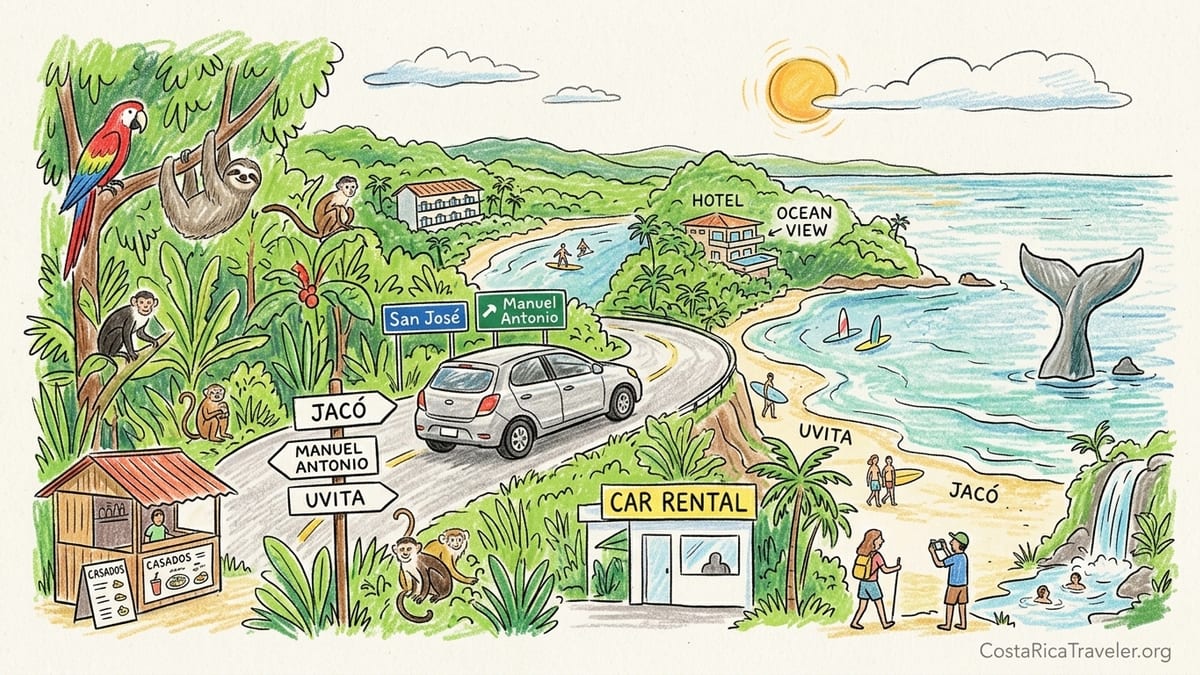
Central Pacific Costa Rica looks like a budget dream on paper: free beaches, cheap casados, and small national-park entrance fees. Yet my own road trip between Jacó, Manuel Antonio and the quieter stretches near Uvita in late 2025 ended up more expensive than I expected once beachfront rooms, guided wildlife tours and repeated paid activities stacked up. Below is exactly what I spent, where costs crept up, and how those numbers compare with current 2026 prices so you can plan a Central Pacific itinerary that matches your budget rather than surprises it.
Trip Snapshot: When, Where and How I Traveled
I based this cost breakdown on a 9-night Central Pacific trip I took as a couple in November 2025, shoulder season between the heaviest rains and the December holiday surge. We started with three nights in Jacó, continued with four nights in the Manuel Antonio and Quepos area, then finished with two quieter nights near Uvita on the southern edge of the Central Pacific region. All prices below are in US dollars, which is how almost everything was quoted on the ground.
We rented a compact automatic car out of San José International Airport, booked a mix of midrange hotels and apartments, and combined self-guided stops with a few key guided experiences. This was not a shoestring backpacker trip, but it also was not a luxury-resort vacation. Think modest ocean-view hotels instead of all-inclusive properties, local sodas instead of fine dining most nights, and shared tours rather than full-time private guiding.
Because travel prices in Costa Rica are rising, I have also added a short “current 2026 examples” section under several headings, especially national parks and popular activities, so you can see how my past spending compares with what you are likely to pay if you travel now.
The numbers you will see are real receipts and notes from that trip: specific nightly rates, tour prices, and gas station bills, each tied to a place and approximate date. Use them as a grounded reference point, then layer current price-checking on top when you book.
Getting Around: Car Rental, Fuel and Parking
We chose to rent a car because we were visiting three different bases along the Central Pacific. In mid November 2025, I booked a compact automatic through a major international agency at San José Airport for 9 days. The base rate was 24 dollars per day, but mandatory basic liability insurance, a small collision damage waiver, and taxes pushed the total to just under 54 dollars per day. The final bill at pickup on 10 November 2025 came to 486 dollars including airport fees.
Fuel costs were lower than I had feared but still noticeable. Over 9 days we drove roughly 520 kilometers between San José, Jacó, Manuel Antonio and Uvita, including day trips. We filled up three times at gas stations near Jacó, Quepos and Uvita. Each fill was between 22 and 28 dollars. The total fuel spend for the trip, based on receipts from 11 to 18 November 2025, was 74 dollars.
Parking costs varied widely by town. In Jacó, many hotels include gated parking and we never paid extra. In Manuel Antonio, our hilltop hotel had tight but free parking, yet we still paid for parking near the national park entrance on two mornings. The small private lots just off the main access road charged 5 dollars for half a day in November 2025, and we paid that twice for a total of 10 dollars. In Uvita, we paid a modest 2 dollars equivalent in colones to park at Playa Hermosa for one long beach afternoon.
If you prefer to avoid driving, current 2026 quotes for private shuttles give a sense of what that would cost instead. A private van transfer for up to four people between San José and Manuel Antonio is typically around 190 to 200 dollars one way in 2026, and San José to Jacó is often quoted around 140 to 160 dollars. For two people doing multiple stops, our rental car plus fuel came out cheaper overall, though it required more confidence on narrow, curvy roads.
Where I Slept: Beachfront, Hillside and Simple Lodges
Lodging was where my Central Pacific budget moved the most, driven largely by how close I wanted to sleep to the ocean. In Jacó, we booked a midrange hotel one block off the beach for 3 nights, 10 to 13 November 2025. The room was simple but had air conditioning, hot water and a small pool. The nightly rate with taxes was 96 dollars, for a Jacó total of 288 dollars.
In Manuel Antonio, I chose an ocean-view hotel on the hill between Quepos and the national park. The room looked out toward the Pacific through a tangle of jungle green, and monkeys crossed the power lines at eye level each morning. That view carried a price. Our four nights from 13 to 17 November 2025 cost 158 dollars per night including breakfast and taxes, for a total of 632 dollars. If we had stayed in Quepos proper or in a simpler lodge back from the main hotel road, we could have trimmed at least 40 dollars per night.
Near Uvita, we intentionally came back to earth. We booked a small cabin-style lodge set in the jungle about a 10-minute drive from Playa Hermosa. The room had a fan, screen windows and a shared open-air kitchen. Our two nights from 17 to 19 November 2025 were 72 dollars per night, or 144 dollars total. It was less polished than Manuel Antonio but felt refreshingly local and put us closer to how people actually live along the coast.
Across all three bases, our accommodation total for 9 nights was 1,064 dollars for two people, an average of about 118 dollars per night. The unexpected jump compared with pre-trip estimates came almost entirely from the Manuel Antonio segment, where that combination of ocean view, included breakfast, and wildlife in the trees added more than 150 dollars to what I had originally budgeted.
Eating and Drinking: From Resort Restaurants to Local Sodas
Food was another category where the Central Pacific region surprised me. Before the trip I imagined mostly inexpensive, open-air sodas and casual beach cafes. While those exist and are a great value, resort-style menus and imported ingredients can push meal prices close to North American levels, especially in Manuel Antonio.
In Jacó, our pattern was a cheap local breakfast, a simple lunch and a more comfortable sit-down dinner with drinks. For three days we spent roughly 15 dollars per person per day on breakfast and lunch combined, and about 40 to 45 dollars per couple for dinner including a beer or cocktail. The total food and drink spend in Jacó from 10 to 13 November 2025 was around 210 dollars.
In Manuel Antonio, the hilltop restaurants with ocean views were the real budget busters. One sunset dinner on 14 November 2025 at a popular view restaurant came to 68 dollars for two main courses, one shared appetizer and two cocktails. Even simpler restaurants on the main hotel road routinely ran 50 to 60 dollars for two with drinks. Over four nights, our combined breakfast (when not included at the hotel), lunches and dinners totaled about 420 dollars. We could have shaved that dramatically by eating more often in Quepos town, where casado plates at small sodas hovered between 7 and 9 dollars in late 2025 instead of 14 to 18 dollars for more dressed-up international plates in Manuel Antonio.
Uvita pulled costs back down. With access to a shared kitchen, we bought groceries at the main supermarket in town. Our receipt from 17 November 2025 shows 42 dollars spent on basics: fruit, bread, eggs, pasta, sauce, cheese, coffee and snacks. We supplemented that with two dinners out at a local soda near the highway, both around 22 dollars for two including juices. Our total food and drink spend in Uvita was around 90 dollars for two days.
Across the full 9-night trip, we spent approximately 720 dollars on food and drinks for two people. What raised the total was not the everyday casado or grocery run, but the cumulative effect of several resort-priced dinners in Manuel Antonio, plus cocktails at sunset that we had not really budgeted for ahead of time.
National Parks, Wildlife Tours and Guided Activities
The Central Pacific region is famous for its wildlife and national parks, and this is where we chose to invest. We visited two major parks on this trip: Carara National Park and Manuel Antonio National Park, and we paid for guided wildlife tours in both rather than walking alone.
At Carara, north of Jacó, we entered on the morning of 11 November 2025. Entrance for non-resident adults was 10 dollars per person plus value-added tax, which at 13 percent brought the total to about 11.30 dollars per person. For two people that made our unguided entrance fee just over 22 dollars, paid online in advance in line with SINAC’s ticketing rules at the time. Once inside, we hired a local guide waiting near the main trailhead. His rate was 40 dollars for a 2-hour bird and wildlife walk for both of us, which we paid in cash. Our total Carara visit including entrance, guiding and parking was roughly 65 dollars.
In Manuel Antonio, we decided to book a guided morning walk in advance because of the park’s reputation for dense wildlife. On 14 November 2025 we paid 60 dollars per person for a small-group guided tour booked through a local operator, which included the guide’s services and a transfer from our hotel to the park entrance. The park entrance fee itself was separate and purchased online. Non-resident adults currently pay 18.08 dollars including VAT to enter Manuel Antonio National Park, and that is the same amount that appeared on our tickets for that day. For two people, park admission alone was 36.16 dollars.
Adding the guided tour fee and admission, our total cost for that one morning in Manuel Antonio National Park was around 156 dollars for two people. It was a highlight of the trip and we saw sloths, white-faced capuchins, squirrel monkeys and motmots, but it was far from a budget line item. If we had walked the first part of the trail independently and focused our guiding budget on a single private wildlife guide instead of a full small-group tour, we might have reduced that cost.
For 2026 planning, it helps to know the current official park entrance prices. Manuel Antonio charges non-resident adults 18.08 dollars including Costa Rica’s 13 percent VAT as of late 2026. Carara charges 10 dollars for non-resident adults, with VAT applied on top at the time of purchase, and entry must be booked through the SINAC online system. Children under 2 years enter free as non-residents in both parks, with specific rules requiring a reserved zero-cost ticket.
Surf Lessons, Beach Days and Ocean Adventures
Between Jacó and Manuel Antonio, the Central Pacific coast is one of Costa Rica’s easiest places to learn to surf, and surf lessons were one of our favorite expenses. In Jacó, we booked a 2-hour beginner lesson on the south end of the beach on 12 November 2025. The surf school charged 55 dollars per person for a shared group lesson that included a board, rash guard and instruction. For two people we paid 110 dollars. That price lined up closely with what many Jacó surf schools still quote in 2026, where 2-hour group lessons commonly run between 50 and 65 dollars per person.
In Manuel Antonio, we opted not to repeat formal lessons but did rent a longboard directly on the public beach below the hilltop hotels. On the afternoon of 15 November 2025, we paid 20 dollars for a 3-hour board rental from a beach vendor, who accepted cash after a short round of friendly negotiation. That was slightly cheaper than Jacó’s shop-front rental prices, where multi-day board rentals continue to be around 25 dollars per day in 2026 at several schools along the main street.
Many of our beach days cost almost nothing besides meals and hydration. Playa Hermosa just south of Jacó, the main public beach in Manuel Antonio outside park boundaries, and Playa Hermosa near Uvita were all free to access when we visited in November 2025. Our only out-of-pocket costs on those days were parking in a couple of places and a few rented beach chairs. One set of two loungers and an umbrella on Jacó’s main beach cost 15 dollars for the afternoon on 11 November 2025, which felt high but included friendly watchful eyes on our belongings while we were in the water.
Other ocean adventures add up far faster. We did not fish on this particular trip, but current 2026 pricing from Central Pacific operators shows inshore fishing charters out of Quepos often starting around 650 to 750 dollars for a half-day private charter for up to four anglers, with offshore full-day charters starting well over 1,000 dollars. A shared boat is rare for serious sportfishing, so this is very much a splurge category rather than a casual add-on for budget travelers.
Mangroves, Waterfalls and River Rafting
On the nature side, we chose one mangrove tour and one rafting day rather than trying to squeeze in every activity on offer. This helped control costs and fatigue while still giving us a varied itinerary between beach time and river time.
The Damas Island mangrove estuary near Quepos is a classic Central Pacific experience. On 16 November 2025, we joined a shared afternoon boat tour departing from a dock about 20 minutes outside town. The operator charged 60 dollars per person, which included transportation from our hotel, the boat trip, an English-speaking naturalist guide and a simple post-tour snack. For two people our total was 120 dollars. The tour lasted about three hours on the water and we saw boas coiled in trees, herons, kingfishers and troops of monkeys using the mangroves as highways.
For river rafting, we drove inland from Jacó on 12 November 2025 to join a half-day trip on the Savegre River, booked through a local adventure outfitter. The rate at that time was 85 dollars per person for a shared raft that included transport, safety gear, a river-side fruit stop and lunch back at base afterward. For two people, the charge was 170 dollars, plus 10 dollars to rent a dry bag and pay for tips.
We also spent a half-day exploring waterfalls near Uvita. The entry fee to a locally managed waterfall property just outside town was 8 dollars per person in cash on 18 November 2025. There was no guide and only a short, moderately steep path to the falls, so our total cost for that outing was 16 dollars plus whatever we spent on smoothies afterward. As with the beaches, these simple, self-guided natural stops deliver a lot of value per dollar compared with fully packaged tours.
As of 2026, many mangrove boat tours in the Quepos and Damas area are still priced between about 55 and 75 dollars per adult, depending on inclusions and group size. Half-day rafting on the nearby rivers continues to cluster around 80 to 100 dollars per person. If you build several of these guided activities into a short stay, the cumulative bill can rival what you spend on accommodation.
What Really Pushed My Budget Higher
Looking back at the receipts, a few specific choices explain why this Central Pacific trip ended up pricier than the rough budget I had scribbled in my notebook before flying to San José. The first was choosing a view-focused hotel in Manuel Antonio. The jump from a functional room in Quepos or a simple cabin a little up the hill to a boutique hotel with a dramatic ocean view was about 60 to 80 dollars extra per night. Over four nights, that single choice added roughly 280 dollars to our total.
Second was opting for guided experiences in every major wildlife setting. I do not regret this, because guides opened our eyes to animals and plants we would have missed, but the cost impact was real. In Carara, the local guide fee of 40 dollars on top of entrance turned a modest park visit into a 65 dollar outing. In Manuel Antonio, our small-group guided walk plus entrance fees topped 150 dollars for one morning. Add the mangrove tour and the rafting, and our guided-activity bill for the Central Pacific portion alone came to more than 500 dollars.
Third was eating like we were on vacation a bit too often in Manuel Antonio. Those sunset restaurant bills between 50 and 70 dollars for two, with cocktails, compounded quickly. Simply substituting a couple of those dinners with meals in Quepos town or self-catered plates would have saved us about 120 dollars over the week without sacrificing much enjoyment.
Finally, we underestimated the appeal of repeating paid activities. After enjoying the first surf lesson in Jacó, we talked seriously about booking another the next day. In the end we rented a board instead, which saved money. But if we had followed our impulses on surf lessons, additional mangrove tours or an extra rafting day, our guided-activities budget could easily have doubled.
Where the Central Pacific Felt Like Good Value
For all of those splurges, there were also parts of this trip that delivered noticeable value. The first was the simple fact that almost every beach we loved was free to access. Walking for miles on Jacó’s wide, grey sand in the early morning, watching pelicans skim the waves at Playa Hermosa near Uvita, or ending a hot day with a swim at the public beach in Manuel Antonio did not cost anything beyond parking and whatever we chose to rent in terms of chairs or boards.
Self-guided stops also worked well for our budget. Carara is an excellent park to walk partly on your own after an hour or two with a guide, especially on the accessible main loop. Once our guide left, we continued exploring on our own without extra cost and still saw macaws and agoutis. The low-cost waterfall near Uvita was another standout example, where a simple local entrance fee opened the door to a half-day of swimming, photos and people-watching.
In terms of food, local sodas and small bakeries delivered some of the best value of the trip. On 16 November 2025, for example, we ate lunch at a soda in Quepos where two casado plates with chicken, rice, beans, plantains, salad and a natural juice each cost 18 dollars total for both of us. Compare that with the 60 dollar sunset dinner later the same day and you understand how quickly restaurant choices can shape your perception of Costa Rica’s value.
Finally, sharing tours helped. The mangrove outing and rafting trip were both in small groups of six to eight people, which kept per-person prices moderate while still offering a semi-personalized experience. A private mangrove tour or private raft would have roughly doubled the cost. For most travelers, small-group formats in the Central Pacific hit a good value-quality balance.
Current 2026 Examples and How My Costs Compare
Prices in Costa Rica continue to shift upward, so it is helpful to place my late 2025 spending alongside some current 2026 reference points for the Central Pacific coast. The most concrete numbers come from national parks. As of October 2026, Manuel Antonio National Park charges 18.08 dollars for each non-resident adult including VAT, and children between 2 and 12 years pay 5.65 dollars. Carara National Park charges 10 dollars per non-resident adult, with 13 percent VAT added at purchase, and requires online ticketing in advance for everyone including infants.
Surfing prices have not jumped dramatically. In 2026, many Jacó surf schools still post 2-hour group lessons in the 50 to 65 dollar range per person, with private lessons often between 80 and 110 dollars depending on timing and inclusions. Daily surfboard rentals around Jacó typically sit around 25 dollars, with multi-day discounts bringing the per-day cost down to the high teens if you commit to several days.
Mangrove tours and rafting in the Central Pacific mostly track general inflation. Shared Damas mangrove boat tours continue to cluster between 55 and 75 dollars per adult, sometimes including a meal, while half-day rafting trips on nearby rivers remain around 80 to 100 dollars per person. Operators sometimes offer small discounts for children or during shoulder-season weekdays, but those details change frequently and should be confirmed directly when you book.
Accommodation is the most variable category in 2026. Simple guesthouses set back from the beach in Jacó or Uvita still appear in the 60 to 90 dollar range for a double room with fan or basic air conditioning during shoulder season. Ocean-view boutique hotels in Manuel Antonio commonly quote 150 to 250 dollars per night for high season for similar rooms to the 158 dollars per night I paid in November 2025. If your budget is tighter, relocating just a few minutes inland or to Quepos town can still trim 40 to 80 dollars per night in 2026.
The Takeaway
When I add all the receipts from this 9-night Central Pacific Costa Rica trip, the totals are revealing. We spent about 1,064 dollars on accommodation, roughly 486 dollars on the rental car, 74 dollars on fuel, about 12 dollars on parking fees, around 720 dollars on food and drinks, and a little over 700 dollars on national-park visits and guided activities including surf lessons, mangrove tours, rafting and a waterfall visit. That puts the Central Pacific portion of the trip at around 3,050 dollars for two people, excluding international flights.
The categories that truly drove costs were ocean-view accommodation in Manuel Antonio, repeated guided wildlife and adventure activities, and resort-priced restaurant meals along the main hotel roads. In contrast, free beaches, low-cost local sodas, self-guided waterfall and viewpoint stops, and shared tours rather than private ones helped keep the budget from going even higher.
If I were planning this trip again for 2026, I would still rent a car and invest in a handful of excellent guided experiences. I would, however, rethink where I sleep and how often I dine with a sunset view. I would likely spend two or three nights in a simpler hotel in Quepos or further down the coast instead of four nights in a hilltop view property, saving several hundred dollars. I would keep one standout splurge dinner in Manuel Antonio but shift more meals to sodas in town or to self-catered picnics after grocery runs.
Most importantly, I would choose my paid activities deliberately instead of spontaneously adding them on. One national park with a guide, one mangrove tour, one rafting day and one or two surf sessions already make for a full, memorable Central Pacific itinerary. Everything beyond that should be treated as a conscious splurge, not a casual afterthought. With that mindset, the Central Pacific coast of Costa Rica can still feel like a fair-value destination in 2026, even as prices slowly climb.
FAQ
Q1. How much should I budget per day for a Central Pacific Costa Rica trip in 2026?
For a couple staying in midrange accommodation, renting a compact car and doing a few guided activities, a realistic 2026 daily budget is around 250 to 350 dollars per day excluding flights. Very thrifty travelers using buses, basic rooms and mostly self-guided activities can get closer to 140 to 180 dollars per day for two.
Q2. Is Manuel Antonio more expensive than Jacó or Uvita?
Yes, Manuel Antonio is usually the most expensive of the three because of ocean-view hotels and resort-style restaurants. Jacó and Uvita still have midrange and higher-end options, but they also offer more budget-friendly guesthouses and local sodas, which can keep overall costs lower if you choose them.
Q3. Do I really need a rental car on the Central Pacific coast?
You do not have to rent a car, but having one provides flexibility for beaches, waterfalls and small towns. With current 2026 shuttle prices between San José and Manuel Antonio or Jacó often near 150 to 200 dollars per vehicle each way, a rental car can be cost-effective for two or more travelers who plan to move between several bases.
Q4. How much do surf lessons cost in Jacó and Manuel Antonio now?
In 2026, group beginner surf lessons in Jacó usually cost between 50 and 65 dollars per person for 2 hours, while private lessons can range from about 80 to 110 dollars. Prices in Manuel Antonio are broadly similar, with some beach schools quoting slightly higher rates during peak holiday periods.
Q5. What are the current 2026 national-park entrance fees in the Central Pacific?
As of late 2026, Manuel Antonio National Park charges 18.08 dollars for non-resident adults including VAT, and Carara National Park charges 10 dollars plus 13 percent VAT. Children and residents have different, usually lower, fee structures and must also reserve online in advance.
Q6. Where can I save money on food along the Central Pacific?
You can save significantly by eating at sodas in Jacó, Quepos and Uvita, where complete casado plates often cost under 10 dollars, and by using hotel or guesthouse kitchens to prepare some meals. Limiting resort restaurants and sunset cocktail spots to a few special evenings can cut your food budget by hundreds of dollars over a week.
Q7. Are guided wildlife tours worth the cost in this region?
For many travelers, a guided tour in at least one major park is worth the expense. Guides in Carara and Manuel Antonio are excellent at spotting camouflaged birds, monkeys and sloths that most visitors would miss. If your budget is tight, choose one or two guided walks and explore additional trails on your own.
Q8. How much should I expect to spend on activities like mangrove tours and rafting?
In 2026, shared mangrove boat tours around Quepos usually run between 55 and 75 dollars per adult, and half-day rafting trips typically cost 80 to 100 dollars per person. Building several of these into a short trip can easily add 400 dollars or more to a couple’s total budget.
Q9. Is it possible to visit the Central Pacific on a backpacker budget?
Yes, it is possible if you are selective. Staying in hostels or simple guesthouses, relying on buses or shared shuttles where practical, eating mainly at sodas, and limiting paid tours to one or two key experiences can keep daily costs relatively low. Free beaches, inexpensive waterfalls and self-guided walks help stretch a backpacker budget.
Q10. If I want to splurge on just one thing in the Central Pacific, what should it be?
If you are choosing one splurge, consider either an ocean-view hotel night in Manuel Antonio or a standout guided nature experience such as a wildlife-focused morning in Manuel Antonio National Park or a mangrove boat tour. Both options deliver the kind of wildlife and scenery that make the Central Pacific memorable and justify spending a little extra.