


I have split my time in Costa Rica’s Central Pacific coast across both the classic dry months and the wetter green season, moving up and down the strip from Jacó and Herradura through Quepos and Manuel Antonio to Dominical. I went in February and March on one trip, then returned in late May and again in October on others. What I found is that the region does not behave like a single weather block, and that the official charts about “dry” and “rainy” season only tell part of the story. The way the sky behaves at 3 p.m. in Jacó is not the same as it does in Manuel Antonio or Dominical, and those differences ended up shaping my beach time, wildlife encounters, rafting days and even hotel bills.
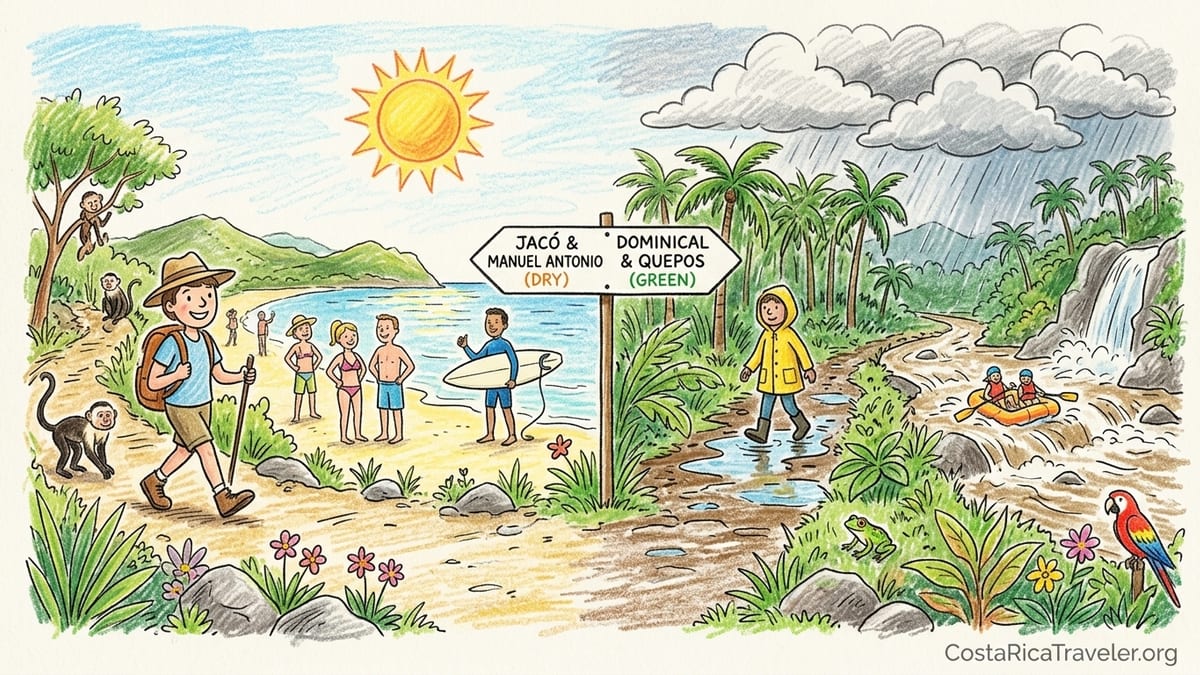
How the Central Pacific Seasons Actually Felt on the Ground
Tourism guides describe the Central Pacific as having a relatively short, moderate dry season from roughly January to March, with April acting as a transition month and wetter weather building from May onward. They also note that rainfall generally increases as you drive south from Herradura and Jacó toward Quepos, Manuel Antonio and Dominical. That broad picture matched what I experienced, but the lived reality was more nuanced than a simple “summer versus winter” split.
On my dry season trips in February and early March, I spent a week based in Jacó and Herradura, and another centered on Manuel Antonio. Skies were usually clear from sunrise until late afternoon. Across those weeks, I experienced perhaps three brief showers total, each lasting less than 20 minutes. Humidity was still high, but noticeably lower than later in the year, with sticky moments mainly when walking away from the ocean breeze in midafternoon. Sun exposure was far more of a concern than getting rained out.
By contrast, when I returned in late May and again in October, the pattern flipped. Mornings were often bright or at least bright-cloudy, but I could feel the air thicken by late morning, and towering clouds stacked over the mountains behind the coast. In May, I saw rain on five out of seven days around Manuel Antonio, usually starting between 2 and 4 p.m. and lasting one to two hours. In October near Dominical, heavy downpours arrived most afternoons and sometimes continued into the evening, with two nights of solid rain that never really let up. It never felt cold, but everything from clothes to camera straps seemed to stay slightly damp.
These conditions meant I had to think of the Central Pacific not as a place with a single “best month,” but as a coastline where the same activity can feel very different depending on whether you are in February in Jacó or October just south of Dominical. It also made me more strategic about early starts, backup plans and where to spend money on accommodations.
North of Quepos: Jacó and Herradura in Dry and Green Season
Jacó and neighboring Herradura, roughly two hours from San José, gave me the clearest sense of the Central Pacific’s split personality. In February, Jacó felt almost desert-like compared to the rainforest down the road. Daytime highs hovered around the upper 80s Fahrenheit, and away from the water the heat could feel intense, especially on the black sand of Jacó Beach in midafternoon. On my February week based there, I had six completely dry days and one tiny sprinkle that ended before I had time to put a cover on my daypack. Visibility on the coastal highway was excellent, and I never once hesitated to plan a full beach day.
Those dry months were perfect for lazy afternoons on the sand and sunset walks. Surf in Jacó Beach itself was manageable for beginner lessons, and nearby Playa Hermosa was delivering more powerful, organized sets that local surfers appreciated. With no runoff from upstream rains, the sea felt clearer, and I did not see the chocolate-colored plumes that appeared in May after heavy showers. In Herradura, boats headed out from the marina for sport fishing under nearly cloudless skies, and captains spoke of February and March as their most reliable window for flat seas and bluewater trips.
When I came back in late May, the same stretch looked and felt different. Mornings still started bright, but three of my six afternoons brought solid, drenching rain. One storm rolled in around 1:30 p.m. with a visible gray curtain racing down the valley behind town; within minutes, the highway surface had that glassy sheen that makes you slow down, and visibility dropped to the point where oncoming cars disappeared into spray a few hundred meters ahead. Each storm lasted about an hour, then faded to drizzle. By 4 or 5 p.m., the sky sometimes cleared enough for a muted sunset, but the beach never fully dried.
In those conditions, Jacó’s beach afternoons were more fragile. Twice I watched surf lessons cut short as instructors hustled boards and students off the sand under heavy rain and occasional low rumbles of thunder. Trails in nearby Carara National Park turned slick and muddy within a day of serious rain, though they remained walkable in hiking sandals if I accepted muddy calves. The upside was that hotel prices were significantly lower than what I paid in February. A simple midrange hotel room in Jacó that had cost around the equivalent of 140 United States dollars per night in dry season dropped to roughly 90 dollars in late May, and I could walk into many restaurants without a reservation.
South to Quepos and Manuel Antonio: Where “Green Season” Feels Truly Green
The further south I went, the more pronounced the wet-dry contrast became. Quepos and Manuel Antonio, often described as sitting in the heart of the Central Pacific, felt noticeably more humid and rain-prone than Jacó on every trip. In February and early March, I still enjoyed what most travelers would call ideal weather. Across about ten days split between those months, I saw rain only twice, both times late in the evening for less than half an hour. Mornings inside Manuel Antonio National Park were bright, with sun shafts cutting through dense foliage and capuchin monkeys warming themselves on exposed branches by 8 a.m.
During one early March visit, I walked both the main trail system and the side paths to Playa Gemelas and Playa Escondido without stepping in a single puddle. The ground felt packed and dry, and I did not need anything more than trail runners. Beach days at Playa Espadilla mostly ran uninterrupted from midmorning until 4 p.m., and the typical rhythm became park hike in the early morning, long beach swim and rest through midday, then a late lunch while watching macaws cross the sky overhead. In that season, the main constraint was crowding inside the park and on the main beach, not the weather.
By late May, that same area shifted into a different gear. Humidity felt heavy from breakfast onward, and the forest lived up to the “rain” in rainforest. On a seven-day stay, it rained in some form on six days. Four afternoons brought full tropical downpours that began around 3 p.m. and lasted one to three hours. Two others had shorter showers of 20 to 40 minutes. Trails that had been firm and dusty in March turned into a patchwork of slick red clay and standing water. On the steep steps down to some viewpoints, I was grateful for hiking shoes with real tread; more than once I watched flip-flop wearers hesitate or slide.
River conditions also transformed. In March, rafting the Savegre River gave me playful but moderate rapids, with water levels low enough that guides sometimes had to thread carefully through rocks. In late May, that same river swelled, with choppier, faster-moving water and a brownish tint from sediment. Guiding companies described May through November as their prime high-water months and sometimes shifted beginners from the more technical Naranjo River to the Savegre if levels rose too much. I enjoyed both seasons on the river, but the green season runs felt wilder and more immersive, with waterfalls on the canyon sides that had been dry in March suddenly roaring after an afternoon of rain.
Even Wetter Further South: Dominical and the Edge of the Southern Pacific
Driving an hour or so south from Quepos toward Dominical, the rainfall stepped up another notch, especially during my October stay. While official maps still group Dominical into the broader Central Pacific touring region, it behaves more like the northern edge of the very wet Southern Pacific. In early March, a three-night visit gave me two completely dry days and one brief late-afternoon shower that barely interrupted a sunset beer at a beach bar. The surf was powerful but clean, and beach access roads were dusty rather than muddy.
In October, however, Dominical was the place where I finally understood why locals speak respectfully about “October rains.” Over five days, I experienced rain every afternoon and night. Two days had lighter, on-and-off showers beginning around noon. Three others brought intense storms that swept in from the ocean with visible sheets of water, then lingered well into the evening. On the heaviest day, the rain started just after lunch and continued without a full break until sometime after midnight. Side roads to smaller lodges collected deep puddles that hid potholes, and one unpaved shortcut to a viewpoint became rutted enough that I chose not to attempt it in a regular rental car.
Beach time in that October window required flexibility. Mornings from about 7 to 11 a.m. could be gorgeous, with low golden light, mist rising off the tree line and only a handful of surfers out. After midday, though, storm clouds usually built, and by 2 p.m. I often needed to retreat under cover. Trails to nearby waterfalls were far muddier than in March, and river crossings ran higher and more opaque. Local guides kept a closer eye on river levels and would sometimes cancel late-afternoon waterfall trips if the water rose quickly, emphasizing that flash floods can be a risk in this shoulder between the Central and Southern Pacific.
The compensation for all that water was the landscape itself. Hillsides were an almost neon green, frogs called constantly at night, and I saw more birds active along the river edges than I had in the dry season. Accommodation prices reflected the weather risk. A simple room that had cost me the equivalent of around 110 United States dollars per night in March dropped to closer to 70 dollars in October, and guesthouses that had been close to full earlier in the year now had only a few rooms occupied midweek.
Humidity, Comfort and How the Weather Changed Day-to-Day Life
Looking back across these trips, humidity turned out to be as important as rainfall when it came to comfort. In February and early March, particularly in Jacó and Herradura, relative humidity still felt high by temperate-climate standards, but there were stretches of the day when it eased noticeably. Walking the length of Jacó Beach around 8 a.m. felt warm but manageable, and my clothes dried overnight on hotel balconies. Ceiling fans plus open windows were enough in a few places, and I sometimes chose rooms without air conditioning to save money.
By late May in Quepos and Manuel Antonio, the story changed. Even on mornings without rain, moisture hung in the air. Simple tasks like climbing the stairs from Quepos town up toward the ridge hotels had me sweating within minutes, and laundry never fully dried unless there was direct sun on the balcony. In one small lodge set back from the sea, the sheets felt slightly damp to the touch each evening, a common reality in the green season. Air conditioning went from optional to highly desirable, especially for sleeping well. I noticed that rooms with efficient air conditioning and good sealing commanded a clear price premium.
Road conditions and visibility also fluctuated in ways that mattered. In dry season, the drive from Jacó to Quepos was straightforward, with clear views and only occasional slowdowns behind trucks. In May and October, heavy afternoon rains sometimes turned that same stretch into a cautious crawl, with spray from other vehicles reducing visibility and temporary standing water forming in low spots. I learned to schedule most inter-town drives for the morning whenever possible and to leave earlier than the map suggested if an afternoon storm looked likely.
Surf and river color followed the weather closely. After multi-day dry stretches in February, the water at beaches like Manuel Antonio’s Playa Espadilla and Jacó looked relatively clear, with a green-blue tone near shore. After an October night of serious rain in Dominical, the ocean took on a brownish cast near the river mouths, and floating debris appeared more frequently. On those days, I timed my swims away from where rivers entered the sea and spoke with local surf shops about any water quality concerns.
Crowds, Prices and How Season Changed the Human Landscape
The seasons did not just reshape the sky and sea; they changed who else was around and how much I paid. During February and early March, especially around Manuel Antonio, the Central Pacific felt busy in a way that matched its status as a peak tourist season. Manuel Antonio National Park required advance reservations for my chosen days, and the main trail could feel like a slow-moving procession by 9 or 10 a.m. Beachfront restaurants filled up around sunset, and some of the better-known hotels along the ridge above the park were close to full, with nightly rates reflecting that demand.
Over Christmas and New Year on a separate dry-season visit, the busyness reached another level. Quepos streets were full of cars searching for parking, and the road from town to the park backed up significantly in the midmorning heat. Locals talked about holiday weeks and Easter as periods when they themselves avoided Manuel Antonio if they could. During those peaks, basic rooms that might cost the equivalent of 120 to 180 United States dollars per night at other times of year jumped noticeably higher, and some smaller guesthouses only offered multi-night minimums.
In late May and October, the atmosphere was very different. Around Jacó and Manuel Antonio, I repeatedly found last-minute availability for midrange hotels and could often negotiate small discounts in person for stays of three nights or more. Rafting outfitters on the Savegre and Naranjo Rivers that had been booked solid in February now had multiple boats sitting ready in May, and small group excursions sometimes turned into effectively private trips. On one overcast May weekday in Manuel Antonio, I shared a long stretch of Playa Espadilla with only a handful of other people for an hour, something that would have been hard to imagine in February.
Restaurant pricing did not fall as dramatically as accommodation, but a few tour operators in Quepos offered shoulder-season promotions, such as slightly lower rates on sunset sails or package deals that bundled rafting with ziplining. Guides spoke openly about May and June and then September and October as periods when they valued every booking, with a slight bump again in July and early August when North American and European school holidays brought families despite the rain.
What I Personally Preferred, and What I Would Do Differently Next Time
After experiencing the Central Pacific in February, early March, late May and October, I could not pick a single best month, but I did come away with clear personal preferences. For a first-time visitor focused mainly on beaches, wildlife viewing in Manuel Antonio National Park and generally avoiding weather surprises, my own favorite conditions were in February and early March. I loved waking up to consistently clear skies, hiking dry trails in the park, then spending long afternoons by the sea without constantly watching storm clouds. The trade-off was that I paid more for rooms and shared key viewpoints and beaches with many other travelers.
For a more active, nature-focused trip centered on rafting, waterfall hikes and simply feeling the rainforest alive, I preferred the late May conditions around Quepos and Dominical. Yes, the humidity was heavier, and my boots and backpack straps stayed damp, but the rivers carried more water, side streams poured off the hillsides, and the forest vibrated with sound. Afternoon rains became part of the rhythm instead of an annoyance. With that said, I would avoid repeating my October timing for Dominical unless I were prepared to lose some afternoons entirely to relentless rain and potential road issues.
If I were planning again, I would structure my schedule differently between north and south. For Jacó and Herradura, I would target late January through early March and keep my time there shorter in the deepest green months, using it mainly as a stopover or surf base. For Quepos and Manuel Antonio, I would happily visit either in the dry season or in late May or even November, when the forest is lush but rains can be shorter and prices friendlier. For Dominical and the cusp of the Southern Pacific, I would prioritize the shoulder months on either side of the heaviest rains, such as March or November, rather than deep October.
I would also front-load my most weather-sensitive activities, such as national park hikes and offshore fishing, into the mornings even in the dry season, and reserve more flexible experiences, such as spa time or hanging around a café, for the hours when clouds typically build. Finally, I would budget more deliberately for air conditioning in green season and consider spending a little extra to stay somewhere with good drying space for clothing and gear, especially south of Quepos.
FAQ
Q1. Is January or February better for visiting Manuel Antonio and Quepos?
In my experience both months offered very reliable sunshine, but February and early March felt slightly drier, with almost no rain on my trips and very firm park trails. January can still have an occasional leftover shower from December, though many visitors hardly notice the difference.
Q2. How wet did late May actually feel on the Central Pacific coast?
Around Jacó I had rain on roughly half the afternoons in late May, usually showers of 45 to 90 minutes. Around Quepos and Manuel Antonio, it rained in some form on six of seven days, with several strong afternoon downpours that turned trails muddy but left mornings mostly clear.
Q3. Is October really that rainy near Dominical?
On my October stay near Dominical it rained every afternoon and night over five days. Two days had intermittent showers, while three saw heavy storms starting soon after lunch and lasting well into the evening, which limited late-day beach time and made some side roads sloppy.
Q4. How did the surf and sea conditions change between dry season and green season?
In February and March, I found the surf around Jacó, Manuel Antonio and Dominical to be consistent but relatively clean, with clear water near shore. In late May and especially after heavy October rains, the waves carried more sediment near river mouths, the water took on a brownish tint in places and floating debris appeared more often, though the surf itself remained very surfable.
Q5. Were dry season hotel prices really much higher?
In Jacó and Manuel Antonio, I paid the equivalent of roughly 140 United States dollars per night for a simple but comfortable midrange room in February and early March. The same general standard of lodging dropped to about 90 dollars in late May and closer to 70 dollars in wetter October in Dominical, with more last-minute availability and occasional on-the-spot discounts.
Q6. Did afternoon rains ruin your beach time in green season?
Afternoon rains changed, but did not ruin, my beach time. In late May around Jacó and Manuel Antonio, I could usually enjoy the beach from midmorning until early afternoon before clouds stacked up, then retreat for a couple of hours while it rained. In October in Dominical, I learned to treat mornings as my main beach window and plan indoor or sheltered activities after lunch.
Q7. When did you find the best conditions for rafting on the Savegre and Naranjo Rivers?
My February run on the Savegre had friendlier, lower water and easier lines, good for nervous first-timers. In late May, both the Savegre and Naranjo carried more volume, with splashier rapids and faster currents that felt more exciting. Outfitters I spoke with favored roughly May through November for the most dynamic high-water runs, as long as levels stayed within safe limits.
Q8. How muddy did hiking trails get in green season?
In Manuel Antonio and around Dominical, trails that were dry and dusty in March became slick and patchy with standing water after several late May and October storms. I could still hike them in regular shoes, but I appreciated proper tread, and I finished most walks with mud splashed up to my calves. Boardwalk sections inside Manuel Antonio helped, but side trails were clearly wetter.
Q9. Did you ever have to change driving plans because of rain?
On paved main roads like the stretch from Jacó to Quepos, I mainly just slowed down during heavy afternoon storms when visibility dropped and water pooled in low spots. Near Dominical in October, I chose not to drive one unpaved side road to a viewpoint after a long day of rain left deep puddles and ruts. I never became stuck, but green season taught me to do more driving in the mornings.
Q10. If you had to choose just one month for a first Central Pacific trip, which would it be?
For my own travel style, I would pick early March if I wanted near-guaranteed sun, reliable beach time and easier logistics, accepting higher prices and more people. If I wanted a greener landscape, livelier rivers and lower rates, I would lean toward late May or November, but I would build in realistic expectations for afternoon rain and flexible plans.