

The Central Pacific coast of Costa Rica is often reduced to a single place name: Manuel Antonio. In reality it is a chain of very different bays, beaches, estuaries, and forests stretching from the crocodile-filled Tárcoles River down past Dominical. Over several trips I have surfed, rafted, hiked, drifted through mangroves, and simply watched the sun go down from quiet stretches of sand. Some things I would book again in a heartbeat. Others felt more commercial than magical. This guide focuses only on experiences I have personally completed in the region, organized by the type of experience rather than by town, with a clear verdict on what I would actually repeat.
Watching Wildlife Where It Actually Steals the Show
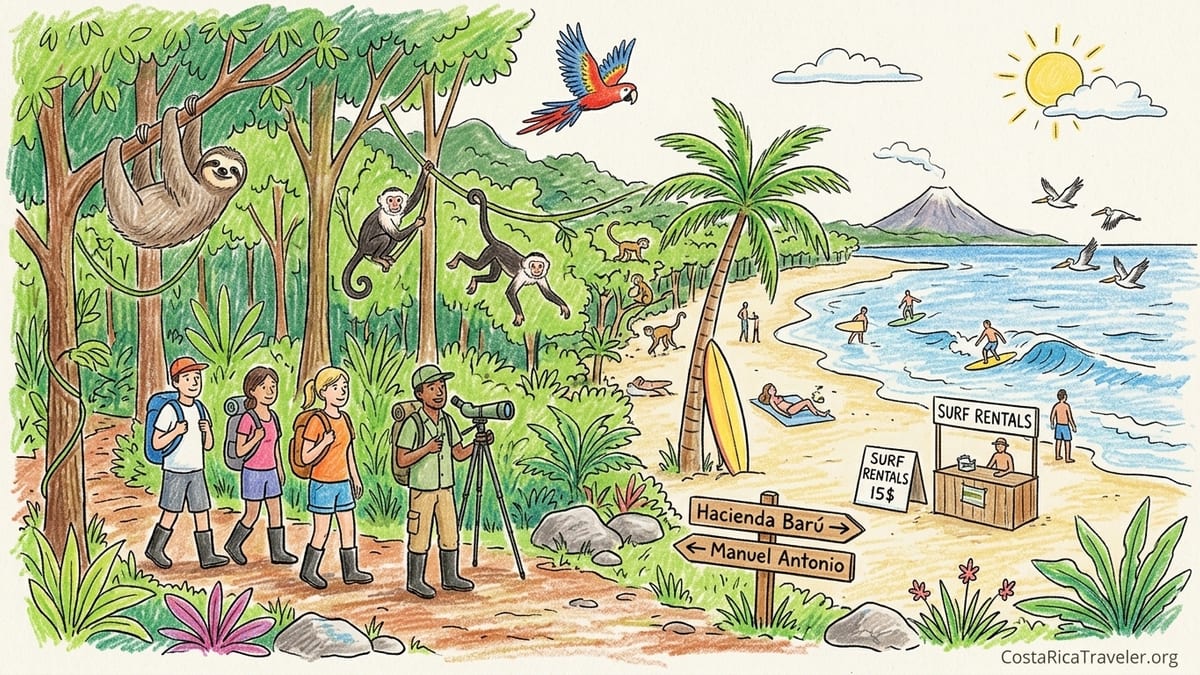
My best wildlife morning in the Central Pacific was not in a national park at all but at Hacienda Barú, a private wildlife refuge between Playa Dominical and Playa Guapil. I booked directly through the lodge’s reception the day before, paying around 40 US dollars per person for a three-hour early-morning rainforest walk in a small group of six. The equipment was basic but adequate: rubber boots available on request, the guide’s spotting scope, and simple binoculars to share. Our local guide was calm, patient, and obviously knew the trails extremely well, pointing out three-toed sloths, white-faced capuchins in the canopy, and an impressive list of birds while also allowing long stretches of quiet walking. Humidity was high after overnight rain and the clay trails were slick in places, but the physical effort was moderate and suitable for anyone comfortable with a few gentle hills. I would absolutely repeat this walk and recommend it to travelers who want wildlife without crowds.
By contrast, my first wildlife “big ticket” experience in the region was a guided morning inside Manuel Antonio National Park. I prebooked an official guided tour that bundled entrance ticket, transport from my hotel in Quepos, and the services of a certified guide. At the time I paid just under 70 US dollars per adult, which was in line with published bundled rates that include the park’s foreign-visitor entrance fee of around 16 US dollars plus tax, transport, and guiding. The group size was larger than advertised; instead of the promised eight, our group ended up being twelve people following a single spotting scope. The guide was extremely knowledgeable and very skilled at finding tiny frogs and camouflaged bats, but the experience felt slightly conveyor-belt: many guides lined up along the same stretch of paved trail, each in turn inviting their groups to look through the scope at the same sloth or iguana. Wildlife viewing was excellent, yet the atmosphere was crowded. I am glad I did this once, but next time I would skip the packaged tour, buy my own ticket, and walk the interior trails quietly, using other groups’ scopes only when invited.
Some of my most memorable wildlife moments were unscheduled and free. One afternoon I parked at the public end of Playa Espadilla Norte, the long beach just outside the Manuel Antonio park boundary, and walked north along the sand and tree line. Without any guide, and with no cost beyond parking a few hundred meters back on the road, I watched a troop of squirrel monkeys move through the trees over the sand, pelicans diving for fish in the surf, and an osprey hunting near the rocky headland. The physical effort was simply an hour or two of walking on flat sand, barefoot, with the Pacific on one side and fringe forest on the other. Compared with the paid, structured tour inside the park that morning, this free beach walk was more relaxed, less crowded, and almost as rich in wildlife. It is an experience I would repeat on every visit.
If you are serious about birding, I found inland foothill birding above Quepos more rewarding than the busy coastal trails. One dawn, I joined a privately arranged birding outing in the hills along the road toward Naranjito. The tour was coordinated through a small local guide recommended by my guesthouse, and I paid the equivalent of about 80 US dollars for a five-hour session for just two of us, including transport and the use of good-quality binoculars and a spotting scope. We birded quiet country roads and edge habitats overlooking cattle pastures and patches of forest. It was humid and required some uphill walking along gravel tracks, but nothing strenuous. The guide’s knowledge of calls and his ability to imitate them made the outing special. This low-key, rural edge-birding is exactly the kind of experience I would repeat, particularly because it spreads tourism income beyond the coast.
National Parks Beyond the Manuel Antonio Checklist
On my first trip I treated Manuel Antonio as the non-negotiable highlight of the region. I prebooked my timed entrance for mid-morning, which is required because visitor numbers are capped and tickets are only sold online through the national park system. I paid the official foreign visitor rate, then negotiated a guide at the entrance for an additional 25 US dollars per person in a loose group of five. The guide’s English was excellent, and he carried a good-quality scope. We spent about two and a half hours moving slowly along the main trails before being released to enjoy the beaches independently. The morning was very hot and humid, and even at a slow pace the combination of heat and frequent stops to crowd around scopes made the experience somewhat tiring. I enjoyed the chance to ask questions and get context, but in hindsight I would not pay for an additional on-the-spot guide again if I had already done one guided tour in the region.
On a later visit, I tried Manuel Antonio without a guide. I again prebooked the entrance ticket online, arrived at the park gate by 7 a.m., and walked straight past the unofficial touts who claim guiding is mandatory. Once on the trails, I simply followed the boardwalks and dirt paths toward the interior beaches, occasionally pausing near guided groups whose scopes were already trained on something interesting. I still saw sloths, agoutis, deer, raccoons, and lizards, along with plenty of shorebirds on the beaches. Because I was not bound to a group, I could spend longer on less crowded side trails and then settle on Playa Manuel Antonio for swimming and shade. This self-guided visit cost me only the official park entry fee, involved four to five hours of gentle walking and swimming, and felt more like a day in nature than a moving classroom. This is the approach I would repeat in future.
To balance all the attention on Manuel Antonio, I deliberately added another protected area in the Central Pacific: Carara National Park near the Tárcoles River. I arrived by rental car, paid the posted foreign visitor day rate in colones at the park office, and walked the universally accessible Araceas and Quebrada Bonita trails on my own. There was no additional guided fee unless requested, and trails were significantly quieter than Manuel Antonio. The habitat is transitional between dry and wet forest, and even without a guide I saw scarlet macaws flying overhead and several species of trogon. The equipment required was basic walking shoes, plenty of water, and a wide-brimmed hat. The weather was hot but less humid than further south that day, and the physical effort was an easy two-hour loop on mostly flat terrain. If your goal is forest immersion rather than a famous name, I would repeat Carara before paying again for a crowded guided tour in Manuel Antonio.
Across these visits, the pattern was consistent. Guided tours inside headline parks were fine introductions and made sense on a first visit or for travelers anxious about spotting wildlife. However, my most satisfying park days, and the ones I would repeat, involved either self-guided walks on official trails or guided visits to less famous reserves and refuges around Dominical, Quepos, and Carara. The Central Pacific’s breadth is real, and it rewards those who look beyond a single check-box park name.
Surfing & Simple Beach Days Along the Central Pacific
Surfing was my original excuse to head to the Central Pacific coast, and I started in Jacó, one of the region’s most accessible and developed surf towns. I booked a beginner lesson with a long-standing local surf school based on the main strip, paying around 55 US dollars for a group lesson that ended up being three students with one instructor. The package included soft-top boards, rash guards, and a quick theory session on the sand before spending about 90 minutes in the water. The waves that afternoon were waist- to chest-high beach break, water was bathtub warm, and currents were present but manageable under supervision. Physical effort was moderate to high because of repeated paddling and wading, especially for those with no prior surfing experience. The instructor was enthusiastic and focused on safety, but the beach felt busy and the experience leaned towards a standard tourist activity. I enjoyed it as an introduction and would recommend Jacó lessons for first-timers who value convenience. Personally, I would not repeat this exact commercial lesson now that I am comfortable renting a board on my own.
For a more relaxed surf session, I drove about 30 minutes south to Playa Hermosa, the stretch of coast known for more serious waves and surf competitions. Here I simply rented a board from a small beachside operation for roughly 15 US dollars for two hours, leaving a cash deposit and some basic contact details. There was no formal lesson, no insurance paperwork beyond a simple rental slip, and only a handful of other surfers in the water that mid-morning. Conditions were more powerful than Jacó, with shoulder-high sets and quicker takeoffs, which meant the physical effort and risk were both higher. This is not the right beach for first-time surfers, but for intermediate surfers the freedom to choose your own peaks and finish the session with a cold drink at a local soda felt perfect. I would happily repeat unstructured rental sessions at Playa Hermosa whenever I pass through.
Further south, beach time shifted from surf-focused to slow and scenic. At Playa Matapalo, between Quepos and Dominical, I spent a late afternoon walking along the endless dark sand with only a few local families around. There were no rental shops on the beach, no line of surf schools, just one or two modest rustic bars set back in the trees. Parking was free along the main access road, and my main equipment was simply a sarong and a dry bag. The sky that day was hazy with high cloud, which turned the sunset into a long, pastel show over the Pacific. The physical effort was minimal, and there was an almost complete absence of commercialization. Compared directly with paid tours earlier in the week, this simple beach walk was one of the most memorable experiences of the trip. It is exactly the kind of free, unstructured time I would plan more of in the future.
Even in busier Quepos and Manuel Antonio, unscheduled early-morning or sunset swims were often more satisfying than booked activities. One morning I walked down to Playa Biesanz, a small cove north of Manuel Antonio reached by a short downhill path from the road. Parking attendants asked for a small fee, equivalent to a few US dollars, which I paid. On the beach, I rented an old but serviceable sit-on-top kayak for an hour for about 10 US dollars, paddling slowly around the calm bay while brown pelicans glided by at water level. The operator was informal but friendly, with basic life jackets and no complicated waiver process. The bay was sheltered that day, and despite a light swell rolling in from outside, the paddle required low to moderate effort and was suitable for anyone comfortable on the water. I would repeat this low-key, semi-structured hour far more readily than I would book another crowded group catamaran cruise.
Mangrove & River Boat Trips: Close Encounters on Calm Water
My first dedicated mangrove experience in the Central Pacific was a Damas Island estuary tour from Quepos. I booked through a local operator recommended by my hotel and paid around 65 US dollars per person, which included hotel pickup, the boat tour, and a simple meal afterward. The group consisted of eight guests plus a bilingual naturalist guide and boat captain. The equipment was functional: a covered riverboat with bench seating, life jackets for everyone, and a basic flashlight for peering into the prop roots at dusk. We spent roughly two hours meandering through the narrow channels at high tide, spotting green herons, mangrove swallows, and a roost of night herons while white-faced capuchin monkeys moved overhead. The pace was slow, physical effort almost nonexistent, but the humidity and mosquitoes at sunset were noticeable. I would repeat this tour because it combined education and scenery without feeling rushed, though I would choose an even smaller boat or kayak option next time.
On another trip, I joined a more classic river wildlife excursion on the Tárcoles River, near the major bridge on the highway between San José and the Pacific coast. I booked a mid-morning outing directly with a well-known crocodile tour operator by phone the day before, paying about 35 US dollars per adult for a tour without hotel transport. Our group filled roughly half the covered boat, about fifteen guests total, accompanied by a captain and one bilingual guide. Life jackets were provided, and the vessel felt stable even when we leaned over the sides to photograph large American crocodiles on the sandbanks. The weather was hot but breezy on the water, and the physical effort was again minimal. While it was undeniably impressive to see very large crocodiles at close range, the tour also felt more commercial than intimate, with a rehearsed script and clear staging at regular crocodile-haunt stops along the river. I am glad I did it once as part of a transfer day, but I would not personally plan my itinerary around repeating this particular tour.
Between these two, the Damas mangrove experience felt more like entering a living ecosystem, while the crocodile tour felt more like a wildlife show on a set route. Both were safe, reasonably priced experiences that deliver on their promises. For travelers with limited mobility or very young children, these low-effort boat trips can be among the easiest ways to see wildlife in the Central Pacific. Still, if you are choosing just one, I would repeat the quieter mangrove canals over the more theatrical crocodile spectacle.
In contrast, one boat-based outing I would actively skip next time is the large afternoon catamaran cruise out of Marina Pez Vela in Quepos that I tried on an earlier visit. I purchased a ticket through a tour desk in town, paying close to 80 US dollars for a half-day cruise including snorkeling, a simple meal, and open bar on board. There were more than forty people on the boat, music was loud from the moment we left the marina, and any sense of being in nature was overshadowed by a party-at-sea atmosphere. The snorkeling stop, at a rocky islet offshore, was short and murky that day because of swell, and gear was basic but serviceable. For travelers who enjoy a social, party-style outing, this may still appeal, but for those seeking wildlife or seascapes it is a lot of money and time for a fairly generic experience. I would not repeat this particular style of boat trip in the Central Pacific.
Whitewater Rafting & Scenic River Valleys
Whitewater rafting on the Savegre River became one of the standout experiences of my time on the Central Pacific coast. I joined a full-day Savegre trip operated from Quepos, booked through a reputable local rafting company two days in advance. The price at the time was around 105 US dollars per person, consistent with current published rates for a package including hotel pickup, all equipment, a hot lunch, and a photographer following in a safety kayak. Our group left Quepos in a minibus just after 7 a.m., driving about an hour inland through oil palm plantations and forested hills before reaching the company’s river base. After a thorough safety talk, we were issued helmets, life jackets, and paddles, all in good condition. Guests were divided into rafts of five plus one river guide. Over roughly two and a half hours on the water, we navigated continuous class II and III rapids under a mix of sun and high cloud, with short breaks at calm pools and a waterfall stop.
The physical effort for this Savegre trip was moderate. Participants needed to be able to paddle strongly on command, hold stable positions in the raft, and clamber in and out on slippery rocks during the lunch break. That said, one older couple in our group with average fitness managed well under the guide’s direction. Water levels on our trip were mid-range at the end of the dry season, which meant exciting but not intimidating rapids. Guides were professional, tuned in to safety, and enthusiastic about the river’s natural history, pointing out kingfishers and herons along calmer stretches. I would readily repeat this exact outing, especially with friends or family looking for a shared adventure that feels wild but controlled.
A different rafting day on the Naranjo River, also accessed from Quepos, felt more intense and less likely to be something I would repeat. I booked through another local company, paying slightly less, around 90 US dollars for a half-day trip including transport and snacks. The Naranjo run we did was shorter than the Savegre, with about an hour and a half on the water, but the rapids that day were steeper and faster, pushing into the upper end of class III with a few class IV moves. Boats were smaller, with four guests and one guide, and the guides were again professional and well equipped. However, the river level was higher following recent rain, and the combination of stronger current and more technical maneuvers demanded sustained, high physical effort and good swimming confidence. I enjoyed the challenge but finished the day more drained than exhilarated. For strong paddlers this can be ideal, but for mixed-ability groups or families I would choose the longer, more moderate Savegre instead.
One of the unexpected benefits of both rafting days was the scenic drive into the river valleys. The shuttles wound through small agricultural communities, past roadside sodas selling coffee and empanadas, and into increasingly forested foothills. These transfers felt like bonus scenic drives through parts of the Central Pacific that many beach-only visitors never see. If you are not a rafter, it is still worth considering a guided waterfall or swimming-hole outing in these same valleys simply to enjoy the countryside. In any case, for pure value and memorability, the Savegre rafting day is one of the few high-ticket Central Pacific tours I would happily book again.
Sport Fishing & Marina Life Around Herradura and Quepos
Sport fishing is one of the big-ticket activities in the Central Pacific, particularly out of Los Sueños Marina in Playa Herradura and Marina Pez Vela in Quepos. On one trip I joined a half-day inshore charter from Playa Herradura that I split with three other travelers from my hotel. We booked through a small local captain whose details were posted on a board near the beach, paying about 130 US dollars per person for a shared four- to five-hour trip targeting roosterfish and snapper along the rocky coastline. The panga-style boat was basic but seaworthy, with a sunshade, life jackets, radios, and a modest selection of rods and lures. The captain and his mate were friendly, Spanish-speaking with enough English to communicate about techniques and species. Sea conditions that morning were calm with a light swell and scattered clouds, and the physical effort was low to moderate; most of the time was spent waiting on lines or reeling in when we got a strike.
We landed a couple of small snapper and one decent jack, which the crew filleted so we could take some back to our hotel restaurant. The experience felt personal and local, without the polish or higher price of the large sport-fishing yachts. For travelers who like time on the water and do not need luxury fittings, this sort of modest inshore charter can be rewarding and is an experience I would repeat, particularly if shared with friends to keep the cost manageable. That said, it is still a relatively expensive outing compared with a day of self-guided beach time.
In Quepos, I tried something at the other end of the spectrum: a heavily marketed shared offshore trip from Marina Pez Vela, sold through a tour desk in town. I paid close to 300 US dollars for a full day on a larger sport-fishing boat with a capacity of about twelve anglers plus crew. The equipment was top-notch, from heavy trolling rods to fighting chairs, and the crew was extremely professional. We ran several hours offshore in search of sailfish and mahi-mahi, burning significant fuel in the process. The day was mostly blue water and trolling, punctuated by bursts of action when a fish hit the spread. I enjoyed learning from the crew, but with so many anglers on board, each person only had one or two real chances on the rods, and the atmosphere occasionally slipped into competition over turns. The physical effort for guests was low most of the time but high during the brief moments of fighting a fish.
While it was impressive to see sailfish leaping behind the boat, the overall value equation felt skewed. Between the long, exposed travel time at sea, the crowded rail, and the high price, I left feeling satisfied to have done it once but not eager to repeat it. For most travelers, I would recommend either a smaller, shared inshore charter like the one from Playa Herradura or simply an evening stroll around the marinas to watch the boats return and enjoy a drink with a view, instead of committing a large portion of a travel budget to a single offshore day.
Scenic Driving & Rural Tourism Between Beach Towns
One of the under-appreciated pleasures of the Central Pacific region is simply driving the coastal and inland roads, stopping often. On my last trip I rented a compact SUV in San José and drove the main coastal highway, with spur roads into smaller communities, over the course of a week. The base daily rental rate worked out to around 45 US dollars before insurance, and fuel costs were moderate. Having my own wheels allowed me to link a sequence of short drives and informal stops that collectively became some of the most rewarding experiences of the trip.
South of Jacó, I turned off repeatedly toward lesser-known beaches, following signed roads to Playa Bejuco, Playa Esterillos Oeste, and Playa Dominicalito. At each I paid either nothing to park along the public road or the equivalent of a few US dollars to a local attendant watching cars under palms. The beaches varied from broad, nearly empty stretches of dark sand lined with coconut palms to rocky pocket bays with small clusters of fishing boats. There were no guides, no fixed schedule, and no tour prices, only the cost of fuel and modest parking. Physical effort was limited to short walks along sand and occasional scrambles over tidepool rocks. Compared with the time and money invested in large organized tours, these unstructured coastal stops delivered a stronger feeling of discovery and connection to everyday coastal life. These are exactly the sorts of experiences I plan around when I return.
On another day, I drove inland from Quepos toward San Isidro de El General, following a winding paved road that climbed quickly into cooler hills. I stopped for coffee at a roadside soda, where a full plate of casado and a fresh fruit drink cost less than a typical tour tip. Small family fincas offered informal fruit and cheese sales along the road, and viewpoints opened over patchwork valleys. There was no formal rural tourism brochure guiding these stops, only the willingness to pull over where it felt safe and interesting. The weather that day was mixed sun and cloud, with occasional mist at higher elevations, and the physical effort consisted mainly of short walks to viewpoints. I would repeat this kind of exploratory inland drive over many paid excursions, especially for travelers who enjoy photography and casual interactions with local residents.
Driving on these roads does require attention. Afternoon rain can make surfaces slick, and some unpaved spurs toward waterfalls or remote beaches become rutted. However, with unhurried pacing and daylight-only driving, I found it an accessible way to expand beyond the beach strip and experience the Central Pacific’s inland character. The region’s official tourism narratives often emphasize specific activities, but in practice, renting a vehicle and allowing time for unscripted detours was one of the most satisfying “activities” of my trips.
The Takeaway
Across several visits to Costa Rica’s Central Pacific, the experiences I would actually repeat have a consistent profile. They are either small-scale guided outings into wilder corners, such as the Savegre River rafting day or a dawn birding walk near Naranjito, or they are essentially unstructured: long walks along relatively empty beaches, self-guided park visits at off-peak hours, and slow drives that stitch together coastal and rural communities. These activities balanced cost, crowd levels, and a sense of genuine place.
Some official highlights were worth doing once but not twice. A guided morning in Manuel Antonio National Park delivered excellent wildlife spotting but felt crowded enough that I now prefer to visit unguided. A crocodile tour on the Tárcoles River showcased huge reptiles at close range but leaned toward spectacle over immersion, and a big-boat catamaran cruise from Quepos felt more like a generic party outing than a Costa Rica-specific experience. High-priced offshore sport fishing from Quepos offered undeniable thrills but did not justify its share of time and budget for me compared with simpler inshore trips or even shore-based evenings at the marina.
If you are planning your own route through the Central Pacific, consider mixing one or two carefully chosen paid experiences, such as Savegre rafting, a Damas mangrove trip, or a private refuge walk, with plenty of free or low-cost time on beaches and rural roads. Give yourself space to trade a second or third tour for an unscheduled sunset swim or a meandering inland drive. The region’s real breadth reveals itself when you are not sprinting from one organized activity to the next.
FAQ
Q1. Do I need a guide to enjoy Manuel Antonio National Park?
On my first visit I hired a guide at the entrance and appreciated the detailed wildlife spotting, but on later visits I enjoyed myself more by entering early with only my prebooked ticket, walking the trails quietly, and using other groups’ scopes when invited. I would only pay for a guide once, then explore on my own.
Q2. Is Savegre River rafting suitable for beginners and families?
On the Savegre trip I joined, most rapids were class II and III, and our rafts included first-time rafters and an older couple who managed well with a competent guide. As long as you can paddle, follow instructions, and are comfortable getting splashed, Savegre is a good beginner-friendly option.
Q3. How does the Naranjo River compare to the Savegre for rafting?
My Naranjo day felt shorter but more intense, with steeper, faster rapids and higher water levels after rain, pushing into the upper end of class III and some class IV moves. It demanded more sustained physical effort and confidence, so I would choose Savegre again for mixed-ability groups.
Q4. Are crocodile tours on the Tárcoles River worth the money?
The Tárcoles boat tour I joined cost about 35 US dollars, included a safe covered boat and bilingual guide, and delivered very close views of large crocodiles. It was impressive but felt somewhat staged and commercial, so I am glad I did it once but would not prioritize repeating it over quieter mangrove or river experiences.
Q5. Where did you find the best balance of wildlife and low crowds?
My best balance came at places like Hacienda Barú near Dominical and on self-guided early-morning walks in Carara National Park and along quieter beaches such as Playa Matapalo and Playa Dominicalito, where wildlife viewing was excellent without the dense crowds of headline attractions.
Q6. Is renting a car in the Central Pacific region worthwhile?
Renting a compact SUV allowed me to reach lesser-known beaches, inland villages, and trailheads on my own schedule, turning short drives into some of the most rewarding experiences of the trip. For travelers comfortable driving in hilly, occasionally wet conditions, I consider it money well spent.
Q7. How expensive are surf lessons and board rentals around Jacó?
In Jacó I paid around 55 US dollars for a small-group beginner lesson including board and rash guard, while simple board rentals at nearby Playa Hermosa were about 15 US dollars for two hours. Lessons are convenient for first-timers, but once you are comfortable, rentals are much better value.
Q8. Are large catamaran cruises from Quepos a good way to see the coast?
The afternoon catamaran cruise I tried from Marina Pez Vela included snorkeling, food, and open bar for around 80 US dollars, but with forty-plus people on board and loud music, it felt more like a generic party than a nature experience. I would skip it in favor of smaller boats or independent beach and viewpoint time.
Q9. Is inshore sport fishing a better value than offshore charters?
The inshore trip I shared from Playa Herradura cost about 130 US dollars per person and felt personal and relaxed, with a good chance of catching fish for the table. My offshore day from Quepos cost more than twice as much per person in a larger group, with long trolling periods and only brief turns on the rods, so I found inshore options a better balance of cost and enjoyment.
Q10. If I only have two full days in the Central Pacific, what would you repeat?
With two days, I would repeat one full Savegre River rafting day or a Damas Island mangrove trip, then spend the other day on a self-guided early visit to Manuel Antonio or Carara followed by a long, unstructured beach afternoon at a quieter stretch like Playa Matapalo or Playa Bejuco, leaving space for unscheduled sunset time.