


The Caribbean coast of Costa Rica feels different from the rest of the country. Reggae and calypso drift from beach bars, bicycles outnumber cars, and the rainforest leans right into the sea. The stretch from San José to Cahuita, Puerto Viejo, Cocles, Punta Uva and Manzanillo is one of the country’s most rewarding road trips, but only if you understand where it makes sense to drive, when to park the car and switch to a bicycle, and how to factor in side trips like Tortuguero that are only reachable by boat or plane.
Understanding the Route: From Central Valley to Caribbean Coast
The core of this trip runs San José → Cahuita → Puerto Viejo → Cocles → Punta Uva → Manzanillo, all of which are connected by paved roads. From Manzanillo you reach the end of the public road inside the Gandoca Manzanillo Wildlife Refuge, so this is a true out‑and‑back coastal route. Most travelers start and finish in San José because that is where major car rental agencies and the main international airport are located.
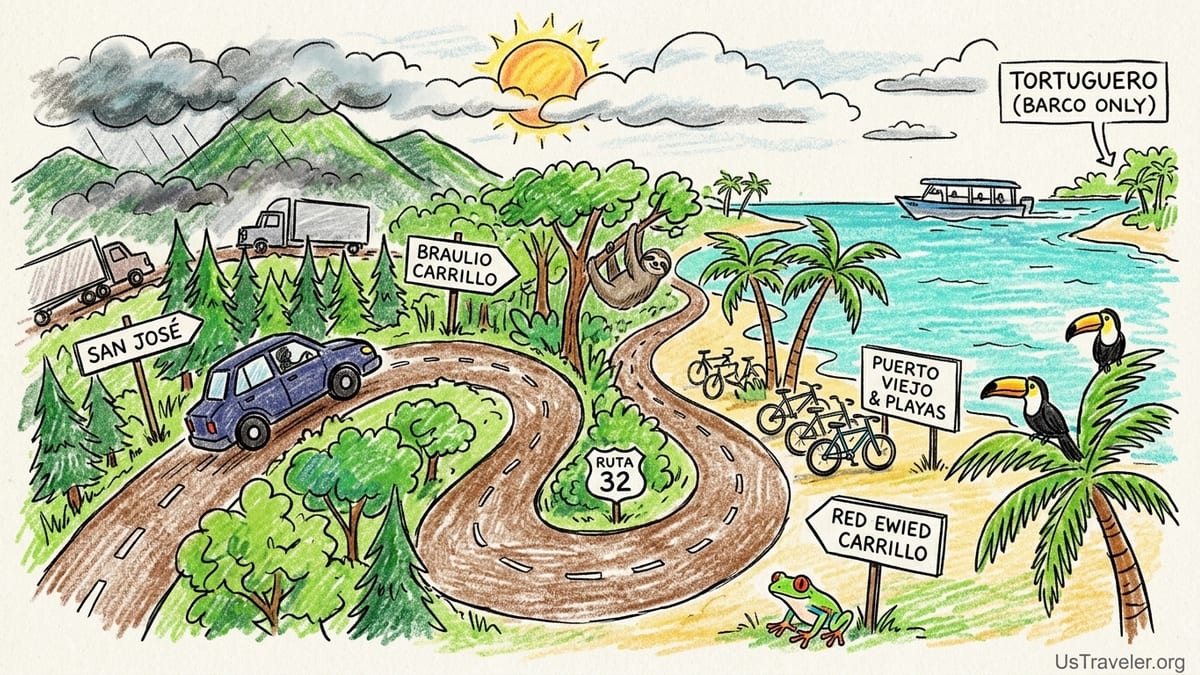
Leaving San José, you follow Route 32 across the Cordillera Central toward the port city of Limón. This is a winding mountain highway that passes through Braulio Carrillo National Park before descending to the Caribbean lowlands. From the outskirts of Limón, a coastal road heads southeast toward Cahuita and then Puerto Viejo de Talamanca. From Puerto Viejo, the same paved road continues in a straight line to Cocles, Playa Chiquita, Punta Uva and finally Manzanillo.
Tortuguero is different. It sits on a narrow sandbar between canals and the sea, with no road into the village. You cannot drive to Tortuguero itself. Instead, you drive to a dock such as La Pavona, leave your car in secure parking, and board a river boat for about an hour to reach the village. This is why most self‑drivers plan Tortuguero as a separate road‑and‑boat segment before or after the main coastal loop.
The distances are not large, but traffic and weather can slow you down. In typical conditions, San José to Cahuita takes around 4 to 5 hours by car, Cahuita to Puerto Viejo about 45 minutes, and Puerto Viejo to Manzanillo roughly 20 to 25 minutes. Build in extra time for construction delays or heavy rain on Route 32, especially in the green season.
Driving Route 32 Safely from San José to Limón
Route 32 is the backbone of this road trip. It leaves the Central Valley on a modern divided highway, then narrows as it climbs into the mountains and enters Braulio Carrillo National Park. Here you will encounter sharp curves, frequent rain and occasional fog. Large trucks use this road to move cargo to and from the Caribbean ports, so you should expect slow‑moving heavy vehicles and limited passing zones.
Travelers often compare this section to driving a rural mountain pass in bad weather: not technically difficult in daylight, but tiring if you are not used to it. Plan to drive only in daylight, both for visibility and because landslides and fallen branches are more easily spotted in time. If you land at San José airport in late afternoon or evening, it is usually wiser to stay overnight in the Central Valley and start the drive the next morning rather than tackling Route 32 in the dark on your first day.
Once you descend out of the park, the landscape flattens into banana and pineapple plantations. The final part of Route 32 into Limón is mostly straight and easier, though still busy with trucks and local traffic. Gas stations are fairly regular along the corridor, but it makes sense to start the day with a full tank in San José and top up again around Guápiles so you are not searching for fuel late in the day.
In terms of vehicle choice, a standard sedan is sufficient for this journey in dry season, since the entire route to Cahuita and Puerto Viejo is paved. In wetter months, or if you are nervous about potholes, a compact SUV gives a bit more clearance and comfort without the fuel cost of a large 4x4. The key is not off‑road capability but good tires, functioning wipers and strong brakes.
Rental Cars, Practicalities and When They Add Value
A rental car adds the most value on the long trunk segments: San José to Cahuita or Puerto Viejo, Puerto Viejo back to San José, and the side trip to docks like La Pavona for Tortuguero. On these legs, having your own vehicle means you can leave San José early, stop at viewpoints in Braulio Carrillo, pause for lunch in Guápiles, or detour to a waterfall or chocolate farm near Siquirres without fitting yourself around shuttle schedules.
Several major international rental brands operate at San José airport and in the city, alongside reliable local firms. For a realistic sense of cost, visitors in 2025 and 2026 commonly report paying roughly 40 to 60 US dollars per day for a compact sedan in low season before mandatory local insurance and taxes, which can add another 20 to 30 dollars per day depending on coverage. Expect higher rates for SUVs, automatic transmissions and high‑season dates such as Christmas and Easter.
Before leaving the lot, walk around the car with an agent and photograph existing scratches, check that the spare tire, jack and warning triangle are in place, and confirm that the emergency number is saved in your phone. Costa Rican road safety advice also recommends using only official parking lots when possible and keeping no visible valuables in the car when you step away, even for a quick beach stop.
The main limitation of a rental car on the southern Caribbean coast is that once you are based in Cahuita or Puerto Viejo, you often do not need or want to drive. Distances between beaches are short, parking can be informal and limited, and the rhythm of life encourages slower, low‑impact travel. This is where bicycles and fixed‑route shuttles can be more practical than holding a car for days on end.
Cahuita and Puerto Viejo: Where to Park and When to Ditch the Car
Cahuita is a small, laid‑back town with a national park entrance at the edge of the village and another near Puerto Vargas. Many lodges sit just off the main road, with on‑site parking in gated lots or clearly signed gravel areas. An example pattern is checking into a hotel on the edge of town, parking the car behind a simple gate, and then walking to dinner and the park entrance. For park visits, you will find a basic pay parking area near the main entrance and a handful of informal lots managed by local residents, where an attendant watches cars for a modest fee.
Puerto Viejo de Talamanca is busier and more compact. The main streets near the beach are narrow, and in high season every curb seems lined with cars. Many mid‑range hotels and guesthouses provide a few off‑street parking spaces, but smaller cabins in town may not. Travelers commonly report that when they stay in the center, they park at their accommodation and then leave the car there, exploring on foot or by bike to avoid the stress of parallel parking on crowded streets.
Security is a recurring concern. Break‑ins from unattended parked cars can occur, especially at unmonitored beach pull‑outs where travelers leave luggage visible. In practice this means avoiding leaving anything of value in the vehicle whenever you park at a beach or trailhead. Time your long driving days so that you go straight from one hotel with secure parking to the next, instead of mixing long drives with sightseeing stops while the trunk is full of bags.
This road trip also connects naturally with other destinations such as La Fortuna, near Arenal volcano. Many visitors who drive from San José to the Caribbean coast then continue from Puerto Viejo back across the country to La Fortuna, rather than returning to the capital in between. Others drop the car when they arrive back in San José and switch to shared shuttles for onward travel, especially if they feel they have had enough mountain driving after Route 32.
Bicycles and Beach Hopping on the Southern Coast
South of Puerto Viejo the road runs almost completely flat along the coast, shaded by jungle and lined with small hotels, cafes and surf schools. This is one of the easiest and most enjoyable places in Costa Rica to get around by bicycle. It is common to see visitors pedaling with a surfboard tucked under one arm or strapped to a side rack, headed from town to a favorite break in Cocles or Punta Uva.
Several dedicated bike rental outfits operate in and around Puerto Viejo, alongside hotels that lend or rent bicycles to guests. One local company is based near the main beach and specializes in sturdy cruiser bikes and e‑bikes for exploring between Puerto Viejo, Cocles, Playa Chiquita, Punta Uva and Manzanillo. Another, run from a beachfront hotel in Playa Negra, quotes around 9 US dollars per day for a basic single‑speed cruiser, with small discounts for week‑long rentals and optional delivery to hotels as far south as Manzanillo for an extra fee.
The practical upshot is that you do not need a car to enjoy this stretch. Even casual cyclists can cover Puerto Viejo to Manzanillo, about 13 kilometers one way, in around 45 minutes on a flat paved road, stopping at Cocles for surf, at Playa Chiquita for a swim and at Punta Uva for views of the iconic palm‑fringed bay. Traffic includes local cars, delivery trucks and other cyclists, so basic road awareness is important, but the overall feel is relaxed compared with the highways.
If you are staying multiple nights in Puerto Viejo or Punta Uva, a good strategy is to arrive by car or shuttle, settle into your hotel, and then rent bikes for daily use. You can leave the rental car parked at your lodge for two or three days while you explore by pedal power, using the car only on arrival and departure days. This reduces fuel and parking stress and lets you experience the coast at the slower pace locals enjoy.
Reaching Punta Uva and Manzanillo by Road
Beyond Cocles, the coastal road continues to Playa Chiquita, Punta Uva and Manzanillo as a two‑lane paved strip with short curves and occasional potholes. There are no complex junctions or unmarked dirt tracks to navigate; you simply follow the main road until it ends at Manzanillo. Because of its simplicity, this section is manageable even for nervous drivers, provided you respect speed limits and watch for pedestrians and cyclists sharing the shoulder.
Punta Uva, roughly midway between Puerto Viejo and Manzanillo, feels noticeably more tranquil than town. Many lodges are tucked down short side lanes that may be gravel or dirt, especially closer to the beach. A compact SUV can make these access tracks more comfortable in wet weather, but in dry conditions a sedan usually copes fine at low speed. Parking is typically in open sandy lots at the accommodation, sometimes with a simple chain or gate at night.
Manzanillo marks the end of the road and the start of the Gandoca Manzanillo Wildlife Refuge. Vehicles park in the village on informal gravel spaces near the beach, with local residents often offering to watch cars for a fee while visitors hike trails or join guided wildlife walks. Because of the limited formal parking, weekends and national holidays can feel crowded. On those days, traveling by bicycle from Puerto Viejo or Punta Uva not only avoids parking headaches but also keeps you out of the inevitable line of cars leaving town at sunset.
If you plan to cross into Panama after visiting Manzanillo, most travelers backtrack by road to Puerto Viejo and then continue north toward the border at Sixaola or the more southern route to Bocas del Toro via local shuttles and boats. Rental agencies usually do not allow their vehicles to be taken across the border, so the standard pattern is to return the car in Costa Rica, then continue by shuttle and water taxi into Panama.
Adding Tortuguero: Road and Boat, Not a Driving Detour
Tortuguero lies on the northern Caribbean coast, surrounded by canals and protected wetlands. There is no direct road into Tortuguero village or the national park. Instead, visitors reach it by combining a road transfer with a boat ride, or by taking a small domestic flight. For a self‑drive itinerary, the usual pattern is to drive from San José or the Caribbean coast to La Pavona dock, park the car there, and then board a river boat to Tortuguero.
Driving from San José to La Pavona generally takes around 3 to 4 hours, again using Route 32 through Braulio Carrillo before turning off toward Guápiles and Cariari. The final stretch to the dock is on paved secondary roads through farmland. At La Pavona you will find a simple visitor area with restrooms, a small restaurant, kiosk and a large open parking lot watched by attendants. Parking is a paid service with day and overnight rates; travelers commonly mention approximate prices on the order of a few thousand colones per day, payable in cash or by card, but exact amounts change frequently.
Public boats from La Pavona to Tortuguero village are scheduled several times per day, typically in the early morning and early afternoon, and the trip itself usually lasts about an hour to an hour and fifteen minutes depending on water levels. Tickets are sold at the dock office and cost the equivalent of a handful of US dollars per person each way. Hotels can also arrange private boats at higher cost but with flexible departure times, which can be useful if your drive from San José or Puerto Viejo arrives later in the day.
Because there is no road, you never take your rental car beyond the dock. For many travelers, this makes keeping a car during the Tortuguero segment unnecessary. One common approach is to return the rental in San José, join an organized shuttle and boat package to Tortuguero, then pick up a new rental afterwards to continue to the Caribbean coast or La Fortuna. Another is to keep the car and park at La Pavona while you spend two nights in Tortuguero, which works well if Tortuguero sits between two driving destinations such as La Fortuna and Puerto Viejo.
Onward Connections to La Fortuna and Panama
From the Caribbean coast, one of the most popular onward destinations is La Fortuna, the town near Arenal volcano. By car, the direct inland route from Puerto Viejo or Cahuita back toward Guápiles and on to La Fortuna can take 5 to 7 hours depending on traffic, roadworks and weather. Many travelers choose to break this into two days, overnighting in a town like Guápiles or Sarapiquí to avoid a single very long driving day and to enjoy rafting, birdwatching or chocolate farm visits along the way.
If you prefer not to drive back through the mountains, shared tourist shuttles run between Puerto Viejo and La Fortuna on a fixed schedule. These are typically minivans that pick you up at your hotel in the morning and drop you at your accommodation in La Fortuna by mid to late afternoon, with a lunch stop en route. The cost is higher than public buses but lower than a private transfer and eliminates the need to navigate mountain roads or manage rental car returns and pick‑ups.
Toward Panama, the standard route from Puerto Viejo is north to the Sixaola border, where you cross on foot and continue by shuttle and boat to Bocas del Toro. Rental cars from Costa Rica almost never cross this border; instead, you plan to drop the car in a town such as Puerto Viejo or Limón and then continue with ground and water transfers arranged by local operators. Travelers heading deeper into mainland Panama often choose to fly from Bocas or return to San José for inter‑regional flights.
When planning, think through where you truly benefit from having a car. If your trip looks like San José → Tortuguero → Puerto Viejo → La Fortuna → San José, many people book one rental covering San José to La Pavona and La Pavona to La Fortuna, then rely on boat transfers and shuttles in between. Others are more comfortable keeping the car for the entire route and simply accepting parking costs at docks and hotels as the price of maximum flexibility.
The Takeaway
A Caribbean Costa Rica road trip from San José through Cahuita, Puerto Viejo, Cocles, Punta Uva and Manzanillo is straightforward to drive, provided you respect the character of Route 32 and keep your expectations realistic. The entire coastal section is accessible on paved roads, and a basic sedan or compact SUV is usually all you need. The places that feel remote and wild, like Manzanillo and Tortuguero, are nonetheless part of an established travel circuit with services geared toward independent visitors.
The key is to match your transport choices to each section. Use a rental car for the long hauls to and from the coast and for reaching docks like La Pavona. Once you are settled on the southern Caribbean, switch to bicycles and your own feet for beach‑hopping days, keeping the car safely parked at your lodge. Treat Tortuguero as a road‑and‑boat side trip, not a driving detour, and think ahead about where it makes sense to return or pick up a rental when combining it with destinations like La Fortuna or Panama.
If you plan around daylight driving on Route 32, secure parking at every overnight stop, and a few relaxed days with a bike between Puerto Viejo and Manzanillo, this corner of Costa Rica offers one of the easiest and most atmospheric introductions to the Caribbean side of Central America.
FAQ
Q1. Can I drive my rental car all the way to Tortuguero?
No. There is no road into Tortuguero village. You drive only as far as river docks such as La Pavona, leave your car in paid parking there, and then take a boat to reach Tortuguero.
Q2. Is a 4x4 necessary for the San José to Puerto Viejo route?
For most of the year you do not need a full 4x4. The route is fully paved. A regular sedan works fine, though a compact SUV can be more comfortable on potholes or in heavy rain.
Q3. How long does it take to drive from San José to Puerto Viejo?
In normal conditions it usually takes around 5 to 6 hours, including time to get out of the capital, cross Route 32 through Braulio Carrillo, pass Limón and continue down the coast past Cahuita.
Q4. Is parking safe in Cahuita and Puerto Viejo?
Many hotels have gated or off‑street parking that is generally considered safe. Problems most often occur at unsupervised beach lots, so avoid leaving valuables in the car and choose attended parking whenever possible.
Q5. Do I need a car once I am staying in Puerto Viejo or Punta Uva?
Not necessarily. Distances between beaches are short, the road is flat, and bicycle rentals are widely available. Many travelers park their car at the hotel and use bikes for daily beach hopping.
Q6. What is the best way to get to Manzanillo without a car?
The most enjoyable option is by bicycle from Puerto Viejo, which takes about 45 minutes on a flat road. Alternatively, you can use local taxis or arrange a shuttle through your lodging.
Q7. Are there gas stations on the way to the Caribbean coast?
Yes. You will find several stations between San José and Limón, especially around Guápiles. It is wise to start with a full tank and top up before leaving the highway for smaller coastal towns.
Q8. Can I drive from Puerto Viejo directly into Panama?
You can drive to the Costa Rican side of the border near Sixaola, but rental cars are usually not allowed to cross. Most travelers drop the car on the Costa Rican side and continue by shuttle and boat into Panama.
Q9. When are shuttles better than driving on this route?
Shuttles are often better if you are uncomfortable with mountain driving, arriving late in the day, or planning to spend several car‑free days on the coast when a parked rental would mostly sit unused.
Q10. What happens if heavy rain closes Route 32?
In periods of intense rain or landslides, authorities sometimes close sections of Route 32 temporarily. In that case, shuttles and locals follow official detours or wait for reopening, and you may need to adjust your schedule by a few hours or a day.