


I have driven, bussed and boated my way up and down Costa Rica’s Central Pacific coast several times in the past few years, always starting and ending in San José and using Jacó and Manuel Antonio as reference points rather than goals. With each trip I learned a little more about which towns are worth lingering in, which beaches are better admired than swum, and where the real payoff lies once the day-trippers have gone back to the capital. This is how I would spend my own time after genuinely exploring the region, what each place added to the overall trip, and what I would do differently on my next Central Pacific run.
Getting In From San José: The Reality Of The Route
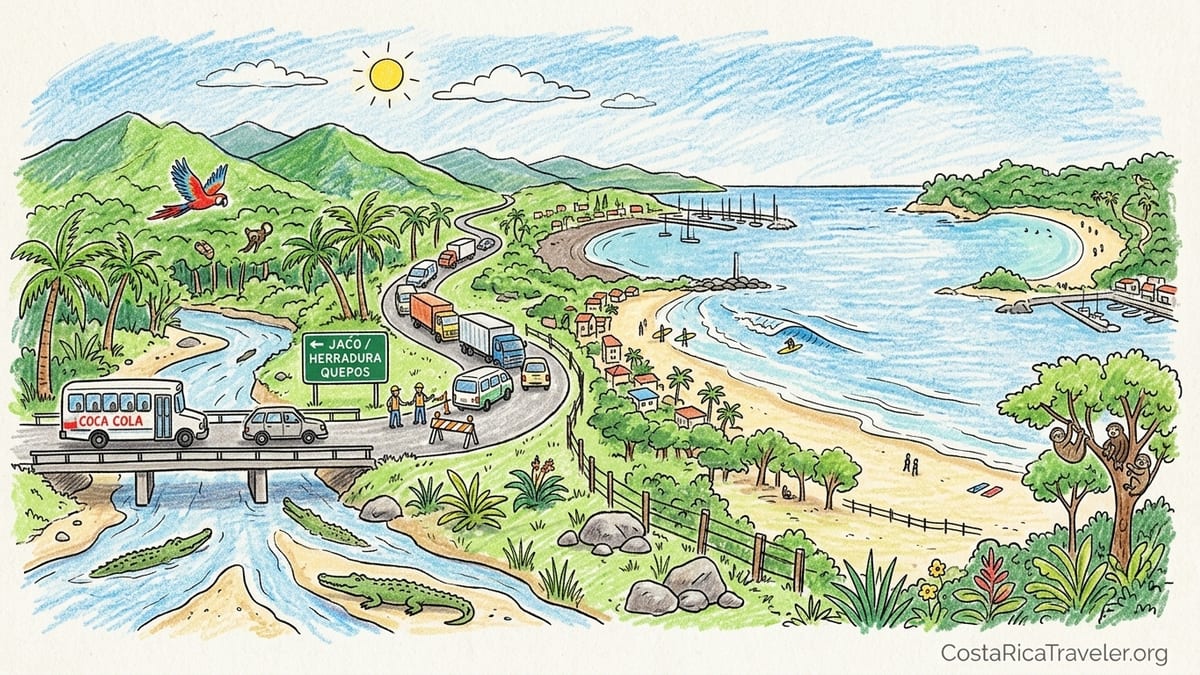
Every Central Pacific itinerary starts with the same choice: bus or car from San José down Route 27 and then Route 34 to the coast. On my first trip I took the public bus from the Coca Cola terminal to Jacó, about two and a half hours in light traffic and under four US dollars one way. On later trips I rented a basic sedan at Juan Santamaría International Airport and paid the tolls in cash colones, which added roughly five to seven dollars to the drive. That freedom changed the trip, but it also made the bottlenecks more obvious, especially around the Tarcoles River bridge construction zone, where even local reports have described backups that can stretch several kilometers when works are active and lanes are reduced.
On one March drive that should have taken three hours from San José to Quepos, I spent more than an hour crawling the last ten kilometers before the Tarcoles bridge, watching people abandon air-conditioned shuttles to stretch their legs on the shoulder. That delay did not ruin the trip, but it did force me to reconsider where I based myself. Places that looked close together on a map, such as Herradura and Esterillos, felt much farther apart once you factored in one-way bridges, roadworks and the steady line of freight trucks that share Route 34 with tourists.
Because of those logistics, I now plan for the transfer day to be a partial write-off. If I take the bus, I accept that I will arrive in midafternoon and only have energy for a walk on the nearest beach and a casual casado at a soda. If I drive, I schedule grocery shopping in Orotina or Jacó, then stop at a coastal town that has easy, obvious parking and a walkable center. I treat the national parks, mangrove tours and serious surfing days as activities for later in the week, once my base is set and I am no longer thinking about the capital.
That mental shift matters, because it frees you from chasing too many stops. The Central Pacific is compact on paper, but the best parts are rarely visible from the highway. They lie at the end of dusty side roads, short river crossings, or residential lanes that you only trust because a hotel host drew you a map by hand. Giving yourself one clean arrival and then radiating out from a good base makes everything that follows feel less rushed and more deliberate.
Herradura: My Practical Base Near Jacó
Herradura, just north of Jacó, is not the prettiest beach I visited on the Central Pacific, but it turned out to be one of the best logistical bases for a mixed trip of remote work, day trips and sport fishing. I spent four nights here, in a modest condo about a ten-minute walk from Playa Herradura and a short drive from the large marina and supermarket. That stay felt about right: long enough to explore the area without getting stuck in the resort bubble that surrounds the marina, short enough that I did not grow tired of the darker sand and somewhat murky water in the bay.
What Herradura contributed to the trip was convenience. From my balcony I could see both the mountains and the masts in the marina, and I could drive to Jacó’s surf beaches or Carara National Park within forty minutes, depending on traffic. The paved road in from Route 34 is straightforward, and parking at both the supermarket and the public beach access was easy, with informal attendants watching cars for a small tip. When I wanted a more polished dinner than a roadside soda, the marina restaurants were there, alongside charter companies offering full-day offshore fishing for marlin and sailfish at prices that started around several hundred dollars per boat.
Emotionally, though, Herradura felt like a place I used rather than loved. The beach is a calm, horseshoe-shaped bay, which makes it good for stand-up paddleboarding and children’s swimming, but the water never had the clear turquoise color some visitors imagine when they picture Costa Rica. In the afternoons, especially on weekends, local families picnicked in the shade and music from parked cars created a friendly but noisy background. After sunset the atmosphere shifted to the marina, which glowed under soft lighting as crew cleaned boats and anglers compared stories. Those evenings were pleasant, yet I rarely felt tempted to stay out late. Jacó’s louder nightlife was only a ten-minute drive away, but I preferred the quieter nights in Herradura itself.
If I returned, I would still use Herradura for three or four nights as a base for Carara, crocodile-spotting on the Tarcoles River, and a quick dip into Jacó’s restaurants and supermarkets. I would not choose it for a full week of beach time, nor would I recommend it to travelers who dream of long, empty walks on untouched sand. Herradura is where the Central Pacific starts to feel organized, with big-box groceries, gated condos and air-conditioned cafes. That has value, but it is a very specific kind of coastal experience.
Jacó: Convenient Hub, Mixed Emotions
Jacó was the first Central Pacific town I ever stayed in, and for that reason alone it will always have a certain nostalgia for me. On that initial trip I spent three nights in a small hotel a few blocks back from the beach, within easy walking distance of the main strip. Since then I have returned for shorter stays and day visits, usually one or two nights at a time. I have come to think of Jacó as a place that is more useful than lovable, and I am glad I did not devote my entire trip to it, even though it is often marketed as an obvious coastal base.
What Jacó gives you is infrastructure and energy. Buses from San José terminate here, so arriving without a car is straightforward, and the town layout is flat and walkable. Surf schools line the beach road, offering board rentals and group lessons that, during my visits, ranged broadly in price depending on season and the inclusion of transport. The long gray beach itself is better for surfing and sunset walks than for tranquil swimming, with a consistent shore break that made me cautious about going in much deeper than my waist when the waves picked up. Even so, the sunsets I watched from near the north end of the beach were among the most dramatic of the trip, with the sun dropping behind fishing boats and pelicans skimming the water.
The downside is that Jacó rarely relaxes. During my first stay I underestimated how the nightlife would affect my sleep. Even two blocks inland, I could hear music from bars and clubs until well after midnight on Friday and Saturday. Groups on weekend trips from San José filled the sidewalks, and while I did not feel unsafe, the atmosphere was more bachelor-party than beach-retreat at times. Daytime brought a different crowd, including families and retirees, but the sheer density of shops, ATV tour operators and real-estate offices kept reminding me that Jacó is as much a business hub as a surf town.
For that reason, I now use Jacó in short, deliberate bursts. I come in for groceries at one of the large supermarkets, maybe stay a single night to break up the drive from San José, or arrange a surf lesson when I want reliable waves and an easy meet-up point. I do not count on it for quiet time, and I do not pretend that the beach is ideal for long, unbroken swims. Jacó is an efficient starting point, not the emotional core of a Central Pacific itinerary, and my later trips improved when I treated it that way.
Esterillos Oeste and Surroundings: Where I Finally Slowed Down
About twenty to thirty minutes south of Jacó, the rush along Route 34 begins to ease, and it was in Esterillos Oeste that I finally found the slower, more grounded version of the Central Pacific I had been looking for. I spent five nights here on my second extended trip, renting a simple cabina a short walk from the wide, open beach. That stay was, if anything, slightly too short. I could easily have added two more days without getting restless, especially because this stretch of coast has enough variation between Esterillos Este, Centro and Oeste to keep daily walks and drives interesting.
The main contribution Esterillos made to my overall trip was peace. The beach near my cabina was a broad expanse of dark sand, with long, peeling waves that attracted a dedicated group of surfers in the early morning and late afternoon. Outside of those peak times, especially on weekdays, I often shared the shore with only a handful of people and a few dogs. Swimming here required attention to currents and tides, and I felt more comfortable treating the ocean as a place to play at the edge rather than a lap pool, but the combination of space, breeze and the constant hiss of waves felt restorative after the compression of Jacó.
Practicalities were simpler too. The side road from Route 34 into Esterillos Oeste was paved and in decent condition during the dry months when I visited, and there was enough informal parking near beach access points that I never worried about leaving the car for a couple of hours. Small sodas and bakeries dotted the village streets, and while prices for a basic casado or gallo pinto breakfast had risen since my first trip, they still felt reasonable compared with more established resorts. Without big nightclubs or large supermarkets, the evenings centered around the beachfront and the handful of local bars, where the loudest noises tended to be crashing waves and conversations instead of amplified music.
One of the unexpected pleasures of staying in Esterillos was watching the beach transform as day-trippers from San José came and went. On weekends the parking lot filled up by late morning with vehicles from the Central Valley, families set up shade tents and coolers, and vendors walked the sand selling ceviche and coconut water. By late afternoon, though, the traffic flowed back to the highway, and the beach returned to something closer to the quiet scene I had found on weekdays. If you stay in town rather than just visiting for the day, you get to experience both sides of that rhythm, and it gave me a more complete sense of how the Central Pacific functions for Costa Ricans as well as visitors.
If I planned a future trip, I would allocate at least a full week to the Esterillos area, using it as a base for early-morning surf sessions, day trips south to Parrita’s estuaries, and lazy afternoons reading under beach almond trees. The only real drawback was limited public transport once off the main highway. Buses along Route 34 are fairly frequent, but the last stretch into town often requires a walk in the sun or arranging a local taxi. For travelers without a car, that is a consideration. For me, with a rental and a preference for quiet nights, Esterillos was the point where the Central Pacific began to feel like a place to live rather than just pass through.
Parrita and the Mangroves: Wildlife Without the Crowds
Parrita itself is a small, workaday town on Route 34, and at first glance it did not seem like an obvious stop. On my first drive south I barely registered it beyond a gas station and a cluster of hardware stores. On my second trip, curious about the mangrove and estuary tours I had heard about, I booked two nights in a rustic lodge on the coastal side of Parrita, closer to the mouth of the river and a short boat ride from the canals. Those two nights ended up adding more wildlife to my trip than my much-hyped day inside Manuel Antonio National Park, at a fraction of the crowds.
The estuary near Parrita is a maze of tidal channels, mangroves and low islands, and on a three-hour morning boat tour I saw herons, kingfishers, a troop of howler monkeys and a sleepy crocodile half submerged on a muddy bank. Because the boats in this area carry fewer travelers and depart from small docks rather than large tour hubs, the atmosphere felt personal and relaxed. The guide pointed out not only wildlife but also small farms and fishing shacks along the banks, explaining how local residents use the tides and channels in daily life. Compared with the tightly managed paths and lookouts in the national park, this felt like a more organic window into the Central Pacific’s ecology.
Reaching the lodge required turning off Route 34 onto a narrower road that became partly unpaved as it neared the coast, so I was glad to be driving in the dry season in a vehicle with decent clearance. Parking at the lodge and at the river dock was straightforward, on packed earth within sight of staff and boat captains. The only segment of the experience that felt slightly complicated was coordination by phone and messaging beforehand, as smaller operators in the Parrita area do not always have instant online booking. In exchange for that extra planning, I enjoyed sunsets over nearly empty stretches of beach, with only a few local fishers casting lines into the surf.
If I were traveling again specifically for wildlife, I would happily add a third night around Parrita, particularly to fit in a dusk or night boat tour when nocturnal animals become active. For many travelers, though, two nights as part of a broader itinerary may be enough. There is not much in the way of dining variety or nightlife, and once the evening darkness settles, the main sounds are insects and the distant crash of waves. That quiet, combined with the sense of being slightly off the main tourist circuit, is exactly what made Parrita memorable for me.
Quepos and Manuel Antonio: Beauty With Caveats
No honest account of the Central Pacific can skip Quepos and its gateway role to Manuel Antonio National Park, but I also cannot pretend they were the parts of my trip that I most wanted to linger in. Across two separate trips, I spent a combined five nights in the Quepos and Manuel Antonio area: three nights in a small hotel up on the hill between town and the park, and two nights down in Quepos itself near the marina. That was enough time to see the area’s strengths and its limits.
Manuel Antonio National Park is famous for good reason. The combination of forest trails, monkeys, sloths and sheltered beaches inside a relatively small protected area creates a high-impact day of wildlife and scenery, and the park remains one of the most visited in Costa Rica according to official conservation authorities. Entry has to be booked online in advance through the national system, and during my visits, morning time slots, especially around 7 a.m., sold out several days ahead in busier months. Inside the park, I saw white-faced capuchin monkeys, raccoons and a surprising variety of birds, but the human crowd was just as striking, particularly on the main path toward Playa Manuel Antonio and Playa Espadilla Sur.
The beaches inside Manuel Antonio are visually stunning, with lighter sand and gentler waves than the open-coast beaches near Jacó and Esterillos. When I arrived early in the morning on my first visit, I enjoyed an hour of relatively quiet swimming in waist-deep water with good visibility. By late morning, however, the shoreline grew dense with visitors who had hiked in from the entrance, many carrying only towels and sunscreen because the park does not allow regular food coolers past the gate and requires visitors to rely on on-site concessions for snacks and drinks. The experience shifted from serene to busy in a matter of hours, and by early afternoon I was ready to hike back out.
Outside the park, the road between Quepos and Manuel Antonio is a steep, winding ribbon lined with hotels, restaurants and viewpoints. Buses run this route regularly, and parking near the park entrance is dominated by private lots and attendants who wave cars into spaces for a fee that, in my case, was higher than I had paid anywhere else on the Central Pacific. Quepos itself felt more grounded and local, especially around the central market and the marina promenade in the evening. I appreciated the ability to walk the flat streets, visit bakeries, and watch fishing boats return while the hills of Manuel Antonio glowed in the background.
In terms of contribution to my overall trip, the Manuel Antonio area delivered concentrated wildlife sightings, a classic national park day and some excellent meals with sunset views. It also introduced the most logistical friction: tickets purchased in advance, timed entry windows, busy parking, higher prices for tours and restaurants, and a general sense that the area is operating near its capacity during peak weeks. If I returned, I would still devote one full day to the park, arriving on the earliest bus from Quepos, and I would probably stay two or three nights in Quepos itself rather than up in the hills, to reduce reliance on taxis and shuttles. I would not choose to spend a full week here, nor would I frame it as the only highlight of the Central Pacific.
Carara, Tarcoles and The Inland Side Trips
Carara National Park, located between San José and Jacó near the Tarcoles River, quietly became one of my favorite stops in the region. I visited twice, each time as a half-day trip from a base in Herradura or Jacó, and both visits left me wishing I had scheduled more time. Carara is known among birders for its population of scarlet macaws and its location at the transition between dry and humid forest, which means a rich mix of species. On my first mid-morning walk along the main accessible trail, I watched a pair of macaws wheel overhead and disappear into the canopy, their red and blue wings flashing in the sunlight, while a guide pointed out poison dart frogs near the path.
Unlike Manuel Antonio, Carara is not focused on beaches, and that is part of its appeal. The main trail system loops through thick forest, with well-maintained paths and occasional viewpoints toward the river. Visitor numbers felt lower on both of my visits, and because entry is also managed through the national reservation platform, there was an orderly rhythm to arrivals. Official information boards indicated that the park entrance is a short drive south from the Tarcoles bridge and that tickets should be arranged online. I appreciated the clear parking area near the ranger station, where I felt comfortable leaving the car for several hours while walking.
The Tarcoles River itself, especially the famous crocodile bridge on Route 34, was both fascinating and mildly stressful. On my first trip, before major repair works began, I joined the line of visitors stepping carefully onto the narrow pedestrian walkway of the bridge to peer down at large crocodiles resting on sandbanks below. Parking consisted of pulling over near informal lots on the north side of the bridge and paying a small fee to attendants. More recently, roadworks and lane closures around the bridge have created longer delays on the highway, and several locals I spoke to suggested that visitors consider dedicated riverboat tours as an alternative way to see crocodiles, both for safety and to reduce congestion on the bridge itself.
On balance, I would still include Carara on any Central Pacific itinerary, particularly for travelers who care about birds and forest walks. Ideally, I would stay one night in the area instead of just day-tripping, perhaps at a small lodge on the inland side of Route 34, to allow for both a very early morning walk in the park and a boat tour on the river without rushing. The combination of Carara’s quieter trails and the Tarcoles’ wildlife viewing rounded out my understanding of the region, reminding me that the Central Pacific is not only about beaches and surf breaks but also about rivers, wetlands and the less visible movements of animals between them.
The Takeaway
Looking back over multiple trips to Costa Rica’s Central Pacific, the pattern that emerges is simple: my most satisfying days were rarely the ones I spent in the busiest hubs or ticking off the most famous names. They were the days when I had a comfortable base, easy access to both sea and forest, and enough time to watch a place change between morning, afternoon and night. If I could redesign my first itinerary with the knowledge I have now, I would divide my time differently and resist the instinct to pack in too many short stops.
On a ten-night Central Pacific journey starting and ending in San José, I would likely spend three or four nights based in Herradura or nearby, using that period for Carara National Park, a Tarcoles River crocodile or birding tour, and practical errands in Jacó. I would still swing through Jacó itself for a single overnight or a dedicated surf day, but I would not anchor the trip there. Instead, I would devote at least five nights to the Esterillos and Parrita area, where quieter beaches, mangroves and fewer large hotels create the kind of everyday coastal life that is easy to sink into. I would then end with one or two nights in Quepos, with a single, well-planned day in Manuel Antonio National Park, catching the earliest possible bus or shuttle to beat some of the crowds.
Within that framework, there would still be room for improvisation. If a particular beach near Esterillos felt especially good, I might add an extra night and skip an inland side trip. If the roadworks around Tarcoles were particularly disruptive on a given week, I might prioritize boat tours that depart from less congested docks rather than insisting on a bridge stop. The key lesson I took from my time on the Central Pacific was that it rewards depth more than breadth. Staying just long enough in each place to understand its rhythms, rather than sampling as many names as possible, turned a string of coastal towns into a coherent journey.
Most of all, I learned that the most famous spots, like Jacó and Manuel Antonio, are best treated as tools and highlights rather than default destinations. They provide services, access and unforgettable single days, but the heart of the region, at least for me, lay in the slightly quieter stretches in between: the long, dark-sand beaches of Esterillos, the tidal whispers of Parrita’s mangroves, and the early-morning calls of macaws deep inside Carara’s forest. That is where I would choose to spend my time if I had the Central Pacific to explore all over again.
FAQ
Q1. Is it better to rent a car or rely on buses along Costa Rica’s Central Pacific coast?
For flexibility and access to quieter beaches and mangroves, I found renting a car from San José worth the extra cost, though buses work well for reaching larger hubs like Jacó and Quepos.
Q2. How many nights should I plan for the Central Pacific region on a first trip?
On my most balanced itinerary, ten nights felt ideal, with time split between a practical base near Jacó or Herradura, quieter beaches around Esterillos and Parrita, and a short stay near Quepos for Manuel Antonio.
Q3. Is Jacó a good place for families, or is it mainly a party town?
Jacó has services and beginner-friendly surf, but weekend nightlife can be loud; families who value quiet evenings may prefer to sleep in Herradura or Esterillos and visit Jacó by day.
Q4. Are the beaches in the Central Pacific good for swimming, or mainly for surfing?
Many open-coast beaches like Jacó and Esterillos have strong waves and currents; I treated them as places for playing in the shallows and walking, and reserved longer swims for more sheltered bays such as inside Manuel Antonio.
Q5. Do I really need to book Manuel Antonio National Park tickets in advance?
Yes, in my experience advance online reservations were essential, especially for early morning entry times in busy months, and tickets were checked at the gate before entering.
Q6. Is Carara National Park worth visiting if I am already going to Manuel Antonio?
Carara gave me quieter trails and better birdwatching, including scarlet macaws, so I considered it a valuable complement to Manuel Antonio rather than a duplication.
Q7. What was the biggest disappointment on your Central Pacific trips?
My main disappointment was expecting Jacó to feel like a relaxed beach village; in reality it was busier, noisier and more commercial than I had hoped, especially at night.
Q8. When during the day did the Central Pacific beaches feel best?
I enjoyed early mornings and late afternoons most; mid-day heat and day-tripper crowds were strongest then, while sunrise walks and sunset sessions were quieter and cooler.
Q9. How did ongoing roadworks around the Tarcoles bridge affect your plans?
Delays near the bridge sometimes added an hour or more to my drive, so I started treating that section as a possible bottleneck and avoided tightly timed same-day activities right after crossing.
Q10. If you had to pick just one base on the Central Pacific for a slower stay, where would it be?
For a slower, more immersive stay, I would choose Esterillos Oeste or the nearby beaches, where I found long, uncrowded sands, a few local sodas and a quieter rhythm than the main resort towns.