


I learned the hard way that “being close” in Costa Rica does not always mean “saving time.” On my last Central Pacific trip I split my stay between three bases: two nights near Herradura just north of Jacó for an easy arrival and marina access, four nights on the hill road between Quepos and Manuel Antonio for the park and restaurants, and three nights near Dominical on a quieter stretch of coast. I loved the variety, but I underestimated how much time I would spend in the car. In hindsight I would have used only two bases and chosen them more carefully around drive times, humidity, nightlife and how much I actually wanted to leave the hotel after dark.
Understanding the Central Pacific Region as a Base
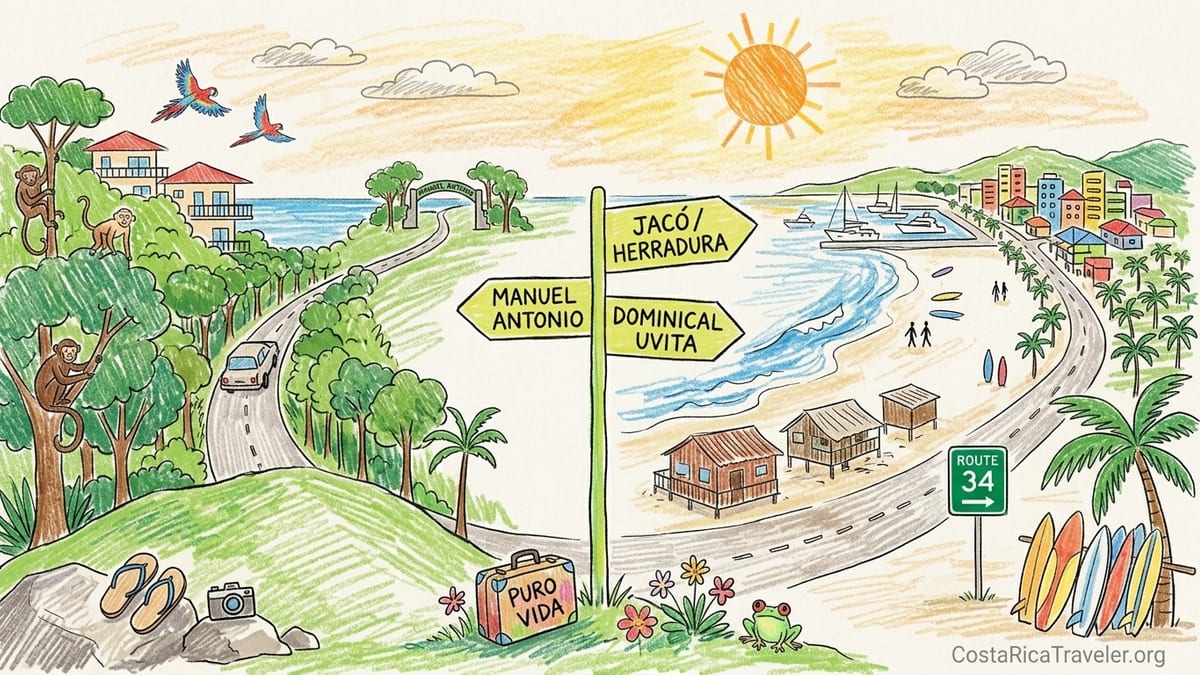
Costa Rica’s Central Pacific region runs roughly from Herradura and Jacó down past Manuel Antonio to Dominical and Uvita, tied together by Route 34, the coastal highway known as the Costanera Sur. This strip is one of the easiest beach areas to reach from San José. Jacó lies about 100 kilometers from the capital via Route 27 and 34, a drive of around 1.5 to 2 hours in normal daytime traffic. Manuel Antonio and Quepos sit farther south, roughly 160 to 170 kilometers from San José, which usually translates to about 3 hours by car when you factor in tolls, trucks and slow sections through towns.
The simplicity of Route 27 plus Route 34 is what makes the Central Pacific popular for first-time visitors and short trips. It is a modern toll road down to the coast, then a flat two-lane highway running past palm plantations and beach towns. Compared with mountain routes toward Monteverde or the Caribbean side, this drive is relatively straightforward. That has encouraged a wide range of development: surf towns, marina resorts, condo complexes, wildlife lodges and laid-back villages all along the same corridor.
From a base-planning point of view, what matters is that the distances look small on a map, but time stretches because most roads beyond the main highway are narrow, sometimes steep, and shared with pedestrians, delivery trucks and wildlife. The seven-kilometer access road between Quepos and Manuel Antonio, for example, is famous for being slow and busy despite its short length. I learned to stop judging by kilometers and start judging by the time it took to get a coffee, find parking and walk to the beach or park gate.
When you choose a base here, you are really choosing how you want to spend your days: walking to restaurants in sticky evening air, listening to road noise near the nightlife, driving 45 to 75 minutes for excursions, or falling asleep early to waves and howler monkeys in quieter coves. There is no perfect choice, but understanding the character of each stretch helps you build a strategy that fits your style.
How Many Bases I Used, What Worked and What I Regretted
On paper, three bases sounded ideal. I started with Herradura for two nights, at a condo near the Los Sueños marina just north of Jacó. The logic was simple: after landing at San José in the afternoon, we could drive 1.5 to 2 hours mostly on toll highway, finish in daylight and have a pool, beach and supermarket nearby. That part worked. Herradura has large supermarkets, chain restaurants and the sheltered bay, and the air conditioning in the condo battled the humidity well. What I underestimated was how car-dependent we would feel. To reach busier Jacó for restaurants and surf we still had to drive 10 to 15 minutes each way and deal with town traffic and parking every night.
From there we moved to a mid-range hotel on the hill road between Quepos and Manuel Antonio for four nights. This is the classic “Manuel Antonio strip,” with jungle on one side and Pacific views on the other. It was convenient for the park: a 10 to 15 minute drive down to Quepos and another few minutes toward the park gate, although morning traffic and parking checks meant the outing still absorbed most of a day. The trade off was constant movement. The road is narrow, busy and lined with hotels, so we had road noise and frequent honking from buses even though capuchin monkeys and iguanas visited the trees by the breakfast terrace.
For the final three nights, we shifted to a small rental near Dominical, just south of the official Central Pacific planning region but still on the same Route 34 corridor. Dominical sits about 50 kilometers south of Manuel Antonio, with a direct drive of roughly 50 to 60 minutes in normal traffic. The town felt immediately quieter. There was one main dusty street with open-air sodas and surf shops, and the ocean felt wilder. We still had a supermarket, but fewer restaurant choices and much darker nights once the sun went down. Humidity felt higher, especially in a more rustic rental with only bedroom air conditioning. With all windows closed for the AC, drying towels and swimwear took ages.
My regret was not the individual places but the number of moves. Packing, checkouts and 1 to 1.5 hour hops between bases added up. It fractured what could have been a more relaxed week. In hindsight I would have chosen two different styles of base within the Central Pacific and accepted slightly longer individual day trips rather than three separate check-ins.
Beach Town Hub vs Hilltop Jungle vs Quiet Coast
Most visitors to the Central Pacific end up choosing among three broad types of base. The first is the busy beach town hub. Jacó and, to a lesser extent, central Manuel Antonio beach itself fall into this category. You stay in town, walk to a cluster of restaurants, bars, surf schools and small supermarkets, and trade some peace and quiet for being able to leave the rental car parked at night. These areas are hot and humid, with dense construction that holds heat, but they also have better paved streets and more lighting after dark.
The second type is the hilltop jungle strip, exemplified by the road between Quepos and Manuel Antonio or the hills behind Jacó. Here you find hotels and rentals perched above the sea, wrapped in rainforest. Wildlife sightings can be frequent: monkeys cross electric lines, scarlet macaws fly overhead, toucans call in the early morning. Pools often have ocean views, and sunsets from balconies are superb. The cost is that you are tied to the road. Walking is often impractical because of steep grades, lack of sidewalks and heat, so even a quick dinner out means driving, parking on a tight shoulder and sometimes climbing stairs along the roadside.
The third type of base is the quieter stretch of coast, such as Esterillos, Playa Bejuco or Dominical and neighboring coves farther south. Here construction is more spread out, nightlife is limited and dark skies return after 8 p.m. Surf breaks are common, and you can sometimes stay in small hotels or rentals that open almost directly to uncrowded sand. Access to grocery stores and restaurants might involve a short drive rather than a walk, and in some areas unpaved side roads or river crossings can appear in the rainy season. Humidity feels more present in these spots, and unless you choose a well-insulated rental with full air conditioning, interior spaces can stay damp.
Each style has a distinct soundscape and daily rhythm. In town, the background is motorbikes and music from beach bars. On the hill road, it is bus engines climbing and descending, punctuated by monkey howls at dawn. On the quieter coast, it is mostly waves and insects, with perhaps the occasional truck low on the highway. When you imagine your mornings and evenings, consider which of those atmospheres you want to live in for a week.
Real Drive Times and Whether “Close” Really Saves You Time
Official distances can be misleading in Costa Rica. On a map, Jacó to Manuel Antonio looks simple: about 70 kilometers along Route 34. In practice, the drive often takes 1.5 hours or a little more once you consider slow trucks, roadwork and traffic through Parrita and Quepos. Local transfer companies routinely schedule around 90 minutes for this run. Similarly, the distance from Manuel Antonio to Dominical is roughly 49 to 50 kilometers by road, yet most sources and tour operators allow around 50 to 70 minutes for the drive, depending on stops and conditions.
From San José to Jacó, you can cover the roughly 100 kilometers in as little as 1 hour 15 minutes in light traffic according to real estate and local driving guides, but typical daytime journeys land closer to 1.5 hours. To reach Quepos and Manuel Antonio from San José by private car, drivers usually suggest about 3 hours using Route 27 and Route 34, which matches my own experience on a weekday morning with one brief coffee stop. Buses and shared shuttles take longer because of intermediate stops.
Staying close to the park gate in Manuel Antonio did help us make the 7 a.m. opening time on our chosen morning, which is important because large tour buses tend to arrive between about 9 and 10:30 a.m. That early entry meant cooler temperatures and quieter trails. However, “five minutes from the park gate” in marketing language still translated to 20 to 30 minutes of door to entrance counting parking, getting organized and standing in ticket lines. A couple we met in Dominical drove up for a day trip and reported that leaving at 5:30 a.m. put them at the park around 6:45 to 7 a.m., only about half an hour later than we managed from our hilltop hotel.
Where proximity truly saved time was in short, repeated errands. Staying in Herradura meant that if we forgot sunscreen or snacks, we could drive five minutes to a full-size supermarket. In Dominical, the nearest larger grocery run was a more deliberate outing along the highway. For bigger-ticket experiences like zip line tours, mangrove boat trips or waterfall hikes, almost everyone ended up driving 30 to 60 minutes regardless of base. That undercut the value of paying a premium for being extremely close to one particular attraction.
Access to Food, Shops, Nightlife and Practicalities
Food access is where the character of each base matters most. In Jacó and central Manuel Antonio beach, dozens of casual restaurants line the main streets. You can walk to sodas for casados, grab pizza or burgers, or splurge on seafood without needing a car. Convenience stores stay open into the evening, and some supermarkets offer reasonably wide selections of imported items. Nightlife includes surf bars, live music venues and, in Jacó’s case, a noticeable party scene that lasts late into the night on weekends.
On the Quepos to Manuel Antonio hill road, restaurants are strung out along the ridge. Some hotels include on-site dining with ocean views, and a cluster of independent restaurants and cafes sit at key curves. We often drove 5 to 10 minutes along the road for dinner, parked on narrow shoulders and then walked up or down steps. The atmosphere skewed more to sunset cocktails and mid-range dining than to beach bar nightlife. Quepos down the hill offered a denser local town center with sodas, bakeries and basic shops, reachable by car or local bus.
In quieter coastal areas like Esterillos or Dominical, you might find a few dependable sodas, one or two beach bars and perhaps a higher-end hotel restaurant that welcomes outside guests. After 9 p.m., many of these towns go quiet, especially outside peak holiday periods. Dominical’s main street has a low-key surfer nightlife with a handful of bars, but road lighting is limited and walking distances can be longer than they appear because of heat and dust during the day.
From a practical standpoint, parking and road noise go together. In Jacó, most mid-range hotels and rentals offer secure parking lots, but you hear engines and music. On the hill road, parking is often stacked or on tight inclines, and you hear trucks changing gears. In quieter zones, you may park under trees or in carports and hear mostly nature, but be prepared for dust, mud or puddles depending on the season. Air conditioning is close to essential in all these bases because coastal humidity remains high year-round, especially in the rainy season when showers can roll through almost daily.
Who Each Base Suits: By Traveler Type
For first-time visitors without a car, staying in or very close to a town center is usually easiest. Jacó offers the most walkable grid, frequent buses, plenty of taxis and a wide range of tour operators who include pick up. The trade off is a more urban feel, higher noise levels and less wildlife at the hotel itself. Manuel Antonio’s hill road and beach area also work reasonably well without a car if you choose a hotel that specifically includes shuttle service to the park and beach, but hills and heat make random walking less appealing.
Surfers often prefer Jacó, Playa Hermosa just to its south, or Dominical. These areas have consistent waves, board rental shops and surf schools. Jacó suits those who want nightlife and short walks between hotel, bar and surf. Dominical draws travelers who like a slower pace, dusty streets lined with surf shops and the ability to drive a short distance to quieter breaks. For serious surfers comfortable with rental cars, staying slightly outside town can mean easier parking and quicker access to dawn sessions.
Families and wildlife-focused travelers tend to gravitate toward the Manuel Antonio area because the national park concentrates sloths, monkeys, raccoons and birdlife on accessible trails and beaches. Staying on the hill road or just outside Quepos gave us wildlife at the hotel and short travel times to guided walks, mangrove boat tours and small marinas. However, for families seeking more space, pools and lower nightly rates, basing farther south around Dominical and driving up to Manuel Antonio for one or two days can make sense, as long as everyone is comfortable with a roughly one-hour highway drive at least twice.
Couples looking for quiet romance or honeymoon settings often find the hilltop jungle lodges or small hotels near quieter beaches more appealing than the bustle of Jacó. Properties set back from the road up short driveways can offer more privacy, better sound insulation and deep jungle ambience. For people doing a full road trip that includes Arenal or Monteverde, weaving in a Central Pacific stop in either Jacó or Manuel Antonio breaks up drives into manageable three to four hour segments and keeps logistics simple because Route 34 connects easily back toward the Central Valley.
With and Without a Car: How It Changes Your Base Strategy
Having a rental car reshapes what is realistic. With a car, using a quieter base like Esterillos or Dominical becomes viable even for relatively short stays, because you can reach larger supermarkets, ATMs and tour departure points along Route 34 without relying on limited bus schedules. You can also choose properties that sit up gravel driveways or in gated communities, where taxis might be reluctant to go. The downside is the mental load of navigating, watching for sudden rain, avoiding night driving on unlit rural stretches and dealing with parking in busy locations.
Without a car, proximity to services outweighs almost everything else. You want somewhere with enough restaurants within a 10 to 15 minute walk for variety, plus a supermarket or at least a well-stocked mini market. Reliable shuttle or bus connections to key attractions become important. In Jacó, you can easily join group tours to Manuel Antonio, Carara National Park or zip line parks that pick up from central hotels. In Manuel Antonio, many tour operators include hotel pick up along the hill road for the park, mangrove tours or catamaran cruises, but you will pay more for private transfers if your accommodation is in a more remote pocket.
Our group had a car on this trip, and we still chose to walk whenever the environment allowed. In Jacó, evening walks on the main strip were fine as long as we accepted noise and crowds. In Manuel Antonio’s hills, we quickly gave up on walking because of steep grades, heat and minimal shoulders. In Dominical, we parked once and walked the dusty main street, but night visibility and intermittent rain made us cautious. If we returned without a car, we would likely choose a central Jacó or Manuel Antonio beach hotel for a shorter overall stay and let tours handle the longer transfers.
When Staying Close to Manuel Antonio Helps, and When It Hurts
For many travelers, Manuel Antonio National Park is the anchor attraction in the Central Pacific. Staying nearby does have clear advantages in certain situations. If your main goal is to visit the park more than once, enjoy its protected beaches and take a couple of guided wildlife walks at different times of day, basing on the hill road or by the main beach simplifies everything. You can reach the gate early, retreat to your hotel pool during the hottest hours and return to town in the evening without long highway drives.
Families with young children, travelers prone to motion sickness and anyone anxious about early morning logistics often benefit from this setup. When the park now limits entries through timed ticketing and daily caps, staying nearby also makes it easier to adjust last-minute if your original entry time is moved or if a storm forces you to switch days. You can pick up snacks, beach toys and last-minute supplies in Quepos or at convenience stores near the beach.
On the other hand, staying very close to Manuel Antonio for an entire week can dilute some of the appeal of Costa Rica if you never leave the strip. The road carries constant bus and taxi traffic, restaurants target tourists with corresponding prices, and beaches outside the park can feel crowded in high season. Noise from bars and traffic may continue past quiet hours, especially closer to the central beach area. If you plan only one park visit and then want waterfalls, quieter beaches and maybe beginner surf breaks, splitting your time or basing farther south can deliver a more varied experience.
Several Costa Rica regulars point to the Dominical and Uvita area as an alternative base for visitors who still want a day or two in Manuel Antonio. From these towns it is roughly a 50 to 70 minute drive north along Route 34 to the park gate, which is manageable as a day trip if you leave early. In return, you get less congested beaches, easier parking at many waterfalls, and lower accommodation prices for comparable quality. The trade off is more driving if you stack many activities back to back.
The Takeaway
Looking back on my own three-base experiment in the Central Pacific, I would plan a simpler strategy next time. For a 7 to 10 day trip focused on beaches, wildlife and a couple of day trips, two bases are enough. I would combine one practical hub, probably near Jacó or Herradura for easy arrival from San José and access to services, with one quieter coastal or hilltop base either near Manuel Antonio or around Dominical, depending on how many days I wanted in the park.
For a car-free visit of five to seven nights, I would choose a single base in Jacó or the Manuel Antonio beach area and let tour operators handle longer transfers. Juggling buses and taxis from quieter stretches can eat into your beach and wildlife time. With a car and more time, I would lean toward splitting between a Manuel Antonio hilltop hotel for three or four nights and a quieter place farther south or in Esterillos for balance.
The Central Pacific is compact enough that you can reach waterfalls, wildlife-rich mangroves, surf breaks and sunset viewpoints from any of these bases in under 90 minutes. What changes is how often you have to get behind the wheel, how sticky the evenings feel when you step outside your air-conditioned room, and whether your soundtrack is waves, monkeys, traffic or music from a beach bar. Start with those sensory details and your own tolerance for driving, and you will land on the base or combination of bases that turns a good Costa Rica trip into a great one.
FAQ
Q1. Is it better to base in Jacó or Manuel Antonio for a first Central Pacific trip?
For first-time visitors, Jacó works well if you want easy logistics, walkable restaurants and surf lessons, while Manuel Antonio is better if your priority is wildlife and the national park. Both are reachable from San José in about 1.5 to 3 hours by car, but Manuel Antonio feels more small-scale and nature focused than Jacó’s busier beach town vibe.
Q2. How many bases should I use for a 7 to 10 day Central Pacific stay?
For most travelers, two bases are ideal for this region. Using just one can lead to longer individual day trips, while using three or more often adds unnecessary packing and driving. A practical combination is one arrival hub near Jacó or Herradura and one quieter base near Manuel Antonio or around Dominical.
Q3. Do I really need a rental car in the Central Pacific?
You can enjoy the Central Pacific without a car if you stay in a walkable area like central Jacó or near the Manuel Antonio beach and hill road, and rely on tours with hotel pick up. A rental car becomes more useful if you stay in quieter zones like Esterillos or Dominical, want to explore several waterfalls independently, or prefer smaller lodges up in the hills.
Q4. How long does it take to drive from San José to Jacó and Manuel Antonio?
In normal daytime conditions, the drive from San José to Jacó is typically around 1.5 to 2 hours via Route 27 and Route 34. Continuing on to Quepos and Manuel Antonio from the capital usually takes close to 3 hours by private car, depending on traffic, weather and stops along the way.
Q5. Is Dominical too far to use as a base for visiting Manuel Antonio?
Dominical is about 50 kilometers south of Manuel Antonio, with a typical drive time of around 50 to 70 minutes each way along Route 34. That is reasonable for one or two day trips to the park if you leave early, but it can feel tiring if you plan to go back and forth several times in a short stay.
Q6. Which areas are best for travelers without interest in nightlife?
If nightlife is not important to you, consider basing along quieter stretches like Esterillos, Bejuco or Dominical, or choosing a hilltop lodge outside the densest parts of Jacó and Manuel Antonio. These spots offer darker nights, more nature sounds and fewer late-night bars, at the cost of needing a car or planned transfers for most outings.
Q7. Where should surfers stay in the Central Pacific?
Jacó and nearby Playa Hermosa are popular for consistent surf, lessons and a lively scene, while Dominical appeals to surfers who prefer a laid-back town with a strong wave and fewer crowds. Beachfront or near-beach accommodations in these areas minimize time spent carrying boards and looking for parking.
Q8. Is it worth paying more to stay very close to Manuel Antonio National Park?
Staying close to the park gate helps if you want multiple early-morning park visits, are traveling with young children, or feel anxious about early transfers. For a single visit, basing slightly farther away on the hill road or even in a quieter town and driving in for the day often gives better overall value and a more relaxed atmosphere.
Q9. How does humidity affect where I should stay?
Humidity is high across the Central Pacific, but it feels more intense in dense beach towns and low-lying jungle areas. Look for accommodations with effective air conditioning, good airflow and somewhere to dry clothes and towels. Hilltop properties often catch more breeze, while fully sealed, air-conditioned rooms in any base make rest more comfortable.
Q10. What would you personally choose next time for a Central Pacific trip?
On my next trip I would use two bases instead of three: an easy-arrival base near Jacó or Herradura for two or three nights, followed by four to six nights split between a hilltop hotel near Manuel Antonio or a quieter coastal base close to Dominical. That balance would cut down on packing and driving while still giving me beaches, wildlife and varied day trips.