


I arrived on the Central Pacific coast of Costa Rica with ambitious plans and a rental car full of sand by day two. On paper, it all looked reasonable: sunrise birding in Carara National Park, surf sessions in Jacó and Playa Hermosa, a couple of long wildlife walks in Manuel Antonio National Park, a mangrove boat tour, plus time to laze on the beach. In reality, road time, tropical heat, afternoon rain and park logistics quickly forced some hard choices. By the end of the week, my itinerary looked very different from the color-coded spreadsheet I had built back home.
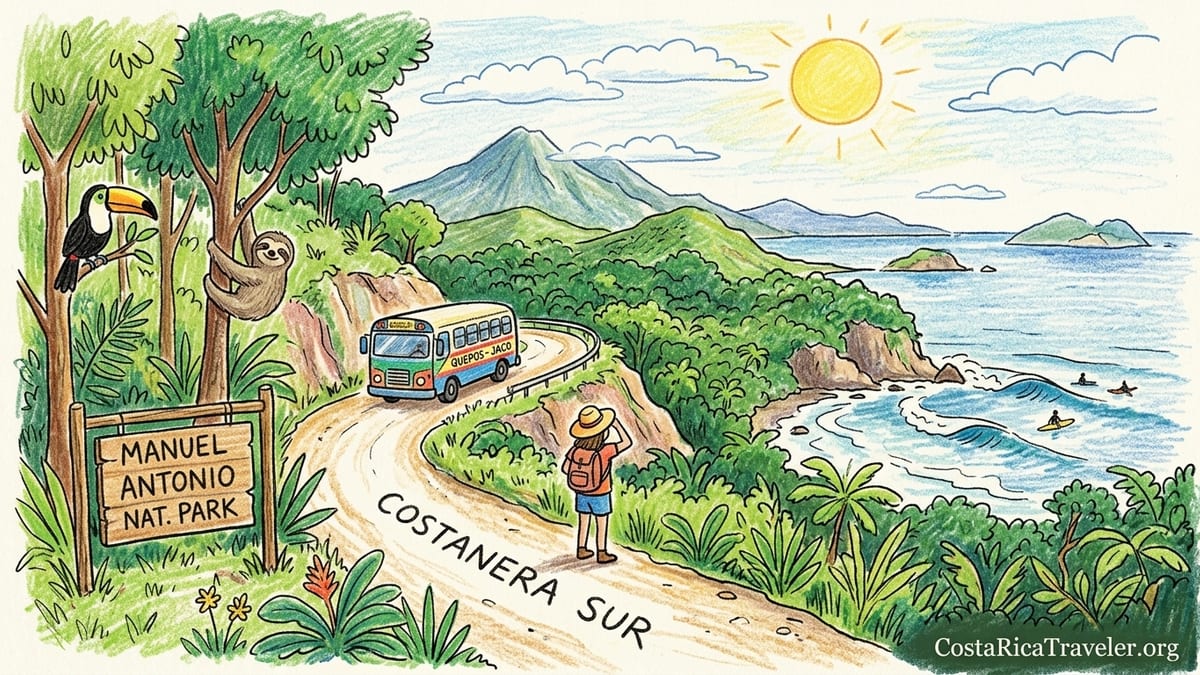
What I Tried to Fit Into One Central Pacific Trip
For context, I focused on Costa Rica’s official Central Pacific tourism region, the stretch of coast that runs roughly from Puntarenas and Jacó down past Quepos to the Río Barú area near Dominical. This band includes resort hubs like Jacó and Manuel Antonio, surf beaches such as Playa Hermosa and Esterillos, and wildlife hotspots like Carara and Manuel Antonio National Parks. The distances are not huge on a map, but the combination of narrow highways, slow traffic and tropical conditions make it feel much bigger.
My original one-week plan used three bases: two nights near Jacó, three nights in Manuel Antonio and two nights down near Dominical. From those stops, I tried to layer in a lot. Near Jacó, I had a dawn visit to Carara National Park, a late-morning crocodile boat trip on the Tárcoles River, and an afternoon surf at Playa Hermosa all scheduled on one day. In Manuel Antonio, I slotted the national park for a morning visit, followed by lunch in Quepos and an afternoon sunset sail. Around Dominical, I wanted to fit in a Nauyaca Waterfalls hike and a half-day at Marino Ballena National Park.
The first reality check was driving time. Jacó to Manuel Antonio is only about 75 kilometers, but in practice it took close to two hours once you factor in slow trucks and roadwork near Parrita. Official tourism and regional snapshots routinely estimate three and a half to four and a half hours from San José to Jacó or Quepos, and my own drives matched that range. That meant my carefully stacked days quickly turned into “transfer days,” where even one move between bases consumed the best beach or wildlife hours.
Heat and park schedules delivered the second reality check. Manuel Antonio National Park closes on Tuesdays and requires advance ticket purchases through the SINAC online system, with the park typically operating from early morning until mid-afternoon and the main beaches closing around 3 pm. Carara National Park opens at 7 or 8 am depending on the season and closes at 4 pm. By midday, both parks are extremely hot and wildlife activity drops. My fantasy of lingering over breakfast and then wandering into the forest at 10:30 simply did not work. If I wanted to see monkeys, sloths and birds and still enjoy the beach, I had to be inside the parks as close to opening as possible.
What Proved Unrealistic Once I Hit the Road
On day two, I learned the hard way that you cannot stack three marquee experiences and a transfer into a single tropical day. I left Jacó for Carara National Park right at opening. The park is only about 30 to 40 minutes by car from Jacó, but even with that short drive, by the time I bought my ticket at the ranger station, chatted with a guide and adjusted binoculars, it was nearly an hour later. A single loop on the accessible trail, with time to watch scarlet macaws and trogons, easily filled two and a half hours. I left already sweaty and hungry, and it was only late morning.
My plan had been to drive five minutes to a Tárcoles River crocodile boat tour, cruise for two hours, then head back to Jacó and catch a mid-afternoon surf session at Playa Hermosa. Technically, this was possible. A two-hour river tour, plus check-in time, bathroom breaks and a quick lunch at a roadside soda, put me back in the car around 3 pm. I could see the whitewater peeling in Hermosa as I drove past. But by then a classic Central Pacific pattern rolled in: big grey clouds, rising wind and the kind of sticky, late-day heat that saps your energy. I surfed for maybe 45 minutes before a heavy shower started. It was fun, but it did not feel like the long, unhurried session I had imagined.
The same stacking problem showed up in Manuel Antonio. One morning, I booked the earliest entry time and a guided wildlife tour inside the park, which typically lasts about three to four hours. Guides in the official guide association near the entrance routinely start at 7 am so visitors can catch the most wildlife before it gets hot. By the time we had slowly worked our way to Playa Manuel Antonio, spotted several sloths, white-faced capuchins and agoutis, and taken a swim, it was early afternoon and the main park beach was closing. My original plan called for freshening up and catching a 2 pm catamaran trip that included snorkeling and a sunset view. In practice, there was no way to comfortably shower, eat and transfer to the marina without compressing everything into a rushed, slightly stressful sprint.
Hotel changes amplified the problem. It is tempting to think that moving every two nights will “maximize variety,” but in the Central Pacific that often just means you re-pack and check in or out on days when you could have been on the water or in the forest. In my case, the transfers from Jacó to Manuel Antonio and then from Manuel Antonio to Dominical both swallowed half-days. I ended up cutting the Nauyaca Waterfalls hike entirely when a stormy forecast made the steep trail and river crossings feel questionable. That was the clearest signal that my original plan tried to tick off too many stops along the coastline.
If I Had Only 3 Days: One Base and One Big Decision
With just three days on the Central Pacific, I would now force myself to choose a single base and live with missing part of the region. The decision comes down to what matters most. If you want easy logistics and a classic mix of rainforest wildlife and beach, I would base in Manuel Antonio or Quepos and not move. If you care more about surf and nightlife, Jacó or neighboring Playa Hermosa makes more sense, again with no hotel changes.
From a wildlife perspective, Manuel Antonio is the stronger bet for a three-day stay. You can see howler and white-faced monkeys, sloths and a wide range of birds in and around the national park and nearby private reserves, without needing to drive north to Carara. I would anchor one full morning in Manuel Antonio National Park itself, which means paying close attention to the park’s schedule. The park is closed on Tuesdays, and tickets must be purchased in advance through the official SINAC online platform, choosing an entry time that suits your morning. I would book the first or second entry window, hire an official guide at the entrance and then spend the rest of the day at the park’s beaches or back at my hotel pool.
That leaves roughly two and a half days to play with. I would reserve one afternoon or evening for a mangrove boat or kayak tour in the Damas Island estuary near Quepos, which is known for its rich birdlife and the chance to see monkeys and crocodiles from the water. Another half day can go to a sailing or catamaran trip, timed to coincide with sunset over the Pacific. The remaining open windows can absorb the slow rhythm of the coast: a breakfast with ocean views, a swim at Playa Espadilla, or a walk up to one of the hillside viewpoints above the bay.
On such a short stay, I would skip Carara, Tárcoles and the push down to Dominical entirely. Those are worthy destinations, but the extra road time dilutes the experience. A three-day trip should feel like settling into one corner of the Central Pacific, not a preview reel of the entire region. In my notes after that first visit, I wrote a simple rule for three-day itineraries: choose one base, pick one marquee nature experience, and treat everything else as optional garnish.
Five Days: Two Bases and a Mix of Beach, Wildlife and Forest
At five days, the Central Pacific starts to open up. There is enough time to combine at least two different environments without every other day turning into a transfer. If I had five days to redo my own trip, I would still limit myself to two bases, most likely three nights in Manuel Antonio and two nights in Jacó or Playa Hermosa. That balance gives you both rainforest wildlife and a more open surf-beach setting, while keeping the one-way drive between bases to around two hours.
The first three nights in Manuel Antonio would look similar to the three-day outline, but with a more generous pace. I would dedicate day one to arrival and settling in, with maybe a short walk on Playa Espadilla if time allows. Day two would be the national park, booked carefully to avoid Tuesday closures. Because the park can get crowded and mid-morning temperatures spike, I would again choose an early entry time, hire a guide for the first couple of hours, and then keep the afternoon unscheduled in case rain moves in or I simply want a nap.
Day three becomes a flex day. If the weather forecast on arrival suggests clear mornings, I might slot a Damas mangrove tour or a local waterfall visit here. If I arrive in the middle of the rainy season and afternoons look stormy, I would instead leave this day open as a buffer, ready to swap it with the park day if needed. The key lesson from my own overstuffed itinerary is that you need at least one day in a five-day plan that can slide to absorb weather or fatigue. The Central Pacific’s green season usually delivers sunny or partly cloudy mornings with a high chance of afternoon rain, which means activities that rely on clear skies or calm seas belong early in the day.
After three nights, I would transfer north to Jacó or Playa Hermosa for the final two nights. The drive is straightforward, and shared shuttle services regularly connect Manuel Antonio and Jacó for around two to three hours of travel. Recent shuttle price lists show private transfers in the range of roughly 130 to 170 US dollars for a small group, with shared services costing less per person but locking you into fixed departure times. Whatever option you choose, I would schedule the move in the late morning so you can still catch an afternoon swim or surf at your new base.
From Jacó, you can access Carara National Park and the Tárcoles River on a dedicated morning, rather than trying to shoehorn them into a transfer day. Carara opens from 7 or 8 am depending on the month and closes at 4 pm, so you can easily walk one or two trails before the worst heat. Entrance fees for foreign adults are around the equivalent of 10 US dollars, according to the latest SINAC tariff tables, which is modest compared to the value of seeing scarlet macaws and other wildlife at close range. If you are not interested in birding or forest walks, you can trade that outing for a longer surf session or a ride down to Playa Hermosa, which is a well-known spot for more advanced waves.
Seven Days: A Meaningful North-to-South Route Without Constant Transfers
With a full week, it is tempting to dot the entire Central Pacific coastline with one- and two-night stays. My experience convinces me that this is exactly what you should not do. Instead, I would treat seven days as a chance to build a gentle arc from north to south with only two, or at most three, bases. My revised seven-day plan uses two main stops and one optional add-on, spending three nights near Jacó and four nights in the Manuel Antonio and Río Barú area.
Starting in Jacó for three nights serves two purposes. First, it breaks up the drive from San José, which often takes three and a half to four hours depending on traffic and weather. Second, it gives you access to both surf beaches and Carara National Park without the need for a long early-morning backtrack from Quepos. On this northern portion, I would schedule one dawn or early-morning visit to Carara, one unhurried day focused on the ocean and local beaches around Jacó and Hermosa, and one flexible day that could hold a Tárcoles crocodile boat tour or simply extra surf time.
After three nights, I would move south to Manuel Antonio and stay put for four nights. That extra night, compared with my original plan, is not about seeing more specific attractions. It is about absorbing the inherent unpredictability of a tropical coast. On my own trip, one of my planned beach days disappeared into a day-long front of heavy rain. Another afternoon, lightning storms shut down water-based tours. With four nights, you can schedule Manuel Antonio National Park once, leave a full extra morning in reserve to return if rain or crowds spoil the first attempt, and still have time for a mangrove tour and one boat or sailing trip.
If you are eager to include the southern Central Pacific around the Río Barú and Dominical, I would turn that into a carefully chosen day trip rather than another hotel move. From the Manuel Antonio area, the drive to Dominical usually takes about an hour and a half along the coastal highway when conditions are good. That makes it realistic to leave after breakfast, hike to Nauyaca or spend a few hours on the wide, more laid-back beach at Dominical, and still be back in Quepos before dark. The alternative, which I tried, is sleeping a night or two near Dominical and packing everything into shorter windows. In my notes, I underlined the phrase “adds one more unpack and repack” next to that idea.
On a seven-day trip you can also afford a true rest day, which matters more than most planners admit. I would deliberately label one mid-trip day as “no fixed plans” and allow that to be the place where a local recommendation, an unexpected invitation or simple fatigue can dictate the flow. In my case, that ended up being a day largely spent at a hillside hotel pool near Manuel Antonio, watching storms form over the ocean while capuchin monkeys played in the trees below. It did not appear on my original spreadsheet, but it turned out to be one of the clearest memories of the trip.
How I Now Choose Bases, Buffers and Park Days
Looking back, the biggest shift in my Central Pacific planning is philosophical rather than logistical. Instead of asking “How many places can I see in a week?” I now ask “Where do I actually want to wake up, and how many mornings do I need there?” On this stretch of Costa Rica’s coast, mornings are when the region shows its best self: wildlife is active, temperatures are bearable, and thunderstorms have not yet built. That is when you want to be entering parks, walking forest trails or paddling through mangroves.
For base selection, I treat Manuel Antonio and Jacó as the two pillars of a first Central Pacific trip. Each offers a different personality. Manuel Antonio mixes dense forest with cliffside hotels and compact beaches, and it is anchored by a national park that remains one of the country’s most visited protected areas. Jacó is more developed, with a busy main strip, a range of surf schools and easier access to Carara and the Tárcoles River. On a first visit, I generally advise choosing one of these for a short stay, or both for anything five days or longer.
Weather buffers are now non-negotiable in my own itineraries. Even in the dry season from December to April, the Central Pacific can deliver the occasional washout day or unusually strong winds that affect boat tours. In the green season, roughly May through November, afternoon thunderstorms are common, and certain activities, such as waterfall hikes or river crossings, can become unsafe after heavy rain. With that in mind, I schedule important fixed elements like Manuel Antonio or Carara early in the stay and leave at least one entirely uncommitted day in each base to absorb cancellations or simply allow rest.
As for park days, I will not stack two major parks on consecutive mornings unless I have at least six or seven days in the region. Walking for several hours in high humidity takes more out of you than most people expect. My own misstep was scheduling both Carara and Manuel Antonio in the first three days. If I were advising my earlier self, I would insert at least one pure beach or pool day between them. That is when you can enjoy simple pleasures: grilled fish at a beachfront soda in Jacó, or a sunset drink on a hillside terrace in Manuel Antonio.
Where I Would Cut on a Second Trip
It may sound strange for a travel writer to talk about removing places, but my time on the Central Pacific convinced me that omission is a form of respect for a destination. On a second trip, especially if I had seven days again, I would actually cut the number of beach stops. I would either stay entirely in the Manuel Antonio and Río Barú area, perhaps adding more time in Dominical and Uvita, or stay mostly around Jacó and Carara with only a brief extension south.
For example, I would probably skip staying in both Jacó and Playa Hermosa as separate bases. The two are close enough that you can reach one from the other in a short drive or even a quick taxi or rideshare. If surf is a priority, I might stay in Playa Hermosa and treat Jacó as the place to go for dinner or errands, rather than splitting nights. Likewise, if wildlife and quieter beaches are the main draw, I would resist the urge to add a last-minute night in Dominical to “see what it is like,” and instead commit to a longer stay in one area.
I would also reconsider how many organized tours I stack into a single week. Between guided wildlife walks, mangrove boat tours, sailing trips and adrenaline options like canopy ziplines, it is easy to fill every morning and afternoon with a set start time. What I found, though, is that some of the most rewarding Central Pacific hours were unstructured. Wandering Jacó’s black-sand beach at low tide, watching surfers at Playa Hermosa from the shade of a palm, or spotting squirrel monkeys in the gardens of a Manuel Antonio hotel required nothing but time and attention.
In practical terms, that means on a second trip I would choose at most one guided national park visit and one boat-based tour, then leave the rest of the days open for walking, swimming and exploring at my own pace. I would still buy park tickets in advance where required and remain aware of closure days, but I would be less inclined to attach everything to a guide or group excursion.
The Takeaway
Designing a Central Pacific Costa Rica itinerary is ultimately an exercise in choosing depth over breadth. My own experience, with its overambitious timelines and wet, hurried afternoons, taught me that road distances on a map say very little about the energy it takes to move along this coastline. Heat, afternoon storms, park hours, surf conditions and the simple act of changing hotels all conspire to limit what you can reasonably fit into three, five or seven days.
If I had to reduce everything I learned to simple time-allocation rules, they would look like this. With three days, pick one base and one marquee nature experience, likely Manuel Antonio National Park or Carara, and accept that you will miss the rest. With five days, use two bases, link wildlife and beach by pairing Manuel Antonio with Jacó, and protect at least one buffer day that can flex around weather or fatigue. With seven days, resist the temptation to hop every 50 kilometers. Instead, choose two main bases and enjoy the rhythm of mornings in the forest, afternoons by the sea and evenings listening to rain on a tin roof.
Most of all, remember that the Central Pacific rewards those who slow down. The scarlet macaws over Carara do not appear on command, and the perfect sunset over Playa Espadilla does not care how many color-coded cells are in your spreadsheet. Give yourself room to stay a little longer than seems necessary, and you might find, as I did, that the memories you carry home are not the number of parks you ticked off, but the unplanned hours between them.
FAQ
Q1. Is it realistic to visit both Carara and Manuel Antonio National Parks in one day?
It is technically possible to drive between Carara and Manuel Antonio in around two hours, but combining both parks in one day usually leads to rushed visits and fatigue. I recommend dedicating separate mornings to each, especially in the heat and humidity of the Central Pacific.
Q2. How many hotel bases should I plan for a 7-day Central Pacific trip?
For a week, I suggest two main bases, typically a combination of Jacó or Playa Hermosa and Manuel Antonio or the Río Barú area. Adding more bases often turns every other day into a transfer and reduces your meaningful time on beaches and trails.
Q3. What is the best way to get between Jacó and Manuel Antonio?
The drive between Jacó and Manuel Antonio usually takes around two hours along the coastal highway. You can rent a car, hire a private shuttle, or use a shared shuttle that runs on fixed schedules. Recent price lists show private shuttles for small groups in roughly the low hundreds of US dollars for the vehicle.
Q4. Do I need to buy tickets in advance for Manuel Antonio National Park?
Yes, tickets for Manuel Antonio must be purchased in advance through the official SINAC online system. You choose a date and entry time, and the park is closed on Tuesdays, so factor that into your itinerary planning.
Q5. When is the best time of day to visit Central Pacific national parks?
Mornings are best for both wildlife viewing and comfort. Parks like Manuel Antonio and Carara open early, and animals are more active before the strongest heat. By late morning or early afternoon, the combination of humidity, crowds and lower animal activity can make walks less rewarding.
Q6. Is Jacó a good base if I am not a surfer?
Yes, Jacó can work even if you are not focused on surfing. It offers a wide beach, plenty of restaurants, easy access to Carara National Park and the Tárcoles River, and a range of accommodations. However, if you prefer quieter surroundings and more rainforest, Manuel Antonio or the Río Barú area may suit you better.
Q7. How should I plan for rain when visiting the Central Pacific?
In the green season, expect sunny or partly cloudy mornings and a high chance of afternoon showers or thunderstorms. Plan key activities like park visits, waterfall hikes or boat tours for the morning and leave at least one flexible day in each base to absorb weather disruptions.
Q8. Is it safe to drive between Central Pacific destinations at night?
Local advice generally discourages night driving along the coastal highways due to narrow roads, limited lighting, sharp curves and the possibility of animals on the road. Whenever possible, schedule transfers between bases for daylight hours and arrive at your next destination before dark.
Q9. How far in advance should I book accommodations in Manuel Antonio and Jacó?
During the dry season and major holidays, popular hotels in both Manuel Antonio and Jacó can book out weeks or even months ahead. For high season, reserve well in advance. In the shoulder and green seasons, you have more flexibility, but booking at least a few weeks before arrival still helps secure better options.
Q10. What would you skip if you only had three days in the Central Pacific?
With just three days, I would skip the temptation to see the entire coastline. I would choose either Manuel Antonio for wildlife and compact beaches or Jacó and nearby Carara for a mix of surf and forest, and I would not attempt to add Dominical or the Río Barú area on such a short trip.