


I have spent just over three weeks in Costa Rica’s South Pacific, moving slowly from the mainland coast around Uvita and Dominical, out to the Osa Peninsula, and then farther south toward Golfito and the Panama border. I did this the way many independent travelers do: a mix of public buses and shuttles, a couple of rental-car stints, and more boat transfers than my day pack really wanted. What follows is not a neat list of “top” destinations. It is the route I actually took, where I slept, what worked, and what I would do differently if I had a limited amount of time to invest in this incredible corner of the country.
Starting on the Mainland Coast: Why I Based Myself Around Uvita
Across two different trips, I have spent a total of six nights in and around Uvita, split between a hillside guesthouse above town and a simpler cabina within walking distance of Marino Ballena National Park. Uvita is not a classic beach town with one obvious center. It is a spread-out service hub stitched together by the coastal highway and side roads that climb into the hills. That sounds unromantic, but it is exactly what made Uvita a smart first base for exploring the South Pacific. I could rent a car for only the days I needed it, walk to a supermarket, and still be at the park entrance in a short drive or a long, sweaty stroll.
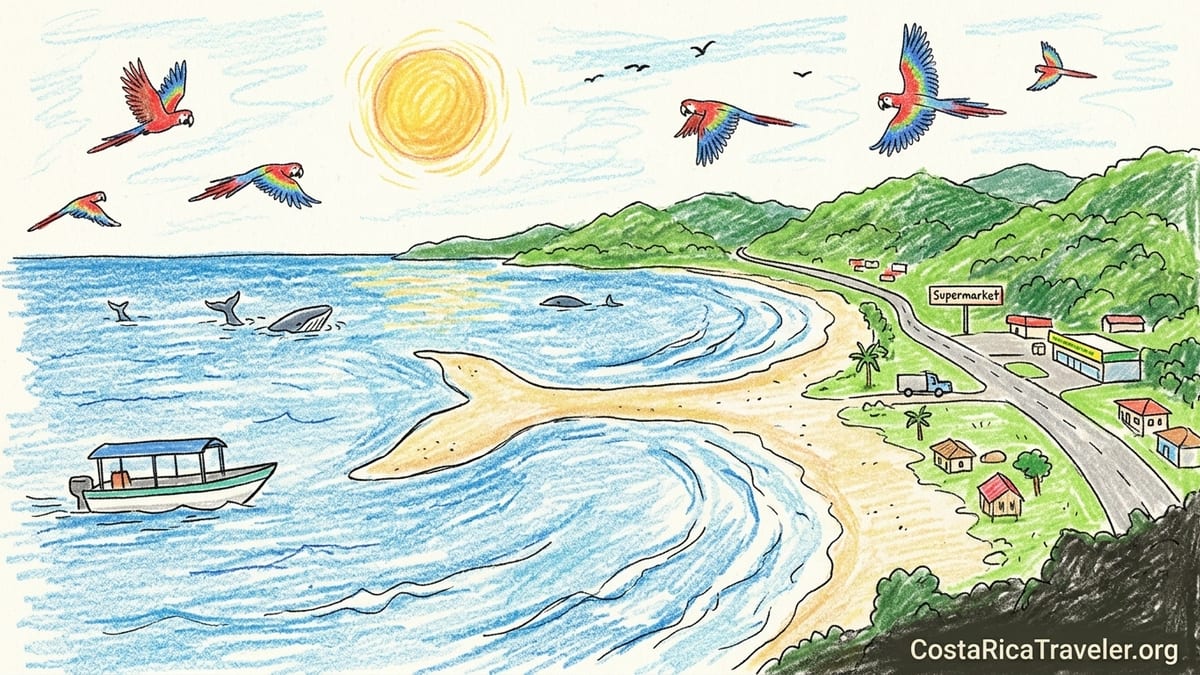
The real draw here is Marino Ballena National Park, Costa Rica’s first marine national park and one of the better-known places in the country to see humpback whales in season. The park protects a stretch of coastline that includes Uvita, Colonia, Arco, Ballena and Piñuela beaches, along with several small offshore islets. Inside the park, the sandbar that forms the famous “whale tail” is not just a drone-shot novelty. At low tide I could walk out along the rocky spine, with waves meeting from both sides, and look back at forested hills that still feel wild despite the town’s growth. Over two long days in the park I did little more than swim, walk, and watch scarlet macaws cross the sky at dusk.
From a logistics standpoint, Uvita is straightforward if you have your own wheels. With a rental car, it took me about 15 minutes from a hillside rental to the main park entrance, and around 25 minutes to reach quieter Piñuela beach to the south. Without a car, Uvita feels more complicated. Distances that look short on a map stretch out in tropical humidity, and the coastal highway is not pleasant to walk. I did one three-night stint here without a vehicle and relied on taxis for park visits and grocery runs. It worked, but costs added up and evenings were confined to whatever was in easy walking distance.
Would I stay overnight again? Yes, but deliberately. Uvita is less atmospheric than tiny beach villages, especially at night. The “evening scene” is scattered between a few restaurants, a craft beer bar, and small sodas along the highway. On my last visit I spent four nights, and that felt right: two full days for the park and whale-watching, and one flexible day for a day trip north to Dominical for surf and a sunset dinner. For a future South Pacific trip of 10 to 14 days, I would happily allocate three or four nights to Uvita as a mainland anchor for marine wildlife and easy tour logistics, even if I accepted that it is not the most charming place to wander after dark.
Drake Bay: Remote Feeling, Real Transfer Costs
Drake Bay was the part of my South Pacific trip that felt most like a frontier. I spent four nights there, all at small lodges within walking distance of the beach, and reached it twice via the classic boat route from Sierpe. The transfer itself is memorable: a low, covered boat slipping through mangroves, then out across the mouth of the Sierpe River and along the open Pacific before nosing ashore in Drake Bay. On my most recent visit, the morning boat from Sierpe left around mid-morning and arrived just after lunch, which meant that even though the distance was not great, a full travel day disappeared into buses, waiting times, and the boat run itself.
Once I was there, though, I understood why people build their entire itinerary around Drake. It is one of the most practical jumping-off points for Corcovado National Park and Caño Island. Over my four nights I did one full-day hike into Corcovado with a local guide, leaving by boat before sunrise and returning salty and exhausted after sunset, and one boat trip to Caño Island for snorkeling over reefs with reef sharks and sea turtles. The marine wildlife here felt richer than anything I had seen off the mainland coast. Dolphins rode the bow wave on the way back from Caño, and brown boobies tracked the boat almost all the way home.
Drake Bay’s main settlement is small and still feels like a village. In the evenings there were maybe a dozen low-key options for dinner, a couple of beach bars, and long stretches of dark coastline where the only lights were the lodges themselves. This is not a place for nightlife. After 9 pm, I usually found myself on a lodge deck listening to the surf and the insect noise, or tucked into a book under a fan. I was glad I did not rent a car just to get here. The boat ride handled the final approach, and any vehicle would have sat unused most of the time, since the best experiences are accessed by boat or on foot.
There is a trade-off, however. Drake Bay works best if you can commit at least three nights, and four or five if you want to mix Corcovado, Caño Island, and a free day for local trails and swimming. Anything shorter feels rushed for the amount of transfer time involved. On a tight itinerary of seven or eight nights in the South Pacific, I would think carefully before adding Drake. It offers world-class marine life, primary rainforest, and the sense of being right up against the wild edge of Costa Rica, but it also locks you into long, weather-dependent boat transfers that can eat up precious days if seas are rough or schedules shift.
Puerto Jiménez: Gateway Town That Grew on Me
Puerto Jiménez on the Golfo Dulce side of the Osa Peninsula is where my romantic notions of “remote jungle” collided with bus timetables, bank ATMs, and a surprising number of hardware stores. I spent three nights in and around Puerto Jiménez, arriving once by ferry from Golfito and another time by road from the north. At first glance it is an unremarkable port town, but it quickly proved its value as a base when I needed to string together park permits, boat tickets, and last-minute groceries.
Puerto Jiménez is the primary overland access point for several ranger stations in Corcovado National Park, and a growing cluster of jungle lodges sits within an hour or so of town. On my longest stay, I used Jiménez for one night on either side of a two-night lodge stay near the park boundary. Those transfer days highlighted its role as a logistics anchor. In the late afternoon, when boats returned from dolphin-watching on the Golfo Dulce and colectivos rolled in loaded with supplies, the town felt like a crossroads for everyone moving between the deeper Osa and the rest of the country.
With a car, Puerto Jiménez is easy enough to integrate into a road trip. The paved road in from the Inter-American Highway was in decent condition on both my visits, and the final stretch along the gulf is scenic. I did the approach once in a high-clearance SUV and once in a smaller rental, and only the final kilometers out to some rural lodges really demanded extra clearance. The bigger question is whether you need a car here at all. In town, I walked everywhere, and for visiting nearby beaches or lodges I either joined arranged transfers or hopped into shared taxis. If I came back strictly for Corcovado and Golfo Dulce, I would strongly consider skipping a rental car for this segment and relying on local transport instead.
Evenings in Puerto Jiménez are functional rather than romantic. There are a few simple restaurants, a bakery that stayed open late enough for post-dinner coffee, and the casual hum of a working town. It did not feel unsafe when I stuck to the main streets, but it is not a place to stroll the promenade in resort wear. Would I overnight again? Absolutely, but with purpose. Puerto Jiménez is less a destination than a staging ground. On a future trip I would give it one night before and after any serious Corcovado or Golfo Dulce adventure, using the in-between days to be deeper in the forest or across the gulf in quieter spots.
Golfito and the Golfo Dulce: Quiet Water, Subtle Payoffs
Across two South Pacific itineraries, I have spent a total of five nights in Golfito and one more at a small lodge across the bay. Golfito itself sits squeezed between the water and steep rainforest hills, a linear town that still shows its history as a banana-company port. It is closer to the Panama border than to San José, and when I walked along the waterfront in the evening, I saw more cargo boats and fishing skiffs than tourist catamarans. For travelers, that mix is both its charm and its challenge.
From a nature perspective, the Golfo Dulce is quietly spectacular. The gulf is partially enclosed by the Osa Peninsula and the mainland and is surrounded by protected areas such as Piedras Blancas National Park and the Golfo Dulce Forest Reserve. That combination creates calm, nutrient-rich waters that support dolphins, sea turtles, and impressive coastal birdlife. Over three days based in Golfito I joined one boat trip that doubled as local transport. We crossed the gulf toward Puerto Jiménez, detoured along mangrove-lined inlets, and stopped at a tiny beach where scarlet macaws fed in almond trees above the sand. It was some of the best casual wildlife viewing of my trip, and yet there were only a handful of other travelers on board.
Reaching Golfito is easier than it looks on the map, especially if you are already coming south along the highway. I arrived once by direct bus from Uvita, arriving mid-afternoon, and another time on a short domestic flight that landed at the small local airstrip a few minutes outside town. In both cases, taxis were waiting and fares into the center were modest. Having a car in Golfito itself felt unnecessary. The waterfront, duty-free shopping zone, and most small hotels and guesthouses are strung out along the same stretch, and I could cover most of what I needed on foot or by short taxi ride.
The trade-off is that Golfito is not a classic beach destination. There is water everywhere, but it is primarily a port town, with working docks, fuel depots, and metal-roofed houses pressed up against the hills. Nightlife is minimal outside of a few bars and local sodas, and there are fewer easily walkable swimming beaches than around Uvita or Dominical. I liked the sense of being in a real Costa Rican town that has lived through booms and busts, but if I had only a week in the South Pacific I would probably treat Golfito more as a two- or three-night detour for Golfo Dulce kayaking and boat excursions rather than a core base.
Farther South Toward Pavones: Surf Dreams and Bumpy Roads
Farther south again, I chased the idea of empty waves and a last-frontier vibe down to the Pavones area, where the road follows the coast toward the Panama border. I spent three nights near Pavones and another afternoon in tiny villages along the way. Pavones is famous among surfers for a very long left-hand point break that can run for hundreds of meters in the right swell. I do not surf at that level, but I wanted to see the town and understand whether it made sense on a broader South Pacific itinerary.
Getting there highlighted the trade-offs. I arrived once on a public bus that connected through Golfito and then bumped along a narrower coastal road, and once in a rental SUV from the north. The second time was more comfortable, especially after heavy rain, but even then the final approach was slower and required more attention than highway driving around Uvita. A car was useful here, because I wanted to explore beaches beyond the main point and stock up on groceries for a hillside cabina. Without one, I would have been limited to what I could walk or arrange locally.
As for the town itself, Pavones is essentially a scattering of small businesses and lodgings near the river mouth and along the dirt road. In the evenings, the atmosphere rotated around sundown sessions on the point and casual meals at a handful of restaurants and sodas. When the swell was up, the lineup was busy and felt quite focused. When conditions went quiet, the whole settlement relaxed into a slower rhythm of beach walks, hammock time, and card games under tin roofs. I liked the feeling of being almost at the end of the road, but it came at a price in transfer time.
Would I overnight again? If I were a committed surfer, absolutely. As a general South Pacific traveler, I would be more cautious. The waves and laid-back community make Pavones special, but the extra day it takes to get in and out means it competes directly with easier-access experiences on the Osa and mainland. On a trip shorter than two weeks, I would likely skip Pavones in favor of spending those nights either deeper in the Osa or adding a second mainland base.
Balancing Wilderness and Convenience: How I Would Restructure the Trip
Looking back at the nights I actually spent from Uvita to the border, the main lesson is that transfer days disappear quickly in the South Pacific. Boat schedules, river crossings, and winding secondary roads all add friction. That is part of the charm, but it means that every far-flung add-on has to earn its place. The places that did were those that offered either concentrated access to wildlife or a very comfortable base for exploring a wider area without constantly packing and repacking.
For marine wildlife and open-ocean experiences, Drake Bay still stands out. The combination of Corcovado access, Caño Island for snorkeling, and the sheer density of dolphins and seabirds I saw on the crossings made my four nights there some of the most memorable of the entire trip. The price I paid was time. Each entry and exit was effectively a half or full day of transport wrapped around boat schedules and tides. In contrast, Uvita and Marino Ballena gave me rewarding whale and dolphin sightings during the right months, long wild beaches, and comfortable infrastructure with much less transfer complexity.
For rainforest immersion without feeling totally cut off, the Golfo Dulce side near Golfito and Puerto Jiménez surprised me. Short boat rides put me into mangroves and national park buffer zones, while still allowing a return to simple but practical town life in the evening. I did not feel as exposed to heavy weather as on the open Pacific, and the water was calm enough for casual kayaking and paddleboarding. Yet neither Golfito nor Puerto Jiménez is the kind of place most travelers want to spend a week.
In retrospect, the biggest disappointment was my own tendency to chase one more remote corner instead of giving myself an extra night to simply be somewhere. Pavones, for me as a non-expert surfer, fell into that category. It was interesting and atmospheric, but the cost in time meant I was counting bus transfers when I could have been snorkeling in clearer water or hiking an extra day in Corcovado. That does not make Pavones unworthy, but it underlined how important it is to match destinations to your primary reason for being in the South Pacific in the first place.
The Takeaway: How I Would Divide a Future South Pacific Trip
If I had 12 nights for a future South Pacific journey, knowing what I know now, I would divide my time deliberately between the mainland coast, the Osa Peninsula, and the farther-south areas instead of trying to sample every possible stop. I would give four nights to the mainland coast around Uvita and Dominical, five nights to the Osa Peninsula split between Drake Bay and the Golfo Dulce side, and three nights to the far south only if surf or a border crossing toward Panama was a priority.
On the mainland coast, those four nights would be centered on Uvita with at least two full days inside Marino Ballena National Park. One would focus on simply walking the whale tail sandbar at low tide and swimming near Colonia beach, the other reserved for a whale-watching or dolphin tour in season. With a rental car for a couple of days I would add side trips to quieter beaches like Piñuela and up to Dominical for a sunset surf scene, then return the car before heading farther south.
For the Osa Peninsula segment, I would choose between two patterns depending on budget and tolerance for transfers. The first would be three nights in Drake Bay and two nights near Puerto Jiménez or at a lodge across the Golfo Dulce, focusing those days on boat-based wildlife and at least one serious Corcovado hike. The second pattern, if I wanted to minimize boats, would be to skip Drake and instead spend four or five nights using Puerto Jiménez and nearby lodges as a hub for both rainforest and gulf excursions. In both cases, I would limit nights in the towns themselves to what was needed for logistics and invest the rest in places where I could hear howler monkeys at dawn.
Farther south, I would only invest the remaining nights toward Pavones or the border region if I had a specific reason, such as chasing that legendary left-hand point break or continuing overland into Panama. For a first-time South Pacific visitor interested in a balance of marine wildlife, rainforest, beaches, and manageable travel days, the mainland coast around Uvita and the Osa Peninsula provide more than enough. The South Pacific rewards depth more than breadth. The more I returned to the same coves, trails, and tide pools, the more I saw. My ideal future itinerary would reflect that, trading one more pin on the map for an extra morning watching dolphins in the Golfo Dulce or an unhurried sunset over Marino Ballena’s long, changing line of surf.
FAQ
Q1. Do I need a rental car to explore South Pacific Costa Rica?
For Uvita and the mainland coast, I found a rental car very useful for reaching park entrances and nearby beaches. Around Drake Bay and many parts of the Osa Peninsula, I did not need a car because most movement was by boat or arranged transfers. In Golfito and Puerto Jiménez I could walk or use short taxis for most errands. If you are comfortable combining buses with a few taxis and shuttles, you can manage sections of the route without a car, but having one for at least part of the trip adds flexibility.
Q2. How many nights should I spend in Drake Bay?
Based on my two visits totaling four nights, I would recommend at least three nights in Drake Bay, and four or five if you can spare them. One full day is usually absorbed by a Corcovado National Park excursion, another by a trip to Caño Island for snorkeling or diving, and you will appreciate an extra day to hike local trails or simply recover from early starts and long boat rides. Anything less than three nights feels rushed for the amount of transfer time it takes to get there.
Q3. Is Uvita a good base for whale watching?
Yes. Uvita sits at the edge of Marino Ballena National Park, which is one of Costa Rica’s key areas for humpback whale watching during peak seasons. I used Uvita as a base for boat tours into the park’s waters and for long walks along the beaches inside the protected area. The town has enough operators, accommodations, and restaurants to make tour logistics straightforward, even if it lacks the compact charm of a smaller beach village.
Q4. What is the evening atmosphere like in these South Pacific towns?
Evenings in Uvita are low-key, with scattered bars and restaurants but no central nightlife strip. Drake Bay is even quieter, with most people turning in early after long days on the water or in the park. Puerto Jiménez and Golfito feel like working port towns in the evening, with a few local bars and sodas open but little in the way of tourist-oriented entertainment. Pavones focuses on post-surf social time at small eateries and beachfront spots, and the mood depends heavily on the swell.
Q5. How difficult is it to reach Golfito and the Golfo Dulce area?
In my experience Golfito was relatively easy to reach compared with more remote corners of the Osa. There are direct buses from points north along the highway and short domestic flights that land at the local airstrip just outside town. From Golfito, boats cross the Golfo Dulce to places like Puerto Jiménez and small beaches and lodges. The roads closer to the Panama border are slower and narrower, but they are passable in normal weather with either a sturdy sedan or a small SUV.
Q6. Is Pavones worth it if I am not a serious surfer?
For me as a casual surfer, Pavones was interesting but not essential. The town has a relaxed, end-of-the-road atmosphere and a stunning long left-hand point break, but the travel time to get there and back competes with experiences you can have more easily elsewhere in the South Pacific. If you are not drawn specifically by the wave or by the idea of a very quiet, surf-centered stay, you may prefer to spend those nights around Uvita or deeper in the Osa Peninsula.
Q7. Can I visit Corcovado National Park as a day trip?
Yes, but where you base yourself matters. From Drake Bay, I joined a long but rewarding day trip to Corcovado that involved an early-morning boat, guided hiking, and a return at sunset. From the Puerto Jiménez side, some ranger stations are accessible as day hikes with proper planning and guides. Even so, the travel time and early starts make overnight stays near the park edge or at jungle lodges appealing if you want a more relaxed schedule.
Q8. How safe did you feel traveling around the South Pacific region?
Most of the time I felt comfortable traveling solo with standard precautions. In towns like Uvita, Puerto Jiménez, and Golfito I stayed aware of my surroundings, avoided carrying valuables at night, and used taxis rather than walking long distances after dark. Remote lodges and Drake Bay felt very secure, with staff used to hosting international guests. As in the rest of Costa Rica, basic situational awareness goes a long way.
Q9. When is the best time to visit for marine wildlife?
My experiences with whales and dolphins were best when sea conditions were calm and visibility was good, which often aligned with drier months and recognized whale migration periods along the South Pacific coast. Because exact peak times and regulations can change, I would check current local information or tour operator guidance before planning a dedicated marine wildlife trip, especially if your main goal is seeing humpbacks around Marino Ballena or offshore from Drake Bay.
Q10. How would you prioritize destinations for a first South Pacific trip?
For a first visit with limited time, I would put Uvita and the Marino Ballena coast at the top of the list, followed closely by either Drake Bay or the Puerto Jiménez and Golfo Dulce area, depending on how comfortable you are with boat transfers. I would only add Golfito as a short side trip and reserve Pavones or the far south for future visits or for travelers with specific surf or onward-routing goals. That mix strikes a balance between marine wildlife, rainforest, beaches, and realistic transfer days.