


I planned my first trip to Costa Rica’s South Pacific expecting a simple choice between “dry” and “rainy” season. Once I arrived on the stretch from Dominical to Osa, I realized how misleading that is. This is one of the wettest parts of the country, rainfall increases the farther south you go, and what matters for travelers is not just whether it rains, but when in the day, how hard, and how that changes everything from trail mud to whale sightings.
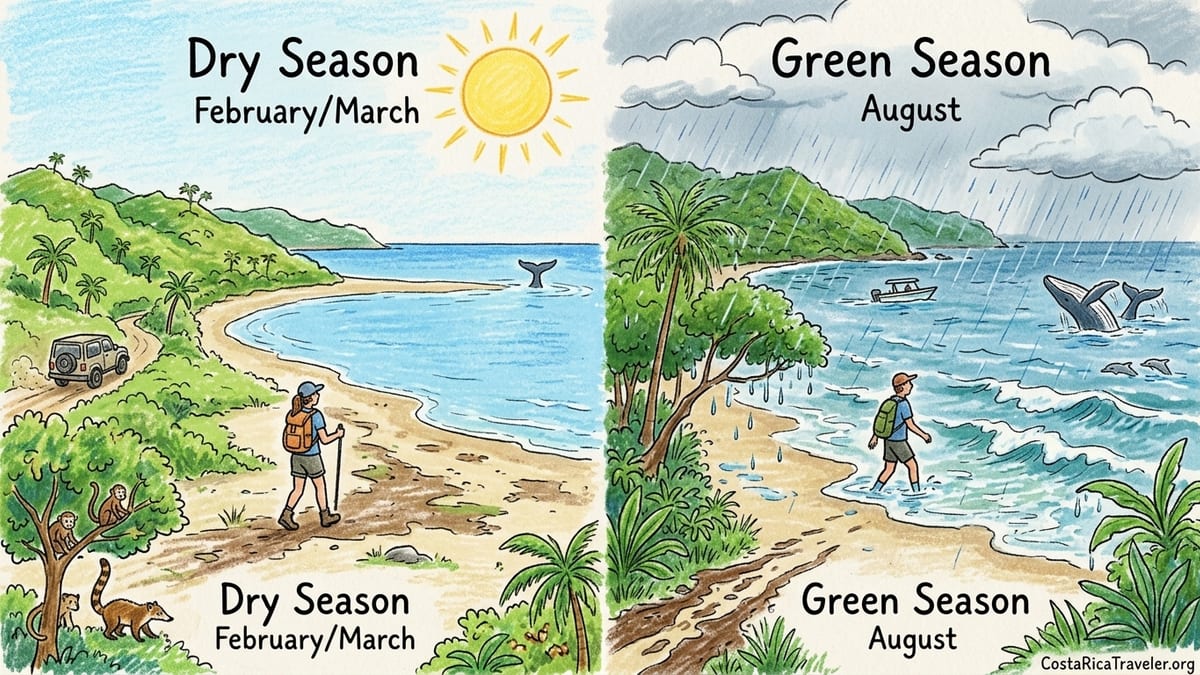
How I Experienced the South Pacific Climate
Before getting into patterns and planning, it is important to be clear about what I personally experienced on the ground versus what I researched later. My firsthand experience in Costa Rica’s South Pacific comes from two trips based around Dominical, Uvita and the edges of the Osa Peninsula. The first visit was in late February into early March, during the officially promoted dry period for this region. The second was in late August, in the heart of the greener, wetter season when southern humpback whales are most visible offshore. Everything I say about February, March and August in this article comes from being there on those exact trips. Descriptions of other months and broader seasonal patterns are drawn from climate data, local guides and official tourism information.
On both trips I stayed several days in Uvita and Dominical and spent time on the coastal highway, local buses and 4x4 transfers toward Osa. That gave me a good feel for how fast road and trail conditions change with rain, what “humid” actually feels like when you are hiking in dense forest, and how long storms really last compared with what guidebooks promise. It also allowed me to see how different the same beach can feel in different months, even if the air temperature is technically similar.
Throughout this article I will clearly label “From my February/March trip” or “From my August trip” when I am talking about firsthand experience. When I refer to whale migrations, long term rainfall averages or official guidance, that will be information I confirmed later through local operators and national tourism sources. That separation matters in a region where climate change is already shifting how reliable older rules of thumb really are.
February and Early March: My Firsthand “Dry Season” Reality
From my February and early March trip, the first surprise was how green the South Pacific still looked in what is marketed as dry season. Compared with the Guanacaste lowlands, hills around Dominical and Uvita remained lush, and afternoon clouds built almost every day. Over ten days, I had only two days without any rain at all. On the other eight, showers arrived mainly in short bursts. Typically the mornings were bright and clear, then thin clouds moved in by late morning, with a light shower or two in mid afternoon and, on three days, a heavier downpour around sunset.
On those heavier days, rain lasted roughly one to two hours, often with a clear break before and after. This meant that beach time was rarely lost completely. I could swim and walk at Playa Dominical or the Whale’s Tail in Marino Ballena National Park in the morning, retreat to a café or my cabina when the rain hit, then come back out for a pastel sunset. Visibility for coastal views remained good, although distant Osa ridges sometimes disappeared behind low cloud at peak downpours. Compared with August, though, the sea felt calmer and clearer, with gentle swell and fewer whitecaps near shore.
On trails in February and early March, I found mud to be present but manageable. The main path out to the Whale’s Tail was firm sand at low tide but slick in a few spots on incoming tides where small runoff channels formed. Inland, shorter rainforest hikes near Uvita and Dominical had patches of clay that became slippery after showers, but the overall experience was far drier than what I later found in August. I hiked in trail runners rather than full boots and only once ended the day with shoes fully caked in mud. River levels were modest, and small creek crossings on local waterfall trails were mid‑calf at most.
Humidity, Heat and Everyday Comfort in the Dry Period
From my February and March stay, humidity was high but not overwhelming in the mornings, climbing steadily toward midday. Around Uvita, I typically woke to air that felt fresh with a soft breeze, ideal for early walks along the beach or yoga on an open deck. By late morning, especially inland or uphill, the humidity became “shirt sticking to your back” intense. On days with passing showers, the brief rain would cool things for a short time, but the air quickly turned steamy once the sun returned.
In practical terms, this meant early starts made a huge difference. I scheduled most active outings between about 6:30 a.m. and 11:00 a.m. On one inland waterfall hike that began closer to 1:00 p.m., the combination of steep trail, reflective rock and concentrated humidity made the climb noticeably harder, even though the total distance was short. Back in town, I noticed fans were sufficient at night in simple guesthouses, although air conditioning was a welcome luxury in Uvita, particularly closer to the highway where breeze is less reliable.
Boat conditions off Uvita were also relatively gentle in this late dry period visit. From my February/March trip, swells were small enough that several guests, including children, remained comfortable on open bow seats. Approaches to Ballena Island and the Whale’s Tail sandbar felt smooth, with occasional spray but no pounding against chop. Smaller skiffs could approach rocky points and snorkel areas without the constant need to reposition. This calmer sea state made a big difference for anyone prone to motion sickness, and it also improved underwater visibility on days with enough sun.
On land, road conditions reflected the combination of seasonal dryness and residual moisture in this very wet region. The paved Costanera Sur highway between Quepos, Dominical and Uvita was in good shape on my February/March trip, even during brief storms. Where things changed quickly was on unpaved side roads leading to hilltop lodges and remote beaches. Dust was present on sunny days, but the underlying surface remained firm. After heavier evening showers, some steeper 4x4 driveways developed slick patches, yet taxis and transfer vans continued to run on schedule, and I never experienced a rain‑related road closure in this period.
Wildlife and Activities in Late Dry Season
From my February and March visit, wildlife felt active but slightly more concentrated around water. On short rainforest walks near Uvita, I saw howler monkeys almost daily in the early morning, along with agoutis and coatis near streams. Bird activity seemed strongest from sunrise to around 9:00 a.m., then tapered as heat and humidity rose. Guides pointed out that trees were carrying fewer fresh shoots than in the peak green months, so many animals were sticking closer to riparian corridors and fruiting trees rather than ranging widely across drier slopes.
For beach‑focused days, though, this late dry window was excellent. From my February/March trip, I enjoyed several hours each morning on the sand with full sun and minimal crowding, particularly at Playa Hermosa and the further reaches of Marino Ballena National Park away from main entrances. Surf breaks at Dominical and Dominicalito provided reliable waves for intermediate surfers, while a few surf schools still had smaller beginner waves in sheltered corners. The combination of strong sun, lighter winds and mostly clear skies created classic “postcard” conditions without the packed beaches you might find further north.
Whale and dolphin watching in late dry season is a more nuanced story. I did not schedule a dedicated whale tour on my February/March trip, but I did join combined snorkeling and coastal cruises out of Uvita. On those outings, boat captains and guides emphasized that early in the year is part of one of the humpback whale periods, but sightings were more hit‑or‑miss compared with the later green season. During one transfer by boat toward Caño Island, we briefly saw a distant spout and a tail slap, but nothing like the prolonged encounters that are typical from August through October. Based on my experience, travelers who choose February or March for this region should prioritize beaches, general wildlife and calmer seas, while considering whales a possible bonus rather than a guarantee.
Other activities linked well with this transitional dryness. Waterfall visits were still rewarding on my February/March trip, with enough volume for swimming pools at Nauyaca and smaller local cascades, but without the extreme force and brown runoff characteristic of peak rains. Zip‑lining and canopy tours around Dominical also operated smoothly in mostly dry conditions, and visibility into valleys was generally clear, which made the higher price of some tours feel worthwhile.
My August Trip: Living the “Green Season” in the South Pacific
My August journey into the same South Pacific corridor was a different world. This region is among Costa Rica’s wettest, and rainfall increases as you move south toward Osa. That pattern was immediately obvious. Over nine days based around Uvita, Dominical and boat trips further south, I logged rain on every single day. From my August trip, typical mornings still started mostly clear or partly cloudy, but clouds built faster, often by 9:00 or 10:00 a.m. Short showers could pop up before noon, and by mid afternoon, heavy downpours were common.
On four of those August days, I experienced true tropical deluges that lasted two to three hours, often arriving between about 2:00 p.m. and 5:00 p.m. These were not gentle showers. At their heaviest, visibility offshore dropped dramatically, with islands and headlands vanishing into gray sheets of rain. On several late afternoons and evenings, thunder rolled through the hills behind Uvita, and lightning flashed toward the inland ridges. There were also lighter days with more broken rain, where showers cycled through every hour or so, lasting 20 to 40 minutes each.
Trail conditions responded quickly. From my August trip, even short rainforest paths became saturated. The same inland hike that had been manageable in trail runners in February turned into ankle‑deep mud in multiple sections, especially on shaded clay slopes under dense canopy. Simple wooden steps and exposed roots grew slick after each storm. I used trekking poles and waterproof sandals for some local waterfall approaches, while keeping sturdier shoes dry in my pack for the return. At the coast, the sand path to the Whale’s Tail shoal at low tide remained walkable, but runoff carved deeper ruts, and standing water collected in depressions after repeated downpours.
Rivers and creeks were visibly higher during my August stay. Small side streams that had been easy rock hops in February were knee‑deep in places, and the main rivers feeding into beaches like Dominical took on a stronger current and browner color after sustained rain. On one waterfall trip, guides decided to modify the approach route because a usual crossing point had become too deep for casual visitors. These are decisions that locals make by eye, and they illustrate how flexible travelers need to be if they visit in the heart of the green season.
Humidity, Boats and Day‑to‑Day Comfort in August
August humidity in the South Pacific felt heavier and far more constant than in late dry season. From my August trip, there were almost no truly “fresh” mornings. Even at sunrise, the air felt thick, and clothing took longer to dry. Simple laundry washed by hand on my cabina porch sometimes stayed damp for more than a day. Inside lodgings without air conditioning, bedding could pick up a faint mustiness if windows remained open during intermittent showers.
This level of humidity changes how you plan activities. I shifted almost everything active to the very early morning, starting boat tours at 7:30 a.m. whenever possible and arranging inland hikes for 6:00 or 6:30 a.m. returns. By late morning, even cloud cover did not relieve the sense of saturation. It was not necessarily hotter than February, but the inability to escape dampness made rest time between outings more important. Cold drinks and shaded verandas stopped being luxuries and became essential recharging spots.
Boat conditions in August were more energetic. From my August trip, launches from Uvita’s beach involved wading through small but insistent surf, timing boarding with the waves. Once offshore, swells were longer and higher than in March, and certain days had pronounced chop. A few guests on my tours needed motion sickness tablets, and captains adjusted speed and route to avoid the worst of the whitecaps. Approaching Ballena Island and exposed reef areas required more care, and on one particularly rough afternoon, a planned snorkeling stop was shortened because surface conditions deteriorated.
Despite the rougher seas, this same August period delivered unforgettable whale encounters. From my August trip, on one three‑hour tour near Marino Ballena National Park, we spent almost an hour in the company of a mother humpback and her calf, watching repeated tail lifts, pectoral fin slaps and occasional short breaches at a respectful distance. On another day, we saw multiple groups spouting in different directions, with guides choosing the most relaxed animals to observe. Dolphins frequently rode the bow in cloudy light, even as rain squalls passed in the middle distance. The constant possibility of storms was the price of these rich marine experiences.
Wildlife and Green Season Trade‑offs
On land, August rewarded patience with dense, layered wildlife experiences. From my August trip, forest trails near Uvita yielded more bird calls and more visible movement in the mid canopy, even late in the morning when February outings had gone quieter. Toucans, tanagers and honeycreepers appeared more frequently around fruiting trees that had fully flushed in the wetter conditions. Frogs were also far more vocal at night. After heavy evening rains, walking short paths between cabinas turned into a chorus of chirps and croaks, and I saw several bright tree frogs on low vegetation at eye level.
Mammals behaved a bit differently as well. Howler monkeys still announced dawn spectacularly in both seasons, but in August I spotted them lower in the trees along watercourses, taking advantage of abundant foliage close to streams. Sloths proved easier to see in August on certain guided walks, partly because guides knew which trees were currently in leaf flush that attracted them. In drier late season conditions, some of those same trees had been more sparsely leafed out, and animals were more spread out across the landscape.
From a comfort perspective, however, this bounty came with limitations. Beach time in August required more flexibility and a willingness to get wet. I often had one or two usable beach windows per day rather than half‑day stretches. On several days, I managed sunrise walks at Playa Hermosa or Playa Dominicalito, then retreated by mid morning as clouds thickened and showers rolled in. Even when rain held off, humidity kept sand slightly damp, and towels never felt entirely dry. People still surfed happily in light rain, but sunbathers were rare compared with February.
Road conditions in August also changed the rhythm of travel. The main Costanera remained open during my visit, but I encountered more standing water, minor washouts along shoulder edges, and one temporary slowdown where crews were clearing mud from a previous night’s slide on a nearby slope. Side roads to remote lodges turned into genuine 4x4 tracks, with deep potholes filling with muddy water after every long storm. Drivers and local hosts were pragmatic about it: departures were sometimes moved earlier in the day to beat the heaviest predicted afternoon rain, and travelers were warned to expect margin in their schedules.
What I Researched Later: Patterns, Tourism Messaging and Activities
Outside my own February, March and August trips, I later dug into official and local information to understand the broader patterns. National tourism materials and regional guides currently describe the Pacific side, including the South Pacific, as having a main dry period roughly from mid December through April, with January through March emphasized for reliably sunnier, drier weather. April is framed as a transitional month, and rains typically build from May onward, peaking from around September through October. Within this, the South Pacific corridor from Dominical through Uvita to Osa is noted as one of Costa Rica’s wetter zones, with rainfall generally increasing the farther south you go.
Visit Costa Rica and regional promotional materials highlight beaches and aquatic sports during the dry period in this region. In practice, that lines up with what I saw in February and March: calmer seas, clearer snorkeling days around Marino Ballena National Park, and more consistently sunny beach mornings. At the same time, these sources and local operators place special emphasis on whale and dolphin watching during the greener months, especially when southern hemisphere humpback whales are present between roughly July and October, with a strong peak in August and September. There is also a second whale presence from Northern Hemisphere populations around late December to March, which helps explain the occasional sightings I glimpsed in the dry period.
Tour operators in Uvita and along the Ballena Coast currently schedule whale watching and combined snorkeling tours across much of the year, but they tend to stress different selling points by season. In drier months, marketing leans harder on clear water, beach time at the Whale’s Tail and family‑friendly sea conditions. During the green season, the focus shifts to the sheer probability of humpback encounters, lush green backdrops and dramatic skies. Prices for boat tours vary by operator, but in general, whale and dolphin watching excursions from Uvita are often advertised as half‑day trips that include park fees and basic refreshments, with some packages combining snorkeling or visits to nearby sea caves when conditions permit.
Beyond whales, the official seasonal guide for Costa Rica’s regions ties other activities to timing in the South Pacific. The dry period is associated with easier access to remote beaches, more beginner‑friendly surfing days in bays like Playa Colonia and Playa Piñuela, and straightforward driving on the coastal highway. The greener period is associated with stronger waterfalls, more intense rainforest experiences and increased opportunities for bioluminescence viewing in certain bays and gulfs, though that is weather and moon dependent. What my research reinforced is that there is no single best month, only different trade‑offs depending on whether you prioritize wildlife, calm seas, dry shoes or empty beaches.
How I Would Time a Return Trip
After feeling both late dry season and deep green season firsthand, I would not tell anyone that a single perfect month exists for the South Pacific. Instead, I would choose timing according to specific goals and my own tolerance for rain and humidity. For mostly beach‑driven travel, with a side of light wildlife watching and perhaps an opportunistic whale sighting, I would personally return in late February or very early March. From my February and March trip, that window gave me many usable beach hours, manageable humidity in the mornings, firm enough trails for casual hikers, and calm enough seas that even motion‑sensitive friends would likely enjoy a boat ride.
If my top priority were whales and marine life, I would choose late August again, or push into early September if my schedule allowed and I was comfortable with higher rain risk. From my August trip, the density and quality of humpback encounters outweighed the inconvenience of soaked shoes and shortened beach days. I would build in extra days specifically to account for tours rescheduled due to rough seas or intense afternoon storms and stay flexible about which activities happened when.
For surfing, my preference would be a shoulder period that still has some seasonal swell but slightly less intense rain than what I experienced in late August. Based on local advice and patterns I researched after my trips, I would look hard at May or June for a future surf‑centered visit to Dominical and nearby breaks. These months often see building swell and lush landscapes, with rains increasing but not yet at September and October levels. I cannot speak from personal experience for those specific months, so I would double check recent conditions with local surf shops before booking.
For fewer crowds overall, even if that means embracing wetter weather, I would lean into the heart of the green season outside national holiday periods. My August trip already felt quieter than late February and March, with more space on tours and easier last‑minute booking. If I wanted an even calmer experience and was comfortable with the real possibility of heavy, day‑long rain, I might consider October, while recognizing that some operators reduce departures in the wettest weeks and that road issues become more likely.
FAQ
Q1. Is January really dry in Costa Rica’s South Pacific?
January is generally one of the drier months on the South Pacific coast, with sunnier mornings and reduced overall rainfall compared with mid year, but this region is still wetter than many other parts of the country, and short showers can occur.
Q2. How much did it actually rain during your February and March visit?
On my late February and early March trip, it rained in some form on eight out of ten days, usually as one or two short afternoon or early evening showers and, on three of those days, a heavier one to two hour downpour near sunset.
Q3. What were trail and mud conditions like in so‑called dry season?
In late February and March, main coastal trails were mostly firm, with only scattered muddy patches, while some inland rainforest paths had slick clay after showers but remained manageable in regular trail shoes.
Q4. How did river and creek levels change between your visits?
In February and March, small creeks were shallow and easy to cross, usually no higher than mid calf, while in August those same crossings could reach the knee and carry a stronger current, with guides sometimes altering routes.
Q5. Was beach time still enjoyable in the August green season?
Beach time in August was enjoyable in shorter windows, especially at sunrise and late morning, but frequent showers and heavier afternoon storms meant planning around rain and accepting that towels and clothes might stay damp.
Q6. When would you personally go back for the best whale watching?
For humpback whales, I would return in late August or early September, when my own experience and local information align around higher chances of prolonged encounters, while building in extra days as a buffer for bad weather.
Q7. Which months would you pick for mainly beach and swimming conditions?
For primarily beach and swimming conditions in the South Pacific, I would personally choose late February or early March again, when I found calmer seas, longer sunny stretches and still‑green hillsides without constant heavy rain.
Q8. How important is having a 4x4 vehicle in this region?
On my February and March visit, a regular car worked for the main highway and many lodgings, but in August I was glad to rely on transfers and vehicles with higher clearance, as side roads and steep driveways became muddy and rutted.
Q9. Does wildlife viewing really improve in the green season?
From my August trip, forest wildlife felt more active and concentrated, with more bird calls, more visible frogs and easier sloth spotting on guided walks compared with the relatively quieter late dry season mornings.
Q10. If I want fewer crowds but not constant rain, what timing would you suggest?
For fewer crowds with some balance on weather, I would consider a shoulder month like May or June, when rains are building and landscapes are lush but conditions are often less intense than the peak of September and October, while confirming recent patterns locally before finalizing plans.