


Guanacaste’s Pacific coastline has quietly become one of the most sophisticated resort regions in the Americas. From the gated, ultra-lux enclaves of Peninsula Papagayo to the broad beaches of Conchal, Hacienda Pinilla, Tamarindo and Flamingo, travelers can now choose between polished five-star compounds, relaxed surf towns and everything in between. This guide compares the strongest beach resorts in these hubs, focusing on real-world factors that matter on a booking form: beach access, pools, spas, golf, restaurants, kids’ facilities, excursions, transfers and just how “inside the bubble” each property really feels.
Papagayo: Costa Rica’s Luxury Peninsula
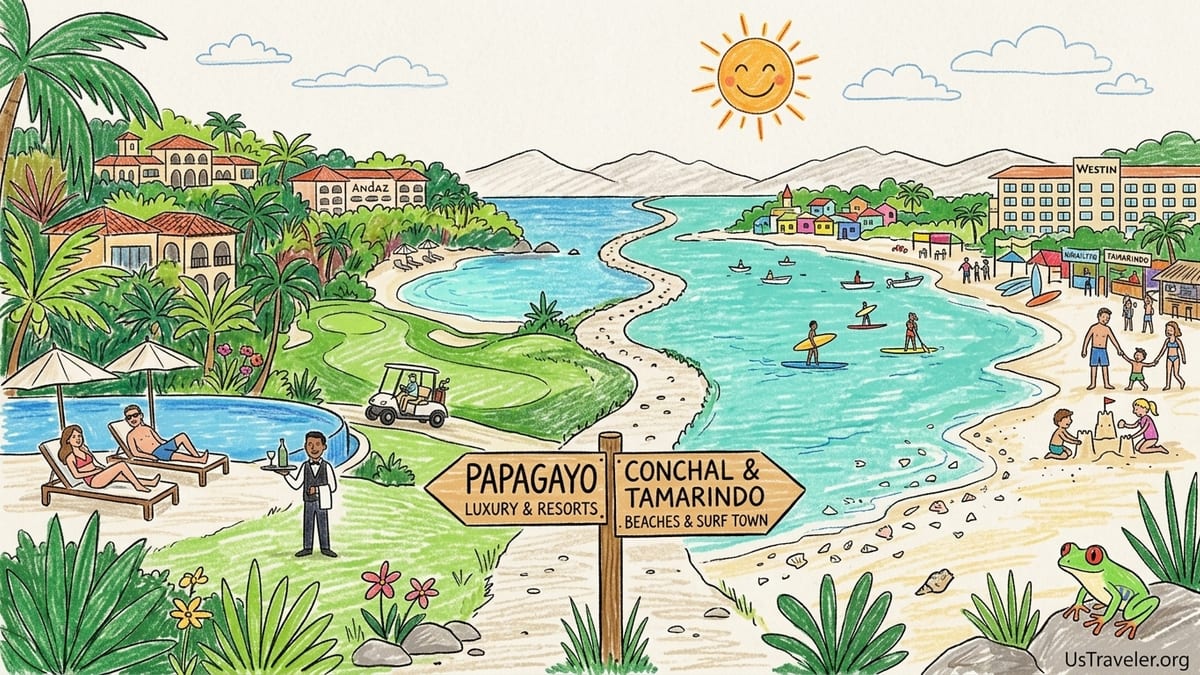
Peninsula Papagayo sits about a 35 to 45 minute drive from Guanacaste’s Liberia Airport, reached mainly by private transfer or pre-booked shuttle. The gated 1,400-acre peninsula is now the tightest cluster of luxury resorts in Costa Rica, anchored by Four Seasons Resort Peninsula Papagayo, Andaz Costa Rica Resort at Peninsula Papagayo and newer ultra-luxury arrivals like Nekajui, a Ritz-Carlton Reserve, and the Waldorf Astoria Punta Cacique. The feel here is polished and residential rather than town-based: once you pass the security checkpoint, you are in a controlled resort community rather than a public beach strip.
For many travelers, Four Seasons Papagayo remains the benchmark. The resort occupies a narrow ridge between two beaches, with dense tropical dry forest and views across Culebra Bay. Guests typically split their day between the calm bayside beach, multiple infinity pools, and the peninsula’s 18-hole Arnold Palmer golf course. Rack rates often sit in the 1,200 to 2,000 US dollar per night range in high season for entry rooms, and villas and private residences run much higher, which reflects both the consistent Forbes Five-Star status and current demand.
Andaz Costa Rica, managed by Hyatt, is the more design-forward and comparatively more affordable option on Papagayo, though in practice nightly rates can still run 500 to 900 US dollars in peak periods. Built into forested hillsides, it offers several tiered pools, three cove-style beaches including an off-site beach club accessed by boat, a spa, and a well-regarded Cambi kids’ club. By contrast, Nekajui and the Waldorf Astoria push further into ultra-luxury, with dramatic cliffside settings, high suite-to-room ratios, and a focus on private plunge pools, elevated wellness programming and curated excursions for guests willing to pay four-figure nightly rates as a starting point.
In practical terms, Papagayo works best for travelers who want a self-contained, high-service resort stay within easy reach of the airport. You will not be walking to casual local sodas or beach bars; most dining and activities are billed to your room and priced at international luxury levels. On the flip side, families and honeymooners appreciate the sense of security, the private-feeling coves, and the ability to arrange everything from ziplining in the nearby hills to boat trips into the Papagayo Gulf through on-property concierges.
Conchal: All-inclusive Beachfront and Emerging Luxury
Playa Conchal, roughly an hour and a half south of Liberia by road, is famous for its shell-fragment shore and turquoise water. The beach is fronted not by a town but by a resort development known as Reserva Conchal, home to Westin Reserva Conchal, a large all-inclusive resort, and a newer W-branded luxury hotel along with residences and a golf course. Compared with Papagayo, Conchal offers a broader sandy beach and a more classic “walk out to the waves” feel, but fewer separate five-star flags clustered together.
The Westin Reserva Conchal is one of Guanacaste’s most established upscale all-inclusive properties. Expect more than 400 rooms and suites arranged in villa-style buildings across extensive grounds, a sprawling lagoon-style pool that appeals to families, and multiple on-site restaurants included in the nightly rate. For many travelers, the predictability of an all-inclusive format is the draw: once you have paid, there is no need to watch every cocktail or snack. Typical high-season rates often start around the mid-400s to 600 US dollars per night for two adults, which can represent solid value for guests who plan to stay mostly on property.
The newer W-branded hotel within Reserva Conchal targets a younger, design-conscious crowd, with contemporary rooms, a beach club atmosphere and more of a boutique scale compared to the Westin. Both properties share access to the development’s amenities, including an 18-hole golf course and a beach club area with pools and restaurants. The beach itself is shared with day visitors at the public access end, but resort guests enjoy manicured loungers and service in front of their respective clubs, with jet skis, stand-up paddleboards and snorkel trips bookable directly from the sand.
Conchal’s drawback is that, like Papagayo, it is largely a planned development rather than an organic town. The nearby village of Brasilito, a few minutes’ drive away, adds more local color and budget dining options, but you will still rely on taxis or rental cars to get there. If you value a true walkable beach town over a resort campus, Tamarindo or Flamingo will feel more vibrant. If you prefer a stress-free week with kids around a huge pool, all meals handled and calm water for beginner snorkeling, Conchal is a strong contender.
Hacienda Pinilla and Tamarindo: Golf, Villas and Surf-town Energy
Continue south from Conchal and you reach the Hacienda Pinilla development and, slightly beyond, the surf town of Tamarindo. Hacienda Pinilla is a 4,500-acre gated community with ranch-style landscapes, trails, three main beaches and an 18-hole golf course. Here, JW Marriott Guanacaste Resort & Spa provides the primary full-service beachfront hotel experience, with condo and villa rentals filling in the rest of the inventory.
JW Marriott Guanacaste sits on Playa Mansita, a smaller cove within Hacienda Pinilla. The resort is known for its large central pool that faces the ocean, colonial-inspired architecture, multiple on-site restaurants and an impressive spa. Many rooms face either the pool gardens or the ocean. Rates often land in the 450 to 800 US dollar range in high season, and the property draws a mix of families, couples and incentive groups who like having golf and horseback riding inside the same gated footprint. Compared with Papagayo, the atmosphere is slightly more relaxed and less intensely manicured, with more sense of the wider ranch around you.
Outside the Marriott, Hacienda Pinilla’s villa neighborhoods attract travelers who want space and privacy but still prefer some resort-like structure: access to the Beach Club, shared tennis and pickleball courts, and easy drives to Tamarindo for dinners or surf lessons. This can work particularly well for extended families, since four-bedroom homes often price competitively against multiple hotel rooms, especially in shoulder season months like May or November.
Tamarindo itself is one of Costa Rica’s most famous beach towns, a crescent of sand backed by surf schools, casual bars, restaurants and small boutique hotels. It is a 20 to 25 minute drive from Hacienda Pinilla’s main gates. For travelers who want nightlife, independent cafes and the option to walk everywhere in flip-flops, Tamarindo delivers an energy that none of the gated developments can match. The trade-off is less seclusion and more everyday bustle: traffic at peak times, beach vendors, and a lively bar scene that might not suit travelers who go to bed early.
Flamingo: Marina Views and Boutique-scale Comfort
North of Tamarindo and west of Conchal, Playa Flamingo and the newer Marina Flamingo area offer another flavor of Guanacaste beach life. Flamingo’s main appeal is its broad, pale sand beach and the elevated headlands overlooking the bay, where many villas and smaller hotels take advantage of the views. The marina, which has been undergoing significant redevelopment, has brought in more yacht traffic, restaurants and a polished waterfront promenade feel.
Resort-wise, Flamingo is less about giant compounds and more about mid-size hotels and condos. Margaritaville Beach Resort Playa Flamingo is one of the most recognizable names here, occupying a prime position directly across from the sand. It functions as a casual, family-friendly resort with a central pool, multiple dining outlets, entertainment programming and easy beach access. Nightly rates often range from the mid-200s to 400 US dollars depending on season, and the atmosphere skews more laid-back than luxury, which many families appreciate.
Newer condo-style developments around the marina target travelers who prefer apartment-style living with access to rooftop pools and on-site restaurants rather than a full resort ecosystem. This makes Flamingo attractive for longer stays, digital nomads and groups of friends who want a comfortable base near both the beach and the marina for fishing charters and catamaran cruises. You are also within relatively easy driving distance of Conchal and Tamarindo for day trips.
The main compromise in Flamingo is that, while the beach and bay are beautiful, the resort and hotel infrastructure is more fragmented compared with Papagayo or Conchal. You might book a great room with a view but still need to walk or drive down a hill to the beach, or rely on local tour operators rather than on-site concierges for excursions. For independent-minded travelers, that can be a plus; for those who want everything handled inside one lobby, Papagayo or Conchal may be more straightforward.
Choosing Your Base: Beach, Pools, Golf and Spas Compared
For travelers who prioritize direct beach access, Conchal and Flamingo often come out ahead. Westin Reserva Conchal sits behind a short path to the sand, where the bay is usually calm enough for swimming and paddleboarding. Tamarindo offers an enormous surfing and walking beach, though many hotels sit across a small road from the sand rather than directly on it. Four Seasons Papagayo is something of an exception up north, with two beaches tucked immediately below the resort, but Andaz and other Papagayo properties often require walks or boat rides to reach their preferred swimming coves.
Pool culture varies significantly. Four Seasons and Andaz feature multiple tiered pools, with quiet areas for adults and splash-friendly zones for kids, while JW Marriott Guanacaste is built around one large, dramatic infinity-edge pool fronting the ocean. At the Westin Conchal, the pool is expansive and lagoon-style, wrapping around palm islands and sun decks, which suits families who spend whole days close to their loungers. In Flamingo, Margaritaville’s main pool is lively and central, but guests looking for more serene settings often gravitate to condo rooftops or smaller boutique hotel pools set back from the beachfront.
Golfers have three main bases to consider: Papagayo, Conchal and Hacienda Pinilla. Papagayo’s Arnold Palmer course offers scenic ocean views, dramatic elevation changes and country-club-style service, typically with green fees priced in line with North American resort courses. Reserva Conchal’s course is another respected option, easily accessed from both the Westin and the W. Hacienda Pinilla’s course threads through dry forest and pastureland, with a more rustic ranch setting but still enough challenge for serious players. Non-golfers, however, may prefer to focus on properties that invest more heavily in spa circuits and hydrotherapy pools, such as Four Seasons, Andaz, JW Marriott and some of the newer ultra-luxury Papagayo openings where wellness programming now rivals the golf offering.
Families, Couples and Activity Levels
Families with younger children often gravitate toward the Westin Reserva Conchal, Margaritaville Flamingo, JW Marriott Guanacaste, Andaz Papagayo and Four Seasons Papagayo. These properties all offer some mix of kids’ clubs, shallow pool sections and connecting rooms or suites. For example, Andaz’s Cambi kids’ program typically runs supervised activities like crafts and nature walks for ages roughly four to 12, while Four Seasons has its own branded children’s and teen offerings and can arrange family-focused boat trips and wildlife walks. At the Westin, the all-inclusive model simplifies budgeting for snacks and drinks, which matters if you are traveling with teens.
Couples and honeymooners, especially those willing to splurge, often compare Four Seasons Papagayo, the newer ultra-luxury Papagayo resorts, and the W at Conchal. The appeal is quieter adults-only pool zones, high-touch spa rituals, private dining setups and the possibility of booking suites with plunge pools or extended terraces. Some couples, however, prefer the bohemian feel of Tamarindo or the views from Flamingo’s hilltop villas, trading formal luxury for sunset bars, taco stands and independent coffeeshops a short walk away.
In terms of activity level, Papagayo and Conchal are perfect for travelers who want curated excursions arranged through a concierge: half-day zipline tours in the hills, catamaran sails, sportfishing, visits to volcanic hot springs inland, and guided hikes in nearby national parks. Hacienda Pinilla and Tamarindo lean into surfing, horseback riding and more independent exploration; you might rent a car and spend days beach-hopping along the Nicoya coastline. Flamingo is something of a hybrid, where you can walk to the marina to meet a fishing charter in the morning, then return to a quiet condo pool and a neighborhood restaurant at night.
If you are deciding between, say, Andaz Papagayo and Westin Conchal for a one-resort week with kids, the calculus often comes down to inclusions versus environment. Andaz feels more intimate and integrated into the forest, with a more boutique layout but à la carte pricing. Westin offers a conventional big-resort spread with a simpler budget picture. Many families with school-age children who want more variety of pools, snacks and casual food outlets ultimately lean toward Conchal or Flamingo, while those comfortable with higher nightly rates and a quieter, more controlled environment opt for Papagayo.
Access, Transfers and How Isolated You Will Feel
Nearly all of these resorts rely on Liberia’s Daniel Oduber Quirós International Airport, which has frequent nonstops from major US hubs during the North American winter. Papagayo is the closest cluster: in light traffic, a private transfer in an air-conditioned SUV or van generally takes about 35 to 45 minutes. Many luxury properties either arrange these directly or work with preferred ground operators, with one-way pricing commonly in the 80 to 150 US dollar range for a couple, depending on vehicle type. This quick access makes Papagayo popular for long weekends, corporate buyouts and travelers wary of long road journeys after a flight.
Conchal, Tamarindo, Hacienda Pinilla and Flamingo sit farther south and west; transfers typically run 60 to 90 minutes, with prices edging up accordingly. Some travelers choose to rent a car at Liberia instead, especially if they plan to beach-hop. Roads to these hubs are mostly paved but can be narrow, with occasional potholes and unmarked speed bumps as you approach towns and villages. During the heart of the rainy season, usually September and October, heavy downpours can slow travel and make a four-wheel-drive vehicle more reassuring, particularly if you plan to explore more remote beaches and backroads.
In terms of isolation, Peninsula Papagayo is the most self-contained. You will have multiple restaurants, bars, pools and activity desks, but you will not be strolling into a local town at night. Hacienda Pinilla is also gated, yet Tamarindo’s surf-town bustle is a short drive away, so many guests split their time between the two. Conchal and Flamingo land in the middle: they are not true towns in themselves, but nearby Brasilito and the emerging marina district offer at least a handful of local bars, sodas and tour kiosks.
This spectrum is worth considering before you book. If you know you prefer to explore independently, eat in small family-run restaurants and pop into surf shops, a full week sealed inside Papagayo may not be ideal. In that case, a split stay, such as four nights at a Papagayo or Conchal resort followed by three nights in Tamarindo or a Flamingo condo, can offer the best of both experiences without forcing you to compromise on beach or service levels.
The Takeaway
Choosing between Papagayo, Conchal, Hacienda Pinilla, Tamarindo and Flamingo is less about finding the single “best” resort and more about matching your travel style to the right stretch of coast. Papagayo delivers Costa Rica’s most concentrated high-end resort experience, with easy airport access, refined service, outstanding pools, serious spas and a broad slate of curated excursions, but almost no town life. Conchal brings an all-inclusive beachfront model and a more traditional sun-and-sand feel, ideal for families watching their on-the-ground spending.
Hacienda Pinilla and Tamarindo bridge the gap between resort structure and surf-town spontaneity, while Flamingo offers a marina-focused, boutique-scale alternative with strong beach access and growing dining options. As you compare specific properties, look beyond brand names to practicalities: whether you can walk straight to the beach or need a shuttle, how complex your airport transfer will be at the hour your flight lands, whether kids’ programming matches your children’s ages, and how much you realistically want to leave the resort during a typical day.
For many travelers, an intelligent split stay solves the dilemma: a few nights in a high-end Papagayo resort to decompress quickly after landing, followed by several nights in a Conchal, Tamarindo or Flamingo base with easier access to local life. With flight schedules into Liberia expanding each year and new resorts opening across the Gulf of Papagayo, Guanacaste now rewards travelers who take the time to think strategically about their base, so that the version of Pura Vida they experience matches exactly what they imagined when they booked.
FAQ
Q1. Which Guanacaste resort area is best for first-time visitors to Costa Rica?
For a first visit focused on relaxation, many travelers choose Papagayo for short stays because it is closest to Liberia Airport and has the smoothest logistics, or Conchal if they prefer an all-inclusive beachfront setup with a wide sandy bay and predictable costs.
Q2. How long should I plan to stay in Papagayo versus Tamarindo or Flamingo?
A common pattern is four to five nights in Papagayo to enjoy resort facilities and curated excursions, then three to four nights in Tamarindo or Flamingo for more independent exploring, surf lessons and varied dining.
Q3. Are resorts in Papagayo much more expensive than those in Conchal or Flamingo?
Nightly rates at the top Papagayo properties, especially Four Seasons and the newest ultra-luxury hotels, tend to be significantly higher than most Conchal and Flamingo resorts, though mid-range rooms at Andaz or JW Marriott can overlap with higher-category rooms at Westin Conchal or Margaritaville Flamingo in shoulder seasons.
Q4. Do I need a rental car if I stay at a resort in Guanacaste?
You do not need a car if you plan to stay mostly on property at Papagayo or Conchal and rely on resort-arranged excursions, but a rental can be very useful in Tamarindo, Flamingo or Hacienda Pinilla if you want to beach-hop, dine in town most nights or keep transfer costs down for a family.
Q5. Which areas are best for families with young children?
Families with younger kids often favor Westin Reserva Conchal, Margaritaville Flamingo, JW Marriott Guanacaste, Andaz Papagayo or Four Seasons Papagayo because of their kids’ clubs, shallow pool zones, family rooms and easy access to calm water activities.
Q6. Where should golfers base themselves in Guanacaste?
Golfers tend to choose between Papagayo, Reserva Conchal and Hacienda Pinilla, all of which have 18-hole courses attached to or very close to major resorts, so your decision can focus on whether you prefer a more secluded gated environment or proximity to a surf town like Tamarindo.
Q7. Is it easy to arrange excursions from these resort hubs?
Yes, all major resort areas have established relationships with tour operators, and concierge desks can arrange ziplining, catamaran cruises, wildlife tours and day trips to hot springs; in Tamarindo and Flamingo, you can also book many of these directly from beachfront kiosks and marina offices.
Q8. When is the best time of year to visit Guanacaste’s beach resorts?
The dry season from roughly December through April offers the most reliable sunshine and calm seas, while May, June and November can provide better value and greener landscapes, with heavier rains and occasional road disruptions more likely in September and October.
Q9. How far are these resorts from Liberia Airport?
Most Papagayo resorts lie about 35 to 45 minutes by private transfer from Liberia, while Conchal, Tamarindo, Hacienda Pinilla and Flamingo usually require 60 to 90 minutes depending on traffic, roadworks and weather conditions.
Q10. Is it safe to leave the resort and explore nearby towns?
Guanacaste’s main beach towns are generally considered safe for travelers who use normal precautions such as avoiding isolated beaches late at night, keeping valuables out of sight and using registered taxis, and many guests enjoy evening visits to Tamarindo, Brasilito or the Flamingo marina even when based in nearby gated resorts.