


I have spent several weeks over multiple trips roaming Costa Rica’s Northern Plains, basing myself in La Fortuna, Bijagua and Puerto Viejo de Sarapiquí. This region is the country’s adventure heartland, and as a repeat visitor I have now done most of the headline activities more than once. What follows is a personal account of the experiences I would genuinely repeat, with the kind of real-world details I wish I had known in advance: how I booked, what I paid, how long things took, how hard they felt in my legs and lungs, how good the guiding really was, what the weather actually did, and what wildlife I saw with my own eyes instead of from a brochure.
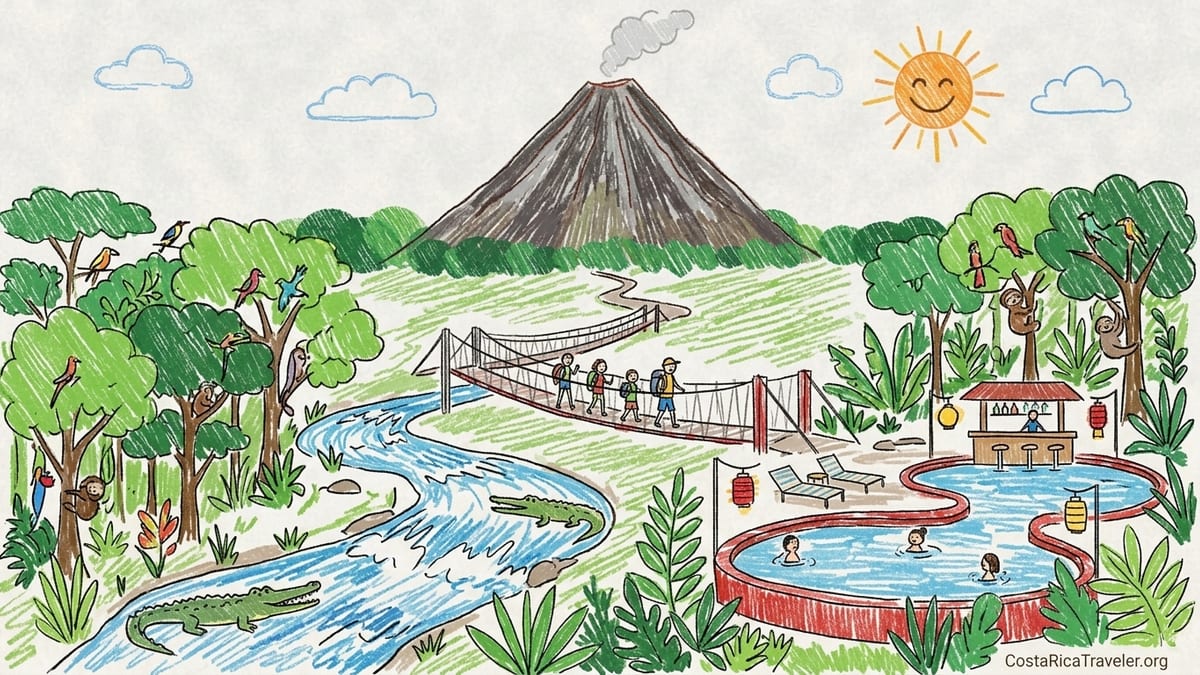
Hiking Arenal Volcano National Park: Lava Fields and Cloud Bursts
On my first Northern Plains trip I assumed Arenal Volcano National Park would be a quick viewpoint stop. Instead it became one of my favorite repeat hikes. I have now walked the main lava and forest trails three times, always entering through the official park sector west of La Fortuna. Each visit I simply drove to the entrance and paid the park fee by card at the gate, which in 2026 was noted locally as roughly the equivalent of twenty U.S. dollars for foreign adults. There was no online reservation system in place when I last visited, unlike more heavily regulated parks elsewhere in Costa Rica, so I arrived shortly after opening around 8 a.m. to avoid midday crowds and heat.
The classic circuit for me combines the Sendero Coladas lava flow trail and a section of forest path that loops toward a volcano viewpoint. Hiking at a relaxed but steady pace, with plenty of photo stops, the loop has taken me around two and a half hours each time. Elevation gain is modest, but the lava section is rocky, uneven and exposed. On my most recent visit in the green season, the day started with broken cloud and light wind, then shifted quickly to steamy humidity and a thirty-minute downpour that turned some stretches muddy. I was glad for trail shoes with real grip and a lightweight rain shell I could stuff into a small daypack.
Guides wait at the entrance and in La Fortuna town, and on my second visit I hired a local naturalist guide as part of a small-group afternoon tour sold through my La Fortuna hotel’s front desk. That bundled transport, guide and park entry for just over seventy U.S. dollars per person, and ran about five hours door to door including a short stop at a roadside viewpoint. The guiding quality was excellent: our guide carried a spotting scope, knew bird calls by ear and pointed out sloths, keel-billed toucans and an eyelash viper coiled on a branch a couple of meters off the trail. Hiking with a guide also meant a steady but never rushed pace, with plenty of water and bathroom breaks at the park facilities near the trailhead.
In terms of physical difficulty, I would rate the Arenal lava-trail loop as moderate. Families with school-age children were managing fine, but I saw a few people in flip-flops struggling on the jagged lava rocks. I would happily repeat the hike again, ideally on a morning with clear views of the volcano’s symmetrical cone. The combination of accessible rainforest, open lava flows and the constant sense of walking in the shadow of one of Costa Rica’s most famous peaks makes Arenal National Park feel like the essential first walk in the Northern Plains.
Soaking in La Fortuna’s Hot Springs After a Long Day Out
La Fortuna’s hot springs are such a defining element of the Northern Plains that I have now tried them three different ways: a high-end resort day pass, a mid-range complex and a visit to the free thermal river used by locals. On my most recent trip, I booked a late afternoon and evening at a mid-range resort with multiple pools and a swim-up bar. I purchased the day pass directly on the resort’s own booking engine a week in advance, paying just under sixty U.S. dollars per adult for entry only. Passes that include a buffet lunch or dinner tended to run between roughly seventy and one hundred dollars per person at comparable properties in September 2026, according to rate tables published by local booking services and the resorts themselves. I paid by card online and received a confirmation to show on arrival; no printed ticket was required.
From La Fortuna town, it took less than fifteen minutes by rental car to reach the front gate, where staff checked my reservation and fitted me with a wristband. I arrived around 4 p.m. and stayed until just before closing at 10 p.m., which felt like the ideal window. In daylight I could see the landscaping and get my bearings among the various pools, and after sunset the complex shifted to a quieter, lantern-lit atmosphere. Air temperatures hovered in the high seventies Fahrenheit with light drizzle, which made stepping into mineral pools heated by Arenal’s geothermal energy especially pleasant. Pool temperatures ranged from comfortably warm to very hot, and I alternated between hotter upper pools and slightly cooler lower ones along a small man-made stream.
All three times I have visited La Fortuna hot springs, the experience has been almost entirely about relaxation rather than wildlife, although I have seen fruit bats skimming the water surface at dusk and a few small frogs near landscaped edges. Service levels varied between properties, but at the better-run resorts pool attendants and restaurant staff were attentive without being intrusive, and the facilities were kept very clean despite steady visitor traffic. Towels and lockers were available at extra cost, typically involving a small refundable deposit for the towel and a few dollars for locker use, which I found worth paying to avoid bringing my own towel from the hotel.
Physically the hot springs are easy. Paths are paved, there are handrails on steps into the pools and plenty of loungers for resting. The main thing is to stay hydrated in the heat. From a value perspective, I would repeat a paid hot springs evening after a day of hiking or rafting, especially at a mid-range price point. I would probably skip the highest-priced flagship day passes, which can climb well above one hundred dollars per person with meals, unless I wanted a special-occasion splurge. For budget balance, I still appreciate the free riverside thermal area outside town, but I now treat that as a quick local experience rather than a full evening, since there are no changing facilities or staff and it can feel crowded.
Walking Mistico’s Hanging Bridges in the Morning Mist
Of the several hanging-bridge parks in the Arenal area, the one I keep returning to is Mistico Arenal Hanging Bridges Park, a privately run reserve a short drive north of La Fortuna. I have now walked its main loop twice, once with a guide and once independently. Both times I booked a timed-entry ticket directly through the park’s online reservation system, choosing an early morning slot at 7:30 or 8 a.m. The last time I visited, general admission for adults was listed in the thirty-to-forty-dollar range, with guided group tours costing noticeably more but including the guide and often transport if booked through local tour operators. I paid in advance by card and showed a digital voucher at the reception desk.
The core route is a paved and graveled loop of several kilometers with a series of fixed and hanging bridges suspended through and above the rainforest canopy. When I walked it without a guide, the circuit took me about two and a half hours with abundant photo stops. On my guided visit, which I booked through a La Fortuna agency as part of a three-stop package that combined hanging bridges, La Fortuna Waterfall and a volcano hike, the group spent closer to three and a half hours inside the park. That tour cost me just under one hundred and fifty dollars per person, including transport, lunch, all entrance fees and guiding at each site. It was a full ten-hour day, picked up at my hotel around 7 a.m. and dropped back around 5 p.m.
Weather and wildlife are why I now always aim for the earliest possible entry. On my first Mistico visit, the early morning was draped in light mist with overcast skies and temperatures in the low seventies Fahrenheit. That kept the hike cool and seemed to encourage bird activity. With the guide’s spotting scope we saw motmots, toucans, a trogon, a small troupe of howler monkeys and several coatis foraging near the trail. On my unguided return a year later during a drier period, I still saw leafcutter ants, lizards and plenty of birds, but without a guide I definitely spotted less than on the naturalist-led walk.
I would rate Mistico’s hanging bridges as easy to moderate depending on fitness level. The trail has some uphill sections, but much of it is paved and there are frequent benches. People of a wide range of ages and abilities were completing the loop at their own pace. If you are very sensitive to heights, some of the longer suspension bridges might feel challenging, as they sway slightly when others walk on them. For me the sensory payoff of standing at canopy level, wrapped in cloud forest sounds, far outweighed any nerves, and this is absolutely an experience I would repeat yet again, especially with first-time visitors in tow.
Hiking Río Celeste in Tenorio Volcano National Park
Río Celeste, inside Tenorio Volcano National Park north of Bijagua, is the one hike in the Northern Plains that I have driven several hours out of my way to repeat. The surreal milky-blue color of the river and waterfall feels almost impossible until you see it in person. On my latest visit in mid-2026, regulations at Tenorio had tightened compared with my first trip. Tickets were no longer sold at a simple cash ticket office; instead they had to be purchased online with a card, with a daily visitor cap and a last-entry cutoff early in the afternoon. Entry for foreign adults was described on Spanish-language park materials and local planning guides as just over thirteen U.S. dollars, charged in colones and payable only by card. Once in the system, my confirmation was checked by rangers at the gate alongside my passport number.
From the small town of Bijagua, the drive to the park entrance took me around forty minutes on a partly paved, partly gravel road in a standard two-wheel-drive rental car during the dry season. I parked in a private lot for a separate small fee of a few dollars, paid in cash. The out-and-back trail from the ranger station to the main waterfall, blue lagoon and El Teñidero takes most people around three hours according to official park brochures, and that matched my experience on both visits. The first stretch with its many steps down to the waterfall viewpoint is the most demanding; later sections undulate but are more gradual.
Weather makes an enormous difference here. On my first hike I underestimated just how wet and slippery the path could get. Rain showers arrived within an hour of starting, and sections of the trail became muddy and slick. The waterfall and river were still an incredible turquoise, but clouds settled low and visibility at some viewpoints was limited. On my repeat visit I chose a day with a better forecast, started right after the 8 a.m. opening and wore proper hiking shoes instead of light trainers. Conditions were vastly better, with bright but not harsh sun, humidity in the eighties and only one short shower. The river glowed an unbelievable blue at the waterfall and again at El Teñidero, where two clear streams join and appear to transform into one opaque turquoise flow.
Wildlife on the Río Celeste trail has been more subtle for me than around Arenal, but I have still seen poison dart frogs, several bird species and a small eyelash viper curled under leaves off the main path that a ranger pointed out. Park rules strictly prohibit swimming in the river inside the park, and there are rangers on patrol reminding visitors of that. Overall I would rate the hike as moderate to strenuous for those not used to stairs and heat. Families with children were managing, but some turned back after the waterfall section. Having now done it twice, I would absolutely go again, though only with proper footwear, a rain jacket and an early time slot booked well in advance.
Caño Negro Wildlife Boat Tour on the Frío River
The Caño Negro Wildlife Refuge, near the border with Nicaragua, offers some of the best freshwater wildlife viewing I have experienced in Costa Rica. I have done the classic boat tour twice, both times booking through tour operators in La Fortuna who bundled transport, guide, boat, lunch and refuge fees. On my most recent trip, I reserved at a local agency office in town the afternoon before going, paying just under one hundred and forty dollars per person. The van picked me up at my La Fortuna hotel at 7:30 a.m. and the entire excursion took around ten hours, returning just before 6 p.m.
The drive from La Fortuna to the dock near Los Chiles took close to two and a half hours along paved and then secondary roads. At the river, our group of ten boarded a covered motorboat with bench seating. My first Caño Negro tour had been on a smaller boat with only six guests, and if I have a choice I now always ask agencies about typical group size. Both times, the guide on board was a certified naturalist who spoke excellent English and Spanish and clearly spent a great deal of time on the river. He and the boat captain communicated constantly, slowing or idling whenever one of them spotted movement in the trees or shallows.
Weather along the Frío River has been hot and humid on both my visits, with temperatures easily into the high eighties Fahrenheit by late morning and only light cloud cover. The boat’s roof provided shade, but I was happy to have a hat, sunglasses and a high-SPF sunscreen. In terms of wildlife, Caño Negro has delivered some of the densest sightings I have had in the Northern Plains. On my first tour we saw two species of monkeys, caimans, iguanas, several heron species, roseate spoonbills, kingfishers and a sloth. On my repeat trip, during a different season, we added turtles, anhinga, black-collared hawks and a distant group of locals fishing on the banks, which gave the whole day a more lived-in feel beyond the wildlife.
Physically, the Caño Negro boat tour is easy, as you sit for most of the trip. The only effort is dealing with the long drive to and from La Fortuna and managing the heat. Both times lunch was served at a simple restaurant in town, with typical Casado plates of rice, beans, salad, plantains and a choice of chicken, fish or vegetarian options. I would certainly repeat Caño Negro again, perhaps basing myself in a closer town like Los Chiles for a night to shorten the logistics, but even as a La Fortuna day trip it remains one of my top recommendations for travelers whose main priority is birds and river wildlife.
Rafting the Sarapiquí River’s Class II–III Rapids
If you ask local tour desks in La Fortuna or Puerto Viejo de Sarapiquí about rafting, the Sarapiquí River almost always comes up first. I have rafted it twice on the section popular with adventure companies, rated at class II to III depending on water levels. My most recent run was booked from a lodge just outside Puerto Viejo de Sarapiquí, which partnered with a rafting company operating several daily departures. I reserved a morning tour two days ahead, paying roughly ninety U.S. dollars per person, which included transport from the lodge, all equipment, guides, snacks on the riverbank and lunch at a countryside restaurant afterward.
The day started with an 8 a.m. pickup and a short drive of less than thirty minutes to the put-in point. Weather was typical for the region: already warm and humid by morning, with soft cloud cover that later burned off into strong sun. After a detailed safety briefing in both Spanish and English, we were each fitted with helmets, life jackets and paddles and divided into rafts of six guests plus one lead guide. A separate safety kayaker accompanied us for the duration of the descent. The total time on the water was about two and a half hours, with several stops in calmer sections for swimming and photos.
Physically, rafting the Sarapiquí at this level felt active but accessible. You need to be able to sit on the raft’s edge, brace your feet and paddle strongly when the guide calls commands, but many first-timers and families with teenagers were on my trips. On my first run during the late rainy season, the river level was high and some rapids felt closer to solid class III, with exciting drops and bigger waves, but guides always positioned the rafts to avoid hazardous rocks or trees. On my more recent dry-season trip, water levels were lower, the ride felt slightly bumpier on rocks and some rapids a bit more technical, but overall it was still well within adventure holiday territory rather than hardcore whitewater.
Wildlife along the Sarapiquí was a pleasant bonus I had not expected on my first trip. During calmer stretches we drifted past kingfishers, toucans and riverbank herons, and heard howler monkeys calling from the forest. One guide pointed out a small group of white-faced capuchin monkeys leaping between branches overhead. The guiding quality on both of my runs was excellent, with a strong focus on safety and environmental respect. After two very positive experiences, the Sarapiquí is a section of river I would happily raft a third time, especially with friends who are new to whitewater and want something fun but not extreme.
Exploring Venado Caverns Underground
Venado Caverns, set near the small community of Venado north of La Fortuna, delivered one of the most memorable and different experiences I have had in the Northern Plains. I have done the caving tour once so far, and it is exactly the sort of activity I would repeat with the right group. I booked directly through a La Fortuna-based tour company that coordinated with the cavern guides. The half-day tour cost just over one hundred U.S. dollars per person and included round-trip transport, entrance fees, local caving guide, helmet, headlamp and basic refreshments afterward. We started mid-morning, with the van collecting us from our hotel around 9 a.m. and returning around 2:30 p.m.
The drive to Venado took roughly an hour and a quarter along increasingly rural roads. Unlike the better-known volcano and waterfall sites, the caverns felt immediately more off-the-beaten-path. At the small visitor center we met our local guide, who gave a safety briefing, helped us into boots, helmets and lamps, and explained that we would get wet and muddy. That turned out to be an understatement. Inside the caverns the air was cool and humid, around the mid-sixties Fahrenheit, a noticeable change from the heavy warmth outside. Over about ninety minutes underground, we waded through shallow streams, squeezed through narrow limestone passages, climbed small rock formations and stood in chambers glittering with stalactites and stalagmites.
Wildlife underground is not abundant in the same way as on a forest trail, but we did see small bats clinging to the ceiling in some chambers, cave crickets and other invertebrates. Our guide was clearly experienced and kept a close eye on all eight of us, offering a steadying hand at trickier squeezes and suggesting alternative routes for anyone who did not feel comfortable with certain sections. The tour companies describe Venado Caverns as moderately demanding, and based on my experience that is accurate. You do not need technical caving experience, but you should be reasonably agile, comfortable in confined spaces and ready to get wet. People who are strongly claustrophobic or have knee or back issues may not enjoy it.
I would repeat Venado Caverns with adventurous friends because it offered a refreshing contrast to the above-ground rainforest focus of most Northern Plains activities. The combination of cool temperatures, physical scrambling and the sense of discovery made it one of the most vivid mornings of my trip. The key, I learned, is to wear clothes you do not mind ruining, bring a full change for afterward and keep any valuables or electronics you care about dry in the waiting area.
The Takeaway
After multiple trips through Costa Rica’s Northern Plains, the activities I find myself recommending, and in many cases repeating, form a clear pattern. Hiking Arenal’s lava trails connects you directly with the landscape that made this region famous. Long afternoons in La Fortuna’s hot springs soak away the effort of hikes and river days. Hanging bridges at Mistico lift you to canopy level in a way that feels almost impossibly cinematic until you hear the bird calls around you. Río Celeste delivers one of the most startling natural colors I have ever seen on foot. Caño Negro’s river boat rides and the Sarapiquí’s class II–III rapids show two very different faces of the area’s waterways, one contemplative and full of birds, the other splashing and adrenaline-fueled. Venado Caverns, finally, takes you below the surface altogether.
For a first or second visit, you do not need to do everything. If your time is short and you enjoy walking, I would prioritize Arenal National Park, one hanging-bridge park such as Mistico and either Río Celeste or the Sarapiquí rafting depending on whether you prefer hiking or river adventure. Add an evening at a hot springs resort and, if you can spare a long day, a Caño Negro wildlife tour. If you crave something different and are comfortable underground, include Venado Caverns. These are the experiences I would gladly repeat, not because brochures told me to, but because on real trips with real weather, real mud and real schedules, they have consistently delivered.
FAQ
Q1. How far in advance should I book Northern Plains activities like Río Celeste and Mistico Hanging Bridges?
For experiences with daily visitor caps or timed entries, such as Tenorio Volcano National Park for Río Celeste and Mistico Hanging Bridges, I now book at least several days ahead in the main dry months of December through April and a day or two ahead in shoulder or rainy seasons. Arenal Volcano National Park and most hot springs usually accept same-day visitors, but for bundled tours that include transport and guides from La Fortuna, I have found booking one or two days in advance gives the best choice of departure times.
Q2. What kind of footwear do I really need for these activities?
On my first visit I underestimated the terrain and wore light trainers that struggled with wet mud and lava rocks. After repeating the hikes, I now strongly recommend closed-toe hiking shoes or trail runners with good grip for Arenal, Río Celeste and Mistico, plus secure sandals or old sneakers for rafting the Sarapiquí. For Venado Caverns the tour operator provided rubber boots, but I still wore synthetic socks and quick-drying clothes. Flip-flops are fine only for hot springs areas, not for trails.
Q3. Are guided tours worth the extra cost compared with self-guided visits?
Based on my repeat experiences, guides make the biggest difference on wildlife-focused and complex activities. I would not skip a guided naturalist on Caño Negro or the Sarapiquí river, where interpretation and safety are central. At Mistico and Arenal, having a guide once helped me spot far more birds and reptiles than I would have alone. On repeat visits I have enjoyed going self-guided with the knowledge I gained earlier. For Río Celeste, the well-marked single trail makes a self-guided hike very feasible if you are comfortable organizing your own transport and tickets.
Q4. What did you actually pay for these experiences on your latest trip?
On my most recent Northern Plains circuit in 2026, I paid in the rough ranges of twenty U.S. dollars equivalent for Arenal Volcano National Park entry, low- to mid-thirties for Mistico’s basic admission, a bit over thirteen dollars equivalent for Río Celeste’s Tenorio park entry purchased online, sixty to one hundred dollars for a mid-range La Fortuna hot springs day or evening pass depending on meals, around one hundred and forty dollars for a full-day Caño Negro tour from La Fortuna, around ninety dollars for Sarapiquí rafting from a local lodge and just over one hundred dollars for the Venado Caverns half-day tour with transport. All of these were paid by card, with small extra cash amounts for parking or tips.
Q5. How physically demanding is a typical Northern Plains itinerary with these activities?
My own experience as a reasonably active traveler is that combining these activities across a week creates a moderate overall workload. Arenal, Mistico and Río Celeste involve several hours of walking with some stairs and hills, which can be tiring in humidity but manageable with breaks. Sarapiquí rafting and Venado Caverns feel more intense in short bursts rather than sustained exertion. Caño Negro and hot springs are easy on the body. For families, I would avoid scheduling the most strenuous hikes back-to-back without at least one easier day.
Q6. What kind of weather did you actually encounter, and how did it affect plans?
Across my visits I have encountered almost every version of Northern Plains weather: clear mornings with volcano views, sudden afternoon downpours, overcast cool starts on hanging bridges and hot, still days on the rivers. The main impact was on trail conditions and visibility. Río Celeste in heavy rain became muddier and some sections more slippery, while views at Arenal’s lookouts could be completely clouded in. To mitigate that, I now plan key hikes early in my stay so I can adjust to a clearer day if needed, always carry a lightweight rain jacket and pack a dry bag for electronics.
Q7. Did you see as much wildlife as the brochures promised?
Not every walk looked like a documentary, but across multiple days I saw an impressive amount. With guides I spotted sloths, several monkey species, toucans, trogons, frogs, caimans and a variety of herons and kingfishers. On self-guided walks at Arenal and Mistico I saw plenty of birds, insects and occasional mammals, but fewer than on guided outings. Caño Negro delivered the most concentrated wildlife sightings in a single day, and rafting the Sarapiquí gave a satisfying mix of birds and monkeys between rapids. I have learned to treat brochure photos as a composite of many days rather than a guaranteed list for any single tour.
Q8. Is it realistic to base in one town and do all these activities?
On my first trip I tried to do almost everything from La Fortuna, which was possible but made Caño Negro a very long day and turned Río Celeste into a long drive. On later trips I broke things up by staying in La Fortuna for Arenal, Mistico, hot springs and Venado Caverns, spending a night or two in Bijagua for Río Celeste and a couple of nights around Puerto Viejo de Sarapiquí for rafting and additional nature walks. You could still do a lot with La Fortuna as a single base, but if you have more than six or seven days, spreading your overnights makes the days feel far more balanced.
Q9. How did you handle meals and water on these outings?
For national park hikes like Arenal and Río Celeste, I carried at least one and a half liters of water, some fruit and simple snacks, and ate proper meals back in town. For guided day tours, such as Caño Negro and Sarapiquí rafting, the operators included either a full lunch or hearty snacks, so I only needed extra water and small energy bars. At hot springs, I bought drinks and meals on-site. Tap water at my accommodations in La Fortuna, Bijagua and Sarapiquí was safe to drink, so I refilled bottles each morning rather than buying disposable plastic bottles.
Q10. If you could only repeat three experiences from the Northern Plains, which would you choose?
Forced to choose, I would repeat Mistico Hanging Bridges for the canopy perspective and accessible wildlife viewing, Tenorio’s Río Celeste hike for its otherworldly river color and balanced physical challenge, and the Sarapiquí rafting trip for a combination of adrenaline and rainforest scenery. A close fourth would be an evening at a well-run La Fortuna hot springs resort after a long day out. Those four together, spread over several days, capture most of what I love about Costa Rica’s Northern Plains.