


By the time our raft slid off the rocky shore of the Sarapiquí River and the first splash of cold green-season water hit my face, I had already cycled through excitement, nerves, and a few quiet what-am-I-doing-here moments. I had read that this 84-kilometer river in Costa Rica’s Northern Plains is both a wildlife corridor and one of the country’s classic white-water destinations, especially recommended in the green season from May to November. I wanted to know what that actually feels like from inside the raft. This is exactly how my day unfolded.
Choosing a Sarapiquí Operator and Booking the Trip
I based myself in La Fortuna and quickly discovered that most adventure agencies there now send first-time rafters to the Sarapiquí rather than the closer Balsa River. Several outfitters explained the same thing in slightly different words: the Sarapiquí is cleaner, more scenic, with better wildlife and a steadier progression of rapids. One La Fortuna operator I visited in person offered both Balsa and Sarapiquí, but the staff member pointed at photos of the Sarapiquí’s clear green water and said, "If you want a real river feel and still stay in Class II–III, pick this one."
After comparing options, I booked a Class II–III trip on the La Virgen to Chilamate section, a roughly 7 to 8 mile stretch that local lodges describe as a mix of “crystal-clear pools and lively rapids” surrounded by thick forest. Several companies sell essentially the same section, whether you start in San José, La Fortuna, or from a lodge in La Virgen. Prices when I went ranged around 60 to 90 US dollars per person for a half-day tour without long-distance transport, and closer to 90 to 140 US dollars if hotel pickup from San José or La Fortuna was included, in line with current quotes I saw across booking platforms and operator websites.
I ended up reserving directly through a small outfitter based near La Virgen after reading recent traveler reviews and confirming that they specialized in this river. What mattered to me was guide experience, group size, and safety record more than the exact brand name. In practical terms, the booking process was straightforward: I messaged them the day before via WhatsApp, they replied in fluent English within minutes, and I secured my spot with a card payment link for the next morning. They sent a confirmation with the pickup time, a packing reminder for clothes, and a note that no prior rafting experience was necessary.
If you prefer not to drive, many travelers book through an agency in Arenal or San José that bundles in transportation on top of the local rafting operator’s service. The trade-off is cost and time: a San José day trip can run to ten or more hours door to door, with a significant portion on the highway, while staying near La Virgen or Chilamate cuts your day down to the river itself.
Pickup, Road to La Virgen, and First Impressions of the Northern Plains
The van reached my La Fortuna hotel a little after 8 a.m. It was a standard Costa Rican tourism shuttle: clean, air-conditioned, and already half-full with a mix of North American and European travelers. The guide introduced himself, checked our names off a clipboard, and did an informal gear audit on the spot: "Closed shoes? Sunscreen? Dry clothes for later?" Anyone missing essentials could rent river shoes or buy a cheap dry bag once we reached the operations base.
The drive from La Fortuna to La Virgen took about an hour and twenty minutes, following the relatively new Route 4 across the Northern Plains. As we dropped out of the volcano foothills, the landscape flattened into a patchwork of pineapple fields, pastures, and pockets of rainforest. A couple of times the guide pointed out the ribbon of the Sarapiquí itself, sliding through the trees, and talked about how the river forms part of a larger wildlife corridor between protected areas like La Selva Biological Station and private reserves along its banks. The Costa Rican Tourism Board promotes this whole region as a green-season destination, and watching black clouds stack up over the Caribbean side, I started to see why. The river looked full and moving, but not frighteningly high.
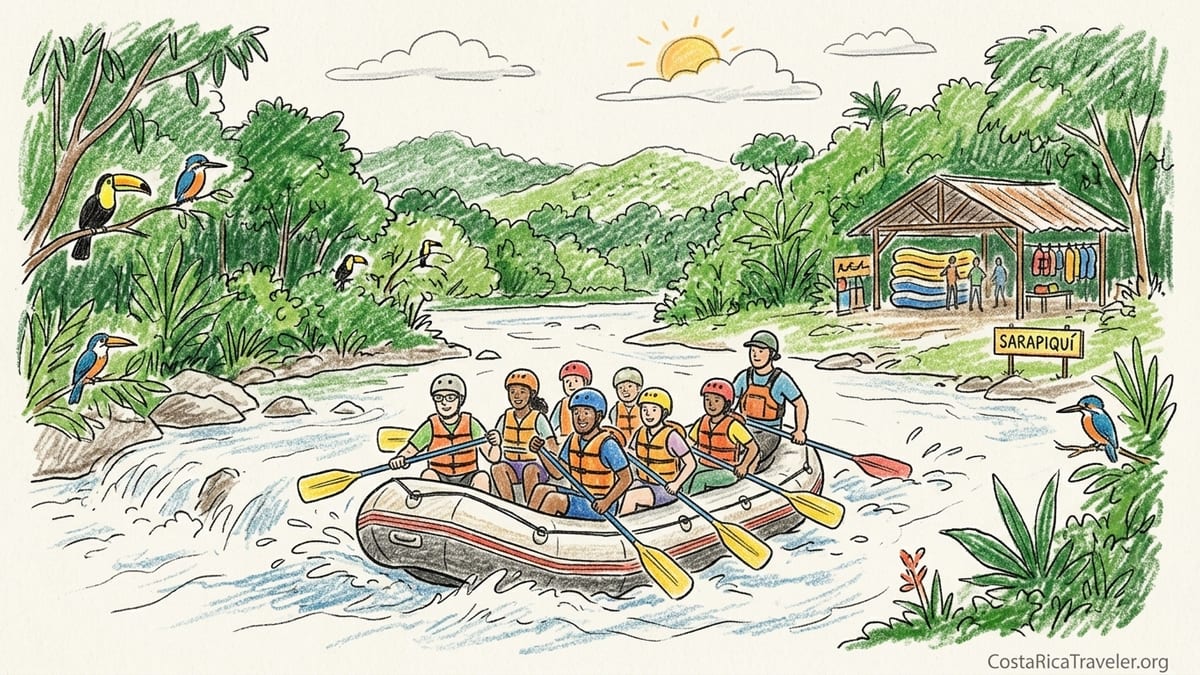
At the outfitter’s base near La Virgen we unloaded into a simple but organized setup: an open-sided rancho with wooden benches, life jackets and helmets hanging in neat rows, and a stack of bright rafts already on a trailer. There were bathrooms and basic changing rooms, plus a table with coffee, water, and sliced pineapple. The team divided us into English and Spanish groups and explained that our trip would run on a solid Class II–III section that day because recent rain had brought the river up but not to the point of closing the more moderate route.
I had been low-key worried about being pushed into Class III–IV rapids without much choice, especially after reading stories of Sarapiquí runs that were advertised one way and felt another. At the base they addressed this directly. When the water level rises too high, they move beginner groups to a calmer lower section or postpone departures; if someone books a Class III–IV trip, they require older teens or adults with good fitness and explicitly brief them about the difference. That clear segmentation did a lot to ease my nerves before we even saw the water up close.
Safety Briefing, Gear, and Getting Matched With a Guide
Our main river guide, a wiry Costa Rican in his thirties with the kind of calm energy you want in a white-water leader, started the safety briefing under the rancho. Each of us received a helmet, a life jacket adjusted to fit snugly, and a lightweight paddle with a T-grip. They checked every buckle personally and had us pull on the shoulder straps to show what a secure fit felt like. They insisted on closed-toe shoes or proper river sandals that strap around the heel; flip flops and loose slides were a firm no.
The briefing was a mix of humor and seriousness. The guide demonstrated the basic forward and back paddling strokes, the "high side" command for when the raft hits a rock or sideways wave, and the "get down" position for bigger drops where everyone crouches low in the raft. He also covered what to do if you fall out: keep your feet up, point them downstream, hold your paddle if possible, and listen for the guide’s instructions or a throw rope. None of this was new in theory, but watching him act out an upside-down rafter and seeing the rescue rope coiled in his hands made the possibilities feel real.
Once the talk ended, they split us into rafts of four to six people plus one guide each. I was paired with a young couple from Canada and a father with his twelve-year-old son. Our guide introduced himself simply as David and ran through our names and where we were from. He asked quietly who was most nervous and had them sit closer to him in the middle; the more confident paddlers went up front. He told us the river that morning was running at a medium-high level for the green season, which meant more continuous waves but fewer exposed rocks than at the very lowest dry-season flows.
The outfitter had a safety kayaker on the water that day, a good sign on any white-water trip. This solo kayaker would float slightly behind or ahead of the rafts, ready to pick up swimmers quickly if anyone came out in the meatier rapids. Between that and a rescue raft designated at the back of the group, the setup felt thought-through rather than improvised.
On the River: Rapids, Calm Pools, and Swimming Stops
We launched from a rocky put-in just upstream of La Virgen. The Sarapiquí was the color of strong green tea, not the chocolate-brown torrent I had feared, and even from the shore you could see the eddies swirling against the banks. Our crew slid into the current with a couple of practice strokes. Within two minutes the guide called a sharp "Forward!" and the first Class II wave train lifted the nose of the raft.
The opening section was a friendly wake-up: small standing waves, easy bends, and enough splashes to soak the front paddlers. David used that time to fine-tune our coordination, correcting our stroke timing and reminding us to keep our paddles low when resting. Almost every minute or two he would name the rapid or feature, sometimes in Spanish and then in English, and explain what he was trying to do with the raft. It turned the ride into a kind of moving lesson instead of just a blind rush through whitewater.
About twenty minutes downstream we hit our first solid Class III drop. From the raft it looked like a stack of offset waves, with a rock garden waiting if you drifted too far left. We hovered above it briefly as the guide gave us the line: "Forward two, then get down." The raft plunged over the lip, water lifted us off our seats, and all sound narrowed to the hiss and thump of waves smacking the tubes. I felt the raft swell under my feet and then, just as quickly, we were spat out into a flat pool where everyone burst into overlapping laughter and nervous expletives.
The pattern for the rest of the run followed that rhythm: bursts of Class II–III rapids with names like "The Roller Coaster" and "Confusión," interspersed with calm green stretches shaded by jungle trees. In the quieter sections we saw anhingas drying their wings, a pair of toucans high in a cecropia tree, and flashes of blue that the guide identified as kingfishers. Once he pointed to fresh tracks in the mud and low broken branches and said it was a favorite crossing zone for howler monkeys and, in rarer cases, tapirs moving between forest fragments. That was my first concrete sense of the Sarapiquí as a wildlife corridor, not just a recreational waterway.
Roughly halfway into the trip we pulled over at a deeper eddy where the river curled against a basalt wall. Here the guides turned the group loose for swimming and simple water play. One by one people jumped from a low, safe ledge into the current while a guide waited downstream with a rope. Floating on my back in the cool brown-green water, listening to the river echo off the gorge, was as memorable as running any rapid. For non-swimmers or more cautious guests, they kept life jackets on and had them hold onto the raft lines while bobbing close to shore, which still felt adventurous without being reckless.
Fear, Excitement, and How it Feels as a First-Timer
Going in, my biggest worry was that I had quietly signed up for more river than I could handle. I had done short rafting trips before, but nothing that was openly labeled Class III in a country where rain can transform a river overnight. The outfitters I spoke to all said the same thing: the Sarapiquí’s La Virgen to Chilamate stretch is one of the most reliable places in Costa Rica for a first taste of genuine whitewater. Being in the raft confirmed that. The waves felt big enough to be thrilling, but the lines were clean, and the guides had obviously memorized every bend and rock.
The most intense rapid of our day came near the end. From the scouting rock it looked like a foaming V-shaped chute with a diagonal wave crashing off the right wall. David gave us the option to walk around if anyone did not feel comfortable. No one took it, but I appreciated that he put the choice on the table without dramatics. When we actually ran the rapid, it was over in less than ten seconds: a burst of paddling, a shouted "High side!" as the raft tilted toward the wave, and then that sudden lightness in your stomach as the boat dropped and righted itself.
A couple of people did fall out from other rafts, which answered a question many first-timers quietly have but rarely ask: does anyone actually swim on these tours? The answer is yes, occasionally, especially on the more technical lines or when people stop paddling to pose for the camera. Each time, the guides responded exactly as they had described in the briefing. The swimmers floated feet up, the safety kayaker swooped in, and within seconds they were back in their boats sputtering and laughing. Watching that play out exactly as rehearsed did as much for my sense of safety as all the theory beforehand.
Emotionally, the day oscillated between focused concentration and childlike fun. There were stretches where every muscle in my arms burned from paddling into the waves, and others where we drifted quietly while the guide pointed out birds and told stories about growing up near the river. The green-season clouds broke open twice in brief, heavy showers. Each time the rain hammered our helmets and the surface of the river turned into fizzy glass, then cleared just as quickly, leaving the forest steaming on both banks.
Lunch, Logistics, and What the Tour Actually Includes
Our take-out point was a broad gravel beach near Chilamate, where the shuttle trucks and vans were already waiting. The guides had us help hoist the rafts onto a trailer, which took only a few minutes with ten or twelve people lifting. Then they handed out towels from a big plastic bin, something not every company does but that makes a real difference when you step off the river soaked and a little chilled from the constant splashes.
The drive back to the base took about fifteen minutes. There we changed into dry clothes in simple but clean changing rooms and strung our wet shirts and swimsuits over a low fence to drip. Meanwhile the staff laid out a lunch buffet under the rancho: rice, beans, stewed chicken, a simple salad, fried plantains, and fresh pineapple and watermelon for dessert. It was classic Costa Rican home-style cooking, nothing fancy but hearty and exactly what you want after two hours of paddling. For anyone with dietary restrictions, they had prepared a separate vegetarian plate after asking about this during booking.
Over lunch, I asked about pricing and what was included. For my particular tour, the base cost covered all river gear, the guides, transport between the base and the river, fruit snacks on the river, lunch, and digital photos taken by a photographer stationed at two big rapids. The only extras were tips and any optional beer or soft drinks with lunch. Guests who had come from La Fortuna or San José had paid a higher all-in price that also covered hotel pickup and drop-off and a simple roadside breakfast stop earlier that morning.
For comparison, I had checked rates with other Sarapiquí outfitters before the trip and saw similar inclusions: safety gear, guides, fruit break, and lunch or at least substantial snacks. Some higher-end packages add stopovers at local chocolate farms or wildlife reserves. The main variables are transportation distance and group size, so it is worth reading the inclusions carefully before you book to avoid surprise add-ons.
What I Wore, Footwear Choices, and What I Wished I Had Known
I wore a quick-dry T-shirt over a swimsuit, lightweight shorts, and old trail-running shoes with proper socks. It was a functional outfit but not perfect. The shoes worked well in the raft and on the rocky shoreline, but they stayed soggy for the rest of the day. If I did it again, I would bring either dedicated river shoes with good tread or sturdy strapped sandals that can handle being submerged and still grip slippery rocks.
On my trip, the outfitter provided helmets and life jackets in good condition, so there was no need to bring my own. They also had a limited number of rental river shoes at the base for a small extra fee, which several people took advantage of. One mistake a few travelers made was arriving in cotton clothing. Cotton T-shirts and shorts stayed wet and chilly once the sun dipped behind the clouds. Quick-dry synthetics or light surf-style materials would have been far more comfortable, especially during the windier stretches.
The thing I most wished I had known beforehand was how exposed the top of the thighs and knees are to the sun. You spend most of the trip sitting on the outer tubes of the raft with your legs forward, which means the tropical midday sun hits the same strip of skin for hours. I had applied sunscreen liberally to my arms, face, and neck but skimped on my legs. By evening, I had a classic rafter’s sunburn across my knees despite the intermittent clouds. If you burn easily, consider longer lightweight board shorts or apply sunscreen well above the hemline.
If you travel with electronics, a small dry bag is invaluable. The company kept our main bags locked at the base, but I brought a phone for photos at the put-in and take-out. A compact waterproof pouch clipped to the raft’s safety line kept it safe between uses. The outfitter also had their own photographer capturing the most dramatic rapids from shore, which meant I did not have to worry about getting action shots myself in the most technical sections.
Green Season vs Dry Season and Comparing River Sections
My day on the Sarapiquí took place in the heart of the green season, which the national tourism authorities specifically recommend for white-water rafting on this river. The rains that sweep across the Northern Plains from May through November raise the water levels, smooth out some shallow rock gardens, and create more continuous, rolling waves on the main La Virgen to Chilamate stretch. You trade slightly higher flows and occasional brown-tinged water after heavy storms for a river that feels alive, framed by intensely green forest.
The guides described how the same Class II–III section changes through the year. In the driest months from late December through April, the river can drop enough that more rocks poke through on the easiest sections. The water turns a clearer green and you may have a bit more time to react between rapids, but some operators will shorten the run slightly to avoid long, shallow drags. By contrast, after several days of heavy rain the river can rise quickly, pushing standard Class II features closer to low Class III and making some normally easy lines feel much faster. When that happens, reputable companies either adjust the put-in and take-out or, if necessary, call off the trip entirely.
Within the Sarapiquí itself, outfitters work with at least two main white-water sections. There is the La Virgen to Chilamate stretch that I ran, targeted at first-timers and families who want a solid Class II–III day. Then there are more demanding upper and middle sections that, in higher water and with different channel constrictions, can approach Class III–IV and are sold as such by specialist companies. Several experienced kayakers and rafters I spoke with later described those upper stretches as more technical, with tighter lines and bigger holes when the river is up.
If you have never rafted before or are traveling with children, the family-oriented La Virgen section is the better entry point. It delivers legitimate white-water without feeling like a test of nerve. If you already have some experience and want to push yourself, ask directly about water levels during the week you plan to visit and whether the outfitter is running the more advanced sections. Either way, it is worth remembering that class ratings are a guideline, not an absolute guarantee. On my trip, the advertised Class II–III felt exactly that, but travelers in other months have reported Class III trips that felt closer to Class II, and rare Class IV days where rain temporarily changed the river’s personality.
The Takeaway
By the time we drove back across the plains toward La Fortuna, my arms ached pleasantly and my hair had dried stiff with river water. The Sarapiquí had delivered what I hoped for: a day that mixed real white-water with long moments of quiet beauty, framed by a corridor of forest that still supports birds, monkeys, and more elusive animals moving between protected areas. It felt like more than a manufactured thrill ride. The river at green-season levels was dynamic, but the guides, safety setup, and clearly defined section kept that energy within a band that felt exciting rather than reckless.
If you are weighing where to spend a precious day of your Costa Rica itinerary, the Sarapiquí deserves serious consideration, especially during the rainy months when the national tourism guides highlight it as a top activity in the Northern Plains. Compared with some more famous rivers in the country, it flies just under the mass-tourism radar. That means slightly smaller groups, a stronger local guiding culture, and a better chance to feel the river as part of a living landscape rather than just another attraction.
It is not a once-in-a-lifetime epic in the sense of multi-day expeditions or remote canyon runs. Instead, it is something more approachable and perhaps more useful for most travelers: a half-day or full-day on moving water that challenges you just enough, introduces you to the rhythms of a tropical river, and leaves you back at your lodge in time for a late-afternoon hammock and a cold drink. For many visitors, that balance between adrenaline and ease is exactly what they are looking for.
If I could change anything about my own day, it would be simple things: more sunscreen on my legs, better river shoes, and perhaps a night or two based in La Virgen or Chilamate instead of just visiting from La Fortuna. That way I could have woken up with the sound of the river in my ears and maybe booked a second run on a slightly different section the next morning. The Sarapiquí is that kind of place: once you have felt its pull, it quietly suggests you come back.
FAQ
Q1. Is Sarapiquí rafting suitable for complete beginners?
Yes, the popular La Virgen to Chilamate section is designed for first-timers and families, with Class II–III rapids, experienced guides, and clear safety briefings.
Q2. What does a typical Sarapiquí rafting tour cost?
Recent prices for half-day Class II–III trips are often around 60 to 90 US dollars without long-distance transport, and roughly 90 to 140 US dollars with pickup from La Fortuna or San José.
Q3. What should I wear for rafting on the Sarapiquí River?
Wear a swimsuit or quick-dry base layer, light shorts, a sun-safe shirt, and secure footwear like river sandals or old sneakers, plus plenty of sunscreen on arms and legs.
Q4. Do I need to know how to swim to join a Sarapiquí rafting trip?
Basic comfort in water is strongly recommended, but reputable operators provide buoyant life jackets, guide support, and options for more cautious participants to skip certain features.
Q5. When is the best time of year to go rafting on the Sarapiquí?
The national tourism authorities highlight the green season from May to November, when rains give the river livelier flows and the surrounding forest is at its greenest.
Q6. How long does a Sarapiquí rafting trip last on the water?
Most Class II–III runs on the La Virgen to Chilamate section give about two hours of actual river time, within a half-day schedule that includes transport, briefing, and lunch.
Q7. Are photos included in Sarapiquí rafting tours?
Many operators work with on-river photographers who shoot at the bigger rapids and offer digital photo packages, sometimes included and sometimes sold as a reasonably priced extra.
Q8. Can children join Sarapiquí rafting tours?
Several outfitters accept children as young as seven or eight on the Class II–III section, provided they fit safety gear properly and an adult accompanies them in the same raft.
Q9. What is the difference between the easier and harder Sarapiquí sections?
The family-focused La Virgen section runs in Class II–III and emphasizes fun and wildlife, while upper sections can reach Class III–IV and are reserved for more experienced or adventurous guests.
Q10. Do Sarapiquí rafting tours run in heavy rain?
Trips often run in normal green-season showers, but reputable operators monitor river levels daily and will shift to gentler sections or cancel if flows rise beyond safe limits.