


I have stayed in La Fortuna, in the tiny farm town of Bijagua near Río Celeste, and in the humid lowlands around Puerto Viejo de Sarapiquí. Each base felt like a different trip, even though they sit within a few hours of one another in Costa Rica’s Northern Plains. Choosing between them is less about which hotel has the best pool and more about how you want your days and evenings to feel, how much you like to drive, and whether packing up every two days sounds exciting or exhausting.
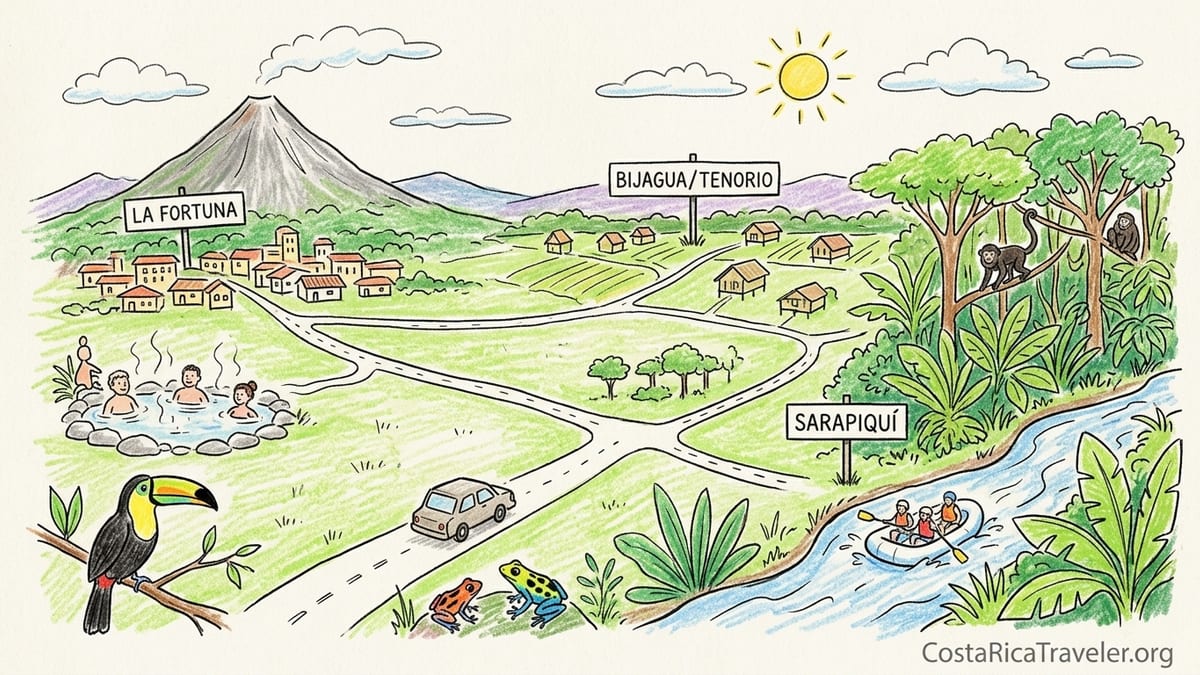
Understanding the Northern Plains “triangle”
La Fortuna, Bijagua/Tenorio for Río Celeste, and Sarapiquí form a loose triangle in Costa Rica’s Northern Plains. You can drive between any two of them in about two to three hours, but each base sits in a very different landscape. La Fortuna clusters below Arenal Volcano and has grown into one of the country’s main adventure tourism hubs, with hot spring resorts, restaurants, and tour desks lining its main roads. The Costa Rican Tourism Board describes it as a key departure point for attractions across the Northern Zone, and that matches exactly how it feels on the ground: busy, convenient and built around visitors.
Bijagua, on the flanks of Tenorio Volcano near Río Celeste, feels like a side road in comparison. The village has a modest plaza, a few small sodas and a scattering of lodges amid pastures and secondary forest. It exists mostly for farmers and families, with tourism added on. Nearby Tenorio Volcano National Park, where you hike to the turquoise Río Celeste waterfall, is about 25 to 30 minutes’ drive from town along a mostly paved access road that turns to gravel for the final stretch, but regular sedans and compact SUVs were handling it when I last drove it. The atmosphere is rural and unhurried, especially at night.
Sarapiquí, centered around Puerto Viejo de Sarapiquí and La Virgen, drops you down into lowland Caribbean rainforest. This is rafting and biology territory. The region is known for white water on the Río Sarapiquí and for research reserves such as La Selva Biological Station, which protects primary forest and has recorded well over 400 bird species. You reach the area most directly via Route 32 through Braulio Carrillo National Park from San José, then turn inland on paved local roads. Driving here feels different again: flatter, warmer and greener, with banana trucks on the highway and a mix of simple roadside restaurants and eco-lodges hidden up short gravel spurs.
When you put these three together, the decision is less, “Which is best?” and more, “Do I want a town with lots of infrastructure, a quiet village near a single star attraction, or a rainforest outpost focused on rivers and reserves?” Having slept in all three more than once, my own answer has changed depending on the trip. The sections below walk through what shifted my choice each time.
La Fortuna: Convenience, hot springs and easy tour logistics
La Fortuna is the most forgiving home base if you want variety without repacking. The town itself is compact, but the tourism footprint is wide. Hotels ring Arenal Volcano along Route 142, and a ten minute taxi ride from the central park can drop you at one of several hot spring complexes on a fully paved corridor. Arenal’s hot spring resorts range from simple day passes with basic changing rooms to large complexes with multiple thermal pools, restaurants and swim up bars. After dark, steam rising under palm trees and the muffled sound of conversation make it feel more like a busy European spa town than a rural Costa Rican village.
Because La Fortuna has so many tour operators, almost everything can be arranged with hotel pickup. I have been collected in a minibus directly from modest guesthouses in town and from mid range lodges several kilometers away for canyoning, hanging bridges, waterfall rappels and full day river trips. Companies commonly bundle a morning hike in Arenal Volcano National Park or at a private reserve, lunch at a roadside restaurant, and an afternoon hot springs visit, dropping you back at your hotel in the evening. For travelers without a car, this is one of La Fortuna’s biggest advantages: you rarely need to think about driving, parking or directions.
Even if you do rent a car, the roads around La Fortuna are straightforward. The main highway linking La Fortuna with Ciudad Quesada and on toward the Central Valley is paved and in decent condition. Route 142 around Lake Arenal is windier, with some slow curves, but it is a proper paved road that many visitors drive daily. To the north and west toward Bijagua and Río Celeste, most of the journey follows Route 4, also paved, before branching onto smaller roads. The real contrast comes in the evening. In La Fortuna town you can wander out at 8 or 9 p.m. and still choose between wood fired pizza, a craft beer bar, a plate of casado at a local soda, or an ice cream on a lively main street. Traffic circulates around the central park, souvenir shops stay open late, and you will share the sidewalks with other visitors rather than walking alone.
The trade off is that you are not alone anywhere for long. In high season, especially December through March, Arenal’s trailheads and hot springs fill quickly. Parking lots by the La Fortuna waterfall and hanging bridge parks can be busy by mid morning. I have found that staying just outside town, at a lodge five to ten minutes’ drive away, slightly softens the bustle. Those hotels often have direct volcano views and more greenery, at the cost of needing a car or arranging a taxi for every errand. But if your priority is maximum choice of restaurants, easy tour pickups and hot springs on demand, La Fortuna is hard to beat as a base.
Bijagua / Tenorio: Early Río Celeste and quiet nights
If Río Celeste is a top priority, basing yourself near Bijagua and Tenorio Volcano National Park changes the experience in ways that are hard to replicate from La Fortuna. From La Fortuna, the standard Río Celeste tour is sold as a full day outing. Operators typically quote a driving time of around two hours each way, plus a 6 to 7 kilometer hike inside Tenorio, lunch and return. Door to door, my day trips from La Fortuna to Río Celeste have taken close to nine hours including hotel pickup, bathroom breaks, the hike and a restaurant stop near the park entrance. It is a great day, but it is a day built around a bus seat as much as a waterfall.
When I stayed in Bijagua, the rhythm shifted. Instead of a predawn pickup, I set an ordinary alarm, drove 25 to 30 minutes along Route 6 and the park access road, and parked in time to be among the first dozen people at the Tenorio Volcano National Park entrance. The road from Bijagua is now mostly paved, with the last portion to the park on a compacted gravel track that sedans and small SUVs were using in dry weather. Arriving under your own power matters because Tenorio limits daily entries and can close the trail in mid afternoon, and because the color of Río Celeste is weather dependent. On one visit, heavy rain the previous night left the water closer to pale green than electric blue. Starting the day nearby gave me the flexibility to come back a second morning without rearranging an entire itinerary.
Bijagua itself is quiet. Along the main strip you find a handful of family run sodas serving set plates of rice, beans, salad and your choice of chicken, fish or beef for a moderate price, a bakery, a small grocery, and a couple of simple bars where locals gather for a beer and televised football. Dinner meant driving five minutes to a roadside soda or eating at the small restaurant attached to my lodge, not choosing between a dozen cuisines. After 9 p.m., the town felt drowsy. I walked back to my cabin under very dark skies, with frogs loud in the ditches and almost no street noise. For me that was part of the appeal, but it would feel limiting if you enjoy long evenings in bars or browsing shops.
Accommodation around Bijagua ranges from basic cabinas to eco lodges in pasture that has been partially reforested. I have stayed at both a simple cabin with a fan and screens and a mid range lodge with large windows facing forest and breakfast included. In both cases, mornings started with the sound of birds and howler monkeys more than traffic. Several properties maintain their own short forest trails, which became my filler activity on non hiking afternoons. Without the range of paid tours that La Fortuna enjoys, you rely more on your hotel’s own offerings, such as farm walks, night hikes on private land or tubing on a nearby river, or on self guided drives to local waterfalls.
Getting in and out of Bijagua requires a little more planning but is not difficult. From La Fortuna I have used the Route 4 and Route 6 combination: driving north through San Rafael de Guatuso to pick up Route 4, then further on to the junction for Route 6 that runs along the western side of Tenorio toward Bijagua. These are paved regional roads with occasional slow moving trucks and some curves, but they feel much less taxing than the full loop on the narrow road around Lake Arenal. If you are connecting from Liberia or the northern Pacific coast, the drive is also straightforward. What you give up in nightlife and restaurant variety, you gain in short morning drives and quiet evenings that feel closer to the countryside than to a resort town.
Sarapiquí: Rivers, reserves and a rainforest pace
Where La Fortuna feels like a mountain resort town and Bijagua like a rural village, Sarapiquí feels like a river station at the edge of the rainforest. Puerto Viejo de Sarapiquí is the main service town, with banks, supermarkets, basic restaurants and gas. A string of eco lodges and reserves sits along and away from the Río Sarapiquí between Puerto Viejo and La Virgen, each reached by a short paved or gravel spur. Road conditions here are relatively easy for Costa Rica. From San José, you follow Route 32 through Braulio Carrillo National Park, a major national highway that cuts travel distance to the Caribbean. Once you leave the park and turn north into the Sarapiquí region, the roads flatten out into a grid of mostly paved secondaries with some patched sections and occasional potholes.
My Sarapiquí stays have felt shaped by the river and the reserves rather than by town life. Busy days started with a dawn bird walk at La Selva Biological Station or another private reserve, guided by local naturalists carrying scopes and field guides, then shifted to a late morning white water rafting run on the Río Sarapiquí. Outfitters in the area offer runs on class II–III sections suitable for families, with hotel pickups from both eco lodges and central town hotels. You return in mid afternoon, often to a lodge where the on site restaurant is your most convenient dinner option. Even if you drive into Puerto Viejo for dinner, most places close early. The evening atmosphere is subdued: the loudest sounds are frogs, insects and the river itself.
Compared with La Fortuna, Sarapiquí’s tourism infrastructure is lighter but well established. You do not see a dense strip of hot spring resorts and international restaurants. Instead there is a patchwork of lodges focused on birders, researchers and travelers who place wildlife ahead of nightlife. On one trip I stayed at a mid range lodge set in forest with a simple pool and an open air dining room. Breakfast was included and dinners were offered as a fixed menu. Walking the property’s own trails, I saw toucans, poison dart frogs and howler monkeys without ever getting into a car. Another time I chose a more budget friendly hotel in Puerto Viejo itself, which gave me easier access to ATMs and cheaper sodas, but I found myself driving out toward La Virgen again each morning for activities.
Driving from Sarapiquí to La Fortuna is a logical leg in a loop itinerary. The route north and west across the Northern Plains crosses a patchwork of agricultural land, small towns and secondary forest on mostly paved roads. My last drive between Puerto Viejo de Sarapiquí and La Fortuna took just under two hours with a brief stop for fuel and coffee, and it felt far less tiring than returning to San José and doubling back. That makes it realistic to pair Sarapiquí with La Fortuna without losing an entire day to travel, but you should still think of it as a travel day with a light afternoon rather than two full activity days.
Driving distances, road realities and how it feels in the car
On a map, two to three hours between bases looks easy. The lived experience depends on curves, trucks, rain and whether you are starting fresh or after a long international flight. Between La Fortuna and Bijagua / Río Celeste you have two broad options. The Route 4 and Route 6 combination through San Rafael de Guatuso and Upala offers a mostly paved, relatively gentle route that many local drivers now prefer when heading toward Liberia or the northern Pacific. There are curves and some patched sections, but it feels like a country highway, not a mountain road. The alternative around Lake Arenal is prettier but involves more continuous curves, occasional narrow sections and slower progress, which can tire passengers prone to motion sickness.
The access road from Bijagua to Tenorio Volcano National Park, as of my last visit and recent reports, is substantially improved from the days when a high clearance vehicle was strongly recommended. The bulk of the distance from town to the park entrance is now on paved road, with only the last piece on gravel. On a dry morning in a compact SUV, the drive felt uneventful. In heavy rain, however, puddles and mud develop quickly, and you should slow down. A similar pattern holds in Sarapiquí. The main approach via Route 32 is a major artery carrying freight between San José and Limón, and conditions on the highway section can change with weather. In thick cloud and afternoon rain through Braulio Carrillo National Park, visibility can drop and the road surface becomes slick. Once you turn off toward Puerto Viejo de Sarapiquí, speeds decrease and the drive feels less intense, though you still need to watch for occasional potholes and slow trucks.
Within La Fortuna’s immediate area, driving is the easiest of the three. The road out to the hot spring corridor on Route 142 is fully paved and signposted, and resort entrances are obvious. The route to the La Fortuna waterfall involves a short, steep paved road that any standard car can handle. The main discomfort is not the road but the concentration of traffic in high season, especially around the central park and at peak arrival times for big resorts. Parking at popular attractions can feel competitive in the middle of the day. That is one reason I like using tour pickups for big-ticket adventures from La Fortuna, even when I have a rental car. When a minibus collects me at the hotel at 7:30 a.m., I can drift through the morning traffic without thinking about spaces or speed limits.
Between Sarapiquí and La Fortuna, the Northern Plains link is not a single signed highway but a succession of regional roads that most navigation apps handle well. Expect stretches with modest speed limits, farm vehicles, bridges over broad rivers, and the occasional roadside fruit stand. My own drives have been marked less by hairpin turns and more by stops to let a line of trucks pass, or to buy pineapple and coffee at a small pulpería. If you plan to move between bases, aim to travel earlier in the day, both for better light and to avoid the heavier afternoon rain that often builds in the rainy season.
Evening atmosphere, food scenes and the feel of each base
Beyond activities and logistics, what finally separated the three bases in my mind was what it felt like to come “home” in the evening. In La Fortuna, evenings are active. Families walk the central park, teenagers gather near the church steps, and restaurant staff stand on the sidewalk explaining menus. I remember finishing a canyoning tour at 4 p.m., soaking in hot springs for two hours, then changing into dry clothes and heading into town for sushi at 8:30 p.m. The restaurant was still half full, and nearby bars had live music. If you enjoy having options and do not mind some bustle, this energy can be a highlight.
In Bijagua, by contrast, evening meant planning ahead. On one stay I finished a long Río Celeste hike, stopped at a roadside soda at 5 p.m. for a plate of arroz con pollo and a fresh fruit drink, and by 7:30 p.m. was back in my cabin listening to rain on the roof. When I did head out later in the evening, I passed only a few people in town and two small bars with a couple of patrons. There were no souvenir shops to browse and no hot springs to soak in. I loved the darkness and the sense of being enveloped by forest and farmland, but it is a quieter social landscape by any measure.
Sarapiquí nights fell somewhere in between. Staying at a forest lodge, I typically ate dinner on site between 7 and 8 p.m., sometimes after an evening frog walk or a short spotlighting walk along the property’s trails. The dining room would empty by 9 p.m. as guests turned in to be ready for early birding starts. When I stayed in Puerto Viejo de Sarapiquí itself, I could extend the evening slightly with a beer at a local bar or a dessert at a town soda, but there was nothing like the concentrated restaurant row of La Fortuna. For many travelers interested in wildlife, this is perfectly acceptable. Sleep comes earlier, and dawn on the trails is the goal.
Food variety tracked closely with this atmosphere. La Fortuna gave me everything from traditional casados at simple sodas for modest prices to more expensive steak houses, Italian pizzerias and cafes serving cappuccinos and smoothie bowls. Bijagua gave me hearty plates and home style cooking, plus the occasional lodge restaurant leaning into more contemporary dishes with local ingredients. Sarapiquí offered a similar mix of sodas and lodge dining rooms, with the main difference that some of the latter explicitly catered to birding groups and researchers, offering fixed menus and early breakfast hours rather than a broad à la carte selection.
Is it worth changing bases or staying put?
The question I wrestled with most on my Northern Plains trips was whether to unpack once in La Fortuna and do everything as day trips, or to move between bases for a deeper feel. After trying both, I would frame it this way. If you have four to five nights for the entire region and dislike packing, using La Fortuna as a single base is sensible. From there you can do hot springs, waterfall visits, hanging bridges, adventure tours and even long day trips to Río Celeste and Sarapiquí. A typical pattern might be three full days of activities based within an hour of town, plus one long day on the road to Tenorio or a rafting river farther afield. You will spend some hours in buses or vans, but you avoid the disruption of check out and check in.
Once you reach six or seven nights, however, changing bases can start to feel less like a chore and more like an upgrade in variety. On one trip I spent three nights in Bijagua, three in La Fortuna and two in Sarapiquí. That meant unpacking three times, but it also meant waking up in three different ecosystems. In Bijagua, I used the early mornings for Río Celeste and nearby trails. In La Fortuna, I stacked adventure tours and hot springs. In Sarapiquí, I slowed down and focused on forest reserves and evening frog walks. Each move was a two to three hour drive, leaving enough of the arrival day for a short walk or a swim.
The practical weight of packing depends on your style. Traveling with a single carry on backpack, I found it easy to throw everything together after breakfast and be on the road by 9 a.m. Families with multiple suitcases and young children may feel differently. Another consideration is how sensitive you are to one or two rainy days. Because Río Celeste’s color depends heavily on weather and rainfall, staying near Tenorio for more than one night gave me the flexibility to pick my hiking morning based on conditions, rather than being locked into whichever day my long day trip happened to run. The same logic applies, in a softer way, to wildlife in Sarapiquí. A two or three night stay increases your odds of a clear dawn or a particularly active night walk.
In the end, my rule of thumb has become this: if I have at least a week and I care deeply about both Río Celeste and rainforest reserves, I split my time between Bijagua, La Fortuna and Sarapiquí. If my time is shorter or I am traveling with people who dislike frequent moves, I stay in La Fortuna and choose just one “stretch” day trip, accepting the busier base as the price of convenience.
The Takeaway
La Fortuna, Bijagua/Tenorio and Sarapiquí all sit within a few hours of each other, yet they deliver different versions of Costa Rica’s Northern Plains. La Fortuna is the clear choice for travelers who want maximum convenience, hot springs, restaurant variety and seamless tour pickups. It is officially treated and widely experienced as a major departure point for attractions across the Northern Zone, and you feel that in the number of tour vans and menus along its roads. Bijagua and the Tenorio area trade that infrastructure for early access to Río Celeste, shorter drives to the park, and much quieter nights in a rural setting. Sarapiquí tilts in yet another direction, putting you closer to lowland rainforest, research reserves and rafting rivers, with lodges that feel like outposts along the water’s edge.
There is no wrong base, only a mismatch between place and priorities. If you want to soak in hot springs every evening and have a different dinner choice every night, sleep in La Fortuna. If you dream of being first at the Río Celeste trailhead and watching mist lift from pastures at dawn, stay in Bijagua. If you imagine waking to the calls of trogons and howler monkeys with a raft waiting on the river, book into Sarapiquí. Having stayed in all three, my best trips have been the ones where I let the place dictate the pace: busy in La Fortuna, unhurried in Bijagua, and tuned to the river and the forest in Sarapiquí.
FAQ
Q1. Is La Fortuna a good single base for visiting Río Celeste and Sarapiquí as day trips?
Yes, La Fortuna can work as a single base if you accept longer days in the van. A Río Celeste tour from La Fortuna usually involves around two hours’ driving each way plus a several hour hike and lunch, so expect a roughly nine hour day. Sarapiquí rafting trips are also sold as full day excursions with hotel pickup, making it realistic to see all three areas while unpacking only once.
Q2. How long does it really take to drive from La Fortuna to Bijagua for Río Celeste?
In my experience, driving from La Fortuna to Bijagua via Route 4 and Route 6 has taken between 1.5 and 2 hours in normal traffic, depending on weather and stops. From Bijagua to the Tenorio Volcano National Park entrance adds about 25 to 30 minutes. Navigation apps usually match this, but rain, road works or slow trucks can stretch the time, so it is wise to allow extra margin if you have a timed entry.
Q3. Do I need a 4x4 to reach Tenorio Volcano National Park and Río Celeste?
For most travelers in dry conditions, a standard sedan or a 4x2 SUV is sufficient to reach Tenorio Volcano National Park from Bijagua or from the La Fortuna side. The approach roads are mostly paved now, with the final access section to the park entrance on gravel that is manageable at low speeds. In very heavy rain, a vehicle with slightly higher clearance can feel more comfortable, but a full off road 4x4 is not strictly necessary for ordinary visits.
Q4. Which base is best if I am traveling without a rental car?
If you will not be driving, La Fortuna is generally the easiest base. Tour companies routinely include hotel pickup and drop off for activities such as canyoning, hanging bridges, rafting and day trips to Río Celeste. Hot spring resorts sit along a single paved corridor a short taxi ride from town. Bijagua and Sarapiquí also have tour operators and transfers, but options are fewer and you will rely more heavily on your lodge to arrange transport.
Q5. How does evening safety and walkability compare among the three bases?
In La Fortuna, I have comfortably walked around the central park and main streets after dinner, with plenty of other visitors out. Normal city common sense applies, but the area feels used to tourists. Bijagua’s main strip is very quiet at night, with few people on the street, so most guests drive a short distance or eat at their lodge. In Sarapiquí, evenings at forest lodges usually revolve around on site dining, while town hotels in Puerto Viejo place you within a short walk of basic restaurants and shops.
Q6. Is Sarapiquí worth a separate stay if I am already visiting La Fortuna?
In my view, Sarapiquí is worth a night or two if you are interested in lowland rainforest, birds and river based activities. While you can raft rivers accessible from La Fortuna, staying near Puerto Viejo de Sarapiquí or La Virgen brings you closer to reserves like La Selva Biological Station and private forests, and the birdlife and humidity feel distinctly different from the Arenal slopes. If your time is short and rafting is your only goal, you can fold it into a day trip from La Fortuna instead.
Q7. How far is Sarapiquí from La Fortuna by car, and what are the roads like?
Driving between Puerto Viejo de Sarapiquí and La Fortuna has taken me around two hours in typical conditions. The route uses a sequence of paved regional roads across the Northern Plains, with agricultural traffic, small towns and some slower sections. There are no extreme mountain passes on this link, but you should be prepared for changing weather, occasional potholes and farm vehicles. Most visitors find it a moderate, manageable drive.
Q8. Where should I stay if hot springs are my top priority?
If hot springs are central to your trip, La Fortuna is the clear choice. The main hot spring corridor sits along Route 142 just outside town, with multiple resorts ranging from simple to luxurious, all built around access to thermal water heated by Arenal’s geothermal activity. In Bijagua and Sarapiquí, the focus is instead on rivers, waterfalls and rainforest; you will not find the same concentration of developed hot spring facilities there.
Q9. Which base feels least crowded in high season?
In peak months like January and February, La Fortuna is the busiest of the three bases, with full restaurants and lots of tour vans. Bijagua and the Tenorio area feel notably quieter, with fewer hotels and less evening activity, though Tenorio Volcano National Park itself can still reach visitor limits. Sarapiquí sits somewhere in between, with lodges that may fill up but a less concentrated town center and more spread out activities, so crowds feel thinner on the ground.
Q10. If I have only five nights, how would you split them among these bases?
With five nights, my own preference is either to stay all five in La Fortuna and add a long day trip to Río Celeste or Sarapiquí, or to split three nights in La Fortuna with two nights in Bijagua. The first option keeps packing simple and maximizes tour convenience. The second lets you experience both an adventure hub and a quieter village near Río Celeste, at the cost of one extra hotel change. Adding Sarapiquí as a third base usually starts to make more sense when you have at least seven nights in the region.