


Caño Negro shows up on almost every list of “must do” wildlife experiences in northern Costa Rica. Promotional photos promise rafts of white birds, caimans along every bend and monkeys on low branches. Before my own visit, I read all of that. What I wanted to know but could not find was something simpler: on a real, regular boat tour, in real conditions, what do you actually see, and how does the experience feel from the first pick-up to the last slow turn back to the dock?
Getting to Caño Negro: The Long Drive North
I based myself in La Fortuna, like many travelers who add Caño Negro as a day trip to an Arenal itinerary. From town, most tour operators quote roughly two to two-and-a-half hours each way by minibus to reach the boat dock on the Río Frío, near the small border town of Los Chiles. Recent tour descriptions and traveler reports put the driving time at about 120 to 150 minutes depending on traffic, roadwork and how many hotel pick-ups the bus makes on the way out of La Fortuna. The route runs north through rolling cattle country and then into flatter lowlands as you approach the Nicaraguan border.
I joined a small group organized by a La Fortuna-based operator that works with local boat captains in Caño Negro. Pick-up was scheduled for 7:30 a.m. at my hotel, which meant leaving town before the strongest heat of the day. A typical group day trip folds in a short coffee and bathroom stop about halfway along the route, at one of the highway sodas that are used to seeing dusty tour vans pull in mid-morning. That stop is not just a comfort break; it is your chance to grab an extra bottle of water, a pastry and to step out of the air conditioning before the boat portion of the tour.
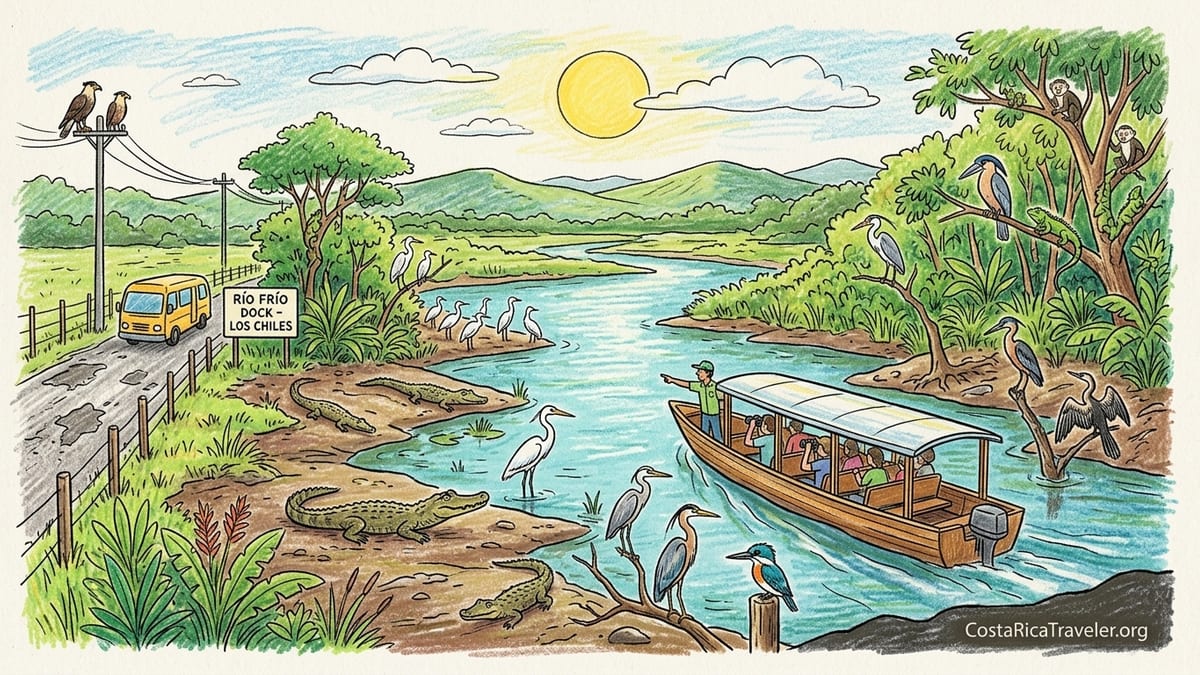
The last section of road toward Los Chiles is paved but patched and slow. It felt more like a farm access road than a highway, and the driver kept a steady but cautious pace to avoid potholes. As we got closer to the river, the landscape opened into pasture and scattered trees, with roadside birds already hinting at what was to come: a line of groove-billed anis on a fence, a flock of white cattle egrets following a tractor, a pair of caracaras on a power pole. Even before boarding the boat, you begin to understand that Caño Negro is about wide open, working rural landscapes wrapped around an important wetland, not a manicured national park entrance with a big visitor center.
Boats, Guides and How the Tour Is Set Up
At Los Chiles we transferred from the minibus to a long, covered river boat tied to a basic concrete dock on the Río Frío. The boat was the standard set-up used across Caño Negro: a narrow hull with bench seats and a fiberglass roof for shade, powered by an outboard motor at the back. There were open sides rather than windows, which matters for both ventilation and photography. The boat seated around 16 guests, but on my trip we had 10 plus the captain and a naturalist guide, which left room to shift sides when wildlife appeared.
Because Caño Negro Wildlife Refuge itself is administered by SINAC and set aside as a protected Ramsar wetland, on-the-ground tourist services are deliberately handled by local private providers in the surrounding communities. SINAC’s current information lists daily opening hours from 8 a.m. to 4 p.m., with guiding, accommodation and transport supplied privately by the community rather than by the park service. The operator from La Fortuna simply arranged our transport and then handed the group to a local captain and guide who work this river most days of the week.
Our guide stood at the front of the boat with a handheld microphone connected to small speakers, but most of the time he spoke quietly and pointed instead. When a bird or animal was spotted, the captain would cut the engine to a low idle or shut it off entirely, angling the boat with a short paddle to give both sides a view. This rhythm repeated again and again: slow travel, sudden pause, whispered explanation, a flurry of camera clicks and binocular adjustments, then a quiet move on to the next bend.
The boat carried a cooler with bottled water and soft drinks, and there was a simple toilet aboard. This matters on a three-hour wildlife-focused excursion under tropical sun. Shade from the roof kept direct sun off our heads, but the open sides meant the air stayed hot and humid. Lightweight clothing, a wide-brimmed hat and high-SPF sunscreen were more important than any particular camera gear.
Heat, Mosquitoes and Water Levels: How the Wetland Felt
I visited late in the dry season, around March, after several weeks with limited rain in northern Costa Rica. By that point the wetland’s seasonal lake had already shrunk back toward the river channel. Guides and recent field reports describe Caño Negro as a classic seasonal system. During the wetter months roughly May through November, the Río Frío spills into half-submerged forest and wide, shallow lagoons. By December the waters start to drop, and from January through April much of the lake contracts into narrower channels and pools. That dry season drawdown concentrates fish and, with them, birds and caimans in the remaining water.
On the day of my tour the river level was moderate, neither at the lowest reported later in April nor at the high, coffee-colored flood of peak rains. Exposed mud banks and fallen branches were visible along many bends, creating perches for herons and sandbars for basking reptiles. Guides who work here year-round pointed out waterlines on tree trunks a meter or more above our heads, marking how high the level can climb in wet months. They described a very different boat experience when the wetland is full, with the captain maneuvering among flooded trees on side channels that were currently dry grass.
Heat was a constant from late morning onward. Our boat left the dock around 10:15 a.m., after the drive and paperwork, and by 11 the open sections of river felt like a slow fan oven. Airflow improved when the captain kept the boat moving, but whenever we stopped for wildlife the humidity wrapped around us. A light, long-sleeved shirt and breathable trousers were more comfortable than shorts and a tank top, especially because they doubled as extra protection from insects.
Mosquitoes were present but manageable on my dry-season visit. There were a few moments in shaded backwaters where I could see small swarms drifting over the water’s surface, but they were less aggressive than I had expected. Guides I spoke with said that biting insects are generally more noticeable at dawn, dusk and in the height of the wet season when more of the forest is flooded. For a mid-morning dry-season tour, a good coating of repellent on exposed skin and clothing was enough. I did see a few guests swatting at no-see-ums around the ankles when we paused close to the vegetated banks, a reminder to spray feet and sandals as well.
What I Actually Saw on the Water
The official description of Caño Negro highlights its importance for migratory waterbirds and wetland wildlife. It has held Ramsar status since the early 1990s, and conservation authorities describe it as one of Costa Rica’s most significant wetland complexes, protecting a seasonal lake, swamp forest and marshes along the lower Río Frío. That broad ecological framing is accurate. On the water, the translation is simple. If you are interested in birds, reptiles and riverbank mammals, this is a place where you can fill several memory cards in a few hours. If you come expecting jaguars or tapirs splashing through the shallows, you will be disappointed.
Birdlife dominated my tour. Within the first half hour we had logged several species of heron, including great blue, cocoi and little blue, plus boat-billed herons hunched under overhanging branches. Great and snowy egrets hunted in the shallows, and a line of roseate spoonbills worked a receding pool with sweeping bills. On open snags we saw anhingas drying their wings and Amazon kingfishers perched over the current. A more serious birder on the boat counted more than 40 species by the end of our outing. Recent trip reports from birdwatchers who launched from the same dock mention similar experiences, including boat-billed herons, ibis, jacanas and even rarer target birds for those with field guides in hand.
Reptiles were just as present, though less dramatic than some marketing materials would have you believe. We saw several spectacled caimans of varying sizes hauled out on mud banks, plus a couple of larger crocodilians that the guide identified as American crocodiles in the broader river channel. Dozens of green iguanas basked in riverside trees, some bright orange breeding males against the foliage. Turtles appeared as low dark humps on logs, dropping into the water when the boat drifted too close, and we passed one section of bank with a tight cluster of mud-colored bats clinging to the trunk of a riverside tree.
Mammals were present but less predictable. On my three-hour circuit we watched a small troop of white-faced capuchin monkeys moving through the canopy and briefly saw howler monkeys higher in the foliage, more heard than clearly seen. Other travelers I spoke with at the dock, who had taken earlier or later departures in the same week, reported seeing three species of monkey on their trips, including spider monkeys, while another boat’s group came back proudest of a close sloth sighting. Those variations underline the core truth of Caño Negro. It is a functioning wild wetland. Much of the wildlife is there, somewhere in the mosaic. What you personally see depends on water levels, time of day, guide skill and plain luck.
Seasonality: How Timing Changes the Experience
Season has a real impact on both what you see and how the tour feels. Conservation agencies and regional travel planners describe the dry season from roughly December to April as particularly productive for bird concentration on the shrinking lagoon and river pools. As the water contracts, fish densities rise in the remaining channels, drawing herons, storks, spoonbills and kingfishers into tighter feeding areas that are easier to scan from a boat. Several recent guides to the refuge emphasize that this dry-season concentration is one of the reasons Caño Negro appears so often on serious birders’ itineraries.
During the green season from about May into November, reports from naturalist groups and returning travelers suggest that bird diversity remains high but more spread out. The same species disperse across a much larger flooded landscape. Boats may be able to reach side channels under trees that are dry in March, and the feeling is more Amazonian, with trees standing in brown water and distant cattle pastures cut off behind a wide sheet of flood. That can be spectacular in its own right, but you may not see the same bird density on a single mudflat that you would during a falling-water period in late dry season.
In practical terms, dry-season tours can also be dustier and hotter on the drive, as unshaded stretches of road reflect heat back into the bus. Green-season tours risk heavier tropical downpours, which tend to build in the afternoon. Several local operators now suggest early-morning departures outside the heart of the tourist high season to balance wildlife activity with more comfortable temperatures. If your schedule is flexible and you care more about photography and bird list than clear skies, late dry season into the early green season can be a good compromise, with concentrated wildlife and a bit of fresh vegetation starting to return to the banks.
Regardless of month, it is worth paying attention to water level notes from guides or your hotel when booking. In years with stronger El Niño patterns, for instance, late dry-season levels can fall far enough to limit where larger boats can go. Some channels may be inaccessible, and tours may spend more time in deeper sections of the main river. That does not ruin the experience, but it changes the landscapes you drift through. Being aware of those shifts helps match your expectations to the reality of the specific week you visit.
Did Binoculars Matter, and How Long Did It Stay Engaging?
On my tour, binoculars mattered more than any other single piece of equipment. The boat maintained a respectful distance from riverbanks and perched birds, both to avoid disturbance and to stay clear of shallow, snag-filled edges. Naked-eye viewing was enough to appreciate larger birds, iguanas and basking caimans, but smaller details, like the powder-blue facial skin of a boat-billed heron or the subtle patterning on a jacana’s wings, disappeared without magnification. I traveled with an 8x32 pair, a common compromise between field of view, brightness and weight. That felt perfect on the water: light enough to hold steadily, but powerful enough to turn a distant shape into a clear subject.
Not everyone in the group had their own optics. The guide carried a high-quality pair that he handed around, and people without binoculars could still enjoy the outing. That said, those with their own glass clearly got more from the constant flow of sightings. Several operators that specialize in birding and nature photography on Caño Negro market their tours directly to guests who already own binoculars or long lenses, and after this boat trip it is obvious why. The wetland is about watching behavior and details at mid-distance, not about animals walking up to your feet.
As for engagement, the tour remained interesting for its full duration, but the rhythm shifted. The first hour passed in a blur of new shapes and names, every bend producing a different heron, another cluster of iguanas or a fresh troop of monkeys. In the middle hour things slowed slightly as many of the commonly expected species had already been spotted, and the guide focused more on explaining ecological relationships: how water levels cue fish spawning, why certain trees line the banks, how long a caiman can stay underwater without surfacing. The final 30 to 40 minutes, as we turned back toward the dock, added a quiet, almost meditative layer. We revisited some of the same stretches of river in different light, spotting birds we had missed on the outbound trip and watching a storm build over distant pasture.
By the time we stepped off the boat, three hours had passed on the water without feeling like a forced march. If anything, the long return drive to La Fortuna felt more tiring than the wildlife watching. For travelers who worry about “boat boredom,” Caño Negro delivers enough variety of species and behavior, especially with a good guide, to fill a standard half-day outing. Those deeply into birding or photography could likely stay engaged for five hours or more on a longer private charter, but for a mixed group of casual wildlife watchers and first-time visitors, the three-hour boat segment was a good sweet spot.
Understanding Caño Negro’s Ramsar Status and Local Role
Beyond the checklist of animals, it helps to place what you are seeing within the larger story of Caño Negro. Costa Rica’s conservation authorities describe the Caño Negro Mixed National Wildlife Refuge as protecting one of the country’s most important wetland zones, with about 100 square kilometers of marsh, seasonal lagoon and swamp forest along the lower Río Frío. The area was recognized as a Ramsar site in the early 1990s, one of Costa Rica’s first wetlands of international importance, in part because of its role as a stopover and feeding ground for migratory waterbirds moving along the Central American flyway.
From a visitor’s perspective, that status has several real-world consequences. First, there is no large-scale infrastructure inside the protected area itself. You will not find a row of souvenir shops or a restaurant-lined promenade on the water’s edge. Instead, services are concentrated in the nearby communities of Caño Negro and Los Chiles, where small lodges, family-run sodas, fueling stations and boat operators cluster. SINAC’s official information makes it clear that tourism services such as guiding, accommodation and transport are provided privately by the local community, within the framework of daily opening hours from 8 a.m. to 4 p.m. That model directs much of the economic benefit of visiting birders and wildlife enthusiasts into the villages around the refuge.
Second, the formal protection of the wetland means that some activities common on other Costa Rican rivers are restricted here. You will not share the water with whitewater rafts or motorboats towing inner tubes. The focus is on low-impact wildlife observation from small craft moving at modest speeds. For travelers used to the more developed adventures around La Fortuna, such as canyoning and zip lines, the quiet of Caño Negro can come as a welcome recalibration. The sounds on the river are mostly natural: howler monkeys in the distance, the splash of a caiman sliding off a bank, kingfishers rattling past, and the steady putter of the outboard when the captain nudges the boat upstream.
Finally, Ramsar recognition has helped drive research and monitoring. While you will not see scientific instruments from the boat, guides regularly reference ongoing counts of migratory species and efforts to protect threatened fish such as the ancient-looking gaspar, or tropical gar, which inhabits the refuge’s waters. Knowing that you are passing through an actively managed conservation landscape, rather than just a pretty stretch of river, lends weight to even the most casual wildlife sighting. A line of black-bellied whistling ducks on a log is not just a nice photograph; it is one point in a much larger, long-term picture of how birds use this wetland year after year.
The Takeaway
Looking back on my Caño Negro wildlife tour, what stands out is not a single dramatic encounter but the cumulative effect of steady, varied sightings in a genuinely wild-feeling wetland. I did not see every animal mentioned in the brochures. There was no close sloth hanging over the boat, no gigantic crocodile lunging from the shallows. Instead, there was a quiet, layered experience: dozens of bird species working the receding waters, caimans resting on mud banks, monkeys moving through the canopy, turtles slipping from logs and iguanas draped over branches like slack ropes.
The logistics were more demanding than a typical half-day outing near La Fortuna. The drive to and from Los Chiles took most of the daylight outside the boat tour itself, and the heat on the river required sensible clothing, hydration and sun protection. Mosquitoes were present but not overwhelming on a late dry-season morning, though conditions would likely be different in peak wet season or at dusk. Water levels shaped everything, concentrating wildlife into smaller areas during the dry months and spreading them across a flooded landscape when the rains returned.
Binoculars significantly deepened the experience, turning ambiguous shapes into identifiable species and revealing behavior that would otherwise fade into the background. A good local guide anchored the tour, spotting animals most of us would have missed and explaining how Caño Negro fits into Costa Rica’s broader conservation mosaic as a Ramsar-listed wetland. The three hours on the boat stayed engaging from first bend to last, even for group members who were not dedicated birders.
If you care about wetlands, migratory birds or simply want a slice of northern Costa Rica that still feels tied to cattle pastures, fishing boats and quiet border towns, Caño Negro is worth the long day. Go for the real experience rather than the marketing promises. Accept that what you see will be shaped by season, water levels and chance. You will likely return to La Fortuna tired, sun-flushed and carrying a memory card full of birds, reptiles and riverbank scenes that feel far removed from the more choreographed attractions closer to town.
FAQ
Q1. How long is the drive from La Fortuna to Caño Negro for the boat tour?
Most organized tours from La Fortuna quote about two to two-and-a-half hours each way by minibus to the Río Frío dock near Los Chiles, depending on hotel pick-ups and road conditions.
Q2. What are the current opening hours for the Caño Negro Wildlife Refuge?
SINAC, the Costa Rican conservation authority, currently lists daily opening hours for Caño Negro from 8 a.m. to 4 p.m., with tourist services run by local private providers.
Q3. What kind of boat is used for the Caño Negro wildlife tour?
Most tours use long, narrow river boats with bench seating and a fixed roof for shade, powered by an outboard motor, with open sides for viewing and photography.
Q4. Which animals are you realistically likely to see on a standard boat trip?
Common sightings include multiple heron and egret species, kingfishers, caimans, iguanas, river turtles and at least one monkey species, with chances of sloths and bats depending on luck.
Q5. How much do season and water levels change the experience?
In the dry season, roughly December to April, falling water levels tend to concentrate birds and caimans along remaining channels; in the green season wildlife spreads across a larger flooded area and the scenery feels more expansive.
Q6. Are mosquitoes and biting insects a big problem on the boat?
In late dry season mid-morning tours, mosquitoes are usually present but manageable with repellent; they tend to be more noticeable at dawn, dusk and in wetter months when more forest is flooded.
Q7. Do I really need binoculars for Caño Negro, or is a camera enough?
Binoculars are not mandatory but greatly improve the experience, letting you see details on birds and mammals that sit at a respectful distance from the boat; a compact 8x or 10x pair is ideal.
Q8. How long is the actual boat tour compared with the total day?
The wildlife boat segment typically lasts about three hours, while the full day from La Fortuna, including transport and stops, can run eight to nine hours door to door.
Q9. Can I visit Caño Negro without joining a tour from La Fortuna?
Yes, independent travelers with a rental car can drive to the villages of Caño Negro or Los Chiles, stay overnight at local lodges and arrange boat trips directly with community-based guides and captains.
Q10. Is Caño Negro worth it if I have already done river floats closer to La Fortuna?
If you enjoy wetlands and birdlife, Caño Negro usually delivers a higher density and variety of waterbirds and reptiles than shorter rivers near La Fortuna, thanks to its protected Ramsar wetland status and larger mosaic of habitats.