


The Caribbean coast of Costa Rica offers a completely different trip from the country’s classic volcano-and-Pacific-beach loop. Think slow canals lined with rainforest, black-sand coves framed by jungle and a mix of Afro-Caribbean and Indigenous Bribri cultures you will not find elsewhere. This guide focuses entirely on the Caribbean, with realistic 7-day and 10-day itineraries from Tortuguero down to Puerto Viejo de Talamanca, grounded in current boat and bus schedules, 2026 prices and the on-the-ground reality of Route 32 closures.
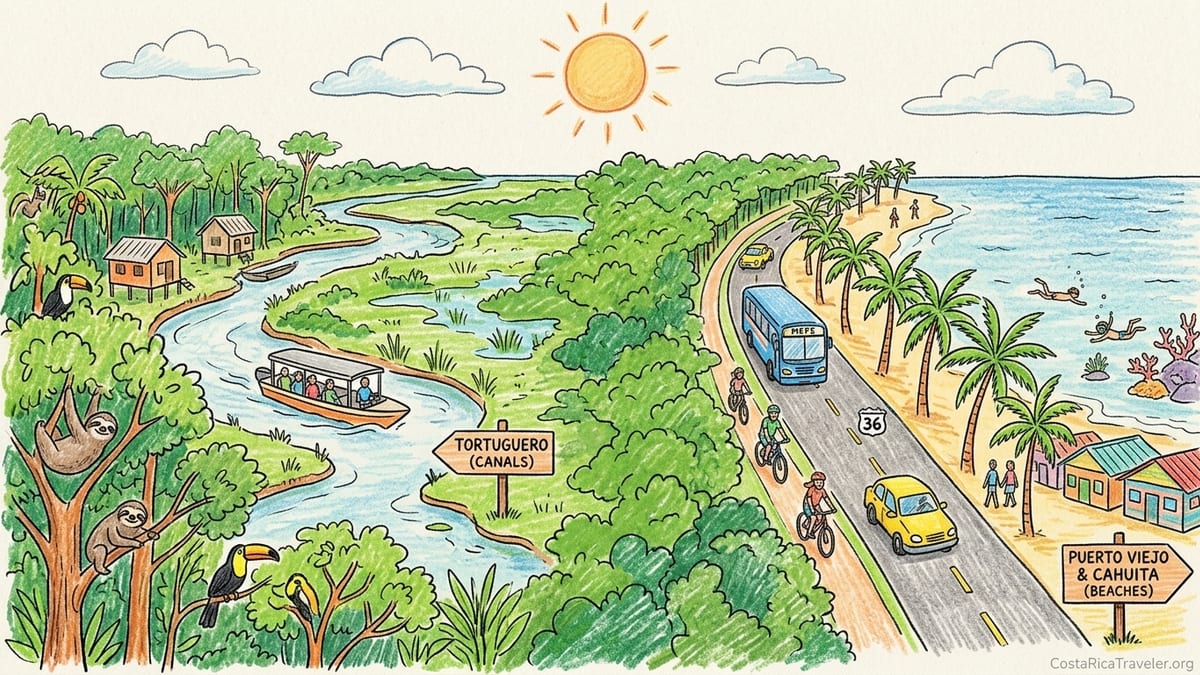
Understanding Costa Rica’s Caribbean Coast Geography
The Caribbean coast of Costa Rica is long and surprisingly segmented. In the far north, Tortuguero and the Barra del Colorado area sit in a roadless maze of canals, rivers and wetlands. Reaching them means combining road transport to boat docks such as La Pavona or Caño Blanco, then continuing by boat into the national park village area. You cannot simply drive into Tortuguero, and there are no day-trip highways connecting it to the southern Caribbean beach towns.
Farther south, the port city of Limón anchors road access to the coastal highway that runs through Cahuita, Puerto Viejo de Talamanca and down to the tiny village of Manzanillo, next to the Gandoca-Manzanillo Wildlife Refuge. Here you can drive, take MEPE public buses or use shared shuttles, and it is common to use a bicycle for short coastal hops between places like Cocles, Playa Chiquita and Punta Uva. The two subregions Tortuguero and the southern coast feel like separate worlds that you connect through San José and Route 32 rather than in one quick jump.
This separation is why Tortuguero is not a casual afternoon excursion from Puerto Viejo. Reaching Tortuguero from Puerto Viejo would require at least one long overland journey back toward Guápiles and Cariari or La Pavona, then a scheduled boat into the canals. Even in perfect conditions, that is many hours of travel each way and involves services that stop operating by late afternoon for safety on the rivers. A smart itinerary treats Tortuguero as its own two- or three-night destination at the start or middle of a trip, not a last-minute side jaunt.
On top of the distance and logistics, current road conditions add complexity. Through late 2026, Route 32 between San José and Limón has been closing and reopening repeatedly due to heavy rain and landslides in the Braulio Carrillo National Park section. Travelers heading for either Tortuguero or the southern Caribbean need to build generous buffers, especially around international flight arrivals and departures, and remain flexible in case authorities temporarily close the highway.
How to Reach Tortuguero and the Southern Caribbean in 2026
Most travelers from abroad arrive via San José’s international airport. From there, you generally choose whether to start with Tortuguero or with Cahuita and Puerto Viejo. The core routes all pass toward Guápiles on Route 32, then either branch off to Tortuguero via Cariari and La Pavona or continue past Limón south along the coastal highway to Cahuita and beyond.
To reach Tortuguero independently in 2026, one common route is to take a bus or shuttle toward Cariari and then continue by taxi or local bus to the boat dock at La Pavona, where public and lodge-operated boats run to the village. Current information from local boat companies indicates several departures from La Pavona in the early and mid-morning, plus early afternoon, with no services after roughly 4:30 p.m. because of low visibility and river safety. Tickets for the public boat are around 4,000 colones per person, about 8 US dollars, each way, paid in cash at the dock. Many midrange and premium lodges bundle boat transfers from La Pavona into their package rates.
To reach Cahuita or Puerto Viejo, MEPE operates direct buses from San José’s Atlántico Norte terminal. As of late 2026, regulated fares set by Costa Rica’s ARESEP show tickets from San José to Cahuita at just under 6,000 colones, and to Puerto Viejo around 7,000 colones, roughly 13 to 16 US dollars. Several daily departures run early morning through mid-afternoon and take about five to six hours depending on Route 32 traffic and construction-related delays. Between Limón and the southern villages, frequent MEPE buses and short local shuttles connect Cahuita, Puerto Viejo, Bribri and Manzanillo, with single rides between Limón and Puerto Viejo costing the equivalent of a few US dollars.
Rental cars and shared tourist shuttles remain common along the southern Caribbean because you can drive door to door once you are past Limón. The complicating factor is Tortuguero. Since there is no road into the village, self-driving visitors leave rental cars in guarded parking lots at La Pavona and then continue only with a backpack or small duffel on the boat. Parking at La Pavona usually costs around 10 US dollars per day. That makes a loop starting and ending in San José with a car practical, as long as you account for the cost of parking and do not schedule tight same-day connections with international flights along Route 32.
Why Tortuguero Is Not a Day Trip from Puerto Viejo
On a map, Tortuguero and Puerto Viejo both lie on the Caribbean coast, so it is tempting to imagine a direct coastal road or quick speedboat between them. In reality, extensive wetlands and protected national park lands separate the northern canals from the southern beaches. There is no practical road that hugs the shoreline, and there is no regular boat route that shuttles tourists between Puerto Viejo and Tortuguero. Instead, all overland traffic feeds back inland and north toward Guápiles and San José before branching again toward Tortuguero.
From Puerto Viejo, a realistic do-it-yourself route to Tortuguero would require taking an early MEPE bus or shuttle back to Limón, then continuing by bus toward Guápiles or Cariari, then transferring to a taxi or local bus to La Pavona in time for one of the morning or early afternoon boats. Under good conditions on Route 32, that pattern still involves six to eight hours of total travel and multiple hops. If Route 32 faces a temporary closure from a landslide, the journey can take much longer, or you may be forced to turn back toward San José and wait.
Boat schedules further limit the idea of a casual afternoon excursion. Authorities and operators stop regular public boat departures from La Pavona by mid to late afternoon, with traveler reports and operators confirming last services around 4:00 or 4:30 p.m. Arriving later would leave you without a safe way to reach Tortuguero village, particularly in the rainy season when river levels and debris make night navigation hazardous. This is why official visitor information stresses reaching La Pavona by early afternoon if you are coming the same day from San José, and ideally even earlier if starting from farther south.
For these reasons, smart planning treats Tortuguero as a dedicated two- or three-night stay that you schedule either right after landing in San José or after a night in the Central Valley or Guápiles area. Trying to squeeze Tortuguero into a single day from Puerto Viejo would mean spending almost the entire day in buses and taxis only to risk missing the last boat. It is not a realistic or relaxing use of precious vacation days, especially given the recent pattern of Route 32 interruptions through October 2026.
Seven-Day Caribbean Itinerary: Tortuguero, Cahuita and Puerto Viejo
This one-week itinerary focuses entirely on the Caribbean, using two nights in Tortuguero followed by four nights split between Cahuita and Puerto Viejo. It assumes you land in San José and prefer a mix of public transport and shared shuttles, with realistic buffers for Route 32 delays. Prices are approximate in late 2026 and do not include international flights.
Day 1: Arrival in San José and overnight in the Central Valley. If your flight arrives after midday, avoid tight connections toward the Caribbean because of Route 32 landslide risks. Instead, overnight near the airport or in San José. Budget travelers can find simple guesthouses from about 50 US dollars for a double with breakfast; midrange hotels cluster around 90 to 140 dollars; premium boutique or branded properties run from around 200 dollars and up. Dinner in San José might cost 12 to 20 dollars per person in a midrange restaurant, less at sodas, the small local diners that serve rice and beans plates.
Day 2: San José to Tortuguero and evening canal village. Aim for an early departure by shuttle or bus toward Guápiles and Cariari, reaching La Pavona by late morning to catch a boat. Many Tortuguero lodges offer combined ground and boat transfers from San José or Guápiles as part of packages that include meals and tours, typically priced from about 180 to 250 dollars per person per night in the midrange, more in premium ecolodges with larger boats and guided activities. Independent travelers might pay roughly 15 to 25 dollars for the bus and taxi combination to La Pavona, 8 dollars for the boat and 60 to 100 dollars per night for simple cabins in the village. Lunch might be a set menu at a Guápiles restaurant along Route 32, then dinner in the lodge or at a village soda for 8 to 15 dollars per person.
Day 3: Tortuguero canal tour and beach walks. This full day is your core Tortuguero experience. A classic morning activity is a guided canoe or small-boat canal tour inside Tortuguero National Park, with departures usually around first light to maximize wildlife sightings. Lodge packages often bundle such tours, while independent visitors can hire guides in the village, with prices generally in the range of 40 to 75 dollars per person for a half-day, including park entrance. The national park fee for foreigners is around 15 US dollars per day, payable by card at official offices. Afternoon options include walking the beach near the village, visiting the small sea turtle conservation center or exploring signed nature trails if conditions allow. Meals depend on your lodging package. Budget visitors might spend 25 to 35 dollars per person for three basic meals in town, while midrange lodge stays include buffets with fresh Caribbean-style dishes and fruit juices.
Day 4: Tortuguero to Cahuita. After breakfast, take a morning boat back from Tortuguero to La Pavona and reconnect to the road. From there, either a pre-booked shuttle or a combination of taxi and public bus takes you back through Guápiles and Limón onward to Cahuita. This is a long but manageable travel day, typically seven to eight hours with connections and a lunch stop in Limón. Expect to pay around 10 dollars to park your rental car at La Pavona for the final day if you left one there, bus fares of 10 to 20 dollars for the combined segments or 50 to 75 dollars per person for a shared shuttle that meets the boat. In Cahuita, check into a hotel near the national park entrance or in the village center. Budget lodging such as small cabinas can start around 45 to 70 dollars per night; midrange hotels with pools sit closer to 110 to 160 dollars; a handful of boutique jungle lodges reach 250 dollars and up. Enjoy a relaxed Caribbean dinner tasting rice and beans cooked in coconut milk for about 10 to 18 dollars per plate.
Day 5: Cahuita National Park and village time. Base yourself in Cahuita village. After breakfast, walk to the main entrance of Cahuita National Park, where foreign visitors contribute a voluntary or suggested donation model through the main Cahuita entrance or pay a fixed fee at the Puerto Vargas sector, depending on which gate they use. Guiding associations in town organize wildlife walks that cost roughly 25 to 45 dollars per person for a few hours. Spend the morning on the beachfront trail spotting monkeys, sloths and toucans, then relax on the park’s white-sand coves. In the afternoon, return to the village for a late lunch and downtime by the pool or at a beach bar. Dinner could be live-music spots on weekends or quieter seafood shacks midweek. Daily food spending in Cahuita might sit between 30 and 60 dollars per person depending on restaurant choices.
Day 6: Transfer to Puerto Viejo and explore beaches from Cocles to Punta Uva. It is only about 16 kilometers from Cahuita to Puerto Viejo, easily reached in under one hour by MEPE bus or taxi. Bus fares are just a couple of dollars, while a private taxi might cost 25 to 40 dollars for a group. After checking into your Puerto Viejo base, rent bicycles in town for around 10 to 15 dollars per day and ride south past Playa Cocles, Playa Chiquita and down to Punta Uva. These stretches feature a mix of mellow surf breaks and calm coves depending on conditions. Budget stays in Puerto Viejo start close to 50 dollars per night in hostels and cabinas; midrange beachfront hotels fall in the 130 to 200 dollar range; premium eco-boutiques and villas can run from around 300 dollars upward. Lunch and dinner options include Jamaican-style jerk chicken, patacones and Caribbean curries, with main dishes typically 12 to 22 dollars in midrange restaurants.
Day 7: Gandoca-Manzanillo Wildlife Refuge and return toward San José. Use your last full day for the southern tip of the coast. Take the morning MEPE bus, taxi or bike ride down to Manzanillo village and explore the forest trails and lookouts of the Gandoca-Manzanillo Wildlife Refuge with or without a local guide. Expect to contribute modest entrance or guiding fees that support community-based tourism initiatives, often 10 to 20 dollars per person for guiding. After a seafood lunch in Manzanillo or back in Puerto Viejo, start the return journey to San José by late afternoon or, preferably, overnight again on the Caribbean and travel to the capital early the next morning. Given Route 32’s landslide-related closures in October 2026, many travelers are now building at least half a day of margin before outbound international flights.
Ten-Day Caribbean Itinerary with Pacuare Rafting and Bribri Culture
The 10-day version keeps the same core axis of Tortuguero, Cahuita and Puerto Viejo but adds a Pacuare River rafting experience and a community-led Bribri cultural visit near Bribri, plus extra time to savor Afro-Caribbean food and slower beach days. This plan assumes you are comfortable with a mix of organized tours and public transport or shuttles.
Days 1 to 3 follow the same pattern: arrival in San José, overnight; transfer to Tortuguero with two nights there and a full canal-tour day. To make the itineraries meaningfully different, book your Tortuguero stay in a slightly more upscale eco-lodge on the 10-day trip, focusing on guided night walks and village history tours. Premium packages in Tortuguero can run 300 to 450 dollars per person per night but typically wrap in all meals, boat transport and multiple guided activities, which keeps your incidental spending low beyond drinks and tips.
Day 4: Tortuguero to Pacuare River lodge or Turrialba. Instead of heading straight to Cahuita, you travel by morning boat back to La Pavona and then drive or shuttle toward Turrialba, the gateway town for Pacuare rafting. Many rafting companies offer combined transfers from Caribbean and Central Valley destinations to their Pacuare put-in points and river lodges. A typical package for a one-night, two-day rafting trip with lodge stay, several meals and transport from San José, La Fortuna or Puerto Viejo costs in the wide range of about 350 to 500 dollars per person, depending on season and lodging level. In a 10-day Caribbean itinerary, you can arrange to be picked up in Guápiles or near La Pavona, raft into a Pacuare lodge for the night and then raft out to a take-out road the next day, continuing onward toward the southern Caribbean.
Day 5: Rafting day and onward to Cahuita. After breakfast at the river lodge, enjoy additional rafting segments through Pacuare’s class III and IV rapids, then reach the take-out point around midday to early afternoon. Many operators coordinate with shared shuttles or private drivers so that Caribbean-bound guests continue east, reaching Cahuita or Puerto Viejo by early evening. This keeps the transport “in line” rather than backtracking to San José. Rafting trips typically include lunch at the take-out and leave you to handle dinner once you arrive in Cahuita. On this itinerary, choose a midrange or premium small hotel in Cahuita to decompress from the river, budgeting 130 to 250 dollars per night for comfortable air-conditioned rooms with pools and breakfast, plus 20 to 35 dollars per person for a celebratory seafood dinner.
Day 6: Slow Cahuita National Park day. With more time, spend an unhurried day at Cahuita National Park. Consider hiring a private naturalist guide for the first couple of hours, then stay on your own to swim and relax. For rainy-day alternatives, the park’s forest trails can become muddy or temporarily closed, so you might pivot to a cooking class in town, learning to prepare Caribbean coconut rice and plantain-based dishes, or visit cultural centers that highlight Limón province’s Afro-Caribbean history. Add another 40 to 80 dollars per person for such experiences in your budget.
Day 7: Transfer to Puerto Viejo and Bribri cultural tourism. Move your base to Puerto Viejo using the same short bus or taxi hop as in the 7-day plan. Once there, arrange a full or half-day visit with Bribri community-based tourism groups near Bribri town along the inland road. These tours typically include round-trip transport from Puerto Viejo, a guided walk through cacao or medicinal plant gardens, a river swim and lunch with a local family. Prices often run between 70 and 120 dollars per person depending on group size and inclusions. This is one of the most direct ways to support Indigenous-led initiatives in the region while learning about traditional land use and culture in a non-safari, people-centered way.
Day 8: Afro-Caribbean food and beach-hopping from Cocles to Punta Uva. Dedicate this day to food and coast. After a leisurely breakfast, rent bikes and spend the morning riding between Cocles, Playa Chiquita and Punta Uva, stopping for swims and fruit smoothies. For lunch and dinner, seek out family-run sodas and Afro-Caribbean kitchens that serve dishes like rondon stew, patty-style empanadas and fish cooked in coconut milk. With extra days, you can afford long midday meals that might cost 15 to 25 dollars per person including a drink. Rainy-day alternatives include café hopping in Puerto Viejo or joining a chocolate-making workshop in the hills above town.
Day 9: Gandoca-Manzanillo Wildlife Refuge deep dive. Take a more in-depth visit to Gandoca-Manzanillo than the brief stop in the 7-day itinerary. Start early with a local guide for a several-hour hike to viewpoints and hidden coves inside the refuge, then relax in Manzanillo village. Guides might charge in the region of 25 to 50 dollars per person depending on route length and group size. In case of heavy rain or trail closures, plan a backup day of surfing lessons in Cocles or indoor yoga and spa time at one of the wellness-focused hotels north of town.
Day 10: Return to San José with buffers. For the final day, prioritize safe travel back to San José. Given recent Route 32 closures in October 2026, the safest strategy is to schedule your bus or shuttle back a full day before any outbound international flight. MEPE buses from Puerto Viejo to San José cost the same regulated fares mentioned earlier and generally take about five to six hours under normal conditions, but you should expect possible delays if landslides or construction slow traffic through Braulio Carrillo. Private shuttles cost more, often between 60 and 100 dollars per person, but can pick you up at your hotel and drop you at an airport-area lodging, simplifying the final leg.
Transport Choices: Buses, Shuttles, Rental Cars and Bikes
Traveling the Caribbean coast of Costa Rica involves different transport layers that each fit particular budgets and comfort levels. MEPE public buses handle most of the coastal traffic between San José, Limón, Cahuita, Puerto Viejo, Bribri, Sixaola and Manzanillo. Current schedules confirmed by bus operators in early 2026 show several daily departures each way between San José and Puerto Viejo, plus at least hourly services between Limón and the southern villages during daylight. Public buses are the cheapest option, around 15 dollars from San José to Puerto Viejo and just a few dollars for shorter legs.
Shared tourist shuttles connect many San José hotels, La Fortuna, Turrialba, Puerto Viejo and even some Tortuguero docks such as La Pavona. These cost more than buses but allow door-to-door pickups, comfortable seats and a single booking that handles your luggage. As of late 2026, typical shared shuttle fares for San José to Puerto Viejo sit in the rough range of 60 to 80 dollars per person, while private transfers for couples or small groups can cost 180 to 300 dollars depending on vehicle size and route.
Rental cars are most practical on the southern Caribbean segment rather than for Tortuguero. Many travelers rent in San José, drive east via Route 32 and park at Cahuita or Puerto Viejo for several days while exploring by bicycle. If they also visit Tortuguero, they either add a night in Guápiles and then leave the car in paid parking at La Pavona, or arrange a transfer and avoid driving entirely for that leg. You need to budget not only the daily rental cost, often 40 to 80 dollars for a compact car before insurance, but also local liability coverage, fuel and around 10 dollars per day for guarded parking at La Pavona or in town.
Bicycles are the signature way to explore between Puerto Viejo, Cocles, Playa Chiquita and Punta Uva. The coastal road is mostly flat, and bike rental shops dot the main strip, charging about 10 to 15 dollars per 24 hours for simple cruisers and more for e-bikes. When it pours, however, cycling becomes less comfortable and visibility drops, so have a backup plan of catching a short MEPE bus or taxi between beaches. Most visitors mix and match: long-distance legs with bus or shuttle, a few days with a rental car if visiting remote lodges and daily biking around their beach base.
Route 32 Weather Risks and Airport Connection Timing
Route 32 is the lifeline between San José and the Caribbean provinces, cutting through the cloud forests and steep slopes of Braulio Carrillo National Park. Official information about this highway notes that fog and landslides are common during the rainy season because of the topography and the heavy rainfall the region receives. In 2026, traveler reports and local news updates through October have highlighted periodic closures and lane reductions after landslides or washouts, sometimes lasting several hours or longer until crews could clear debris.
For trip planning, this means you should not plan tight same-day connections between an international flight arrival in San José and a long journey to the Caribbean, particularly in the May to November rainy period. If your flight lands after about midday, the conservative strategy is to sleep in San José or near the airport and head to Tortuguero or Puerto Viejo at first light the next day. This gives you more daylight flexibility in case Route 32 experiences delays and reduces the risk of missing the last boat from La Pavona or arriving too late to check into lodges that require earlier transfers.
Similarly, on departure days you should count backward from your flight time and consider the cumulative risk of delays. A morning flight out of San José paired with a dawn bus from Puerto Viejo leaves almost zero buffer if a landslide or accident closes Route 32 temporarily. Many seasoned travelers now either return to the Central Valley the day before their flight or opt for an evening flight that gives them at least six extra hours of margin. Some also explore alternate road routes that link the Caribbean lowlands to the Central Valley via other national routes used in emergencies, though these are longer and require confident driving.
If you choose to drive yourself, be prepared for heavy trucks, changing weather and occasional fog banks along Route 32. It is wise to keep your fuel tank at least half full before entering the Braulio Carrillo section, carry some snacks and water and monitor official road status through local news or roadside announcements. On buses and shuttles, operators usually adjust departure times or routes if major closures are announced, but that rarely compensates for trying to squeeze too much travel into a single day.
Budget, Midrange and Premium Scenarios plus Rainy-Day Alternatives
The Caribbean lends itself to a wide range of budgets. At the budget level, you could string together simple cabinas and hostels in San José, Tortuguero, Cahuita and Puerto Viejo, move mostly by MEPE bus and public boats and cook some of your own meals or eat at sodas. A realistic daily budget in late 2026 for this style would be roughly 60 to 100 dollars per person, including a dorm bed or basic double room, three modest meals, national park entrance fees on select days and the occasional guided tour like a canal visit or wildlife walk.
Midrange travelers staying in small hotels with private bathrooms, air conditioning where needed and breakfast included, plus using a mix of buses and shared shuttles, should expect daily costs closer to 140 to 230 dollars per person when averaging Tortuguero packages, rafting add-ons and cultural tours over a week or ten days. This estimate assumes one or two guided activities every couple of days and mostly restaurant dining, with per-meal costs typically between 10 and 25 dollars before drinks in the Caribbean villages.
Premium travelers choosing ecolodges in Tortuguero, a Pacuare river lodge, boutique hotels with pools near Punta Uva and frequent private transfers can easily see daily trip costs of 300 dollars per person and upward, especially once high-end rafting packages and spa treatments enter the picture. The upside is a smoother door-to-door travel experience and more privacy, which can be worth the price in remote spots or for families who prefer a single point of contact for logistics and safety.
Rain is part of the Caribbean character, and you should expect at least a few showers even in drier months. Have a list of rainy-day alternatives ready: chocolate-making workshops in Indigenous or small-farm settings near Bribri, Caribbean cooking classes in Cahuita or Puerto Viejo, yoga studios and wellness centers around Cocles, or simply lingering over coffee and books in beachfront cafés. In Tortuguero, a rainy morning can still be good for wildlife spotting along the canals under ponchos, while afternoon downpours might be better spent in lodge hammocks listening to the storms pass.
Southern-Coast-Only Version for Shorter or Simpler Trips
If coordinating boats, river lodges and Route 32 timing feels overwhelming, you can still experience Costa Rica’s Caribbean culture by focusing only on the southern coast. A seven-night southern-only itinerary might skip Tortuguero and instead split time between Cahuita and Puerto Viejo or Manzanillo, adding Bribri cultural visits and a Pacuare rafting day that picks you up and returns you to the same beach hotel.
In that version, you could spend three nights in Cahuita to emphasize national park hiking and quiet beaches, then four nights in a small hotel between Cocles and Punta Uva to maximize cycling distance to both Puerto Viejo’s dining scene and the Gandoca-Manzanillo Wildlife Refuge. MEPE buses and short taxis would cover all inter-town transport, and you could allocate part of your savings from skipping Tortuguero toward a one-day Pacuare rafting trip that includes early pickup in Puerto Viejo and late-day drop-off back at the same hotel. Rafting operators already run this pattern, bundling breakfast, lunch, gear and all transfers into a single per-person price that currently often falls somewhere between 130 and 180 dollars for a full day.
This southern-only plan reduces the number of moving parts while still delivering coral-fringed beaches, Afro-Caribbean food and the chance to support Indigenous tourism in Bribri communities. It is particularly appealing for families with young children who would find multiple boat rides and long road days tiring, or for remote workers combining several days of beach-based work with a couple of concentrated adventure days.
Whether you choose the full Tortuguero-to-Manzanillo arc, the extended 10-day version with Pacuare rafting and Bribri culture or a simpler southern-only route, the key is to give the Caribbean the time and respect it deserves. Treat it not as an add-on to the more famous Pacific coast, but as a distinct region where water, culture and forest blend into a slower, richer travel rhythm.
The Takeaway
Costa Rica’s Caribbean coast rewards travelers who slow down and plan around its realities. Tortuguero, with its dark-water canals and turtle-nesting beaches, is physically and logistically separate from the southern beach towns of Cahuita, Puerto Viejo and Manzanillo. Reaching one from the other requires retracing your route through inland roads and navigating fixed boat schedules, which makes Tortuguero unsuitable as a spur-of-the-moment day trip from Puerto Viejo.
Instead, build itineraries that respect distances, boat times and Route 32’s weather-related vulnerabilities. A seven-day route with two nights in Tortuguero and four on the southern coast delivers a balanced taste of canals and beaches. A ten-day version layers in Pacuare rafting, Bribri-led cultural visits and long afternoons spent savoring Afro-Caribbean cuisine. For those who prefer low-complexity travel, a southern-coast-only plan still provides rich wildlife and cultural encounters without the need to coordinate boats.
By pairing up-to-date bus and boat schedules with realistic budgets for lodging, food and tours across different comfort levels, you can craft a Caribbean-only Costa Rica trip that feels both immersive and manageable. With a bit of buffer time and flexibility built in for Route 32 closures or tropical downpours, the journey from Tortuguero’s canals to Puerto Viejo’s palm-fringed beaches can become not just a line on a map, but the spine of a memorable, region-focused adventure.
FAQ
Q1. Can I visit Tortuguero as a day trip from Puerto Viejo?
Tortuguero is not realistic as a day trip from Puerto Viejo because you must travel inland toward La Pavona and then take a scheduled boat, which together take many hours each way and stop running by late afternoon.
Q2. How many days do I need on Costa Rica’s Caribbean coast?
A focused trip needs at least seven days to combine Tortuguero with Cahuita and Puerto Viejo, while ten days allows for Pacuare rafting, Bribri cultural visits and slower beach time.
Q3. Is it safe to drive Route 32 between San José and Limón in 2026?
Route 32 is widely used but experiences fog, heavy truck traffic and periodic landslide-related closures, so it is safest to drive in daylight with flexible timing and to check conditions the day you travel.
Q4. Do I need to rent a car for this Caribbean itinerary?
You do not need a car if you are comfortable with MEPE buses and shared shuttles, but a rental is convenient on the southern coast; it must be left at La Pavona or another dock when visiting Tortuguero.
Q5. How much should I budget per day on the Caribbean coast?
Approximate daily budgets range from 60 to 100 US dollars per person at the backpacker level, around 140 to 230 dollars for midrange comfort and 300 dollars or more for premium lodge and private-transfer experiences.
Q6. What is the best time of year to visit Tortuguero and Puerto Viejo?
The Caribbean sees rain year-round, but many travelers favor February and March or September and October for relatively drier windows, turtle nesting in Tortuguero and calmer seas on parts of the southern coast.
Q7. Are Pacuare rafting trips possible from the Caribbean side?
Yes, many outfitters offer Pacuare rafting packages that include pickup in or near Puerto Viejo or Cahuita, rafting and return transport, or a through-trip that continues toward the Caribbean after rafting.
Q8. How do I visit Bribri communities respectfully?
Book tours through community-led organizations based around Bribri town that clearly state how income is shared, keep group sizes small and follow your hosts’ guidance on photography and cultural protocols.
Q9. Do I need advance reservations for Tortuguero boats?
Public boats from La Pavona do not always require advance booking, but lodges often coordinate spots for their guests and it is wise to confirm times and space in high season to avoid long waits.
Q10. What should I pack specifically for a Caribbean-only itinerary?
Pack lightweight rain gear, quick-drying clothes, closed-toe shoes for muddy trails, reef-safe sunscreen, insect repellent, a dry bag for boat days and a small daypack for canal tours and hikes.