


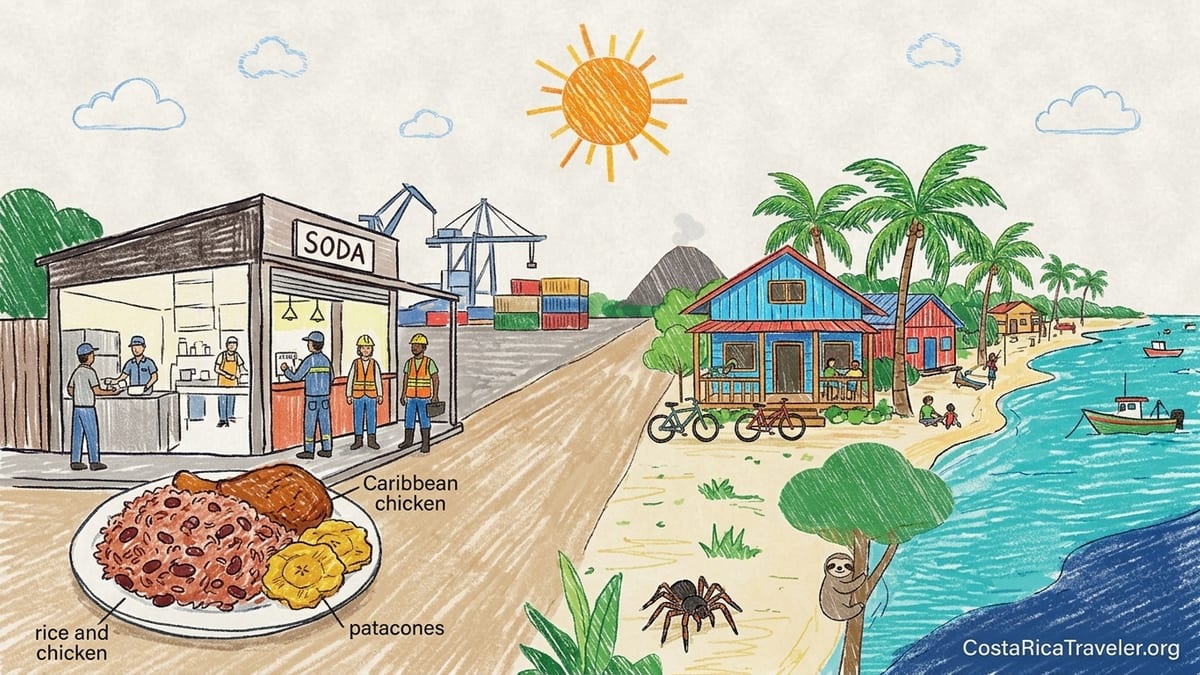
The first spoonful of rice and beans in Limón stopped every other sound on the street. Outside, cargo trucks rumbled past the port and reggae floated from a crackling speaker, but at my plastic table in a no-frills soda the only thing that existed was coconut, chile and smoke. The rice was brick red from beans simmered in coconut milk, the grains glistening with fat and clove-scented spice, a whole chicken leg beside it stained deep brown by a slow-cooked Caribbean sauce. It was not the gallo pinto I knew from central Costa Rica. This was sweeter, silkier, edged with the heat of Panamanian chile, and it tasted like the sea and centuries of crossings to get here.
Starting in Limón: Rice and Beans by the Port
I arrived in Limón on a humid afternoon, the sky the flat gray of an overcast Caribbean day. Instead of heading straight for the cruise-terminal bars, I walked inland a few blocks, past hardware stores and phone shops, until the smell of frying dough and stewed chicken drew me into a small soda on a side street. The menu taped to the wall listed “rice and beans con pollo caribe” for about 4,500 colones, a little under 9 US dollars at recent exchange rates, including the standard 13 percent tax and 10 percent service charge added to most Costa Rican restaurant bills. I ordered without thinking twice.
The plate that arrived was generous and unapologetically local. The rice and beans were cooked together in coconut milk, tinted a brick red by the black beans and seasoned with thyme, onion, garlic and a whole Scotch bonnet chile that had clearly been removed before serving but left its perfume and a lingering warmth. The Caribbean chicken, a thigh and drumstick on the bone, tasted of tomato, sweet pepper and curry, with a molasses hint from brown sugar or cane syrup. On the side sat a handful of patacones, green plantain slices smashed and fried twice until crisp outside and tender within, plus a tiny cabbage salad with lime.
What struck me first was how different this was from the gallo pinto served on the Pacific side of Costa Rica. Gallo pinto is a breakfast dish, a dry mix of separate rice and black or red beans fried together in oil with cilantro and Salsa Lizano. It is savory, light and meant to share a plate with eggs and cheese. Limón’s rice and beans are something else entirely: a standalone main dish born of coconut milk, long simmering and the alchemy of spice. The rice is moist and almost creamy, the coconut fat binding it in a way that feels closer to risotto than to the crisped grains of gallo pinto.
Eating this plate in Limón’s working port city added its own flavor. The service was brisk but not performative, the cook calling out to friends on the sidewalk between stirring pots. Most diners were dockworkers and office staff on lunch break, dressed in uniforms and construction vests, eating quickly before heading back to ships and warehouses. English and Spanish blurred with the lilt of Limón Creole, an English-based Caribbean dialect, a reminder that this city has always looked more to Jamaica and the Antilles than to the Central Valley for its cultural compass.
Bakeries, Patí and Everyday Afro-Caribbean Traditions
After lunch I walked toward the center to track down something I had long associated with Limón in my mind: patí. Patí is a half-moon pastry brought from Jamaica, its flaky wheat dough dyed golden and filled with spicy ground beef or chicken seasoned with chile and allspice. It has the portable practicality of an empanada, but its taste is unmistakably Caribbean. Locals talk about women in the early 20th century boarding the Atlantic railroad with baskets of warm patí to sell to passengers, turning this snack into a symbol of Limón’s Afro-Caribbean heritage.
Near the market I stepped into a small bakery that locals had recommended when I asked for patí. In the glass case, next to thick slices of dark pan bon and trays of fried cake, sat rows of patí, still glistening slightly from the oven. A single patí cost around 900 colones, less than 2 US dollars. I chose one stuffed with beef, the dough cracking in flakes over my fingers as I bit through. The filling was moist and fiery, the heat of the chile hitting after a second or two, balanced by the faint sweetness of the dough. This was the sort of snack eaten standing on the sidewalk, within earshot of bus horns and conversation, and it felt like a bridge between the Caribbean islands and the Costa Rican mainland.
The same bakery offered coconut-heavy sweets that told another chapter of the story: plantinta, a tart filled with ripe plantain; pan bon, a dense fruit bread spiced with nutmeg and clove; and coconut drops, rough little clusters of grated coconut and sugar baked until just set. These were not tourist souvenirs wrapped in plastic. They were everyday treats for Limón families, the sort of thing you would buy on a Saturday after errands or as a snack for the bus back to the inland cities. Coconut, plantain and cassava are not just ingredients here. They are the language in which family recipes are written.
When I asked the woman behind the counter where to go next if I wanted more traditional flavors, she mentioned Soda El Patty as a classic spot for rice and beans, patí and other Afro-Caribbean staples. Online reviews echo that it serves authentic Limón-style food and baked goods at prices usually around 5,000 to 10,000 colones per person, though service can feel abrupt at busy times. I did not eat there myself on this trip, but if you want another grounded option within walking distance of the port, it belongs on your shortlist as a researched alternative rather than a personal favorite.
From Port City to Beach Town: First Bites in Puerto Viejo
A few days later, the bus rolled south from Limón to Puerto Viejo de Talamanca. The transition from port city to beach town was immediate. Cranes and containers gave way to coconut palms and bicycle rentals, and concrete blocks to wooden houses painted in hibiscus reds and ocean blues. The food, however, carried the same DNA: coconut, plantain, fish and fire.
My first meal in Puerto Viejo was at a modest Caribbean soda just off the main road, a place recommended by several residents precisely because it catered more to locals than to surfboard-toting visitors. Plastic tables, a hand-painted sign and an open kitchen were the entire decoration. The day’s offerings were written on a whiteboard: rice and beans with Caribbean chicken, fish in coconut sauce, and a limited number of portions of rondón, the thick seafood and root vegetable stew that every traveler hears about but not every restaurant prepares regularly.
I ordered rice and beans with Caribbean chicken again, wanting to compare it with the Limón version. The plate cost about 4,000 colones, including a fresh passion fruit juice. Here, the beans gave the rice a slightly lighter color, and the coconut flavor stood out more clearly, less masked by clove and more by thyme and bay leaf. The chicken came in a sauce with more pronounced curry notes, closer to Jamaican brown stew chicken, and the heat of the Scotch bonnet was higher, though still rounded rather than sharp. On the side were patacones and a simple green salad dressed with vinegar and lime.
The atmosphere, though, could not have been more different from lunch in Limón. The speakers outside played reggae at a lazy volume, and no one seemed in a rush. Diners were a mix of local families, expats who greeted the owner by name, and travelers comparing beach notes over casados. Service was warm, with time taken to explain each dish and to ask afterward if the spice level had been acceptable. Puerto Viejo may share recipes with Limón, but as a tourism-focused town it layers in a slower pacing and a more conversational style of hospitality.
Rondón, Coconut Fish and the Depth of the Pot
I met rondón for the first time in Cahuita, a short ride from Puerto Viejo along a road fringed with sea almond trees and glimpses of the surf. Friends had insisted that I wait to eat this dish until I could find it in a small family-run place rather than a restaurant that prepared it every day for visitors. The best rondón, they said, still follows the rule that gives it its name: you make it from what you can “run down” that day, whatever the market and sea provide.
At a tiny soda near the entrance to Cahuita National Park, rondón was offered only on weekends and only until the pot ran out. For 7,000 colones, the bowl arrived almost overflowing. The broth was the color of pale caramel, thickened by coconut milk and long-cooked root vegetables: yuca, taro, sweet potato and green plantain. Floating within were chunks of fish, a blue crab cut into sections, and on the very top a whole Scotch bonnet left intact to perfume the stew rather than explode it with heat.
The taste was layered and deep. Coconut milk formed the base, but it was joined by thyme, culantro, onion and garlic, a little black pepper and perhaps a hint of clove. The fish tasted freshly caught, its sweetness amplified by the sauce. The root vegetables had broken down just enough to give the broth body, and the green plantain added a subtle starchiness and slight bitterness that balanced the richness. On the side, as if the bowl were not generous enough, came a mound of rice and beans in coconut milk and two thick slices of boiled green plantain.
In that bowl, the history of Afro-Costa Rican cooking was visible. Rondón traces its origins to Jamaican workers who came to Central America in the 19th century to build railroads and work on banana plantations. They brought with them the technique of simmering fish and roots in coconut milk, adapting it to local ingredients like cassava and native chiles. In Limón province, Indigenous Bribri traditions around cacao, plantain and root crops layered onto these Caribbean methods. What results today is not simply imported Jamaican cuisine, but a hybrid born of the Caribbean Sea, Indigenous farms in the Talamanca foothills and the constraints of working-class life along a once-remote coastline.
Comparing Local Sodas and Caribbean-Fusion Dining
Puerto Viejo’s growing popularity has given rise to a new generation of restaurants that take these traditional flavors and reinterpret them in more polished, often pricier settings. One evening, after several meals in neighborhood sodas, I booked a table at a well-known Caribbean-fusion restaurant in town, the kind that appears in most local guides as a special-occasion option. Here, mains tended to fall between 10 and 16 US dollars, with cocktails around 8 to 10, positioning it clearly above the soda price range.
The menu leaned into local ingredients but arranged them in ways more familiar to international diners: seared fish over coconut rice with a ginger-lime reduction, Caribbean chicken paired with roasted vegetables instead of patacones, and plantain three ways on a single plate. I ordered a coconut fish dish that echoed the flavors I had already come to love. The fish, likely pargo or another local white fish, arrived perfectly seared with crisp skin, set on a bed of rice that had been cooked in coconut milk like traditional rice and beans but without the beans. A sauce of reduced coconut cream, ginger and citrus pooled underneath, and on the side sat caramelized ripe plantain slices.
The flavors were clean and precise. The coconut notes were familiar, but the plating and portion size felt designed for a slower, more curated experience. The service matched: attentive without hovering, explaining vegetarian adaptations and possible allergens unprompted. It was clear that this restaurant saw itself as part of an international conversation about food, drawing on Caribbean roots while making sure guests from Europe or North America could navigate the menu with ease.
By contrast, the sodas I had eaten at in Puerto Viejo and Cahuita operated on a different logic. There, portions were heartier, prices mostly between 3,500 and 6,000 colones for a full plate with drink, and the day’s menu limited to what the cook felt like preparing or had sourced fresh. You might find rondón only on Sundays, or discover that the coconut fish was gone by early afternoon because fishermen had not brought in enough. Service was often friendly but stretched thin when cousins or neighbors stopped in, and you were expected to linger without pressure to order more. Both models have their place. For a first encounter with rice and beans or Caribbean chicken, the soda feels closest to the dish’s origins. For a celebratory dinner that still speaks the language of the coast, the fusion restaurant offers a different, complementary angle.
Vegetarian Plates and Eating Safely with Allergies
The central role of seafood and chicken in Afro-Caribbean cooking can make Limón province look challenging for vegetarians or travelers with allergies, but the reality is more nuanced. Coconut milk, plantain, cassava and beans create a natural foundation for meat-free meals if you know what to ask for and how the kitchen works.
In several sodas around Puerto Viejo, I saw vegetarian plates built from rice and beans cooked in coconut milk, stewed vegetables, salads and patacones. Menus often listed “plato vegetariano” or allowed diners to assemble one by combining side dishes. It is important to ask whether the rice and beans are cooked with any meat broth or small pieces of pork, since recipes vary. In my case, one owner confirmed that her weekday rice and beans contained only coconut milk and spices, while Sunday batches sometimes included a bit of smoked meat for extra flavor.
For vegans, plant-based options usually include patacones fried in vegetable oil, salads dressed simply with lime and oil, and plates built around sautéed vegetables and beans. Some of the more tourism-oriented Caribbean-fusion restaurants in Puerto Viejo also highlight vegetarian dishes explicitly, such as coconut curry with local vegetables served over rice, or plantain gnocchi with a light coconut sauce. These restaurants tend to have printed menus that mark dairy, nuts and gluten, though details can change, so a quick conversation with staff remains essential.
Allergy management on the Caribbean coast requires particular care for those sensitive to seafood, coconut or chile. Coconut milk is ubiquitous in rice and beans, rondón and many sauces. If you have a coconut allergy, you will need to specify arroz blanco instead of rice and beans, and avoid stews and creamed fish entirely. In sodas, cross-contamination is more likely, since pots often share ladles and burners. Puerto Viejo’s higher-end restaurants, which list ingredients more precisely and sometimes accommodate substitutions, may be safer for those with complex allergies. For nut allergies, risk is somewhat lower, as nuts are not central to most Afro-Caribbean dishes here, but always ask about desserts and imported baked goods where peanuts or other nuts might appear.
Dining Culture: Limón’s Work Rhythms vs. Puerto Viejo’s Beach Pace
What stayed with me as much as the food itself were the different ways people eat in Limón city and Puerto Viejo. In Limón, meals seemed tied tightly to the rhythms of the port. Lunch rush began early and ended abruptly, with tables turning over quickly as workers returned to ships, offices or construction sites. Sodas around the center often closed by late afternoon. Breakfast and lunch are the main events, and many bakeries and patí vendors do brisk business in the early morning, filling buses and office desks with coconut-scented packages.
In Puerto Viejo, dining spreads across the day and deep into the night. Surfers grab hearty Caribbean breakfasts mid-morning after the first waves, tourists wander into cafes for brunch at noon, and beach bars with DJ sets stretch dinners into long evenings. The same rice and beans with Caribbean chicken that might be a quick midday plate in Limón turns into a leisurely dinner in Puerto Viejo, taken with craft beer or cocktails and a sunset view. Menus here often reflect that flexibility, with all-day rice and beans or patacones available alongside ceviches and fusion dishes meant to be shared.
Another difference lies in how visibly Afro-Caribbean culture frames the dining experience. In Limón city, it is simply everyday life: the soundscape, the languages, the street vendors with baskets of patí at football matches and bus stops. Restaurants rarely decorate themselves as “Caribbean”; they just are. In Puerto Viejo, Afro-Caribbean identity is still central but sometimes becomes a selling point. Menu boards emphasize “authentic Caribbean rice and beans” or “traditional rondón,” and the music, murals and color schemes often lean consciously into reggae and Rastafarian imagery for visitors.
Neither approach is more real than the other. Limón expresses a cuisine rooted in labor and port history, fed by decades of migration and trade. Puerto Viejo shows how that same cuisine adapts to a tourism economy, balancing local tastes with global expectations. For a traveler interested in food, experiencing both gives a fuller picture of what Afro-Costa Rican cooking means today.
A One-Day Food Itinerary and a Longer Culinary Route
If you have only one full day on the Caribbean coast and care about food, I would start and end it with coconut. Wake up in Puerto Viejo and walk to a local soda near the center for a breakfast plate that includes a small portion of rice and beans cooked in coconut milk alongside eggs or fried plantain. Ask if they can prepare the rice and beans with less chile if you are sensitive, or without egg if you are vegan. Pair it with a glass of freshly blended passion fruit or pineapple juice to taste just how central fruit is to daily life here.
Late morning, rent a bicycle and ride north to Cahuita, stopping at a roadside stand for chunks of cold watermelon or slices of ripe papaya cut to order. For lunch, seek out a family-run soda in Cahuita offering rice and beans with Caribbean chicken or fish of the day. Prices are often around 4,000 to 6,000 colones for a heaping plate, and portions are large enough to fuel an afternoon walk in Cahuita National Park. If you are there on a weekend and rondón is on the board, this is your chance. Share a bowl if you plan to keep riding afterward, as rondón is rich and deeply filling.
Head back toward Puerto Viejo in the late afternoon, stopping at a cacao or chocolate shop run by local producers to learn how Indigenous Bribri and Cabécar communities have long cultivated cacao in the Talamanca mountains. Taste a small cup of hot cacao or a square of high-percentage dark chocolate and notice how its bitterness and earthiness echo some of the same notes you find in coffee and even in the toasted edges of rice and beans. For dinner, book that Caribbean-fusion restaurant you have been curious about in Puerto Viejo. Order a dish that uses coconut, plantain or cassava, and compare its expression to what you tasted at lunch.
With more time, a longer culinary route across Limón province might begin in Limón city, with patí and pan bon from a central bakery and a plate of rice and beans with Caribbean chicken in a port-side soda. From there, you could travel south to Cahuita for rondón and quiet nights, then onward to Puerto Viejo for a mix of sodas and creative kitchens, continuing to Manzanillo for seafood lunches in beachside comedores. Along the way, markets and roadside stands become important stops in their own right, where you can see breadfruit, plantains of different ripeness, cassava and unfamiliar tubers stacked in plastic baskets, each with a story that ends in somebody’s pot.
The Takeaway
Looking back on my days along the Caribbean coast, one dish stands out as my favorite: rice and beans cooked in coconut milk with Caribbean chicken on the side. It held within it everything I had come to Limón province seeking. There was history in the coconut and Scotch bonnet, in the thyme and clove, in the way beans and rice melded into a unified whole instead of sitting side by side. There was geography in the plantain and cassava, crops that tie the Caribbean shoreline to the Indigenous farms inland. And there was everyday life in the plate’s sheer generosity, meant to satisfy port workers and surfers alike.
As for which town delivered the most rewarding food experience, my answer splits in two. Limón city offered the deepest sense of continuity, where patí in a bakery and rice and beans in a bustling lunch soda felt like part of a living, working culture that does not bend itself toward visitors. Puerto Viejo, on the other hand, gave me the broadest range of interpretations, from humble sodas to refined Caribbean-fusion rooms, all within bicycle distance of one another and framed by the sound of waves.
If you care about food, it is worth making time for both. Eat patí on a street corner in Limón with traffic rumbling past, then a few days later taste coconut fish by candlelight in Puerto Viejo with sand under your feet. Somewhere between those two tables, in the contrast between dockworker lunches and sunset tasting menus, the full story of Afro-Caribbean cuisine in Limón province comes into focus: resilient, adaptive and always anchored in the simple, powerful combination of rice, beans and coconut milk.
FAQ
Q1. What is the difference between Caribbean rice and beans and Costa Rican gallo pinto?
Caribbean rice and beans in Limón province are cooked together in coconut milk with spices like thyme and Scotch bonnet chile, served as a main dish with chicken or fish. Gallo pinto is a drier breakfast mix of separately cooked rice and beans fried together in oil with cilantro and Salsa Lizano, typically without coconut and usually paired with eggs and cheese.
Q2. Where can I find authentic patí in Limón city?
Patí is widely sold in Limón’s small bakeries and sodas near the center and market area. Many locals recommend long-established bakeries or Soda El Patty as places to try spicy meat-filled patí, plantinta and pan bon, though my own experience was at a smaller bakery close to the market rather than at El Patty itself.
Q3. Is rondón available every day in Puerto Viejo and Cahuita?
Rondón is often prepared only on specific days, commonly weekends, in small sodas in Cahuita and Puerto Viejo. It depends on fresh seafood supply and the time needed to prepare the stew, so it is wise to ask ahead or check the daily board rather than assuming it will be available every day.
Q4. How much does a plate of rice and beans with Caribbean chicken cost?
In local sodas around Limón, Cahuita and Puerto Viejo, a generous plate of rice and beans with Caribbean chicken usually costs between 4,000 and 6,000 colones, which at current exchange rates is roughly 8 to 12 US dollars, sometimes including a natural juice.
Q5. Are there good vegetarian options in Limón province’s Caribbean towns?
Yes, especially in Puerto Viejo where tourism has encouraged more variety. Many sodas can prepare vegetarian plates built from coconut rice and beans, stewed vegetables, salads and patacones, and several Caribbean-fusion restaurants highlight plant-based dishes using coconut milk, local vegetables and plantain.
Q6. How spicy is Afro-Caribbean food in Puerto Viejo and Limón?
Spice levels vary by cook, but dishes like rice and beans and Caribbean chicken are often moderately spiced with Scotch bonnet or Panamanian chile for warmth rather than extreme heat. You can usually request “poco picante” if you prefer milder flavors, or ask for extra chile on the side if you enjoy more spice.
Q7. Is it safe to eat street food and market snacks like patí and fried cake?
Most travelers eat market snacks like patí, fried cake and coconut sweets without issues, especially when they are freshly baked and still warm. As with any destination, choose stalls with a steady stream of local customers and avoid items that have been sitting uncovered for long periods in the sun.
Q8. How can travelers with seafood or coconut allergies manage on the Caribbean coast?
Seafood and coconut milk are central to dishes such as rondón, coconut fish and rice and beans, so travelers with these allergies need to be cautious. Ask clearly about ingredients, request plain white rice instead of coconut-based rice and beans, and consider eating more often at restaurants that list ingredients and can adapt dishes rather than at very small sodas where cross-contamination is harder to avoid.
Q9. Do restaurants in Puerto Viejo and Limón include tax and service in the bill?
Most sit-down restaurants in Costa Rica, including those in Puerto Viejo and Limón, add a 13 percent sales tax and a 10 percent service charge to the bill. Because of this, additional tipping is optional and usually small, often just rounding up or leaving a little extra if service has been especially attentive.
Q10. Which town is better for food, Limón city or Puerto Viejo?
Limón city offers deeply rooted everyday Afro-Caribbean food in work-focused sodas and bakeries, while Puerto Viejo presents a broader spectrum that ranges from humble neighborhood spots to polished Caribbean-fusion restaurants. For atmosphere and variety, Puerto Viejo is often the better base, but spending time in both gives the richest overall culinary experience.