


Tortuguero is one of Costa Rica’s most atmospheric destinations: jungle, canals and Caribbean sea, without a road in sight. That same magic can make the logistics confusing. This guide explains, in practical detail, how to reach Tortuguero National Park via La Pavona dock, how the boats work, what things really cost in 2026, and how to decide between staying in Tortuguero village or a remote lodge along the canals.
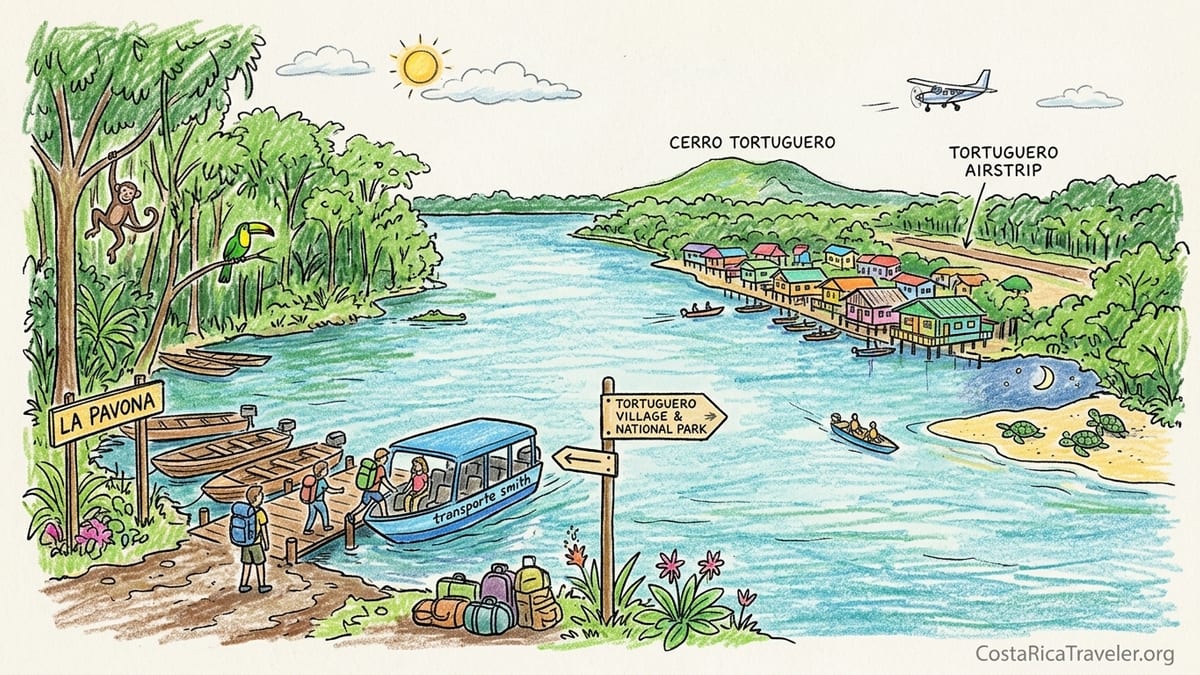
Understanding Tortuguero’s Roadless Reality
Tortuguero National Park lies on Costa Rica’s northern Caribbean coast, hemmed in by the Caribbean Sea to the east and a maze of rivers and canals to the west. There is no road into the village or the national park sectors. Everyone and everything arrives by boat or, less commonly, by small plane. That makes your choice of route and timing far more important than in most Costa Rican destinations.
Most independent travelers reach Tortuguero via La Pavona, a riverside dock near the village of San Francisco, north of Guápiles. You travel overland as far as La Pavona, leave your rental car in paid parking or arrive by bus, then continue by shared boat up the Río La Suerte and the canals to Tortuguero village or your lodge. This last stretch is often described as a highlight in itself, with frequent sightings of monkeys, caimans, iguanas and water birds from the boat.
The alternative is to fly on a domestic airline to Tortuguero’s small airstrip and transfer by boat across the canal to your accommodation. Flights can be time saving for certain itineraries, but most visitors still use the La Pavona route because it is cheaper, more flexible and offers that memorable canal approach that feels like a natural introduction to the park.
Because you cannot simply “drive out” if plans change, it is essential to think through boat schedules, water levels, and how your arrival and departure connect with buses or onward shuttles. The sections below break this down step by step from San José, La Fortuna, Puerto Viejo and Cahuita, along with realistic budgets and what to expect on the ground.
Boat Transport Via La Pavona: Fares, Schedules and How It Works
Boat services between La Pavona and Tortuguero operate as regulated water taxis. From 1 July 2026, the Costa Rican regulator set a maximum passenger fare of 3,970 colones per person for the La Pavona – Tortuguero route, applicable in both directions. This is a fare ceiling, not a fixed nationwide price. Individual operators may charge less, and private boats or package transfers can cost more, but the regulated maximum for a standard passenger seat on the basic route is 3,970 colones.
Public and semi-public boats leave La Pavona throughout the morning and early afternoon, run by several operators whose schedules differ slightly. As an example, Transporte Smith, one of the best known companies on the route, currently advertises six daily departures from La Pavona to Tortuguero and five returns from Tortuguero to La Pavona. Their publicly listed schedule shows multiple morning and early afternoon options, but the exact times can change with the season, water level and demand, so they confirm the exact departure when you book or when you arrive at the dock. Other local boats that do not maintain a full English-language website still operate under the same fare regulations and fill in gaps in the timetable.
In practice, the system feels like organized chaos rather than a classic bus station. At La Pavona, you first pay for parking if you have a car, then you walk to the boat area where staff from different companies call out destinations and times. You buy a ticket from a counter or directly from the operator’s representative. You will usually be given either a paper ticket or a numbered card indicating your boat and departure time. When it is time to board, staff call the boat, help load luggage and distribute passengers to balance weight. On busy days, operators often add extra departures so that travelers arriving on the mid-morning bus from Cariari do not get stranded.
Private arrangements work differently. Some agencies or lodges sell door-to-dock transfers with the La Pavona boat ticket included, often quoted as a single per-person price. For example, a San José or La Fortuna to Tortuguero transfer that includes a shuttle and shared boat might run in the region of 80 to 90 US dollars per person, depending on season and minimum numbers, compared with the public-transport combination of around 15 to 25 dollars. Lodge-run boats that go directly to their private docks frequently cost more than the regulated public taxi boats, especially if running outside the usual public schedule or with few passengers. When comparing offers, check whether the price you are seeing is only for the boat seat, or whether it bundles land shuttles, luggage handling, or a private transfer to a remote lodge jetty.
Reaching La Pavona by Bus or Car
Almost all overland journeys to Tortuguero converge on La Pavona, so it helps to understand that last overland leg first. La Pavona is most easily accessed from Guápiles, a town on the main Highway 32 that links San José with the Caribbean coast. From Guápiles you continue north on smaller roads via Cariari and the rural community of La Pavona or San Francisco until the road simply stops at the river and the boat docks. The final stretch is paved for much of the way but can have potholes and becomes muddy in heavy rain, so allow extra time, particularly in peak wet season.
By bus, the classic route is San José to Cariari, then Cariari to La Pavona. Buses to Cariari leave from the Terminal del Caribe area in San José several times each morning. From Cariari, there are specific buses to La Pavona that are timed to connect with the main public boats. Official information from the conservation authority lists three daily Cariari – La Pavona departures at roughly 6:00, 11:00 and 15:00, coordinated with boats around 7:30, 12:30 and 16:30 from La Pavona to Tortuguero. Schedules in rural areas can shift slightly, but in recent years travelers have consistently reported that the Cariari buses and La Pavona boats wait for each other so that passengers are not left behind.
Driving yourself is straightforward with navigation, but you must plan what to do with your vehicle. La Pavona has paid parking lots next to the dock, typically informal but widely used by locals and visitors. Daily rates tend to fall in the range of 5 to 10 US dollars per day, payable in colones or dollars, in cash. Cars remain there while their owners are in Tortuguero. If you are returning on a late-morning or early-afternoon boat, you can easily pick up the car and drive back to San José or onwards the same day. Trying to arrive at La Pavona after about 15:00 is risky, since most public boats stop by 16:30 for safety reasons, and in low water or bad weather the last departure can be earlier.
For many visitors, especially those without Spanish, a shared tourist shuttle plus coordinated boat is the most relaxed compromise. You are picked up in San José, La Fortuna or Puerto Viejo early in the morning, driven to La Pavona with one or two comfort stops, and then meet a pre-arranged shared boat which takes you directly to Tortuguero village or your lodge. This usually costs several times more than using public buses and the standard water taxi, but can still be cheaper and more flexible than flying, particularly for couples or families.
Route Comparisons: From San José, La Fortuna, Puerto Viejo and Cahuita
From San José, the classic independent route runs San José – Guápiles – Cariari – La Pavona – Tortuguero. If you take an early morning bus from San José to Cariari and then the mid-morning bus to La Pavona, you typically reach Tortuguero mid-afternoon. Total travel time is in the region of five to six hours door to door. Costs add up roughly as 3 to 6 US dollars for the San José – Cariari bus, 2 to 4 dollars for Cariari – La Pavona, around 8 US dollars for the boat at the regulated 3,970 colones fare ceiling, plus whatever you spend on snacks. Many travelers break the journey by stopping in Guápiles for breakfast if taking a shuttle, or by spending a night there if they are worried about missing the last boat.
From La Fortuna (Arenal), you cut across the north of the country towards Guápiles before continuing to La Pavona. Direct public-bus combinations exist but usually involve at least one change and can be slow, so many travelers opt for a tourist shuttle that leaves La Fortuna around 6:00 or 7:00. That shuttle reaches La Pavona in late morning in time for a midday or early-afternoon boat. Typical door-to-dock shuttle fares are often in the range of 50 to 80 US dollars per person, and you then pay the standard public boat fare or board a lodge-arranged boat if that is already included in your accommodation package.
From Puerto Viejo and Cahuita on the southern Caribbean coast, you effectively travel back west to the Guápiles area then turn north to La Pavona. Public buses run Puerto Viejo or Cahuita to Limón and onward to Guápiles, with journey times long enough that it is hard to make a same-day connection to the afternoon boats if you leave too late. Many travelers either overnight in Cahuita, Guápiles, or San José, or they book a combined shuttle and boat. These combined services typically leave Puerto Viejo or Cahuita early in the morning, follow Route 32 over the mountains, drop at La Pavona around midday and connect with a shared boat. Costs for a Puerto Viejo or Cahuita to Tortuguero shuttle plus boat are commonly higher than from San José because of the extra distance, so budgeting more than 80 US dollars per person is sensible if not using public transport.
Domestic flights become most attractive when you value time and simplicity over cost. The regional airline Sansa currently lists Tortuguero among its domestic destinations from San José’s main international airport. Flight times are around 30 minutes, and you then cross the canal by boat taxi to your lodge or the village in a matter of minutes. One-way fares fluctuate significantly by season and how far in advance you book, but they are usually much higher than the combined cost of bus or shuttle plus boat, especially for families. In addition, flights are sometimes cancelled or rescheduled in poor weather, and luggage weight limits are stricter than for land-and-boat travel. As a result, for most budget-conscious travelers and for those with flexible schedules, La Pavona remains more practical than flying, while flights make sense for short trips, older travelers who prefer to avoid multiple changes, or those fitting Tortuguero into tight business itineraries.
Village Guesthouses vs Remote Canal Lodges
Accommodation around Tortuguero falls into two main categories: simple guesthouses and small hotels in Tortuguero village itself, and higher-end lodges scattered along the canals outside the village. Where you stay has a big impact on your experience, day-to-day independence and overall budget.
Staying in Tortuguero village suits travelers who value flexibility and lower costs. The village has a mix of budget guesthouses, mid-range hotels and a few boutique properties. You can walk everywhere, including to the public beach access and the main park entrance at Sector Cuatro Esquinas. Local sodas and small restaurants serve plates of rice and beans, fish and Caribbean dishes for roughly 6 to 15 US dollars, making it easy to eat affordably. You can arrange canal tours, turtle walks, kayaking and hiking with local guides from small agencies on the main street, often comparing prices in person. Rooms in simple guesthouses might range from around 40 to 80 US dollars per night for a double, with basic fan rooms on the lower end and air-conditioned or more stylish rooms at the upper end, depending on season and demand.
Remote lodges along the canals deliver a quieter, more all-inclusive feel. Many are only accessible by their own boats, which meet you at La Pavona or Tortuguero village at set times. Typical lodge rates are higher, sometimes starting around 150 to 200 US dollars per person per night, often including meals and some guided activities such as a morning canal tour or a night walk. Because these properties are isolated from the village, you will usually eat in the lodge restaurant and book activities directly with them. That simplifies daily logistics but reduces your ability to shop around for tours or try different local eateries. Additional tours, special activities or transfers outside set times may add significant extra cost.
When comparing, consider seemingly small details that affect the bill. A couple staying three nights in the village might spend about 240 to 360 US dollars on accommodation, 120 to 180 dollars on meals, and then add separate canal, turtle and hiking tours as they choose. The same couple at a remote lodge might pay a similar total or more, but with many activities and meals already bundled, and fewer incidental expenses once they are there. Village stays tend to favour independent travelers on tighter budgets or those wanting more contact with local life, while canal lodges are best for travelers who value comfort, set schedules, and a more retreat-like atmosphere in the forest.
Exploring Tortuguero: Canals, Trails, Cerro Tortuguero and Wildlife
Tortuguero’s main attraction is its watery landscape. The national park is primarily explored by boat, with official opening hours usually from 6:00 to 12:00 and 13:00 to mid-afternoon. Non-resident adults currently pay about 16.95 US dollars per day to enter the park, while non-resident children pay a lower fee. Entrance is charged per day and per person, and it is separate from any boat trip, turtle tour, or private lodge activity. Many visitors now buy their park tickets online in advance or via a guide, as on-site sales can be limited or require queuing at peak times.
Canal tours come in three main styles: motorboat, canoe and kayak. The classic option is a guided motorboat tour at dawn, when wildlife is at its most active. These typically last two to three hours and cost somewhere in the region of 35 to 55 US dollars per person, not including the park entrance fee. Canoe and kayak tours are quieter and slower, ideal for birdwatchers and photographers who want to enter smaller side channels. Prices are often slightly higher per person than motorboat tours because of the more intimate group size. Whatever you choose, confirm with your guide whether the route enters the national park, the buffer zone, or both, because that determines whether you must show a valid park ticket.
On land, Tortuguero offers short but rewarding walks. The main beachside trail from the Cuatro Esquinas sector enters the coastal forest and sand ridges behind the village. During the day you might see howler and spider monkeys, poison-dart frogs, sloths and a variety of birds. Trails can be muddy, especially after heavy rain, so closed shoes with good grip are important even for short walks. Off-trail walking is discouraged to protect nesting sites and vegetation. Independent visitors often combine a morning canal tour with an afternoon walk along these trails using their park ticket for the day.
Cerro Tortuguero, a low forested hill north of the village across the canal, offers one of the area’s best viewpoints. Access is by boat from Tortuguero village or nearby lodges, usually arranged as a short tour that includes transport and guiding. Cerro Tortuguero has its own modest entrance fee, separate from the main park ticket, and visits are regulated to avoid erosion. On clear days the short but steep hike rewards you with views over the canals, lagoon and Caribbean Sea. This outing is particularly popular on non-rainy mornings outside the peak turtle-hatching times, when the beach trails can be busier.
Turtle Season and Conservation Rules
Tortuguero is world famous for its green sea turtles. Nesting generally takes place from June to October, with the highest concentration of nesting activity commonly observed from around July through October. Outside this period, hawksbill and leatherback turtles may also use parts of the Caribbean coast, but the green-turtle nesting season is the main draw for most visitors. Even during peak season, there are no guaranteed sightings, and specific nesting nights are influenced by tides, moonlight, weather and natural variation.
Turtle tours on the beach are strictly managed to protect the animals and avoid overcrowding. The park authority controls visitor numbers and timings through a system of licensed night tours, usually starting around 20:00 or 22:00. Access to the nesting beaches during these windows is only allowed with an authorized guide who holds the required permits. Tour prices vary by operator but often fall somewhere between 35 and 50 US dollars per person, excluding any separate park or conservation-area fee that may apply to night access. Guides coordinate with beach rangers via radio to be directed to turtles that are already in the nesting process, reducing disturbance and keeping groups spread out along the sand.
Strict rules apply on the beach: no flash photography, no white-light torches, no touching the turtles and no standing in their path to or from the sea. Guides typically use red-filtered lights or very dim torches only when necessary for safety. Walking is done in single file and often behind the turtle so that she is not startled. These measures may feel restrictive in the moment, but they are essential for long-term conservation and have been shaped by decades of monitoring and research in Tortuguero. Travelers who respect the rules not only help protect the turtles but usually enjoy a calmer, more intimate experience on the dark beach.
If you are particularly interested in turtle activity, plan a stay that includes at least two nights during the July to October core season. This increases your chances of joining at least one successful tour and allows flexibility in case weather or sea conditions force cancellations. Outside the main season, you can still enjoy Tortuguero’s canals, forest and wildlife; the park’s appeal is far from limited to turtle nesting alone.
Real Costs and Sample Budgets
Costs in Tortuguero vary by travel style and season, but some key numbers help you build a realistic budget. First, treat transport, park entry, turtle tours, canal excursions and transfers as separate line items. The regulated maximum fare for the La Pavona – Tortuguero boat is 3,970 colones per person each way, but you might pay this fare as part of a package that also includes land transport, luggage handling, or a lodge transfer. Non-resident adult park entrance is about 16.95 US dollars per person per day. Cerro Tortuguero has its own small entrance fee. Turtle night tours and daytime canal or kayak tours are extra, often in the 35 to 55 dollar range per person per activity.
Food costs differ sharply between village and lodge stays. In Tortuguero village, simple breakfasts might cost 5 to 8 dollars, lunches 7 to 12 dollars and dinners 10 to 18 dollars at mid-range places, with street snacks and bakery items cheaper. Over a two- or three-night stay, a solo traveler eating in village sodas could reasonably spend 25 to 40 dollars per day on food. At remote lodges, meals are commonly included in the nightly rate or charged at higher per-meal prices due to transport and supply costs. That can simplify budgeting because you pay most of your costs upfront when booking the lodge package.
As a rough illustration, a solo budget traveler spending two nights in Tortuguero village might stay in a 40 to 60 dollar-per-night guesthouse room, spend around 50 to 70 dollars on food across two and a half days, pay around 34 dollars for two days of park entry, and add one canal tour and one turtle tour at perhaps 40 to 50 dollars each. With round-trip boat fares at about 16 dollars total and public buses to and from San José for under 15 dollars, a realistic two-night total for such a traveler might land somewhere in the 230 to 320 dollar range, not counting souvenirs or drinks. Upgrading accommodation, adding more guided activities or using private shuttles instead of buses will raise that figure accordingly.
For couples and families, per-person costs drop when you share private transfers or family rooms, but guided tours and park fees remain largely per-person. A couple staying three nights in a mid-range village hotel might expect a combined bill in the broad region of 700 to 1,100 US dollars once accommodation, meals, two or three guided activities each, park fees and transport to and from La Pavona are factored in. A family of four in a simple village cabina, eating at sodas and sharing a few key tours, might keep a three-night visit in the region of 1,200 to 1,800 dollars by using public transport and focusing on a smaller number of paid activities supplemented by self-guided walks.
Planning Your Stay: Two- and Three-Night Itineraries
Because of the travel time involved, most visitors find that two or three nights in Tortuguero strikes a good balance. One-night stays are technically possible but feel rushed and vulnerable to bad weather or missed boat connections.
For a two-night visit based in Tortuguero village, a common plan is to arrive around midday on Day 1, check in, and take an orientation walk through the village and along the beach. That evening, if visiting between July and October and availability permits, you join a turtle nesting tour. On Day 2, you start with a dawn canal tour, return for breakfast, rest during the heat of late morning, then use your park ticket for an afternoon walk along the main coastal trail or to relax on the quieter stretches of village beach. You depart on a mid-morning or early-afternoon boat on Day 3, leaving enough time to reach San José, La Fortuna or Puerto Viejo by evening.
A three-night stay allows a slower pace and extra activities. You might alternate a dawn boat tour one morning with a Cerro Tortuguero hike the next, or add a kayak excursion into narrower side channels that motorboats cannot reach. Additional time also helps if you are visiting outside peak turtle season and want extra chances to spot wildlife, or if you are traveling with children who benefit from rest periods between excursions. At a remote lodge, three nights often fits neatly with their two- or three-day activity packages, giving you one arrival day with an afternoon or evening activity, a full central day with morning and afternoon outings, and a final morning tour before departure.
Whichever duration you choose, build in a margin on your departure day. Boats can be delayed by fog, rain, or low water, and buses onward from Cariari or Guápiles can depart late. If you have a flight from San José, aim to arrive in the city the night before rather than trying to connect directly from a morning boat, especially in the wetter months when conditions are less predictable.
The Takeaway
Visiting Tortuguero National Park is less complicated than it appears once you understand the basic pattern: reach La Pavona, take a regulated water taxi up the canals, and then explore the park by boat and on foot. The absence of roads is part of the destination’s charm, but it also means you must be more deliberate about boat times, connecting buses, and where you choose to stay.
The La Pavona route remains the most practical solution for most travelers, offering reasonable prices, frequent departures linked to public buses, and an unforgettable approach through forest-lined waterways. Domestic flights are a useful but more expensive alternative for those short on time or preferring to avoid long overland journeys. Choosing between Tortuguero village and remote canal lodges comes down to your balance of independence versus convenience and your budget for meals and bundled tours.
With a sensible plan that includes at least two nights, a clear understanding of real costs, and respect for conservation rules during turtle season, Tortuguero rewards you with one of Costa Rica’s most distinctive experiences. The journey itself, from the bus to the dock and the boat ride into the jungle, is as much a part of that experience as the canals, wildlife and night-time whispers of the Caribbean waves.
FAQ
Q1. Do I need to book the La Pavona to Tortuguero boat in advance?
It is not strictly required, but in high season it is wise to reserve with a named operator or arrive early. Walk-up passengers are normally accommodated on successive boats as long as they reach La Pavona within the morning and early-afternoon operating window.
Q2. How much should I expect to pay for the La Pavona to Tortuguero boat?
The regulated maximum fare for the basic La Pavona – Tortuguero passenger route is 3,970 colones per person each way. Some operators or packages may charge this amount bundled with land transfers or extras, but standard walk-up seats should not exceed this ceiling.
Q3. Can I drive my rental car all the way to Tortuguero village?
No. The road ends at La Pavona on the riverbank. From there you must leave the car in paid parking and continue by boat to Tortuguero. Cars do not travel on the passenger boats, and there are no vehicle ferries to the village.
Q4. Is it realistic to visit Tortuguero as a day trip from San José?
For independent travelers, a same-day round trip is not practical because of the combined travel time and boat schedules. Some organized day tours exist, but most visitors find that at least one or preferably two nights in Tortuguero are necessary to enjoy canal tours and possible turtle sightings.
Q5. When is the best time to see green turtles in Tortuguero?
Green sea turtle nesting generally occurs from June to October, with July to October especially important. Even in this period sightings are not guaranteed, so staying at least two nights and allowing date flexibility improves your chances.
Q6. Do I need a park ticket for every activity in Tortuguero?
You need a park entrance ticket for each day you enter the national park sectors, whether by canal tour or on foot. Turtle night tours on the beach and Cerro Tortuguero hikes may involve separate fees or permits. Transport to and from La Pavona is separate from all of these.
Q7. Is Tortuguero suitable for families with children?
Yes, provided you plan for boat travel, humidity and some early starts. Many families choose village guesthouses close to restaurants and the beach, join shorter canal tours, and mix guided activities with downtime so children do not get overtired.
Q8. Are domestic flights to Tortuguero worth the cost?
Flights are useful for travelers with limited time or those connecting directly to or from international flights in San José. For most budget-conscious visitors, the higher fares and luggage limits mean that the boat route via La Pavona remains the better-value and more flexible choice.
Q9. What should I pack specifically for Tortuguero?
Essentials include lightweight quick-drying clothing, a light rain jacket, closed shoes or sandals with grip, insect repellent, waterproof bags for electronics, and small denominations of colones or US dollars for boats, tips and village purchases.
Q10. How likely are weather-related cancellations or disruptions?
Heavy rain, low water levels or storms can delay or cancel some boats and flights, especially in the wetter months. Significant disruptions are not daily occurrences, but you should build a timing buffer into your arrival and departure days in case services run slower than scheduled.