


I walked into Cahuita National Park on a humid Caribbean morning expecting a pleasant beach stroll. Instead, I found myself threading a narrow trail between jungle and sea, with howler monkeys roaring over the surf and sand under my boots turning suddenly to roots, mud and leaf litter. What follows is a detailed account of that day on the coastal trail, from the Playa Blanca entrance near Cahuita village toward Punta Cahuita and on to Puerto Vargas, along with the real-world logistics a traveler needs to repeat or adapt this route.
Starting at Playa Blanca: Date, Weather and First Impressions
I visited Cahuita National Park on October 18, 2026, at the tail end of the Caribbean dry spell that often falls between September and October. The morning started bright but hazy, with the sun already strong by the park’s 8 a.m. opening time and the air feeling like a warm, damp towel. It had rained overnight, so the forest floor still held a dark sheen and the leaves above dripped lazily as I walked in.
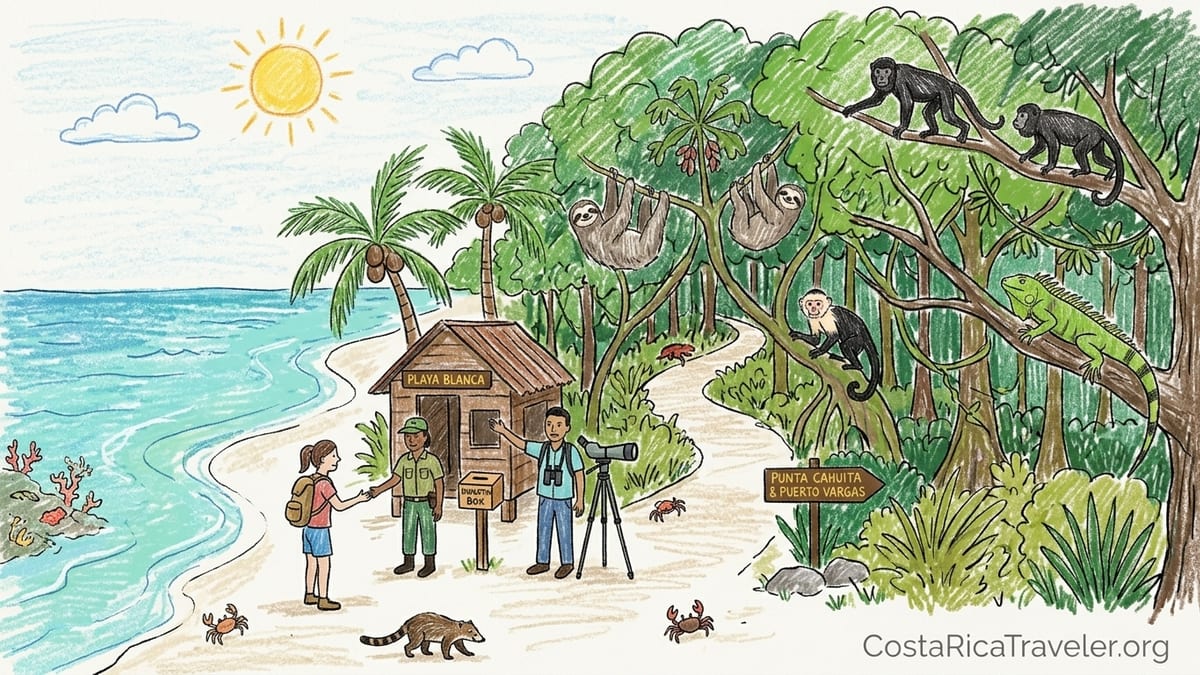
I chose to begin at the Playa Blanca entrance, also known locally as Kelly Creek, at the northern edge of Cahuita village. This is the community-managed side of the park where the “fee” is a voluntary cash contribution rather than a fixed ticket price. A handwritten board near the ranger post reminded visitors that donations support both the park and the village, echoing what official park information now highlights about this co-management model and voluntary system. I added 5,000 colones into the box, roughly ten US dollars that morning, knowing it would go directly into local conservation and community projects instead of a central account.
The difference from other Costa Rican national parks was obvious right away. There were no turnstiles or printed barcodes, just a low wooden office, a ranger in a green uniform, and a simple signboard with rules about no feeding animals, no alcohol, and staying on the trail. It felt less like entering a heavily regulated attraction and more like stepping into the shared backyard of the town. The soundscape shifted within a few steps from reggae filtering out of village bars to the sharper hiss of surf and the guttural roar of howler monkeys in the canopy.
Because I wanted time for wildlife spotting without rushing, I started walking at about 8:15 a.m., aiming to at least reach Punta Cahuita and then decide whether to push on toward Puerto Vargas or turn back to the village. My loose plan was a one-way hike, but I kept in mind that backtracking to Playa Blanca would roughly double my walking distance if I changed my mind.
Understanding the Two Entrances and What You Pay
Cahuita National Park is organized around two officially recognized access points. The Playa Blanca side where I started is tied closely to the community, and visitors leave a voluntary cash donation at the small entrance station. That donation is not symbolic; according to current park and academic sources, Playa Blanca operates under a co-management model where the local committee and SINAC, the national park service, share responsibilities. The voluntary system is a deliberate choice to support local livelihoods as well as conservation, and that context gave meaning to the bills I dropped into the box.
The other entrance is at Puerto Vargas, about 5 kilometers south of Cahuita village along the coastal road. There, the rules and payments feel more like a classic national park. As of late October 2026, the posted fee for nonresident foreign adults and children is 5.65 US dollars, including tax, and payment is handled through a formal SINAC ticket system with card payments accepted. The same price is also confirmed by recent visitor information from Costa Rica travel guides that track updated park fees. Parking is included at Puerto Vargas, while on the village side you typically pay a separate amount to park in a private lot or leave the car on the street.
Knowing this, I decided to enter via Playa Blanca, walk toward Punta Cahuita and then continue toward Puerto Vargas, where I could exit and catch a bus back to Cahuita or Puerto Viejo. That combination let me experience both the community donation model and the more conventional fee system on a single continuous hike, and it also removed any need to backtrack the same scenery. If you only want a shorter, easier loop, you can walk from Playa Blanca out as far as you like along the first few kilometers of trail and then turn around, paying only the voluntary contribution at the village side.
In total, counting my donation at Playa Blanca, bus fare, and a bottled drink at the end, I spent a bit under 20 US dollars on the outing itself, not including the cost of my wildlife guide. That guide fee turned out to be the single biggest decision about how I experienced the park, and it fundamentally changed what I noticed along the way.
Trail Conditions: Roots, Sand, Bridges and the Caribbean Heat
The trail from Playa Blanca begins innocently enough as a broad sandy path under coconut palms, with the beach no more than twenty or thirty meters to the left. For the first half kilometer, it feels like a relaxed seaside promenade. The ground is mostly firm, with patches of soft sand and the occasional tree root, and I passed a few families in flip-flops pushing strollers, clearly planning only a short stroll and swim rather than a full hike.
Beyond that, the walk quickly becomes more of a forest trail. The sand gives way to a compacted mix of earth and leaf litter, riddled with roots that require constant attention. Small wooden bridges cross blackwater creeks and seasonal channels, some in good repair, others slightly warped and creaking underfoot. After heavy overnight rain, several low spots held standing water, and I was glad to have trail runners instead of sandals. In two places between Playa Blanca and Punta Cahuita, I had to step on submerged roots and stones to avoid ankle-deep muddy puddles, and one short detour led me briefly out onto the open beach to bypass a flooded section.
The heat was the most consistent challenge. Even with the trail shaded by low coastal rainforest, the humidity sits at near sauna levels by late morning in October. Within fifteen minutes, my shirt was soaked through. Mosquitoes were present but not overwhelming on my visit, possibly because of the light sea breeze; sand flies, however, were a different story whenever I stopped too long close to the beach. I applied a DEET-based repellent at the entrance and again around Punta Cahuita, and still walked away with a few itchy reminders on my ankles.
Between Playa Blanca and Punta Cahuita, the official distance is around 5.6 kilometers one way, but it feels slightly longer because the path curves and dips in and out of forest and beach. I am a reasonably fit walker and, even with frequent wildlife stops, it took just under two hours to reach Punta Cahuita. The second half of the trail from Punta Cahuita to Puerto Vargas, roughly another 3 to 3.5 kilometers, felt wilder and less busy, with narrower sections where branches brushed my shoulders and the sense of a true jungle corridor between beach and swamp forest intensified.
Hiring a Local Wildlife Guide and What Difference It Made
At the Playa Blanca entrance, a handful of licensed local guides waited near the donation booth, wearing laminated badges and carrying telescopes and binoculars. I had debated in advance whether a guide was worth the extra cost. Recent local operator listings and hotel guides I checked in Puerto Viejo suggested that a standard group wildlife walk in Cahuita in 2026 runs around 30 to 45 US dollars per person for a 2.5 to 3-hour outing, while private guiding for a couple or solo visitor tends to fall in the 60 to 90 US dollar range depending on language and scope. Group sizes are usually capped at six to eight people to keep the experience focused, and guides bring spotting scopes and sometimes simple field guides.
In the end, I chose to hire a local guide, Enrique, for a semi-private walk from Playa Blanca to near Punta Cahuita. We agreed on 70 US dollars total for a three-hour guided segment, with just one other traveler joining, effectively making it a small group of three plus Enrique. He carried a sturdy tripod-mounted scope, a pair of binoculars he lent to whoever was not using the scope, and a waterproof tablet with field photos of birds and reptiles.
The impact was immediate. Within ten minutes, he had stopped us beneath what I would have thought was just another tangle of leaves. Through the scope, the shapeless lump resolved into a three-toed sloth curled into itself, fur matted slightly from the previous night’s rain. A few meters further on, he picked out a green basilisk lizard, perfectly still on a low branch over the creek, something I would have completely missed on my own. His trained eye caught the slightest movement in the canopy and converted it into sightings for us: a keel-billed toucan hopping from branch to branch, a pair of chestnut-mandibled toucans further on, and a line of leafcutter ants hauling green fragments across the path.
For mammals, the guide made an even bigger difference. We heard the first howler monkeys as a low rolling roar somewhere inland. Without Enrique, I might have walked on, satisfied with the sound. Instead, he scanned the treetops with binoculars and eventually pointed out a family group high in the canopy, tails curled, one juvenile hanging briefly by its tail before scrambling back onto a branch. Later, as the trail narrowed, he pointed toward a flash of white movement, and we watched a capuchin monkey pick its way between trees, pausing to peer down at us. Only a fraction of these animals would have registered in my awareness without someone constantly searching the foliage, and in that sense the guide more than justified his fee.
Wildlife Actually Seen Along the Trail
With Enrique’s help on the first segment and on my own afterward, I saw a satisfying but not overwhelming amount of wildlife on this visit. This was not one of those viral-video days where every branch hosts something photogenic. In fact, there were long, quiet stretches when the only signs of life were land crabs scuttling into burrows and ghost crabs tracing quick lines across the sand.
The highlight mammals were the monkeys and sloths. I saw two different sloths between Playa Blanca and Punta Cahuita, both high in cecropia trees, their outlines only obvious once framed in the guide’s scope. The first barely moved at all; the second shifted slowly to reveal the dark stripe masking its eyes. Howler monkeys were both heard and seen at three distinct points along the trail, always inland but visible as dark silhouettes moving through upper branches. A small troop of white-faced capuchins appeared around mid-morning near a rest area close to Punta Cahuita, boldly approaching the edge of the clearing before retreating when the guide clapped and reminded everyone not to feed them.
Closer to the ground, raccoons and coatis were present but more elusive. Near a bridge over a mangrove-fringed channel, we watched a lone raccoon working the water’s edge, dipping its front paws and feeling for food. A coati crossed the path briefly later in the morning, tail held vertical like a flag, before disappearing into undergrowth. Reptiles were easier: in addition to the basilisk, we counted several iguanas, including one large green iguana basking on a sunlit limb over the beach and a couple of younger, darker individuals on the forest floor. Birdlife included the toucans, a yellow-crowned night heron stalking quietly in a tidal pool, and a black hawk circling over the coastline.
It is important to say that not every visitor will see this list of species on a single walk. Wildlife in Cahuita is genuinely wild, not staged, and movement patterns change with weather and time of day. On the return bus that afternoon, another traveler mentioned that their midday walk a day earlier had felt almost empty, with only one distant sloth and a few monkeys far off in the trees. My experience benefited from starting early, walking quietly, and most of all from having a guide whose full-time job is noticing the slight twitch of a tail 25 meters up.
Reaching Punta Cahuita and Continuing Toward Puerto Vargas
By the time we neared Punta Cahuita, the narrow tip of land that juts into the Caribbean and shelters the park’s coral reef, the character of the walk had subtly changed. The forest felt denser and more tangled, with more buttress roots and fewer coconut palms, and the sea appeared in glimpses through curtains of foliage rather than as a constant blue band. The point itself is marked by a small ranger post and a clearing with a couple of benches where many guided groups turn around to head back to Playa Blanca.
We reached this spot around 10:20 a.m., almost exactly two hours after leaving Playa Blanca, with multiple long pauses for wildlife viewing and explanations about plants and park history. This is a natural turning point for a half-day visit. If you return from here to Playa Blanca, your total hiking distance ends up a little over 11 kilometers round-trip, but you can easily shorten that by choosing a closer turnaround spot. Enrique said many of his guests who are not used to walking simply do a slow 4 to 6 kilometer out-and-back along the flattest, shadiest part of the trail before the point, with plenty of wildlife stops.
After a short break and goodbye to the guide, I continued alone toward Puerto Vargas. The number of people on the path dropped immediately. The trail beyond Punta Cahuita narrows and at times runs almost at the high-tide line. On my visit, the tide was mid-rising, and in two stretches I had to walk on sloping wet sand, with waves licking at my shoes, because the inner trail was temporarily under water. This section felt more exposed to the sun, and my pace slowed as the combination of heat and soft sand chewed through my energy reserves.
The last few kilometers before Puerto Vargas pass over several longer boardwalks and bridges built above swampy ground and small inlets. The soundscape shifted again here: fewer waves, more frogs and insects in the background. Monkey sightings picked up briefly when a second group of howlers moved noisily through trees above me. By this stage, I was more focused on putting one foot in front of the other than scanning the canopy, and I realized how much of a difference it had made earlier to have someone else doing the spotting.
Swimming, Sea Conditions and Real-World Discomforts
I swam once during this walk, at a marked safe swimming area near the trail between Playa Blanca and Punta Cahuita, closer to the village side. The water that morning was classic Caribbean postcard material: clear, turquoise shallows over pale sand, with only a mild shore break. A lifeguard stand off to one side reminded me that conditions are not always so gentle. Local operators in the region, and day-to-day reports from Puerto Viejo, often point out that Cahuita can swing from glassy calm to choppy and murky depending on storms, river outflow and surf. The same reef that makes this a snorkeling destination also demands respect when swells pick up.
Out of caution, I limited my swim to a quick ten-minute dip within the flagged area and stayed well inside where families with children bobbed around. The water temperature was bath-warm, somewhere around 28 degrees Celsius, and getting back out into the heavy air did not provide any real cooling. If anything, it made the next kilometer of walking feel even more sluggish as my skin alternated between sun and dripping shade.
The discomforts on this hike were real and worth flagging honestly. The heat and humidity were constant companions. Even with 2.5 liters of water in my daypack and a bottle of electrolyte drink, I finished the day with a mild headache that felt very much like the edge of heat exhaustion. Insects were not unbearable, but I left with extra bites wherever I had failed to cover up or reapply repellent. At the most popular sections near the entrance and first beach access points, crowds also intruded on the sense of wilderness, with loud music from portable speakers at one point competing with the sound of surf and monkeys.
Deeper in, more subtle discomforts appeared. The mud sucked at my shoes where the trail dipped; one narrow boardwalk had a missing plank that required a long stride; a wobbly handrail over a creek made me move slower than I wanted. None of this is dangerous for someone with average mobility who watches their step, but it is not a manicured city park, and anyone with balance issues or serious knee problems should think carefully about how far past the initial flat section they want to go.
Logistics From Puerto Viejo: Transport, Food, Water and Costs
I based myself in Puerto Viejo de Talamanca, the livelier beach town about 20 to 30 minutes south of Cahuita along the coastal highway. To reach the park, I caught an early morning public bus running the Puerto Viejo to Limón route, which stops in Cahuita town and then continues north. The bus fare from Puerto Viejo to Cahuita in 2026 hovers at just a couple of US dollars equivalent, paid in colones to the driver, and the ride took about 25 minutes in light traffic. From the Cahuita bus stop, it was an easy ten-minute walk through town to the Playa Blanca entrance.
On the return, after exiting at Puerto Vargas, I walked a short access road out to the main highway and caught another bus back south to Puerto Viejo. Buses on this stretch generally run at least once an hour during the day, with extra services around local commuting times. If you prefer not to deal with schedules, a taxi between Puerto Viejo and either entrance runs in the ballpark of 8 to 15 US dollars one way depending on the season and how you arrange it, with the Puerto Vargas entrance slightly closer to Puerto Viejo in terms of driving distance.
Food and water planning mattered more than I expected. There are basic services in Cahuita village near Playa Blanca, including sodas serving typical Costa Rican casado plates for around 4,000 to 6,000 colones, bakeries and small supermarkets where you can buy sandwiches, fruit and snacks. Inside the park itself, there are no full-service restaurants. I carried two large water bottles, a bag of nuts, some fresh pineapple from a Puerto Viejo fruit stand, and a couple of energy bars. By the time I reached Puerto Vargas, almost all my water was gone. Taps and restroom facilities are available at both official entrances, but do not assume you can refill in between.
Adding up the day’s expenses from Puerto Viejo, my approximate costs were as follows: about 1,500 colones each way for the bus, equivalent to roughly three US dollars total; 5,000 colones voluntary donation at Playa Blanca; 70 US dollars for the semi-private guide to Punta Cahuita, which I shared informally with the other participant; and a few more dollars for snacks and a cold drink afterward. Had I skipped the guide, I could easily have kept the whole outing, including transport and food, under 25 US dollars. Whether that trade-off is worthwhile depends entirely on how important wildlife viewing is to you and your budget.
Designing Half-Day and Full-Day Versions of This Walk
My actual route, with a guided segment from Playa Blanca to Punta Cahuita and then a solo hike on to Puerto Vargas, essentially turned into a full but not brutal day. I entered around 8:15 a.m. and exited at Puerto Vargas just before 1:30 p.m., for about five hours of unhurried movement plus wildlife stops and one short swim. Including transit from and back to Puerto Viejo and a simple lunch in Cahuita after catching the bus north again to meet friends, the outing occupied nearly the entire day.
If you want a half-day version, the simplest choice is to focus exclusively on the Playa Blanca side and treat Punta Cahuita as an optional goal rather than a requirement. One appealing version would be to hire a guide for a 2.5 to 3-hour early morning wildlife walk that covers the first few kilometers of trail, maybe reaching one of the better viewpoints or smaller points before Punta Cahuita, then return to the village by late morning. You can then swim at Playa Blanca, have lunch in town, and be back in Puerto Viejo by early afternoon. On this plan, total walking might be as low as 4 to 6 kilometers.
For a full-day hiking experience, the one-way traverse I did is ideal. Start at Playa Blanca around opening time, hire a guide for the portion that matters most to you, either the first half where mammals and sloths are often easier to spot or the more remote second half if you prioritize fewer people, and then exit at Puerto Vargas to catch the bus back. Expect total walking distance of 8.5 to 9 kilometers between entrances, plus whatever beach detours and wildlife loops you add. Bring at least 2 liters of water per person, wear lightweight long sleeves to deter sun and insects, and budget extra time for inevitable unscheduled stops when someone else on the trail spots something in the trees.
In reflecting later on whether paying for the guide was worthwhile, my answer remains yes for this particular day and for my own interests. Without Enrique, I would still have enjoyed the mix of forest and beach, but my list of confirmed wildlife sightings would have shrunk dramatically. The small details he pointed out also contextualized things I might otherwise have taken for granted, like the cooperative model at Playa Blanca, the subtle ways overused social media spots are affecting animal behavior, and how sea conditions dictate when local snorkel tours run along the reef. For travelers mainly interested in stretching their legs and swimming, a self-guided visit can be sufficient. For anyone who dreams of sloths, monkeys and toucans on a single morning, paying for experienced eyes is, in my experience, money well spent.
The Takeaway
Walking Cahuita National Park from Playa Blanca toward Puerto Vargas gave me one of the most distinctive combinations of rainforest, wildlife and beach I have experienced in Costa Rica. The constant proximity of the sea means you are never far from a patch of white sand and warm water, yet a step or two inland plunges you into dense, noisy forest where howlers roar and sloths hide in plain sight. Unlike some parks that feel heavily structured, Cahuita retains enough rough edges in its trail, boardwalks and management model to feel grounded in the local community and coastal landscape.
It is not a perfectly comfortable day. The heat is intense, insects are real, and sections of the trail can be muddy, flooded or uneven. Crowds cluster near the entrances, and anyone expecting solitude throughout may be disappointed. Yet those imperfections are part of what made the experience feel authentic. Watching a raccoon hunt crabs in a mangrove channel, or seeing a capuchin monkey pause to assess us from an overhead branch while children squealed at the surf only a few meters away, brought home how unusual it is to find such biodiversity so close to a village and bus stop.
If you are staying in Puerto Viejo or Cahuita and can spare at least a half-day, this walk deserves a place high on your list. Decide in advance whether you want a relaxed, family-friendly stroll with a few wildlife sightings and plenty of swimming, or a more committed point-to-point hike with a guide and serious time on your feet. Bring more water than you think you will need, proper footwear, and cash in small colones bills for the voluntary contribution and snacks. With those basics covered, Cahuita is the kind of park that rewards unhurried attention, where the magic often lies not in a single “must-see” landmark but in the long, slow conversation between jungle and sea that plays out as you walk.
FAQ
Q1. How long is the walk between Playa Blanca and Puerto Vargas in Cahuita National Park?
The coastal trail between the two main entrances is roughly 8.5 to 9 kilometers one way, depending on minor detours, and most visitors take 3.5 to 5 hours with wildlife stops.
Q2. Do I have to pay an entrance fee at both Playa Blanca and Puerto Vargas?
No. If you enter at Playa Blanca you leave a voluntary cash contribution that supports the community-managed sector, while Puerto Vargas has a fixed fee of about 5.65 US dollars for nonresidents.
Q3. Is it worth hiring a wildlife guide in Cahuita National Park?
For travelers who care about seeing sloths, monkeys and birds high in the canopy, a licensed local guide with a spotting scope can greatly increase sightings and context, though budget-conscious hikers may opt to go without.
Q4. How difficult is the trail in terms of terrain and fitness?
The path is mostly flat but includes roots, sand, occasional mud, narrow bridges and short flooded sections, so it is manageable for reasonably fit walkers but not ideal for those with serious mobility issues.
Q5. Can I swim anywhere along the trail?
You can swim at designated beach areas along the coastal section, but conditions vary with swell and currents, so it is best to use marked safe zones and observe any lifeguard guidance.
Q6. What should I bring for a half-day or full-day visit?
Sturdy walking shoes or sandals with grip, at least 1.5 to 2 liters of water per person, insect repellent, sun protection, light clothing and some snacks are important for comfort and safety.
Q7. How do I get to Cahuita National Park from Puerto Viejo without a car?
Regular public buses run between Puerto Viejo and Cahuita along the coastal road, with stops near the village and the Puerto Vargas access road, and taxis are also readily available.
Q8. Are there restaurants or shops inside the park?
There are no full-service restaurants inside the protected area itself, but Cahuita village near Playa Blanca has small supermarkets, bakeries and local sodas where you can eat before or after the hike.
Q9. When is the best time of day to see wildlife on the trail?
Early morning, from park opening until late morning, tends to be more active and cooler, with a better chance of spotting monkeys, sloths and birds before the midday heat sets in.
Q10. Is Cahuita National Park suitable for children and less experienced hikers?
The first section from Playa Blanca is relatively easy and family-friendly, with short, flat stretches and beach access, while longer walks toward Punta Cahuita and Puerto Vargas are better suited to those comfortable with several hours on uneven terrain.