


Costa Rica’s Caribbean coast feels like a country within a country. North of Limón, remote canals, flooded forests and tiny villages such as Tortuguero are reached only by boat or small plane. South of Limón, a string of beach towns from Cahuita to Manzanillo mixes Afro-Caribbean culture, surf breaks, wildlife-filled jungles and a fast-growing range of places to sleep. Choosing the right base matters more here than almost anywhere else in Costa Rica, because distances are short but experiences are wildly different.
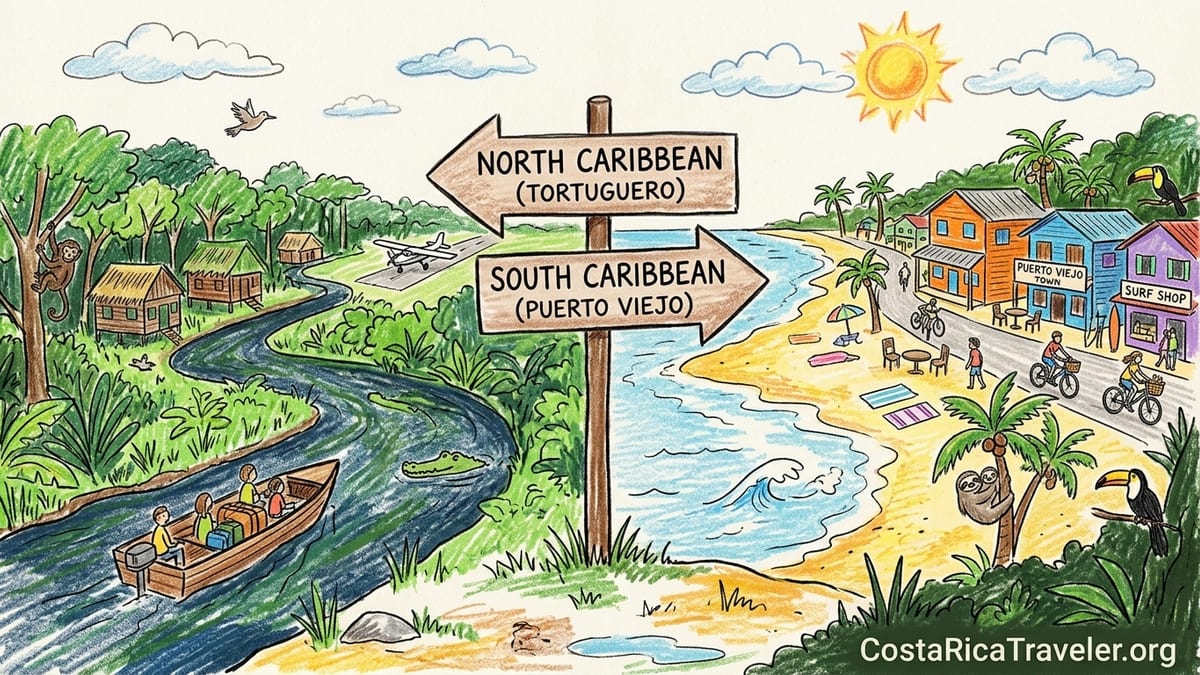
Northern vs Southern Caribbean: Two Very Different Trips
The first decision for Costa Rica’s Caribbean coast is whether you are planning a remote canal-and-jungle experience in the north, a beach-focused trip in the south, or a combination of both. Tortuguero and the less-developed northern reserves sit on a thin sandbar hemmed in by canals and the open sea. There are no conventional roads into the village or national park. You arrive by boat along labyrinthine waterways or by small domestic plane, and once there you move on foot or by boat. This is an immersive, wildlife-heavy stay that feels closer to the Amazon than to a typical beach break.
South of the port city of Limón, by contrast, a paved coastal road links Cahuita, Puerto Viejo de Talamanca and the smaller communities of Playa Negra, Cocles, Playa Chiquita, Punta Uva and Manzanillo. Regular public buses, taxis and rental cars move up and down this corridor, and while the jungle still presses in close, you can choose between walkable towns with nightlife and quieter pockets a few kilometres out. Here, trade-offs are less about access and more about how much buzz, surf and seclusion you want.
Because of that split, Tortuguero requires fundamentally different planning from somewhere like Puerto Viejo or Cahuita. You typically commit to two or three nights in a lodge with packages that might include boat transfers, guided canal tours and turtle walks in season. In the south, you can be more spontaneous: book a guesthouse in central Puerto Viejo and walk to dinner, or rent a bike and explore beaches up and down the coast, changing hotels if you decide you prefer a quieter stretch.
For many travellers, the ideal Caribbean itinerary combines both: a few days in Tortuguero for early-morning canals and night-time turtle nesting, followed by several days on the southern beaches for surf, snorkelling and café culture. The key is understanding what each base actually feels like on the ground, and how accommodation, transport and costs differ between them.
Tortuguero and the Remote Northern Caribbean
Tortuguero village and Tortuguero National Park sit on Costa Rica’s far northern Caribbean coast. There is no ordinary road into the village. You drive or take a bus to docks such as La Pavona or Moín, leave your car on the mainland if you have one, then board a river boat for the final leg, or you fly to the small airstrip near the village on a domestic airline. Once in Tortuguero, there are no cars; you walk along sandy paths through the village or travel by boat along the canals. This is logistically different from arriving by car in Puerto Viejo and checking into a roadside lodge.
Accommodation in Tortuguero clusters into two main types. In the village itself, you find simple guesthouses and small hotels, often family-run, with fan-cooled rooms and modest rates that can be appealing to backpackers and independent travellers. Along the canals just beyond the village sit classic jungle lodges such as Tortuga Lodge and Gardens and Mawamba Lodge. These are typically reached by the property’s own boat and feel secluded, with rooms looking onto the water or gardens, swimming pools, and on-site wildlife such as howler monkeys and toucans. Packages often fold in boat transfers from San José, meals and guided activities, which makes budgeting straightforward but less flexible.
When you compare costs for specific dates, Tortuguero often looks more expensive per night than a basic room in Puerto Viejo or Cahuita, but that price usually covers more. A night at a midrange lodge might include breakfast and dinner, shared boat transport from the dock and at least one guided canal tour. In the village, room rates may be significantly lower, but you will pay separately for boat taxis, national park entry and guided excursions. There is no need or use for a rental car in Tortuguero, which can offset some of the higher nightly rates if you factor in days without car hire.
In terms of daily experience, Tortuguero is about wildlife rather than beaches. The Caribbean surf here is rough and the beach is not usually swimmable; during turtle nesting season, large sections are off-limits at night except on guided tours. Days often start before sunrise with boat safaris through mirror-flat canals in search of caimans, monkeys, sloths and birds. Midday might bring a village stroll and a simple lunch, followed by a walk in the national park or relaxing in a hammock at your lodge. After sunset, you need a flashlight for dark paths and you largely rely on your lodge’s restaurant and bar, since the village is small and quiet.
Limón and the Under-the-Radar Northern Coast
Most travellers who visit the Caribbean coast pass through Limón, the provincial capital, on the way to either Tortuguero or the southern beach towns. Limón is Costa Rica’s main Caribbean port and a working city rather than a resort area, with limited beachfront accommodation aimed at foreign tourists. A handful of business-style hotels and basic guesthouses serve people in transit. Nightlife tends to centre on local bars, and beach access within the city is secondary to port activity.
North of Limón and south of Tortuguero, a stretch of lowland coast and backwater villages sees relatively few visitors compared with the better-known spots. There are wetlands, banana plantations and small communities, and some lodges cater to anglers or birdwatchers interested in the Barra del Colorado area and other wildlife refuges. Infrastructure is sparse, public transport can be infrequent, and you will rely heavily on a rental car or pre-arranged transfers. Accommodation choices are far more limited than in the south, often without the range of hostels, boutique hotels and vacation rentals you find around Puerto Viejo.
This northern corridor can appeal to adventurous travellers who prioritise solitude and nature over dining options and social atmosphere. However, for a first-time Caribbean trip, it rarely offers the best balance of convenience and experience. Many visitors instead treat Limón and the northern coast as a transit zone, spending their limited days either in Tortuguero’s canals or on the southern beaches where services and accommodations are concentrated.
If your flight times or bus schedules force an overnight near Limón, plan on a practical stop rather than a highlight. Choose a hotel in town or near the highway for convenience and security, eat on-site or at a recommended nearby restaurant, and continue early the next morning to Tortuguero or Cahuita.
Cahuita: Laid-Back Village and Easy National Park Access
Cahuita, about forty-five minutes south of Limón by road, makes an excellent first base on the southern Caribbean for visitors who want a small, walkable village and easy access to protected nature. The town sits near the entrance to Cahuita National Park, where trails loop through lowland forest parallel to white and black sand beaches. You can walk directly from the village along flat, shaded paths while spotting capuchin monkeys, raccoons, iguanas and a variety of birds. Compared to Tortuguero’s boat-based access, this is wildlife watching on your own feet, just minutes from a café.
Accommodation in Cahuita ranges from budget hostels and simple rooms in Caribbean wooden houses to midrange hotels with pools just outside the centre. You will not find the same number of high-end boutique properties as around Puerto Viejo, but there is a good spread for budget-conscious couples and families. Many places include breakfast in their rates, with taxes added on top at booking. Because Cahuita is compact, a car is optional. You can walk to most restaurants, grocery stores and the national park entrance, or take an occasional taxi or bus if you stay a bit out of town.
Dining and nightlife in Cahuita are low-key. A handful of restaurants serve Caribbean staples such as rice and beans cooked in coconut milk, whole fried fish and patacones, along with pizza and casual international fare. At night you may find live calypso or reggae in a bar, but the scene is more about a few drinks and conversation than dancing until late. For travellers who like to be in bed early for a morning in the park, that slower pace is a benefit.
For wildlife-focused travellers who prefer to stay on land and keep logistics simple, Cahuita is an appealing alternative to Tortuguero. You still get close contact with forest and sea, often with monkeys visible from your guesthouse garden, but you can arrive on a normal bus or in your rental car, choose your own restaurants, and adjust your schedule day by day. It works particularly well as a base for families with younger children, since distances are short and you can retreat to town quickly if the weather turns.
Puerto Viejo de Talamanca and Playa Negra: Dining, Nightlife and Convenience
Puerto Viejo de Talamanca is the busiest hub on the southern Caribbean coast and the main choice for travellers who prioritise dining, nightlife and social atmosphere. The compact centre mixes Afro-Caribbean culture with international influences, and within a few blocks you find cafés serving specialty coffee, vegetarian and vegan spots, seafood shacks, craft beer bars and late-night venues. Compared to all other towns on this coast, Puerto Viejo offers the widest choice of restaurants and bars, which is especially valuable for longer stays.
Accommodation in and around town is extremely varied. Budget travellers find hostels with dorm beds and social common areas close to the bus stop and beach, while midrange options include colourful Caribbean guesthouses and small boutique hotels. Vacation rentals, from modest apartments to larger houses, dot the surrounding streets. In and near the centre, you can stay without a car and do almost everything on foot or by rental bike. Buses and taxis link Puerto Viejo with Cahuita, the beaches to the south and Limón, so car-free visitors often choose it as their base.
Playa Negra, just north of Puerto Viejo proper, offers a different feel while still staying close to town. Here the sand is darker, accommodation is more spread out, and the atmosphere is quieter. You might choose a jungle lodge tucked inland or a guesthouse near the black sand, benefiting from calmer nights while still being a short bike ride or taxi trip from Puerto Viejo’s restaurants and nightlife. For travellers who like the idea of Puerto Viejo’s amenities but prefer to sleep somewhere more peaceful, Playa Negra can be a smart compromise.
The main trade-off in central Puerto Viejo is between convenience and noise. Staying right in town means you can walk to dinner and back even late at night, an important safety and comfort consideration since local advice usually discourages walking long, dark stretches of coastal road after dark. However, music and street noise can carry well into the night, especially on weekends and during holidays. If you value sleep over proximity to bars, consider staying just outside the centre or in a quieter nearby beach community and budgeting for short taxi rides after dark.
Cocles, Playa Chiquita and Punta Uva: Surf, Coves and Jungle Hideaways
South of Puerto Viejo town along the coastal road, the character of the Caribbean changes every few kilometres. The first major beach is Cocles, known for its consistent surf and wide, golden sand. Lifeguards are often present, local surfers gather near the main break, and a few beach bars and rental stands line the back of the sand. Accommodation in Cocles includes small hotels, surf hostels and midrange jungle lodges set back among the trees. Le Caméléon Boutique Hotel, for example, sits across the road from the beach with a design-forward feel, white-on-white rooms and an emphasis on modern comforts. Cocles suits travellers who want surf, easy daytime beach access and a handful of places to eat within walking or biking distance, while still being just a short ride from Puerto Viejo’s nightlife.
Continuing south, Playa Chiquita shifts the mood to something more intimate. The coastline here is broken into smaller, jungle-backed coves with pockets of sand separated by rocks and coral. Many accommodations are tucked discreetly among the trees, sometimes accessed by narrow lanes off the main road. Hotel Aguas Claras is one of the area’s standout boutique properties, with artful bungalows and suites surrounded by gardens and a strong focus on design and service. Prices here are generally higher than average for the coast, reflecting the boutique positioning and included amenities, and this part of the coast tends to attract couples and travellers seeking a quieter, more polished stay.
Punta Uva, a short distance further, is frequently cited as one of the most beautiful beaches in Costa Rica. Shallow, clear water and a backdrop of leaning palms and rainforest create classic Caribbean scenery, and on calm days it can be excellent for swimming and stand-up paddling. The small settlement near the beach has a few places to eat and low-rise accommodation options, from simple cabins to midrange lodges. Nights are generally quiet, with the main sounds being surf and wildlife rather than music. Compared with central Puerto Viejo, you will rely more on bikes, rental cars or taxis to reach a wide array of dining options.
The key trade-off for staying along this southern stretch from Cocles through Playa Chiquita and Punta Uva is access versus seclusion, especially after dark. During the day, the coastal road is busy with bikes and cars, and it is easy to move between beaches and into Puerto Viejo. After sunset, sections of the road are unlit and surrounded by dense vegetation. Local advice often cautions against walking long distances along the road at night for safety reasons. That means if you stay three to eight kilometres south of town and expect to dine or go out in Puerto Viejo most evenings, you should factor in the cost of regular taxis or be comfortable riding a bike with lights in the dark.
Manzanillo and Gandoca-Manzanillo Wildlife Refuge
At the southern end of the road lies the small village of Manzanillo, which feels more remote and laid-back than Puerto Viejo or even Punta Uva. The settlement fronts a broad beach and marks the gateway to the Gandoca-Manzanillo Wildlife Refuge, a protected area that encompasses lowland rainforest, mangroves, coral reefs and a network of trails and old paths along the coast. Wildlife viewing here can be excellent. It is common for local guides to point out groups of howler and spider monkeys, sloths, poison dart frogs and a host of bird species on half-day walks starting right from the village.
Accommodation in and around Manzanillo is dominated by small guesthouses, vacation rentals and a few eco-oriented properties. One notable example is Congo Bongo EcoVillage, a cluster of self-catering houses tucked a short walk from the beach. Properties like this appeal to travellers who want more space, kitchen facilities and a strong feeling of being in the jungle, with the understanding that you are farther from the larger range of restaurants and services around Puerto Viejo. Prices for vacation houses here can compare favourably with multiple hotel rooms for families or groups, particularly when you make use of the kitchen and stay several nights.
In the village itself, restaurant choice is modest, with a handful of sodas and simple eateries. Nightlife is minimal and evenings are quiet, which many visitors consider part of the appeal. Transportation is also more limited, with fewer taxis circulating than in Puerto Viejo. If you stay in Manzanillo without a car, you should be comfortable planning your days around bus schedules, bicycle rides and pre-booked transfers. The payoff is proximity to largely undeveloped coastline and the opportunity to walk from your door directly into protected forest.
Compared to Tortuguero, where the entire experience is structured around lodge-based activities and canals, Manzanillo combines that sense of being near intact nature with the freedom of road access and independent exploration. You can drive yourself to the trailhead, pack a picnic and spend the day in the refuge, then return to your cabin, with the option of a day trip into Puerto Viejo if you crave a wider restaurant selection.
Accommodation Types, Prices and Practical Comparisons
Across the Caribbean coast, the main categories of accommodation are hostels, simple Caribbean guesthouses, jungle bungalows and cabinas, boutique hotels and vacation rentals, plus dedicated river lodges in Tortuguero. Hostels cluster in Puerto Viejo and Cahuita, offering dorm beds and basic private rooms. These are obvious choices for backpackers and very budget-conscious travellers, with shared kitchens and social spaces that make it easy to meet others and find people to share shuttles or tours with. In Tortuguero village, the closest equivalents are small, no-frills inns rather than formal hostels, but the effect for the traveller is similar: lower prices, simple furnishings and a chance to mingle.
Caribbean guesthouses and cabinas, often made of painted wood and set in gardens, are a hallmark of Cahuita and the smaller southern beach communities. These midrange options tend to be owner-operated, with a personal feel and locally influenced decor. Rooms may include ceiling fans or air conditioning, mosquito nets and small verandas with hammocks. Breakfast is frequently included, while taxes appear as a separate line item on your bill. Locations vary from central village streets to quiet lanes a few minutes’ walk from the beach, and the balance of price to character is often very good.
Jungle bungalows and eco-lodges sit a little higher on the price scale in places like Cocles, Playa Chiquita, Punta Uva and Manzanillo, offering more privacy, lush landscaping and sometimes features such as outdoor showers. Properties like Shawandha Lodge, for instance, place individual bungalows under tall trees with easy beach access close by. Boutique hotels, exemplified by Le Caméléon in Cocles or Hotel Aguas Claras near Playa Chiquita, take this a step further with curated design, higher service levels and amenities such as pools, full restaurants and concierge desks.
Vacation rentals are widespread along the southern Caribbean, from small apartments in Puerto Viejo to multi-bedroom houses on larger lots in Punta Uva and Manzanillo. These can be cost-effective for families and groups, especially when you stay at least several nights and use the kitchen. However, you will need to factor in cleaning fees, security deposits and the absence of hotel-style services. In Tortuguero, river lodges such as Tortuga Lodge and Mawamba Lodge are usually sold on a package basis. When you compare costs, you should look at what is included: some packages cover boat transfers, park fees, guided activities and full board, while others might only include breakfast and transfers.
For any of these property types, it is important to compare identical dates, tax treatment, breakfast inclusion and cancellation rules. High and peak seasons in the Caribbean, such as around Christmas and Easter and certain periods of turtle nesting in Tortuguero, can raise published rates and tighten cancellation policies. Some boutique hotels require non-refundable deposits for discounted rates, while others offer more flexible conditions at slightly higher prices. Before you commit, check whether airport or dock transfers are available or included, particularly for Tortuguero, and confirm whether breakfast is part of the rate or an extra charge that can add up over several days.
Who Should Stay Where, and When to Add Tortuguero
Solo travellers who value social atmosphere and walkability often gravitate to Puerto Viejo town or nearby areas like Cocles. Staying close to the centre gives easy access to cafés, bars, surf schools and tour operators, all without needing a car. A solo traveller who wishes to keep moving could start with two or three nights in Puerto Viejo for orientation and nightlife, then shift to Playa Chiquita or Punta Uva for quieter days before heading back to San José. For a solo visitor particularly keen on wildlife and willing to manage the extra logistics, a short stay in Tortuguero can be rewarding, but it is wise to book a lodge package that simplifies transfers and guided activities.
Couples generally have the widest range of appealing options. Cahuita works well for those who want a small, friendly village and daily walks in a national park. Playa Chiquita and Punta Uva, with their smaller coves and boutique hotels like Hotel Aguas Claras and jungle lodges such as Shawandha, are strong choices for romantic stays. Manzanillo and properties like Congo Bongo EcoVillage suit couples who want more privacy and do not mind cooking some of their own meals. Adding two or three nights in Tortuguero can dramatically enrich a couples trip, especially during green turtle nesting season, by providing a concentrated wildlife experience that contrasts with lazy beach days further south.
Families, particularly those with younger children, tend to benefit from easier logistics and shorter daily transfers. Cahuita, with its flat park trails and calm village atmosphere, is an excellent base, as is a family-friendly lodge or vacation rental in Cocles or Punta Uva where a pool and kitchen are available. Puerto Viejo itself can also work for families if you choose lodgings on a quieter side street rather than right above a bar. Tortuguero can be magical for children who enjoy boats and animals, but keeping the stay to two nights and booking inclusive packages that handle transfers, meals and basic tours will make the experience smoother.
Surfers should focus on Puerto Viejo, Cocles and, for more advanced riders, the reef breaks near town when conditions align. Staying in Cocles or central Puerto Viejo gives quick access to surf schools and board rentals, as well as multiple breaks within a short ride. Wildlife photographers and dedicated birders, on the other hand, might plan a route that includes both Tortuguero and Gandoca-Manzanillo Wildlife Refuge, splitting time between a canal-side lodge and a jungle-based cabin near Manzanillo or Punta Uva. This combination maximises habitat diversity, from flooded forest to lowland rainforest and reef-fringed shores.
Backpackers and very budget-minded travellers usually build their stay around hostels and inexpensive guesthouses in Puerto Viejo and Cahuita, using public buses to reach beaches and parks. Some will add Tortuguero by taking public buses to the La Pavona dock and staying in simple rooms in the village rather than higher-priced lodges. Car-free visitors more broadly will find the southern Caribbean manageable, with frequent buses between Limón, Cahuita, Puerto Viejo and Manzanillo during the day and a predictable taxi scene between major points. For them, Puerto Viejo or Cahuita as a base, plus an organised Tortuguero add-on, offers a strong mix of independence and support.
In deciding whether to add two or three nights in Tortuguero, ask yourself how important canal-based wildlife viewing and the experience of being in a roadless village are to you. If your main goals are beaches, surf and food, you can have a full trip based solely around Cahuita and the southern beaches. If, however, you want Costa Rica’s Caribbean to feel like two distinct chapters, then starting or ending with Tortuguero provides exactly that contrast, at the cost of some extra transfers and structured days.
FAQ
Q1. Is Tortuguero worth the extra logistics compared with Puerto Viejo or Cahuita?
Tortuguero is worthwhile if you care strongly about wildlife and do not mind structured days and boat or plane access. The canals, remoteness and turtle nesting make it a very different experience from the beach towns. If your priority is surfing, restaurants and bar-hopping, you may prefer to spend all your time in the south instead of adding the extra transfers.
Q2. Can I drive directly to Tortuguero from San José or Limón?
No. There is no regular road into Tortuguero village. You can drive or take a bus to dock points such as La Pavona or Moín, leave your car parked there, and then continue by boat, or you can fly on a domestic airline to the local airstrip. Once in Tortuguero you get around on foot or by boat, not by car.
Q3. Where should I stay if I want the best nightlife and restaurant scene?
Central Puerto Viejo de Talamanca has the most bars, late-night venues and diverse dining on the Caribbean coast, including everything from Caribbean home cooking to international options. Staying in or close to the town centre means you can walk to dinner and back, which is an advantage at night when long stretches of the coastal road are dark and not ideal for walking.
Q4. Is it safe to walk between the southern beaches and Puerto Viejo after dark?
Local advice generally discourages walking the longer, unlit sections of the coastal road between towns and beaches after dark, mainly for safety and comfort reasons. During the day many people move around by bike or on foot, but at night most travellers use taxis or ride bikes with lights for anything beyond a short walk within a village.
Q5. Which beach area is best for beginner and intermediate surfers?
Cocles is a strong choice for beginner and intermediate surfers, with a consistent beach break, surf schools and board rentals clustered near the main access point. Puerto Viejo’s more advanced reef breaks can be great for experienced surfers when conditions are right, while the smaller bays around Playa Chiquita and Punta Uva are generally better for swimming and paddling than for learning to surf.
Q6. How do accommodation prices compare between Tortuguero and the southern beach towns?
On paper, midrange and upscale lodges in Tortuguero often have higher nightly rates than simple rooms in Puerto Viejo or Cahuita, but they typically include more, such as meals, boat transfers and guided canal tours. In the south, you can find a wider spread of prices, from hostels to high-end boutiques, and you generally pay separately for meals and activities. When comparing, always line up the same dates, tax treatment, breakfast inclusion and cancellation terms.
Q7. Do I need a rental car on the Caribbean coast?
You do not need a rental car for Tortuguero, since there are no roads in the village and movement is by boat or on foot. On the southern coast, a car is optional. Buses and taxis connect Cahuita, Puerto Viejo and Manzanillo, and many visitors use bicycles for short trips. A rental car becomes more useful if you stay in more remote lodgings, travel with children or plan to combine the Caribbean with other regions on the same trip.
Q8. Which area is best for families with young children?
Cahuita is particularly good for families because it is small, walkable and right next to a national park with flat trails and a mix of forest and beach. Family-friendly lodges in Cocles, Playa Chiquita and Punta Uva also work well, especially if they have a pool and kitchen. Tortuguero can be wonderful for children who enjoy boats and animals, but the transfers and early starts can be tiring, so many families limit their stay there to two nights.
Q9. What is the main difference between staying in Puerto Viejo town and several kilometres down the coastal road?
Staying in town gives easy, walkable access to restaurants, bars, shops and bus connections, at the cost of more noise and activity. Staying three to eight kilometres down the coastal road in areas like Cocles, Playa Chiquita or Punta Uva brings quieter nights, more jungle surroundings and closer proximity to scenic beaches, but you will rely more on bikes, taxis or rental cars, especially after dark, to go out for dinner or nightlife.
Q10. If I only have one week, how should I split my time on the Caribbean coast?
With seven nights, a balanced approach is to spend two or three nights in Tortuguero for canals and wildlife, then four or five nights in the south, divided between a more lively base such as Puerto Viejo or Cahuita and a quieter beach area like Playa Chiquita, Punta Uva or Manzanillo. If you prefer to keep transfers simple, skip Tortuguero and spend the entire week between Cahuita and one of the southern beaches, using day trips to explore different towns and parks.