

The first time I heard about Yorkín, a Bribri village in the Talamanca mountains, it was described not as a chocolate tour but as a river journey into an Indigenous territory. That difference mattered to me. I was not looking for another glossy tasting room. I wanted to understand cacao where it still anchors a living culture. So from Puerto Viejo, on Costa Rica’s Caribbean coast, I set off before sunrise to meet a Bribri guide, travel upriver from Bambú, and spend a long day in Yorkín learning about cacao, land and community on their terms.
Getting to Yorkín from Puerto Viejo
I based myself in Puerto Viejo de Talamanca, a small Caribbean town about an hour and a half from the Bribri Indigenous Territory. My Yorkín visit was arranged with Bua' Bua'ë Travel, an Indigenous-led operator that works directly with the Bribri association Stibrawpa in Yorkín. The evening before the trip, their coordinator confirmed the basic plan: early pick-up in Puerto Viejo, road transfer to the river landing in Bambú, canoe upriver, and a full day in the community focused on cacao and daily life.
We left Puerto Viejo around 7:00 a.m. in a minibus, driving inland past plantain farms and roadside sodas toward Bribri town and then on to Bambú, a small settlement on the Telire River. The drive took about an hour and fifteen minutes under clear September skies, though the driver reminded us that in the heavy rains common from May to November, the same route can feel much longer thanks to potholes and mud. As we approached Bambú, the paved road gave way to gravel and finally a simple dirt parking area above the riverbank.
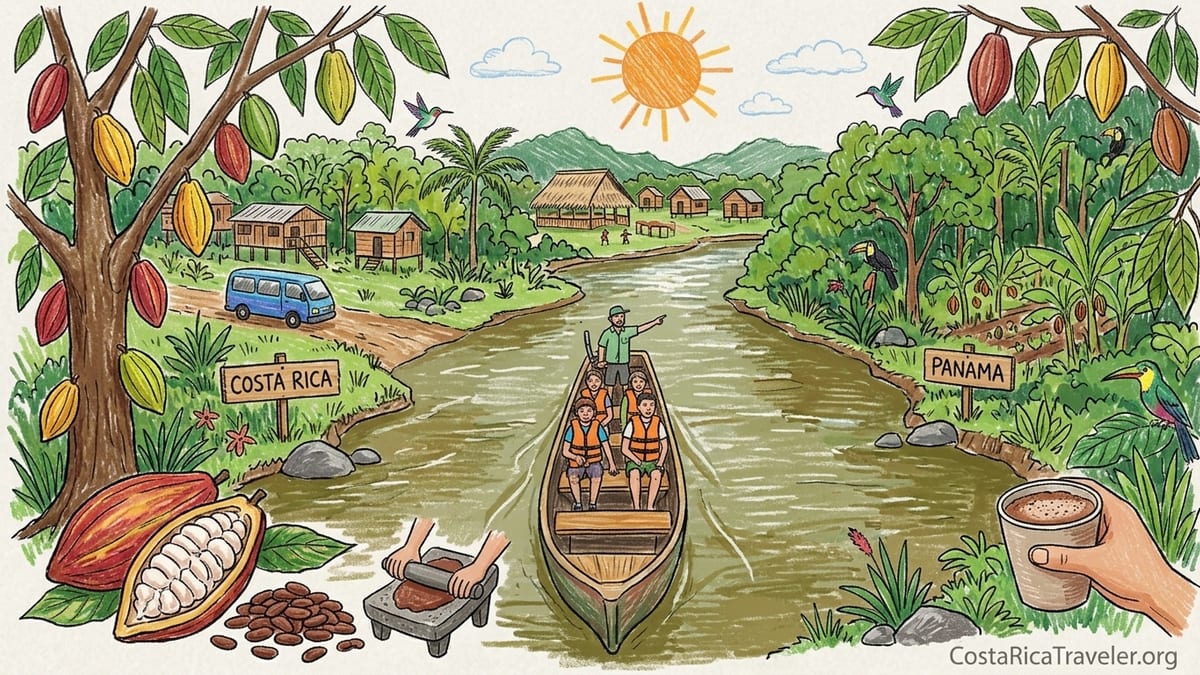
At the river we met our Bribri boatmen and main community guide from Yorkín. The dugout canoe was long, narrow and powered by an outboard motor, with wooden slats for seats and a simple tarp to keep bags dry. Life jackets were handed out before we stepped in. Our guide explained that this was the same route used by families traveling to and from Yorkín for school, supplies and medical visits, not an artificial “tourist only” trail. We pushed off into brown-green water that serves as both transport corridor and border, with Costa Rica on one bank and Panama on the other.
The upriver journey took roughly an hour and a half, depending on the river’s level. In the dry season the boat moves more slowly, weaving among exposed rocks, while in the rainy season the current is stronger and the ride can feel more dramatic. We passed cattle pastures that gradually gave way to thicker rainforest and riverside cacao and banana plots. At several points the boatmen cut the motor and poled the canoe through shallow sections, using long wooden poles in practiced, quiet movements that underscored how dependent access to Yorkín remains on river knowledge and weather.
Staying in a Community, Not at an Attraction
When we stepped onto the rocky shore at Yorkín, there was no ticket booth or souvenir-lined pier. Instead, Stibrawpa members waited under a simple wooden shelter, greeting us first in Bribri and then in Spanish. Stibrawpa is a community association founded in the early 1990s to create rural, community-based tourism that would help families stay on their land, grow traditional crops such as cacao and plantain, and protect surrounding forest rather than sell to outside interests.
From the start, the rhythm of the visit felt different from commercial attractions closer to Puerto Viejo. Before talking about chocolate, our guide gathered us in the shade and explained the association’s purpose, the size of the village and how income from visitors is distributed. The fee I had paid Bua' Bua'ë Travel for the one-day Yorkín experience, about 120 US dollars at the time of my visit, was broken down openly: a significant portion stayed with Stibrawpa for guiding, meals and activities; another part covered transport from Puerto Viejo and the salaries of the Bribri boatmen; a small portion went to the Indigenous-owned operator for coordination.
This transparency was important to me. I had seen tours advertised in Puerto Viejo where the bulk of the money appeared to remain with outside agencies that simply “bought” a cacao demonstration. In Yorkín, the community association controlled the experience, decided what would be shared with visitors and what remained private, and chose which families would cook or guide on a rotating basis to spread the earnings. My role was clearly that of guest, not client in charge.
The walk up from the river to the main community area followed a steep, sometimes muddy path that would be challenging for anyone with reduced mobility, especially after rain. Chickens scattered from under the stilts of wooden houses; clotheslines and school uniforms signaled everyday life rather than a staged “cultural village.” We passed a small school building and a football field carved out of the hillside before reaching Stibrawpa’s communal rancho, an open-sided structure with a palm roof where meals are served and some activities take place.
Cacao as a Living Crop and Cultural Anchor
Our first real activity was not tasting chocolate but walking to the cacao trees themselves. A local farmer, part of Stibrawpa, led us along a narrow trail from the village into mixed plots where cacao trees grew under taller shade species alongside plantains, bananas and timber trees. He explained in Bribri, translated by our guide, how cacao had long been central to Bribri agriculture and exchange, and how diseases and low global prices in the 20th century had badly hurt local production.
Among the glossy leaves hung pods in different shades of green, yellow and red. We stopped at a mature tree and our host selected a ripe pod, cutting it open to reveal the white, mucilaginous pulp around the beans. Tasting the tangy pulp was our first encounter with cacao, far from any packaged bar. He spoke about how certain cacao varieties were favored for ceremonial drinks and how elders remembered times when cacao beans functioned as a form of currency in local markets, a reminder that “chocolate” here is not just dessert but also memory and value.
The farmer was careful to frame the visit within what the community had agreed to share. He pointed out that some rituals and uses of cacao belonged to private spheres such as the usure, the ceremonial house that visitors on longer stays may learn about under strict guidance. Our one-day program would focus on agriculture, processing and daily uses, not on spiritual knowledge or practices that are not meant for tourism. That boundary setting made the experience feel more honest and respectful than tours where every symbol becomes a prop.
We saw how cacao is intercropped with other plants to reduce pests, maintain soil moisture and provide food for families. Unlike in commercial plantations, there was no straight-line monoculture; the plot resembled a small forest, with birds calling overhead and leafcutter ants crossing our path. Our host explained the work schedule across the year, the cooperative selling of dried beans through Indigenous producer associations in Talamanca, and the threats posed by erratic rains and imported pesticides from nearby banana farms.
From Harvest to Drink: Roasting, Grinding and Preparing Cacao
Back at the rancho, we moved into the part of the visit that most resembles what outsiders think of as a chocolate tour, but again the framing was different. The women leading the cacao workshop emphasized that we were learning a home-scale process used for family drinks and occasional sales, not watching a factory demo. They had already fermented and dried beans from recent harvests, laid out on a low table in the center of the space.
The roasting took place in a large metal pan over a wood fire, the smoke drifting through the palm roof and birds calling outside. One of the women stirred the beans slowly, listening for the change in sound as the shells loosened. We were invited to help with the next step, cracking the warm beans by hand and winnowing away the husks. The pace was unhurried, leaving time for questions about how their parents and grandparents had done the same work, often at night after days in the fields.
Grinding came next. Instead of a mechanical grinder, we used a traditional stone metate. The warm nibs were poured onto the stone and worked back and forth with a stone roller until they released cocoa butter and transformed into a thick paste. This was the most physically demanding part, and our laughter about tired arms led to a conversation about how, for generations, this labor had fallen mostly to women preparing cacao at home. Our hosts acknowledged the effort without romanticizing it.
Only after this did we make a drink by mixing the paste with hot water and a small amount of unrefined sugar, whisked in a wooden container until slightly frothy. The result was intense, closer to a spiced, unsweetened cocoa than to any dessert. We sipped from simple cups, not decorative gourds reserved for ceremonies. They explained that some families still prepare more complex ceremonial drinks with additional plants and specific protocols, but those are not demonstrated to visitors and remain within the community.
Meals, Conversations and Everyday Life in Yorkín
Lunch that day was served by one of the Stibrawpa families who had been scheduled to cook for visiting groups. We ate on benches in the rancho, at long wooden tables that filled gradually as community members joined us. The meal included rice, beans, heart of palm in a light coconut sauce, boiled green plantain and a piece of freshly fried fish. There was also a simple salad of cabbage and tomato and a fresh fruit drink. Everything except the fish and some purchased staples came from nearby fields and gardens.
During lunch I sat next to our guide and a teenage student who had grown up in Yorkín and was now studying in Bribri town. They spoke openly about the tradeoffs of community tourism. Income from visitors had helped pay for school supplies and travel, and had funded improvements like a small suspension bridge and upgrades to communal buildings. At the same time, they worried about visits that rush in only for a “chocolate show” without context or that pressure hosts to perform stereotypes.
In the early afternoon, after a short rest, we walked through the village to see some of the community structures that Yorkín has developed with tourism income and external support: simple guest cabins with mosquito nets for overnight visitors, a small area where women sell woven bags and carved gourds, and the path down to the river where children play and people bathe. Photography was allowed only in certain areas and always after asking permission, especially when people were present.
One of the last activities was learning the basics of weaving with suita, a palm leaf used for traditional roofing. Under the guidance of a local woman, we tried folding and tying the long leaves into neat panels. The same space also held archery practice with a traditional bow for those who wanted to try. Both were framed not as shows but as brief introductions to skills that still have practical value in daily life, from building roofs that keep houses cool to hunting and ceremonial uses of the bow and arrow.
Who Organizes the Tours and Where the Money Goes
Before visiting Yorkín I looked closely at different ways to organize the trip from Puerto Viejo. In my case, I chose Bua' Bua'ë Travel because it is Indigenous-run and explicitly partners with community associations such as Stibrawpa. At the time of my visit, their one-day Yorkín experience from Puerto Viejo cost about 120 US dollars per person, including transport to Bambú, canoe travel, community guiding, activities and a hot lunch, but not dinner or accommodation. They also offered a two-day, one-night option for around 165 US dollars, which added basic lodging in Yorkín, additional meals and more time for walks and conversations.
I also spoke with staff at ATEC, the Asociacion Talamanqueña de Ecoturismo y Conservación in Puerto Viejo, which for many years has connected travelers with community-based tours in Talamanca. Their current Yorkín offerings are more focused on one or two night stays, but I found examples of shorter packages as well. Roughly speaking, shorter, roughly six-hour experiences that travel from Puerto Viejo to Yorkín and back in a single day have been listed in the range of 140 to 150 US dollars per person. These usually include round-trip transport, canoe fees, a local guide and at least one meal in the community.
What matters more than small price differences is how much of your payment reaches the village and how much control the community has over scheduling, group size and activities. With Bua' Bua'ë and ATEC, the contracts are made directly with Stibrawpa or similar associations, and the community sets the content and availability. In contrast, some private hotels and agencies sell Yorkín as a packaged “cultural add-on,” sometimes contracting transport and guides through intermediaries who pay the community a fixed, lower rate. That can reduce flexibility for Yorkín families, who may feel pressure to receive more people on days when they would prefer to focus on farm work or ceremonies.
If you want your visit to support community priorities, ask very direct questions when booking: Which organization in Yorkín are you working with? How much of my fee is paid to that association or to local families? Who chooses the guide? Responsible operators are usually proud to answer and to explain the role of associations like Stibrawpa in decision-making.
Yorkín vs Short Cacao Workshops Near Puerto Viejo
In Puerto Viejo and neighboring Cahuita there are several cacao demonstrations that last two or three hours and cost significantly less than a full day in Yorkín. Some are on small family farms that grow cacao among other crops; others are at more commercial venues that focus on tastings and boutique chocolate production. I visited one such shorter workshop near Puerto Viejo a few days after Yorkín, both to taste local chocolate and to better understand the range of options.
That shorter experience took place about twenty minutes from town on a roadside property. For around 35 to 45 US dollars, we walked through a small plot of cacao, saw fermentation and drying areas and then watched a demonstration of roasting and grinding similar in basic steps to what I had seen in Yorkín. The main focus, though, was on sampling different flavored chocolates and hearing about export markets. The hosts were knowledgeable and clearly proud of their craft, but the framing was about artisanal chocolate as a product rather than cacao as part of an Indigenous territory’s history and governance.
Accessibility and logistics are very different between the two. The cacao workshop near Puerto Viejo required only a short drive on paved roads, with level ground and covered spaces suitable even on rainy days. Yorkín, by contrast, requires an early departure, a rougher road to Bambú, and an hour or more in a narrow canoe each way. Paths in the village are steep and can be slippery. Travelers with mobility limitations or severe motion sensitivity might find the river journey challenging, although some operators have begun coordinating adapted visits when river levels and staffing allow.
Cost-wise, comparing a roughly 40 dollar half-day workshop near Puerto Viejo with a 120 dollar or more community-led Yorkín visit is not straightforward. The Yorkín fee includes multiple modes of transport, at least one substantial meal, shared guiding and, crucially, direct payments that support collective structures. Many visitors choose to do both on different days, treating the town-based workshop as an introduction to cacao flavors and the Yorkín trip as a deeper dive into Bribri relationships with land, language and livelihoods.
Costs, Practicalities and Accessibility
By the time I added up everything I spent related to my Yorkín visit, the numbers told a clear story about priorities. The Bua' Bua'ë one-day tour fee of about 120 US dollars covered pick-up and drop-off in Puerto Viejo, road transport to Bambú, river transport, guiding, activities and lunch. I added a small cash tip for the boatmen and guides, plus purchases of woven bags and a few small bags of locally produced cacao, which together came to another 30 to 40 US dollars. Including an early breakfast in Puerto Viejo and snacks for the road, my total outlay for the day was in the range of 170 to 180 US dollars.
For travelers considering a two-day, one-night stay in Yorkín, current community-linked options advertised by Indigenous and local operators often start around 160 to 180 US dollars per person. These usually include basic lodging in shared or private cabins, three to four home-cooked meals, guiding and canoe transport. Additional nights can sometimes be arranged with the community, especially in lower visitor seasons, allowing more time for walks, river swimming or simply reading in a hammock while village life unfolds nearby.
Accessibility is a more complicated issue. Providers describe the Yorkín experience as suitable for visitors who can manage uneven terrain, boat boarding and a walk up from the river of at least ten to fifteen minutes on an inclined path. Rain can turn both the path and village trails muddy. There is no wheelchair-adapted infrastructure along the river route, although some community-based tours that start from Bribri rather than Puerto Viejo have experimented with more accessible options for travelers who can transfer with assistance. Anyone with heart conditions, significant balance issues or late pregnancy should talk honestly with the operator about risks and alternatives.
Packing wisely helps. On my September visit I was grateful for lightweight long pants, closed shoes with good grip, a light rain jacket, sunscreen, insect repellent, and a dry bag for my camera and notebook in case of splashes during the canoe journey. Electricity in Yorkín is limited, so power banks are useful if you are staying overnight. Most important, though, is bringing time and attention. This is not a “checklist” excursion but a chance to listen and observe without rushing.
The Takeaway
What stayed with me after leaving Yorkín was not only the taste of freshly ground cacao, smoky and slightly bitter, but the sense of having entered a place where cacao threads through land, work, language and memory. Spending a day with Stibrawpa and their partners did not make me an expert on Bribri culture; it gave me a small, carefully guided window into how one community is using tourism to stay on its territory and strengthen its own institutions.
The contrast with more commercial chocolate experiences near Puerto Viejo matters. There is nothing inherently wrong with enjoying a short cacao workshop or factory visit. Those can be excellent ways to learn about flavor, fermentation or chocolate-making for the market. But when we label all of these equally as “cultural tours,” we risk flattening very different power relationships. In Yorkín, it is the community that decides what can be shared, when and with whom. Visitors are woven briefly into an existing fabric of agriculture, schooling and family life instead of watching a performance designed primarily for their expectations.
As a traveler, I left with a sharper sense of responsibility. The choices we make about which tours to book and which operators to trust shape which models grow. Asking who controls a tourism project, how revenue is distributed and what boundaries are in place should become as routine as asking what to pack. In places like Talamanca, where Indigenous peoples still fight for land rights and environmental justice, community-led tourism can be one of the tools that allows younger generations to stay, study and continue speaking Bribri on their own territory.
My Bribri cacao experience in Yorkín did not fit neatly into the polished narratives of “bean-to-bar” or “authentic tribal encounter.” It was slower, sometimes muddy, occasionally awkward and always grounded in the reality of a village that existed long before I arrived and will continue long after I leave. That is exactly why it felt worth the river journey from Bambú, the early start in Puerto Viejo and the extra cost. In return for my time and money, I received something rarer than perfect chocolate: a lesson in how community control can turn tourism from simple consumption into a more reciprocal exchange.
FAQ
Q1. How long does it take to travel from Puerto Viejo to Yorkín?
The road journey from Puerto Viejo to Bambú usually takes about 1 to 1.5 hours, followed by roughly 1 to 1.5 hours upriver in a motorized dugout canoe, depending on river conditions.
Q2. How much does a community-led Yorkín tour cost?
Recent Indigenous-led one-day tours from Puerto Viejo to Yorkín have been priced around 120 US dollars per person, with two-day, one-night options starting somewhere in the 160 to 180 US dollar range, including basic lodging and meals.
Q3. What is included in a typical one-day Yorkín cacao experience?
A typical one-day community-led visit usually includes transport from Puerto Viejo to Bambú, canoe travel, local Bribri guiding, a farm and village walk, hands-on cacao processing activities and at least one home-cooked lunch in the community.
Q4. How is a Yorkín visit different from a short cacao workshop near Puerto Viejo?
Short workshops near Puerto Viejo last a few hours, cost less and focus on tasting and chocolate making, while a Yorkín visit involves a full river journey, time in an Indigenous village and a stronger emphasis on community life, land and Bribri control over tourism.
Q5. Is the Yorkín tour physically demanding?
The tour requires getting in and out of narrow canoes, sitting for over an hour on the river each way, and walking up a steep, sometimes muddy path from the river to the village, so it is best for travelers comfortable with uneven terrain.
Q6. Can I stay overnight in Yorkín?
Yes, several community-linked operators and Stibrawpa itself host overnight visitors in simple cabins with mosquito nets, shared or private bathrooms, and meals prepared by local families, usually as part of a two-day or longer package.
Q7. How can I be sure my payment benefits the Bribri community?
Before booking, ask operators which association they work with in Yorkín, what portion of your fee goes directly to that community, and who decides on guides and activities; transparent, community-led providers will answer clearly.
Q8. Is photography allowed during the visit?
Photography is generally allowed in public areas like paths, fields and the river, but visitors are expected to ask permission before photographing people, homes or ceremonial spaces, and some parts of community life are intentionally kept private.
Q9. What should I bring for a day trip to Yorkín?
Lightweight long pants, closed shoes with good grip, a rain jacket, sunscreen, insect repellent, a filled water bottle, a dry bag for electronics and some cash for crafts or extra cacao are all useful for the river journey and village terrain.
Q10. Why does community control matter in cultural tourism?
When Indigenous communities design and manage tours themselves, they can protect sensitive knowledge, decide how income is shared and ensure that tourism supports their priorities instead of turning culture into entertainment designed only for visitors.